Summary: Legal disclaimer: All information about Mercadona products in this article is based on public sources (Mercadona's official website, consumer press, date of consultation: February 2026). Prices, formats, and availability may have changed. This article is for educational and comparative purposes, with no defamatory intent.
Mercadona's frozen cocochas (hake/cod cheeks) frequently appear in searches by those who want to prepare this dish at home without paying the prices of fresh or artisanal cocochas. This is a completely legitimate search: cocochas are a premium cut, and the price can be a deterrent.
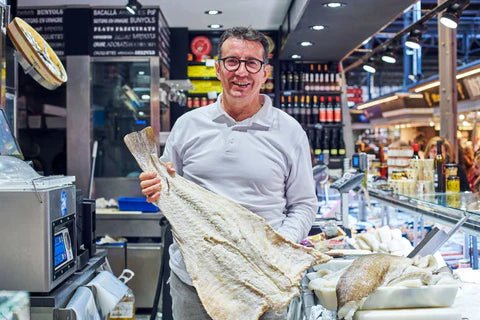
At Bacalalo, we have been working with cod since 1990 in the Mercat del Ninot in Barcelona. We sell artisanal quality cocochas. And precisely for this reason, this article will be honest: we explain exactly what Mercadona's cocochas are, how they differ from artisanal cocochas, and when each option makes sense.
Contents
What are Cod Cocochas (Cheeks)?
Cocochas (or kokotxas, in Basque) are the gelatinous part extracted from the jaw of cod and hake. It is one of the most valued cuts of both fish, especially in Basque and Catalan cuisine.
Its most special characteristic is its high collagen content, which, when cooked at a low temperature, produces a naturally thick, unctuous, silky-textured sauce. This is why pil-pil — the technique of emulsifying the gelatin with oil through gentle movement — works perfectly with cocochas: there is enough collagen to create the sauce without adding thickeners.
Not all cocochas are the same. Depending on the size of the cod, the type of cut, and the desalting or freezing process, the final result can vary enormously.
Mercadona's Frozen Cocochas: What We Know
According to public information available on Mercadona's website and consumer reviews (February 2026), Mercadona markets cod cocochas in frozen format under its Hacendado brand.
Publicly known data (Feb 2026):- Format: bag of frozen cocochas (variable weight depending on presentation available in store)
- Type: desalted cod cocochas, pre-cooked or lightly salted depending on the format
- Price: positioned in an accessible segment, below the artisanal market
- Availability: not in all Mercadona stores (variable distribution by geographical area)
Mercadona does not publish all origin and process data on its public website. For updated information on ingredients, origin, and process, consult the product label directly in-store.
Fresh or Artisanal Cocochas: What Defines Them
At Bacalalo, the cocochas we select have a different profile from any large-surface frozen product. The characteristics we look for:
Traceable origin: North Atlantic cod (Norway, Iceland, Faroe Islands), species Gadus morhua for cod and Merluccius merluccius for hake.
Fresh or desalted cut: cocochas that are processed fresh or recently desalted maintain the integrity of the collagen intact, which directly translates into greater gelling capacity when cooked.
Size: large cocochas (from heavier specimens) produce meatier fillets with a higher proportion of gelatin. Hake cocochas are generally smaller than cod cocochas.
No additives: quality cocochas do not need thickeners or starches to make their own pil-pil. If the product contains modified starch or thickeners in the ingredients, it is because the raw material does not have enough natural collagen.
Related products from Bacalalo


Recommended Products

Natural Cod Liver Foie Gras - 120g | Smoked C...
€3.90

CHATKA Wild King Crab 60% Legs 40% Shredded |...
€95.00

Artisan Cut Smoked Cod Carpaccio | 1 Tub Pack
€15.90

Dried Cod Cheeks (1 tub) - 500g
€19.95
Refrigerated shipping 24-48h throughout the Peninsula
Comparison Table: Mercadona vs. Artisanal (Bacalalo)
| Criteria | Mercadona frozen cocochas | Artisanal cocochas (Bacalalo) |
|---|---|---|
| Format | Frozen | Fresh / desalted / artisanal frozen |
| Process | Industrial | Manual selection |
| Collagen content | Variable (depends on the cut) | High (selected by size and quality) |
| Traceability | Limited information on label | Known origin (North Atlantic) |
| Additives | Possible (check label) | No additives |
| Price per kilo | Low-medium | Medium-high |
| Availability | Wide (Mercadona Spain) | Physical store + online, Spain delivery |
| Pil-pil result | Acceptable with technique | Excellent, natural binding |
| Texture after cooking | Variable | Firm, with pronounced gelatin |
The Price Factor: Real Price per Kilo
This is the part where the most honesty is needed.
Mercadona's frozen cocochas have a significantly lower price per kilo. This is a fact.
However, it is important to consider:
1. Weight loss due to water: frozen products, especially if they have undergone glazing processes or contain added water, lose weight when thawed. A 500g bag can yield 350-400g of real product.
2. Proportion of whole pieces: in an industrial product, the mix of pieces may include cocochas of different sizes and qualities. In an artisanal selection, the caliber is more homogeneous.
3. Need for additional thickeners: if the product does not gel well on its own (low presence of natural collagen), you will need to add cornstarch or another thickener to make the pil-pil. This is not a serious technical problem, but it changes the final result.
The real price of artisanal cocochas is higher, but the yield and the result on the plate are different. It is a decision for each person based on their budget and objective.
When Each Option Makes Sense
Mercadona cocochas make sense when:- Budget is the main factor
- It's for a simple preparation (stew, in green sauce without strict pil-pil)
- Cooking for many people and quantity matters more than individual piece quality
- Easy access to a fishmonger or specialized store is not available
- The goal is to make a classic pil-pil that binds on its own
- The full experience of the dish (texture, gelatin, flavor) is sought
- Cooking for a few diners where every bite counts
- The exact origin of the product is desired
How to Make a Perfect Pil-Pil with Quality Cocochas
The difference in quality is especially noticeable in pil-pil, because this technique directly depends on the natural collagen of the cococha.
Ingredients (4 people):- 600g of quality cod cocochas
- 200ml of extra virgin olive oil
- 4 sliced garlic cloves
- 1-2 chillies (optional)
- Salt (carefully, cod already has some)
- If the cocochas are desalted, drain well. If salted, desalt for 24-36 hours in the refrigerator, changing the water every 8 hours.
- Confit the garlic in oil over very low heat (never above 80°C) for 10 minutes. Remove the garlic (reserve).
- In the same pan with the warm oil, add the cocochas skin-side up.
- Cook over very low heat, constantly moving the pan in gentle circles. The collagen will be released and emulsified with the oil.
- When the sauce begins to thicken and emulsify (between 15 and 25 minutes), it's ready. Add the reserved garlic and serve.
The trick: the heat should NEVER be high. Pil-pil is made at low temperature. If it boils strongly, the emulsion breaks, and you get oil and gelatin separately.
Frequently Asked Questions About Cocochas
1. Are Mercadona's cocochas from cod or hake? Mercadona markets different formats. Always check the product label in-store to verify the species. Cod (Gadus morhua) and hake have different flavor and texture profiles.
2. Can you make pil-pil cocochas with Mercadona's? Yes, although the result may require additional help (cornstarch dissolved in cold water) if the natural collagen is not enough to bind the sauce on its own. The final flavor can be good, but the texture of the sauce will be different.
3. How much do quality artisanal cocochas cost? Fresh cod cocochas in specialized markets or stores like Bacalalo are usually between €15 and €30 per kilo, depending on the size and season. This price reflects that they are a scarce cut (small quantity per animal) and of high culinary value.
4. How many cocochas come from a cod? Very few. A large cod (3-5 kg) produces a small quantity of cococha. That's why it's a scarce and relatively expensive cut even in the artisanal market.
5. Can fresh cocochas be frozen at home? Yes. Fresh cocochas tolerate home freezing well if properly packaged (vacuum-sealed or well-covered). Always thaw in the refrigerator, never at room temperature or in water.
6. Are hake cocochas the same as cod cocochas? They are similar in concept (same anatomical part) but different in flavor, texture, and collagen content. Cod cocochas are more gelatinous and have a more intense flavor. Hake cocochas are more delicate. Classic Basque pil-pil uses both.
7. Does Mercadona sell fresh cocochas in addition to frozen ones? It depends on the store and geographical area. Some Mercadona stores with their own fish counter may have fresh cocochas in season, but it is not a guaranteed product across the entire network.
8. What is the season for fresh cocochas? Cod is a cold-water fish caught year-round. However, there are seasons of greater availability. In Spain, Holy Week concentrates a lot of cod and derivative consumption. At Bacalalo, we work with cocochas all year round.
9. Can I make cocochas in green sauce with Mercadona's? Green sauce (garlic, parsley, broth) is more forgiving than pil-pil because it does not require binding the gelatin from the cococha. It's a good option for using cocochas of lower gelatinous quality with a good final result.
10. Where to buy quality cocochas online? At Bacalalo, we offer selected cocochas with shipping throughout Spain. We have been working with cod in the Mercat del Ninot since 1990 and apply the same selection criteria to each cut.
Conclusion
The choice between Mercadona's frozen cocochas and artisanal ones is not a matter of brand: it's a matter of what result you're looking for and what your budget is.
For a simple stew or a green sauce on any given Tuesday, Mercadona's are fine. For a pil-pil that does justice to Basque technique, for a special dinner, or for those who want to know exactly what they are eating, artisanal kokotxas make a real difference.
At Bacalalo, we have been selecting exactly this type of product for over thirty years. We don't sell quantity: we sell proven quality since 1990.
Discover more