


Anchovies or Boquerones: Real Differences That Matter
This is probably the question that generates the most misunderstandings at the fish counter: "Are anchovies and boquerones the same thing?" The answer is yes and no. They are the same fish, but they are not the same product. The distinction between anchovies and boquerones is not in the species but in how they are prepared, and that difference completely changes the flavor, texture, color, culinary use, and price. At Bacalalo, we explain it dozens of times a month at the Mercat del Ninot, so here's the full version.
Let's start with the basics: both anchovies and boquerones come from the same fish, Engraulis encrasicolus, a small oily fish measuring between 10 and 20 centimeters that inhabits the Mediterranean and North Atlantic. What turns them into different products is the preservation technique applied after fishing.
The same fish, two radically different preparations
The difference between anchovies and boquerones is one hundred percent in their preparation:
Boquerones are Engraulis encrasicolus prepared in vinegar or fresh. Boquerones in vinegar are marinated in acetic acid (white wine vinegar), which denatures the proteins and "cooks" the fish without heat. The result is a white, firm product with a fresh, acidic flavor. In ceviche, the same process is called "cold cooking" with lemon.
Anchovies are the same fish cured in salt for months. The boquerón is cleaned, pressed into barrels alternating layers of salt and fish, and left to ferment for 8 to 18 months at a controlled temperature (between 18 and 25 degrees Celsius). During this time, the fish's own enzymes transform proteins into glutamate amino acids, which generates the powerful umami flavor of the anchovy. The color changes from silvery gray to reddish-brown. The texture becomes softer and oilier.
This transformation process turns the boquerón, which fresh has between 120 and 150 kcal per 100g, into an anchovy with between 200 and 230 kcal per 100g, with a completely different nutritional and organoleptic profile.
Visual differences: how to identify each product
If you have both products in front of you, distinguishing them is immediate:
Color:
- Boquerones in vinegar: pearly white, almost opaque
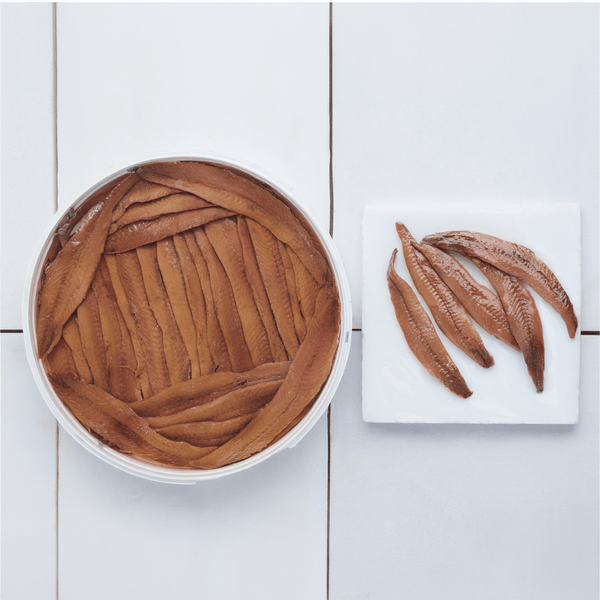
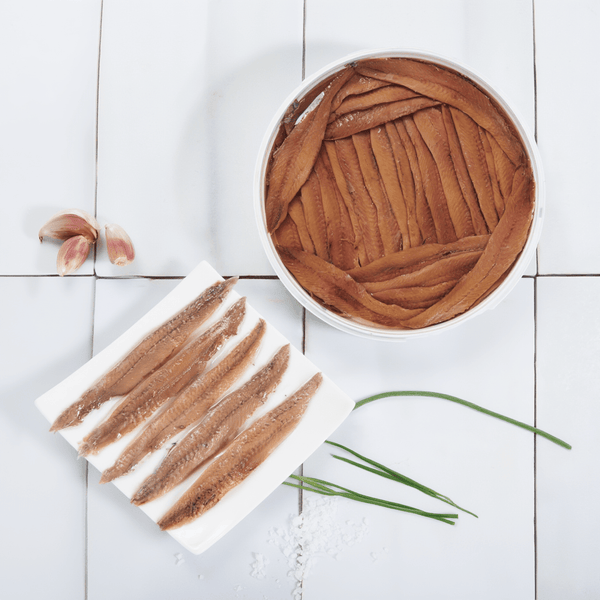
- Anchovies in oil: reddish-brown, with shades ranging from cinnamon to dark brown depending on the curing process
Texture:
- Boquerones: firmer, the flesh separates into thin flakes
- Anchovies: softer and more unctuous, tending to fall apart if handled excessively
Flavor:
- Boquerones: acidic, fresh, with notes of vinegar, almost no sea flavor
- Anchovies: intense, salty, with a strong umami presence, long and marine aftertaste
Price:
- Boquerones in vinegar: 8-15 euros per kg, depending on size and quality
- Quality Cantabrian anchovies: 60-300 euros per kg of clean fillet (equivalent), depending on size and producer
Culinary uses: when to use each
The confusion between anchovies and boquerones causes real problems in the kitchen when one is substituted for the other. They are not interchangeable:
Use boquerones when:
- You want a fresh and acidic appetizer
- The recipe calls for something white (it should not alter the color of the dish)
- You are looking for a mild flavor that won't dominate the dish
- The dish will not be cooked (salad, direct tapa)
- You are preparing fried boquerones, which are fresh boquerones breaded and fried, not boquerones in vinegar
Use anchovies when:
- You want umami flavor depth in a sauce or stew
- The recipe needs that salty and intense kick (puttanesca sauce, anchovy butter, pil-pil)
- You are preparing a Basque gilda (the correct ingredient is always salted anchovy, never boquerón in vinegar)
- You are working with pizza, pasta with anchovies, or tapenade
- You use the "umami hack": an anchovy dissolved in sautéed oil will add depth to any meat or vegetable stew without a noticeable fish flavor
Bacalalo Products

Cantabrian Anchovies in EVOO - 50g
3,95 €

"Cantabrian Deluxe" Assortment
67,00 €

Artisanal Cantabrian Anchovy Gilda
9,90 €

Northern Bonito Belly - Olasagasti
16,95 €
Refrigerated shipping 24-48h throughout the Peninsula
The curing process: why it changes everything
To deeply understand the difference between anchovies and boquerones, one must understand the chemistry that occurs in each process:
In boquerones in vinegar, acetic acid (CH3COOH) at a concentration of 5-7% denatures the muscle proteins of the fish. Protein chains unfold and rearrange, giving that white, firm texture. The process is not fermentation: there is no bacterial transformation, only chemical denaturation by acidity. The boquerón loses its silvery color and becomes opaque white because muscle myosin changes its optical structure.
In salted anchovies, the process is completely different. Salt dehydrates the fish in the first hours, creating a hypertonic environment that stops bacterial growth. Then, for weeks and months, the fish's own proteolytic enzymes (cathepsins, collagenases) break down proteins into free amino acids, including monosodium glutamate, which is the molecule responsible for umami flavor. It is literally a controlled self-digestion process, similar to the ripening of cheese or ham.
The oil in which the anchovy is preserved is not a minor ingredient: it protects against oxidation, carries aromatic compounds, and adds its own flavor. An anchovy in extra virgin olive oil tastes different from the same anchovy in sunflower oil.
Nutritional differences between anchovies and boquerones
The confusion between anchovies and boquerones also matters from a nutritional point of view, because the profiles are different:
Fresh boquerón (100g):
- Calories: 130-150 kcal
- Proteins: 19-21 g
- Fat: 5-8 g
- Sodium: 80-120 mg
- Omega-3: 1-2 g
Anchovy in olive oil (100g):
- Calories: 200-230 kcal
- Proteins: 23-27 g
- Fat: 12-16 g (partly from the preserving oil)
- Sodium: 3,000-4,500 mg (very high due to salting)
- Omega-3: 1.5-2.5 g
The difference in sodium is enormous and must be taken into account. Anchovies are a high-sodium food by definition. They are not suitable for very salt-restrictive diets, although typical serving sizes (2-4 fillets, about 10-15g) reduce actual intake to manageable levels.
Confusion in hospitality and how to avoid it
In many restaurants and bars, especially mid-to-low-end ones, terms are used imprecisely. Asking for "anchovies" and receiving boquerones in vinegar is something that happens frequently. To avoid this:
- If you want salted anchovies, specify: "Cantabrian anchovies in oil, salt-cured"
- If you want boquerones in vinegar, say: "boquerones in vinegar" or "white boquerones"
- Authentic gilda contains salted anchovy, not boquerón in vinegar. If you get a gilda with a white fillet, they are using boquerones
One detail worth mentioning: in southern Spain and some areas of Levante, the word "anchoa" is sometimes used to refer to small fresh boquerones. This regional ambiguity adds to the confusion in the anchovies or boquerones debate, but in the context of quality preserves and tapas, the terms are used as described.
Bacalalo Products
Cantabrian Anchovies in EVOO - 50g
3,95 €
Artisanal Cantabrian Anchovy Gilda
9,90 €
"Cantabrian Deluxe" Assortment
67,00 €
Northern Bonito Belly - Olasagasti
16,95 €
Refrigerated shipping 24-48h throughout the Peninsula
Frequently asked questions about anchovies and boquerones
Are anchovies and boquerones the same fish?
Yes. Both are Engraulis encrasicolus, the same small oily fish. The difference lies solely in the preservation method: boquerones are prepared in vinegar (acidity preservation) or consumed fresh, while anchovies undergo a salt-curing process of several months that completely transforms their flavor and texture.
Can I substitute anchovies for boquerones in a recipe?
It depends on the recipe. For dishes where anchovy acts as a flavor enhancer (sauces, stews, pasta), boquerones in vinegar cannot replace it because they lack the umami profile of cured anchovies. For appetizers where the fish is the star and the recipe allows for an acidic rather than salty flavor, the substitution may work, although the result will be different.
Which has more omega-3, anchovies or boquerones?
The omega-3 content is similar in both cases, as they come from the same fish. The difference is that anchovies have more total fat due to the curing process and the preserving oil, which may mean they contribute more omega-3 per 100g. However, typical serving sizes (10-15g of anchovy compared to 30-50g of boquerones in vinegar) can equalize or tip the balance towards boquerones in actual intake.
Why do boquerones in vinegar turn white?
The acetic acid in vinegar denatures muscle proteins, especially myosin. Protein chains unfold and change their molecular structure, altering the way they reflect light and causing the tissue to change from translucent-grayish to opaque-white. It's the same phenomenon that occurs when heat whitens egg or fish proteins during cooking.
Can you make anchovies at home?
Technically yes, but it requires time and specific conditions. The process involves cleaning fresh boquerones (removing head and guts), layering them with coarse salt in an airtight container, and letting them mature for 8 to 16 months at cellar temperature (between 18 and 22 degrees Celsius). During this time, the brine that forms must be monitored. The result can be excellent, but the process is long and requires attention.
How do I know if an anchovy is bad?
A good anchovy has a uniform brown color, a firm but malleable texture, and an intense but not unpleasant marine odor. Signs of a problem: greenish-gray color or irregular spots, rancid or ammonia smell, pasty texture that falls apart when touched. Once the can is opened, if the anchovy is properly preserved in oil and refrigerated, it will last about 10-14 days in perfect condition.
Anchovies or boquerones for pizza?
For pizza, salted anchovies are clearly superior. Their intense flavor withstands oven heat (200-250 degrees Celsius) without fading, and the anchovy fat melts into the base, adding richness. Boquerones in vinegar, when heated, lose most of their acidic flavor and become bland. Anchovies in oil, on the other hand, enhance the flavor of the other ingredients on the pizza.
Products that might interest you
Discover more



![Regalos Gourmet: 15 Ideas Originales que Sorprenden [2026] - Bacalalo](http://bacalalo.com/cdn/shop/articles/regalos-gourmet-15-ideas-originales-que-sorprenden-2026-4869916.jpg?v=1772706703&width=480)
