Free cold shipping 24/48h on orders over €99
Exclusive €5 discount | Coupon PRIMERO5
Are you a restaurant? | Call 664 173 110
Gourmet flavor without the hassle
Summary: Cantabrian anchovies are Spain's most prized salted product, but not all are what they seem. In this comprehensive guide, we explain what makes Cantabrian anchovies unique, how the artisanal production process works, what the 000, 00, 0, and 1 calibers mean, how much the best brands actually cost, the differences between Santoña, Laredo, and Bermeo, and how to recognize a quality anchovy before buying it. With 35 years of experience selecting anchovies in Barcelona's Mercat del Ninot.
Updated March 2026. Since 1990, we have hand-selected every product. This guide reflects that experience.
If you've tried canned anchovies from a supermarket and thought you didn't understand the enthusiasm for this product, it's possible you've never tasted a true Cantabrian anchovy. The difference isn't one of degree — it's one of category. It's the same distance as between acorn-fed Iberian ham and packaged turkey breast deli meat.
But what makes a Cantabrian anchovy what it is? There are four factors that work together and cannot be replicated anywhere else in the world.
The Species: Engraulis encrasicolus
Cantabrian anchovies come exclusively from the European anchovy, Engraulis encrasicolus, caught in the Cantabrian Sea and the Bay of Biscay. This species, in these specific waters, develops a very particular intramuscular fat profile: enough to provide a melting texture and complex flavor, but without being cloying. Anchovies from Morocco, Argentina, or Chile are of the same species, but raised in different waters with distinct temperatures, salinity, and plankton diets. The final result is a fish with a different lipid profile which, when cured, produces an anchovy with less flavor complexity.
The Fishing Season: Only Three Months a Year
Anchovy fishing for salting in Cantabria occurs between April and June. It's called "la costera" (the season) and lasts approximately 10-12 weeks. During this period, anchovy schools migrate through the Bay of Biscay, offering specimens at their optimal fat point — just before spawning, when all the fish's energy is stored in its muscle. Outside this window, the Cantabrian anchovy changes its composition. Canneries that work with genuine product only have this raw material once a year. Those that use anchovies from other latitudes can produce all year round, but it's not the same product.
The Artisanal Tradition: Over 130 Years of Craft
The Cantabrian anchovy industry began in the second half of the 19th century, when Sicilian and Neapolitan fishermen and canners arrived in Santoña and taught the salting techniques of southern Italy. Since then, the knowledge has passed from generation to generation. The "sobadoras" of Santoña, women with decades of experience, recognize by touch if a fillet is properly cured. The artisanal process is not tradition for tradition's sake — it is the most effective method to transform an anchovy into the gastronomic product that is the Cantabrian anchovy.
Time: No Shortcuts
A quality artisanal anchovy needs between 8 and 18 months of curing in salt. There is no industrial process that can replicate what the natural enzymes of the fish do during this waiting period. The endogenous protease and lipase of the anchovy slowly break down proteins and fats, generating the compounds responsible for the deep umami, melting texture, and buttery nuances that make Cantabrian anchovies irresistible. Accelerating this process produces an inferior result: saltier, less complex, with a rubbery texture.
At Bacalalo, we have been selecting anchovies for 35 years at the Mercat del Ninot in Barcelona. We have tasted hundreds of brands, batches, and calibers. What we sell online are those that pass our selection filter: those that meet the four factors we have just described.
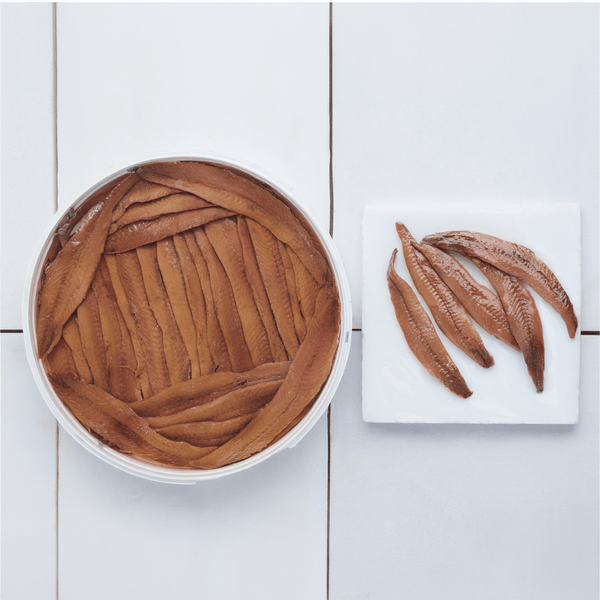
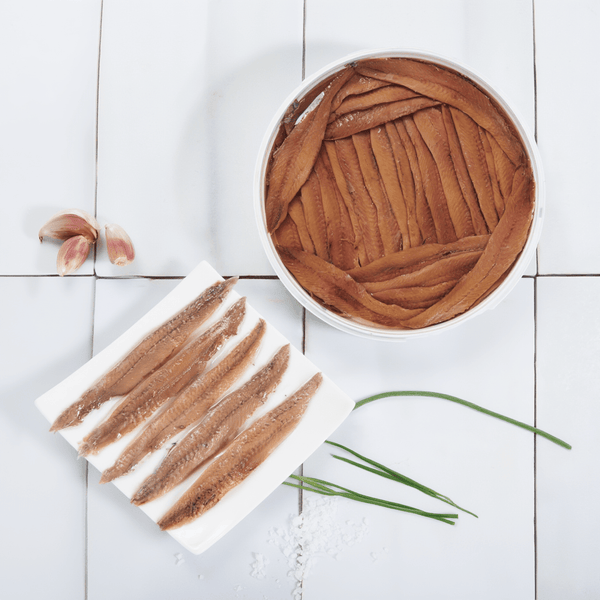
Premium anchovies with careful presentation
The Production Process: From Catch to Can
To appreciate a quality Cantabrian anchovy, it helps to understand what goes into each can. The artisanal process has four main stages that cannot be shortened without sacrificing the final result.
1. The Catch: Purse Seining and Port Selection
Anchovy boats use purse seine fishing: a circular net deployed around a school of fish and closed at the bottom to capture the entire school. Night fishing is most common — anchovies gather at the surface at night, attracted by the boats' lights. Once in port, the anchovies are unloaded into ice boxes and quickly transported to the canneries. The cold chain from the catch is critical: anchovies deteriorate quickly, and any delay affects the final quality.
In the processing plant, workers inspect the fresh anchovies and discard damaged or undersized specimens. This initial filter determines the proportion of large caliber anchovies that will come from each season's catch.
2. Soaking and Salting: The Foundation of the Process
Fresh anchovies are gutted (head and viscera removed) and placed in barrels, alternating layers of fish and coarse sea salt. The term "sobado" refers to the process of arranging and pressing the anchovies in the barrel to ensure the salt penetrates uniformly. The barrels are covered with a wooden lid and weighted down to apply constant pressure.
The salt dehydrates the muscle tissue of the anchovy and creates the environment where the fish's natural enzymes will act during the following months. The salt proportion is critical: too much blocks enzymatic activity and produces an excessively salty anchovy; too little allows bacterial growth. Artisanal canneries adjust this proportion based on experience and the conditions of each fishing season.
3. Maturation: 8 to 18 Months of Active Waiting
This is the longest stage and the one that most differentiates the quality of artisanal canneries from industrial ones. The barrels are stored in cool places and periodically rotated to ensure uniform maturation. During this time, the natural proteases and lipases of the anchovy work continuously: they break down muscle proteins into peptides and amino acids (including glutamate, responsible for umami), and transform fats into free fatty acids that provide aromatic complexity.
The visible result of this process is the color change: the grayish anchovy from the catch turns into the coppery-pink anchovy. The result in the mouth is the melting texture and layered flavor that characterizes the best Cantabrian anchovies.
High-end canneries cure for 10 to 18 months. Mid-range ones, between 6 and 10 months. Industrial ones, sometimes less than 6 months, using process accelerators. The difference in time translates directly into a difference in flavor.
4. Filleting and Packaging: The Work of the "Sobadoras"
Once matured, the anchovy is extracted from the barrel, washed to remove excess salt, and hand-filleted. The "sobadoras" remove the central bone, skin, and any residual bones with their fingers and a small tool. Each fillet is individually inspected and classified by size (caliber). The largest fillets go into "00" cans; medium ones into "0"; small and broken ones into lower categories or the hospitality market.
Manual filleting is the most time-consuming part of the entire process — and the one that most influences the presentation of the final fillet. An experienced "sobadora" can fillet between 4 and 6 kg of anchovies per day. The result: whole, boneless, skin-free fillets, with the uniform color of those that have spent exactly the necessary time in salt.
The fillets are placed in the can or jar, covered with oil (extra virgin olive oil in premium ranges, standard olive oil or sunflower oil in basic ranges), and the container is sealed. The subsequent pasteurization process stabilizes the product for room temperature storage.
What the Calibers Mean: 000, 00, 0, and 1
The caliber classification system for Cantabrian anchovies is one of the most confusing elements for new buyers. The zeros are not a designation of origin or an official certification — they are a de facto standard that canneries in northern Spain have adopted to communicate the size of the fillet. Each cannery may apply it with slight variations, but there is a general consensus that has been in place for decades.
The basic rule: more zeros, larger fillet.
000 Anchovies (Triple Zero)
This is the most exclusive caliber and the least common in the market. 000 fillets are the largest of the entire fishing season: they exceed 10-12 cm in length and have considerable thickness. Only the largest specimens of Engraulis encrasicolus, those that have fed intensely during the season, produce fillets of this size. The proportion of 000 anchovies in a normal season is small — hence their scarcity and high price. The flavor is the maximum expression of the caliber: meaty, with a texture that slowly melts in the mouth, and a deep umami that lingers for several seconds after swallowing. If you want to understand more about this extreme caliber, we have an article dedicated to triple zero anchovies and how to identify them.
00 Anchovies (Double Zero)
The benchmark caliber in the premium market. 00 fillets measure between 8 and 10 cm and come from the largest anchovies of the standard season. These are served in high-end restaurants, included in top-tier cheese and charcuterie boards, and sought after by consumers who are already familiar with the product. At Bacalalo, our "00" Premium anchovies are the selection we have been offering for decades to Mercat del Ninot customers who ask for "the best you have."
The difference between 00 and 0 in taste: the 00 has more flesh, more thickness, and a more intense and long-lasting flavor profile. With the same curing time, the larger fillet develops more complexity. For someone starting out, the difference may seem subtle. For those who have been consuming artisanal anchovies for years, it is clear.
0 Anchovies (Single Zero)
The caliber for unbeatable value for money. 0 fillets measure between 6 and 8 cm — large, meaty, and with all the curing quality of the cannery, but without the premium price of maximum caliber exclusivity. For regular consumption as a tapa, appetizer, or pintxo, the 0 is the rational choice. Our "0" Gourmet Selection anchovies (35 fillets) are the best-selling product in our anchovy section for a reason: they are exceptional in relation to their price.
1 Anchovies (Single One) and "Menu"
Caliber 1 fillets are medium-small, between 4 and 6 cm. They come from the smallest anchovies of the fishing season. When the cannery is good, they have the same curing and flavor as the superior calibers — they are just smaller. They are perfect for cooking, incorporating into sauces, making anchovy pâtés, or putting on pizza where size is not relevant.
The "menu" format mixes fillets of different sizes without classification. It does not imply worse quality of anchovy or curing — they simply have not gone through the individual size selection process. From the same cannery, the "menu" can have exactly the same curing quality as the 00, just with smaller or heterogeneous fillets. It is the most economical format per gram and the one we recommend for intensive use.
The Cantabrian anchovy market has over 40 active canneries in the Santoña, Laredo, Colindres, Castro Urdiales, and Basque Country areas. Not all work to the same standards. This is our honest classification, based on 35 years of tasting products at the Mercat del Ninot — not on advertising or commercial agreements.
Category A: Benchmark Artisanal Canneries
These set the standard. They work exclusively with Cantabrian anchovies caught during the fishing season, cure for a minimum of 10 months, hand-fillet, and spare no expense on oil. Their 00 cans are found in the best restaurants. They are also the most expensive and have the least national distribution — many sell directly or through specialized stores.
Some of the canneries we would include in this category: Conservas Ortiz (their "El Velero" range), Ángel León from Laredo, La Española in its artisanal range, and several small canneries from Santoña and Colindres that do not have a presence in large supermarkets. The consistency of quality from batch to batch is their hallmark.
Category B: High-End Canneries with Wider Distribution
They have managed to scale their production without (too much) sacrificing quality. Their anchovies are clearly superior to standard supermarket fare and offer solid value for money. They may have premium lines (with Cantabrian anchovies and long curing) and more economical lines (with anchovies from other origins). It's advisable to read the label and choose the correct line from each brand.
Category C: Supermarket Brands and Mixed Origin
Anchovies labeled as "Cantabrian" or "from Santoña" but using anchovies from Argentina, Morocco, or Chile with 4-6 months of curing. It's not illegal — it's legal to process imported anchovies in Santoña. But it's not the gastronomic experience described in this guide. They are suitable for cooking, sauces, or pâté. Not for eating as the main star.
Bacalalo's Selection: Our Criteria
At Bacalalo, we don't list every brand on the market. We select those that pass our internal tasting process: 100% verified Cantabrian origin, a minimum of 10 months of curing, manual filleting, extra virgin olive oil in premium ranges, and consistent quality between batches. If a new batch arrives that doesn't meet these criteria, we don't put it up for sale, even if it comes from a well-known cannery.
The Cantabrian anchovy collection in our online store is the result of this selection process applied over 35 years.
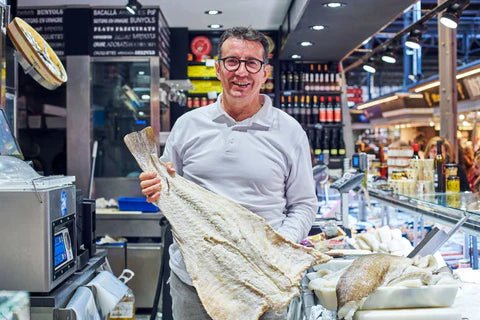
Expert in salted fish and founder of Bacalalo with over 35 years of experience selecting the finest pieces of Icelandic cod and gourmet seafood at the Mercat del Ninot in Barcelona.
Subscribe to get €5 off your first purchase with us. You'll also receive cod and smoked fish recipes, preparation tips for Gadus Morhua , and more offers.