Summary
At Bacalalo, when fresh seafood from Galicia arrives at Mercat del Ninot, Galician scallops are among the first products to sell out. In this guide: What are Galician scallops and how do they differ from sea scallops, How to choose fresh Galician scallops, Ingredients for grilled Galician scallops (4 servings).
Galician Scallops: Grilled Recipe and Canned
At Bacalalo, when fresh produce from Galicia arrives at Mercat del Ninot, Galician scallops are among the first products we sell out of. And it's not surprising: they are one of the most versatile, flavorful, and economically accessible shellfish in all of Galicia. This guide includes the ultimate recipe for grilling them, explains the difference from sea scallops, reviews the best canned brands, and answers the most common questions about this bivalve that deserves much more fame than it has.
What are Galician scallops and how do they differ from sea scallops?
Zamburiñas (Aequipecten opercularis, also called "volandeira" in Galician) are bivalves from the Pectinidae family, the same family as sea scallops. Confusion between the two is very common, and understanding the difference helps to appreciate each product in its correct context.
- Size: Zamburiñas measure between 5 and 9 cm in diameter; sea scallops (Pecten maximus) reach 12-15 cm.
- Flavor: Galician scallops have a sweeter, more delicate flavor with fresher marine notes than sea scallops. Sea scallops have a more robust and meaty flavor.
- Price: Zamburiñas cost between €8 and €18/kg; Galician sea scallops can reach €25-€40/kg. The price difference does not reflect an equivalent quality difference: they are simply different products.
- Preparation: Both can be grilled, baked, and canned, but the more delicate texture of zamburiñas requires shorter cooking times.
- Availability: Galician scallops have a longer season (October-May) than sea scallops, which have strict fishing bans to protect the species.
In Galicia, when someone orders "zamburiñas" in a restaurant or cannery, they generally mean Aequipecten opercularis, although some establishments may use the term interchangeably with volandeira or even small sea scallops. Traceability on the label is the only guarantee to know exactly which species you are buying.
How to choose fresh Galician scallops
To buy fresh Galician scallops with confidence, these are the criteria applied by the Bacalalo team:
- The shells should be closed or slightly ajar. A living scallop reacts to touch by closing its shell. If it is completely open and does not respond, it is dead.
- Fresh sea smell. An ammonia-like or very strong fishy smell indicates spoilage.
- The muscle (the white part) should be firm and bright. A dull or yellowish muscle is not a good sign.
- The shell should be clean. Some algae or sediment is normal in wild shellfish, but excessive dirt can indicate poor handling.
Fresh Galician scallops should be stored in the refrigerator covered with a damp cloth (never in water) and cooked within the first 24-36 hours. Beyond that time, the quality significantly decreases.
Ingredients for grilled Galician scallops (4 servings)
- 1 kg of fresh Galician scallops (approximately 16-20 pieces)
- 4 cloves of garlic
- 1 bunch of fresh parsley
- Extra virgin olive oil
- Flaked sea salt
- Lemon (optional)
- Sweet Pimentón de la Vera (optional, for the traditional Galician variation)
Preparation: Grilled Galician scallops step by step
- Cleaning (5 minutes): Open the scallops with a paring knife or a thin knife by inserting it into the joint of the shells. Remove the flat top shell and keep the concave shell where the muscle rests. Carefully clean the muscle: remove the dark viscera and the orange-gray rim surrounding the white muscle (the coral). The coral is edible and has a more intense, marine flavor; include or remove it according to your preference. Rinse under cold water.
- Prepare the dressing: Finely chop the 4 cloves of garlic and parsley. Mix with 4-5 tablespoons of extra virgin olive oil. This dressing is always added at the end, never during cooking.
- Heat the griddle (3-4 minutes): Heat a cast iron griddle or large pan over very high heat, until it starts to smoke slightly. Do not add oil to the griddle: the liquid from the Galician scallops themselves will prevent them from sticking.
- Cooking (maximum 2-3 minutes): Place the scallops with the concave side down (the one that had the shell) on the very hot griddle. Cook for 60-90 seconds on one side without moving them. Flip them over and cook for another 30-60 seconds. The meat should be opaque on the outside but slightly translucent in the center. Do not overcook them: they will become rubbery and dry.
- Dress and serve: Remove from heat, place on a plate, and add the garlic and parsley dressing on top. A few flakes of sea salt at the last moment. Serve immediately, very hot.
Total time: 15 minutes. Griddle temperature: 220-250°C. Key to success: very hot griddle, minimal cooking time, dressing at the end.
Bacalalo Products

Fresh Coastal Sardines - Pack of 4 Pieces | ...
€2.95

Whole Gourmet Extra Tuna Mojama Loin Artisanal...
€95.00

Natural Cockles 30/40 Pieces - 111g | Ba...
€7.95

North Atlantic Bonito Loins in Olive Oil Jar...
€13.95
Refrigerated shipping 24-48h throughout the Peninsula
Variations of the Galician scallop recipe
Scallops with "vieira" sauce
The most classic preparation in Galician restaurants. Sauté a finely chopped onion, two cloves of garlic, and green pepper in olive oil. Add crushed tomatoes and a teaspoon of sweet Pimentón de la Vera. Reduce for 20 minutes. Place the cleaned scallops in their concave shells, add a tablespoon of sauce over each, and bake at 200°C for 8-10 minutes. The result is heartier and more intensely marine than grilled, ideal as a first course.
Scallops with butter and herbs
Grill the scallops for 60 seconds on each side. Off the heat, add a knob of cold, diced butter over each scallop, along with fresh tarragon or chopped chives. The butter melts with the residual heat, creating a rich sauce reminiscent of fine French cuisine. Simple and very effective.
Canned Galician scallops: brand guide
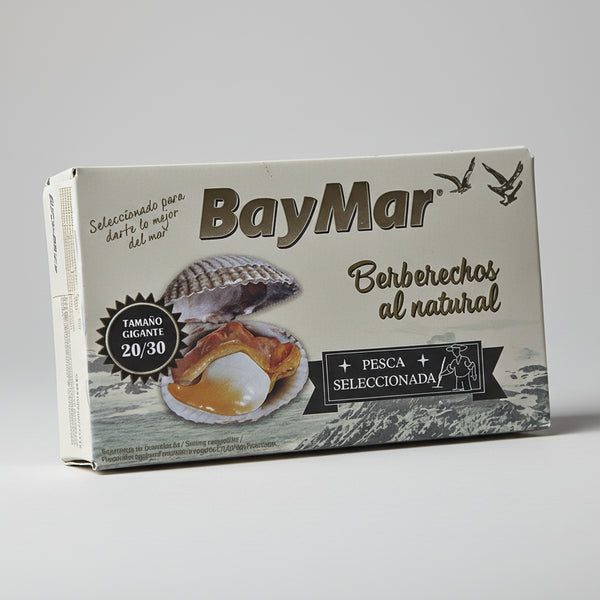
When Galician scallops are not in season or you don't have access to fresh product, canned scallops are an excellent alternative. Canned scallops preserve the mollusk's flavor well and benefit from the cooking and canning techniques of major Galician canneries.
- Paco Lafuente - Scallops in "vieira" sauce: The benchmark standard. The scallops are cooked in a sauce made with their own juices, tomato, and Galician paprika. Price: €12-€16/120g net can.
- Real Conservera Española - Natural scallops: For those who prefer the pure flavor of the mollusk. Price: €10-€14/can.
- Ramón Peña - Scallops in olive oil: A milder preparation where extra virgin olive oil complements without overpowering the flavor of the scallops. Price: €9-€13/can.
- Dani - Scallops in "vieira" sauce: The most accessible option on the market with decent quality. Available in many supermarkets. Price: €5-€8/can.
To serve canned Galician scallops as a quality tapa: transfer them to a small dish or their own empty shells (if you have them), warm lightly in the microwave (30 seconds at 50%), and add a drizzle of olive oil and fresh chopped parsley on top.
Price of Galician scallops and season
Galician scallops have their main season from October to May, with the best specimens in December-February when they are plumpest and the colder water concentrates the flavor. In summer, extraction is limited, and the product appearing on the market is usually of lower quality or not from Galicia.
Estimated prices for fresh Galician scallops in 2025-2026:
- At Galician fish markets (Vigo, O Grove, Bueu): €8-€12/kg
- At city fishmongers: €12-€18/kg
- At a quality restaurant (serving of 4-6 pieces): €12-€20 per tapa
Bacalalo Products
Fresh Coastal Sardines - Pack of 4 Pieces | ...
€2.95
Whole Gourmet Extra Tuna Mojama Loin Artisanal...
€95.00
Natural Cockles 30/40 Pieces - 111g | Ba...
€7.95
North Atlantic Bonito Loins in Olive Oil Jar...
€13.95
Refrigerated shipping 24-48h throughout the Peninsula
🛒 Products mentioned in this article
⭐ 4.9/5 · Cold shipping 24-48h · Since 1990 at Mercat del Ninot
Frequently Asked Questions
How long do you cook grilled Galician scallops?
Grilled Galician scallops need 60-90 seconds on the first side and another 30-60 seconds on the second side, on a very hot griddle (220-250°C). Total: no more than 2-3 minutes. The meat should be opaque on the outside but still slightly pearly on the inside. If you cook it longer, the texture becomes rubbery and the flavor flat. The most common mistake with scallops is exactly that: overcooking them.
Are scallops and "vieiras" (true scallops) the same thing?
No. They are two different species from the Pectinidae family. The "vieira" (Pecten maximus) is larger (12-15 cm), has a more robust and meaty flavor, and is more expensive (€25-40/kg). The scallop (Aequipecten opercularis) is smaller (5-9 cm), with a more delicate and sweet flavor, and more affordable (€8-18/kg). In canned goods, scallops are often in "salsa vieira" (a paprika and tomato sauce that does not mean the mollusk is a true scallop). They are different products for similar culinary uses.
Do you eat the coral of scallops?
The coral is the orange-red part that surrounds the white muscle of the scallop. It is perfectly edible and has a more intense, marine flavor than the muscle. In Galicia, it is common to eat it; in other European cuisines, it is removed because its softer texture is not to everyone's liking. If it's your first time with scallops, try it: many discover that the coral is their favorite part.
How many Galician scallops per person?
As an appetizer or tapa: 3-4 pieces per person. As a first course: 6-8 pieces per person. As a main course: 10-12 pieces. One kilo of whole Galician scallops has approximately 12-16 pieces depending on size, with a meat yield of about 300-350 grams (the rest is shell).
Can fresh Galician scallops be frozen?
Yes. Clean the scallops (remove the shells and viscera), dry them thoroughly with paper towels, and freeze them on a tray separately, without touching. Once frozen, transfer them to an airtight bag. They last up to 3 months. To thaw, do so slowly in the refrigerator for 8-12 hours. Never in hot water or in the microwave. The texture once thawed is slightly softer than fresh, but they are still very good.
What wine pairs best with Galician scallops?
The natural pairing for Galician scallops is Albariño from Rías Baixas, the same region where the mollusk is cultivated. The fresh acidity, citrus notes, and saline touch of Albariño perfectly complement the marine sweetness of the scallop. A Godello from Valdeorras also works very well. For preparations in "salsa vieira" (with paprika and tomato), a dry rosé or even a light red like Mencía can be interesting.
Products you might be interested in
Discover more