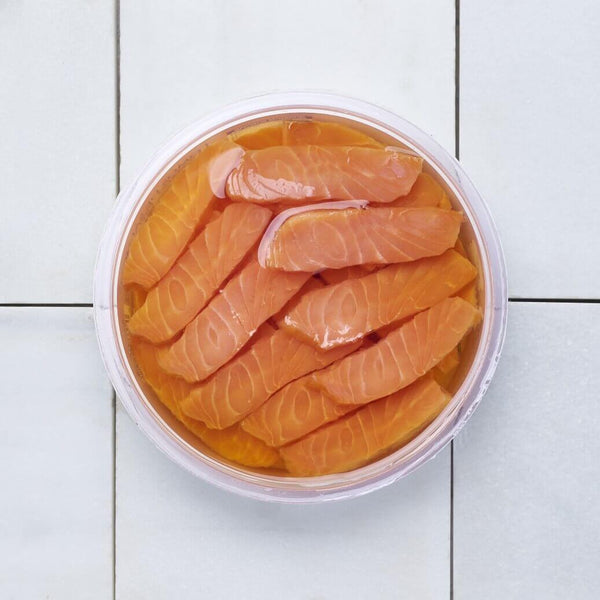
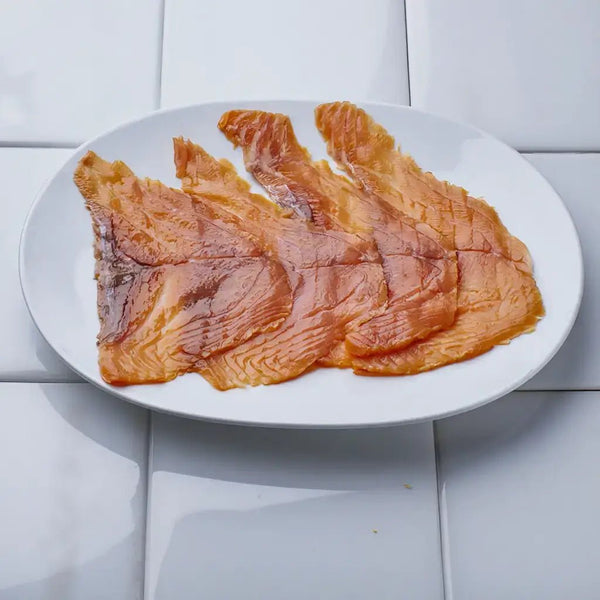
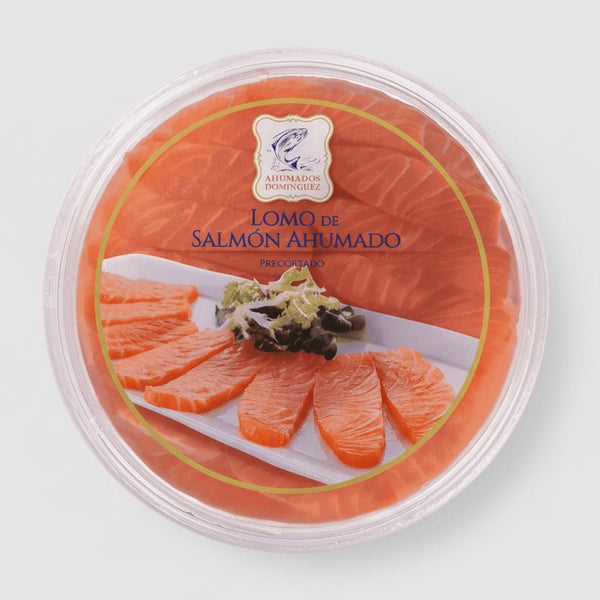
Quick summary: Mercadona's smoked salmon costs between 3.50 and 5.99 euros per tray (25-40 €/kg). It is an adequate product for everyday use, but it uses accelerated industrial processes, liquid smoke, and additives like E392 that artisanal smoked salmon doesn't need. The 5 key differences are: smoking method, ingredient list, texture and flavor, traceable origin, and real price per kilo. If you want it for a quick toast during the week, Mercadona delivers. If you are looking for real flavor and want to know exactly what you are eating, artisanal is in another league.
What smoked salmon does Mercadona sell?
Updated March 2026. In our experience of more than 30 years at Mercat del Ninot, this is what we recommend.
Mercadona offers smoked salmon under its own brand Hacendado, with several references that have changed over the years. Currently, the main options on its shelves are:
Hacendado smoked salmon: current references
- Hacendado Norwegian smoked salmon (100 g): The best-selling reference. Atlantic salmon from Norwegian aquaculture, sliced and vacuum-packed. Usual price: 3.50-3.80 € (35-38 €/kg).
- Hacendado smoked salmon family size (200 g): Same raw material in a larger format. Price: 5.50-5.99 € (27.50-29.95 €/kg). The large format is cheaper per kilo.
- Hacendado smoked salmon strips (100 g): Trimmings and strips for salads or pasta. Price: 2.80-3.20 € (28-32 €/kg). The cheapest option, but the presentation is not suitable for serving on toast.
Mercadona's historical supplier for smoked salmon has been Ahumados Domínguez, a Galician company with a factory in O Grove (Pontevedra), which also supplies other chains under private label. It is important to know this: when you buy Hacendado smoked salmon, you are not buying a Mercadona product. You are buying a product from an industrial manufacturer that produces in large volumes for multiple brands.
The raw material is Salmo salar from Norwegian aquaculture, which is the same species used by artisanal producers. The difference is not in the salmon itself, but in what happens afterwards: how it is cured, how it is smoked, and what is added to it.
Nutritional information for Mercadona smoked salmon
| Nutrient | Per 100 g |
|---|---|
| Calories | 142-160 kcal |
| Protein | 20-22 g |
| Total fat | 6-8 g |
| Omega-3 (EPA+DHA) | 1.2-1.8 g |
| Salt | 2.5-3.5 g |
| Carbohydrates | 0 g |
The salt content deserves attention. A well-made artisanal smoked salmon contains between 2 and 3 g of salt per 100 g. Some industrial products exceed 3.5 g, which indicates a more aggressive curing to accelerate the process and extend shelf life. If you are monitoring sodium intake, always check the label before buying.
The 5 key differences between industrial and artisanal
Let's get to the point. These are the five differences that determine the quality of smoked salmon and, curiously, are rarely explained in advertising.
Complete comparative table
| Criterion | Mercadona / Industrial | Artisanal Premium |
|---|---|---|
| Salmon origin | Norwegian aquaculture (no specific farm traceability) | Norway or Scotland with full traceability to the fish farm, ASC/MSC certification |
| Smoking method | Liquid smoke or accelerated industrial chamber (2-4 hours) | Traditional cold smoking with beech, oak, or alder wood (12-24 hours) |
| Ingredients | Salmon, salt, smoke (may include smoke flavorings, antioxidants E392, sugar) | Salmon and salt. Nothing else |
| Curing | 6-12 hours, standardized process in liquid brine | 12-48 hours, manual dry curing with sea salt |
| Texture and flavor | Uniform, soft, bland flavor with dominant salty note | Complex, unctuous, woody and sea notes, long aftertaste |
| Slicing | Automatic machine, perfectly even 1 mm slices | Hand or semi-manual, irregular 1.5-2.5 mm slices |
| Shelf life | 30-45 days (more additives = longer duration) | 21-30 days vacuum-packed |
| Price/kg | 25-38 €/kg | 35-55 €/kg |
Difference 1: The smoking method
This is the most important difference and the least mentioned. Artisanal smoked salmon is cold-smoked for 12-24 hours with real smoke generated by the slow combustion of noble wood chips. The salmon absorbs natural aromatic compounds from the smoke — phenols, guaiacols, syringols — which provide complex flavor and act as a natural preservative.
In industrial production, the process is accelerated with liquid smoke (smoke condensate diluted in water) that is sprayed onto the salmon or added to the curing brine. It is faster, cheaper, and more uniform. But the aromatic profile is bland: a one-dimensional smoky note compared to the complexity of traditional smoking.
It's not that liquid smoke is dangerous. It is regulated and safe. But it is an industrial shortcut that simplifies a process that should be slow. Like heating a frozen pizza versus making the dough and letting it ferment for 48 hours. The technical result is "pizza", but the experience has nothing to do with it.
Difference 2: The ingredient list
A quality artisanal smoked salmon has two ingredients: salmon and salt. Period. Smoke is part of the process, not an additive.
An industrial salmon may include: salmon, salt, sugar, smoke flavorings, rosemary extract (E392, antioxidant), and, in some cases, colorings. Each extra ingredient is a sign of an accelerated process that needs to be chemically compensated.
Difference 3: Texture and sensory experience
Artisanal smoked salmon has a silky, unctuous texture that melts in the mouth. The intramuscular fat streaks are visible and provide natural softness. The flavor evolves: first sea salt, then wood smoke, then the salmon fat releasing aromas, and a long aftertaste that invites the next bite.
Industrial salmon is more uniform, drier, and has a short flavor profile. Dominant salt notes, a generic hint of smoke, and little persistence. It's not unpleasant, but it's monotonous.
Difference 4: Traceability of origin
Artisanal producers work with specific fish farms, often ASC (Aquaculture Stewardship Council) certified, where breeding density, feeding, and animal welfare are controlled. You can know from which fjord your salmon comes.
Industrial salmon comes from massive batches without individual traceability. It is not necessarily of worse quality, but you cannot verify it. And in a market where transparency is synonymous with quality, opacity generates justified distrust.
Difference 5: Real price per kilo
Here comes the surprise. The price difference is not as great as it seems. Mercadona's smoked salmon in 100g format costs about 35-38 €/kg. A premium artisanal smoked salmon is priced at 40-55 €/kg. We are talking about a difference of 5-17 euros per kilo, which in a 100g serving is 0.50-1.70 euros more.
For less than two extra euros per serving, you go from an adequate industrial product to an artisanal product that is in another sensory dimension. If you buy smoked salmon to enjoy it — not just to fill a sandwich — the price difference is almost irrelevant.
Smoking process: cold vs. liquid smoke
Understanding the difference between these two processes is key to evaluating any smoked salmon, whether from Mercadona, Lidl, or the most exclusive workshop in Scotland.
Traditional cold smoking
The salmon is cured with dry salt for 12-48 hours depending on the thickness of the fillet. Then it is washed, dried, and allowed to form a pellicle — a surface protein film that acts as a magnet for smoke. Next, it is exposed to smoke generated by the slow combustion of wood chips at temperatures between 20 and 30 degrees Celsius for 12-24 hours.
The salmon is never cooked. The proteins remain raw, which preserves that characteristic silky, translucent texture. The smoke compounds gradually penetrate the fish, providing natural preservation (phenols are antimicrobial) and an aromatic range that depends on the wood used:
- Beech: Smooth, balanced, slightly sweet. The European classic.
- Oak: More intense, with earthy and tannic notes. Potent.
- Alder: Sweet and delicate. The Scandinavian favorite.
- Applewood: Subtle fruity notes. For curious palates.
This process requires specific facilities, constant temperature and humidity control, and experienced personnel. Each batch is slightly different. That is part of its value.
Liquid smoke and industrial chambers
Liquid smoke is, literally, condensed smoke. It is generated by burning wood, capturing the smoke, condensing it in water, and filtering it to remove undesirable compounds (tars, polycyclic aromatic hydrocarbons). The result is a liquid that tastes like smoke and can be applied to salmon by immersion, spraying, or injection.
It is efficient. A complete industrial smoking process — from raw material reception to packaging — can be completed in 24-48 hours. The smoking itself lasts 2-4 hours in automated chambers where temperature, humidity, and smoke concentration are precisely controlled digitally.
The advantage: absolute consistency. Every tray tastes the same. The disadvantage: that consistency comes at the cost of complexity. Liquid smoke has a reduced aromatic profile — like the difference between artificial vanilla extract and a real vanilla bean. Technically "vanilla," but simplified.
When you read "smoke flavor" or "smoke" on the ingredient list without specifying wood or method, it is liquid smoke. Artisanal producers who use real smoking explicitly state it because it is their main value proposition.
Additives and preservatives: what the label says
The label is the only objective document you have as a consumer. Here's how to read it critically.
What you find in a typical industrial salmon
- Atlantic salmon (Salmo salar): The raw material. So far, so good.
- Salt: Essential for curing. No salt, no smoked salmon.
- Sugar: Added to soften the salty taste and accelerate dehydration. In an artisanal product, it is not necessary if the curing is done with time.
- Smoke flavor / smoke: Indicates liquid smoke. It is not a dangerous additive, but it reveals an industrial process.
- Rosemary extract (E392): Antioxidant that prevents fat oxidation and maintains the orange color. It is used because the rapid process does not generate enough natural phenolic compounds from the smoke to protect the product.
What you find in an artisanal salmon
- Atlantic salmon (Salmo salar)
- Sea salt
Two ingredients. Smoke does not appear as an ingredient because it is not added — it is the process. Like heat in baked bread: you don't list it as an ingredient because it's part of the preparation.
Additives to watch out for
Additive
Function
Risk
E392 (Rosemary extract)
Antioxidant
Safe. Indicates rapid industrial process
E250 (Sodium nitrite)
Preservative, color fixer
Controversial. Rare in salmon, more common in cured meats
Smoke flavorings
Flavoring
Safe. Indicates liquid smoke instead of real smoking
Sugar / dextrose
Flavoring, aids curing
Safe. Indicates accelerated process
Colorings (E160)
Intensifies color
Regulated but unnecessary in quality salmon
No common additive in smoked salmon is dangerous in the quantities used. But each additive is a patch that compensates for a limitation in the production process. The fewer ingredients, the better the process. It's a rule that rarely fails.
Price comparison: how much does it really cost?
The price of smoked salmon is misleading if you only look at the shelf label. A 100g tray at 3.50 euros seems cheap. But the important price is the price per kilo, because it's the only way to compare products of different formats.
Price table per kilo (March 2026)
Product
Format
Price
Price/kg
Mercadona Hacendado (Norwegian)
100 g
3.50-3.80 €
35-38 €/kg
Mercadona Hacendado (Norwegian)
200 g
5.50-5.99 €
27.50-29.95 €/kg
Mercadona strips / trimmings
100 g
2.80-3.20 €
28-32 €/kg
Lidl (Norwegian)
100 g
3.20-3.60 €
32-36 €/kg
Carrefour own brand
100 g
3.40-3.90 €
34-39 €/kg
Aldi (Norwegian)
100 g
3.10-3.50 €
31-35 €/kg
Royal (manufacturer brand)
100 g
4.50-5.50 €
45-55 €/kg
Artisanal Norwegian premium
100-200 g
4.50-6.50 €
40-55 €/kg
Artisanal Scottish premium
100-200 g
5.50-7.50 €
48-65 €/kg
What the price doesn't tell you
There's a factor almost no one mentions: yield. Industrial smoked salmon tends to contain more water (due to quick liquid brine curing), meaning part of what you pay for is water. Artisan dry-cured salmon loses between 8 and 15 percent of its weight in moisture during the process, concentrating flavor and nutrients. That's why 80g of artisan salmon can be as satisfying as 100g of industrial salmon.
Additionally, artisan salmon is sliced thicker (1.5-2.5 mm vs. 1 mm for industrial), which gives each slice more presence, more texture, and more satisfaction per bite. You eat less and enjoy it more.
If you do the actual calculation – price per gram of dry product, adjusted for sensory experience – the difference between industrial and artisan is reduced to cents per serving. And those cents buy a huge difference in flavor.
Smoked Salmon at Lidl, Carrefour, and Aldi
Mercadona isn't the only supermarket option. It's worth checking what alternatives offer, because there are interesting differences.
Lidl
Lidl sells smoked salmon under its Nixe brand and, occasionally, during its Scandinavian-themed weeks. The standard product is farmed Norwegian salmon, similar to Mercadona's in origin and process. The price is slightly lower (€32-36/kg). Special Christmas and Nordic week editions often include higher quality options with more traditional smoking – if you catch them, they're worth it.
Carrefour
Carrefour has several own brands (Carrefour, Carrefour Bio, De Nuestra Tierra) and also sells manufacturer brands like Royal. Their organic/eco range is interesting: organic farmed salmon with EU Organic certification, cured and smoked with slower processes. The price increases (€40-50/kg), but the quality approaches artisan.
Aldi
Aldi offers its own brand smoked salmon at aggressive prices (€31-35/kg). The quality is consistent with Mercadona and Lidl. Occasionally they have offers on Scottish smoked salmon which, for the price, are the best value in the supermarket.
Supermarket Verdict
For daily consumption and preparations where salmon isn't the main ingredient (salads, pasta, fillings), any of these options will do. The differences between them are smaller than the difference between all of them and an artisan salmon. If you're looking for the best supermarket salmon, pay attention to special editions and organic ranges – that's where you'll find real jumps in quality.
When is artisan worth it?
Not everyone needs artisan smoked salmon for everything. Let's be honest: there are contexts where industrial is perfectly adequate and others where artisan makes a difference that justifies the higher price.
Industrial is good for:
- Salads and pasta: When salmon is mixed with other intense ingredients (vinaigrette, cream, spices), the subtleties of artisan are diluted.
- Sandwiches and wraps on the go: Fast food where texture matters less than convenience.
- Cooking: If you're going to heat the salmon (quiches, gratins, scrambles), the cooking process evens out the differences.
- Frequent consumption on a tight budget: Better to eat industrial salmon than no salmon at all because you can't afford artisan. Omega-3s don't distinguish between labels.
Artisan is worth it for:
- Toasts and appetizers where salmon is the star: If the slice is on top of the bread, visible and palatable, the difference is enormous.
- Special dinners and celebrations: New Year's Eve, birthdays, dinners with guests. Artisan salmon turns a simple toast into a restaurant-quality dish.
- Gourmet gifts: A piece of artisan smoked salmon is a gift that impresses and is remembered.
- When you really want to indulge: That moment on a Sunday morning, calmly, a toast with good bread, cream cheese, and salmon that melts in your mouth. That's priceless.
- People on low-sodium diets: Artisan usually has less salt because slow curing doesn't require as much.
The key is not "always artisan" or "always supermarket." It's knowing when each option provides real value. Spending twice as much on salmon you're going to mix with creamy pasta makes no sense. Serving industrial on New Year's Eve, neither.
Our advice: Always keep a Mercadona or Lidl tray in the fridge for everyday use. And when you really want to indulge, put a serving of artisan smoked salmon on the table. Your palate will notice the difference from the first bite.
Our Premium Smoked Salmon Selection
At Bacalalo, we have been selecting seafood products at Mercat del Ninot in Barcelona for over 35 years. Our smoked salmon meets criteria that we do not compromise on:
- Traceable origin: Atlantic salmon (Salmo salar) from Norwegian or Scottish aquaculture with ASC certification. We know which fjord each batch comes from.
- Real cold smoking: With beech wood chips for 12-24 hours, at less than 30 degrees. No liquid smoke, no shortcuts.
- Two ingredients: Salmon and sea salt. Nothing else.
- Careful slicing: Generously thick slices that maintain the product's integrity. Not transparent slices that break when removed from the package.
- Refrigerated shipping: Vacuum-packed and shipped with guaranteed cold chain in 24-48 hours.
We do not sell any product that we would not consume ourselves at the Ninot counter. This is a rule we have applied since 1990 and one we will not change.
Artisan Smoked Salmon — Bacalalo
Cold smoked with beech wood. Norwegian and Scottish origin with full traceability. Vacuum-packed, refrigerated shipping in 24-48h.
If you want to delve deeper into types of salmon, preservation methods, and how to identify quality, we have a complete guide to smoked salmon that covers the topic in detail.
🛒 Our premium alternative
⭐ 4.9/5 · Cold shipping 24-48h · Since 1990 at Mercat del Ninot
Conclusion: Facts, Not Slogans
Mercadona's smoked salmon is a decent, safe, and accessible product. For everyday use, it does the job. But calling it "smoked salmon" just like an artisan product made over 24-48 hours with beech wood is like calling both an 85% Valor chocolate bar and a generic brand bar with 25% cocoa "chocolate." Technically, both are chocolate. But the experience is radically different.
The five differences we've analyzed – smoking method, ingredients, texture, traceability, and real price – are not opinions. They are verifiable facts you can check by reading labels, comparing flavors, and doing the math. It's not marketing. There are objective factors that explain why one salmon tastes better than another.
The decision is yours. We just wanted you to make it with information, not advertising.
Taste the difference: Discover our artisan smoked salmon and compare it with your usual supermarket brand. If you don't notice the difference, we respect your palate. But we bet you will.
Related readings
- Smoked salmon: complete guide to types and quality
- Smoked salmon and pregnancy: risks and safe alternatives
- Salmon poke: recipe and tricks
- Collection: Premium smoked salmon
Premium Seafood Products — Bacalalo
Since 1990, selecting the best from the sea at Mercat del Ninot, Barcelona. Refrigerated shipping 24-48h.
View smoked salmon →Frequently Asked Questions
Is Mercadona's smoked salmon safe?
Yes. Mercadona's smoked salmon complies with all European health regulations. It is processed under strict temperature and microbiology controls. The additives it contains (E392, smoke flavors) are authorized and safe in the amounts used. Food safety is not a difference between industrial and artisan — both are safe. The difference lies in taste, texture, and process.
How many calories are in Mercadona's smoked salmon?
Mercadona's smoked salmon provides approximately 142-160 kcal per 100 grams, with 20-22 g of protein and 6-8 g of fat, a significant portion of which are beneficial omega-3 fatty acids. It is a nutritionally dense food, rich in vitamin D, B12, and selenium. The calories are practically identical to artisan salmon — the main nutritional difference is in the sodium content, which can be higher in industrial (2.5-3.5 g of salt per 100 g vs. 2-3 g for artisan).
What is the difference between Mercadona's smoked salmon and Lidl's?
The difference is minimal. Both use Norwegian farmed Atlantic salmon processed industrially with similar methods. Lidl's price is usually slightly lower (€32-36/kg compared to €35-38/kg for Mercadona in 100g format). Suppliers may vary, but the organoleptic result is comparable. If you're looking for a real difference, you won't find it between supermarket private labels, but between the entire industrial segment and artisan.
What is the best smoked salmon in the supermarket?
Within conventional supermarkets, the best options are organic ranges (Carrefour Bio, for example) and special editions that Lidl launches during Nordic-themed weeks. These references use slower processes and raw materials from certified organic aquaculture. In terms of manufacturer brands, Royal offers higher quality than private labels, albeit at a significantly higher price (€45-55/kg). If you are willing to pay that price, it is worth considering artisan salmon with home delivery directly.
Does smoked salmon contain colorants?
Farmed salmon does not need added colorants after processing. The orange color comes from astaxanthin included in fish farm feed (identical to what wild salmon obtain by eating krill). This is standard, regulated, and safe practice. Some lower-end producers have used additional colorants (E160) to intensify the hue, but it is uncommon in Spanish supermarket brands. If you are concerned, check the ingredient list: if it only says "salmon and salt," there are no added colorants.
Can I freeze Mercadona's smoked salmon?
You can, but it's not ideal. Freezing breaks muscle fibers, and upon thawing, the salmon exudes liquid and loses texture. If you need to freeze it, do so in its original vacuum-sealed packaging at -18 degrees or lower. Thaw slowly in the refrigerator for 12 hours, never at room temperature or in the microwave. Thawed salmon is suitable for pasta, scrambles, and cooked preparations, but it loses the silky texture that makes it ideal for toasts.
How long does smoked salmon last once opened?
Once opened, smoked salmon lasts 3-4 days in the refrigerator at 2-4 degrees Celsius. Store it in an airtight glass container with plastic wrap in direct contact with the salmon surface to minimize oxidation. If superficial sliminess, ammoniacal odor, or grayish color appears, discard it. Practical tip: if you're not going to consume the entire tray within 3 days, freeze half on the same day you open it.
Marc González Sáez
Founder of Bacalalo.com | Since 1990 at Mercat del Ninot, Barcelona
More than 35 years selecting and selling seafood products. What we write here is backed by decades of counter experience, not market research. If you have questions about smoked salmon or any seafood product, contact us — it's what we do best.