Artisan smoked salmon is slow-smoked with real wood for 8-24 hours at under 28°C, while industrial salmon uses liquid smoke, polyphosphates, and processes that last 2-4 hours. The differences lie in texture, color, ingredients, and price. Here's how to tell them apart once you open the package.
Table of contents
The artisan process step by step
Artisan smoked salmon begins with the selection of the fish. Traditional smokehouses work with fresh, never frozen, Atlantic salmon (Salmo salar) with a fat content greater than 12%. This matters because fat is the vehicle for flavor.
The process has four distinct phases:
1. Dry salting (12-36 hours). The fillet is covered with coarse sea salt, sometimes mixed with brown sugar and dill. The typical ratio is 3:1 (salt:sugar). This step extracts between 8% and 12% of the water from the fish, concentrating flavor and creating a firm texture. Liquid brine is not used because it dilutes the flavor and adds artificial weight.
2. Washing and drying (6-12 hours). The salt is removed, the fish is washed with cold water, and air-dried in a chamber at 4°C. The goal is to form a protein film on the surface — the so-called pellicle — which allows the smoke to adhere evenly.
3. Cold smoking (8-24 hours). Temperature: 20-28°C. Never exceeds 30°C. The most common woods used are oak, beech, and cherry. Each wood provides a distinct flavor profile: oak gives deep, earthy notes, cherry a sweet touch, and beech a smooth, clean flavor. Smoke is generated by slowly burning wood chips in a separate firebox from the fish.
4. Maturation (24-48 hours). The fillet rests in a chamber at 2-4°C. During this period, the flavors balance and the texture sets. This is the phase that factories skip.
The result is a product with a 15-20% weight loss from the original weight. This is key to understanding the price: 1 kg of fresh salmon yields 800-850 g of artisan smoked salmon.
What makes industrial different
The industry doesn't lie when it says its salmon is "smoked." Technically, it is. The difference lies in how, for how long, and the added ingredients.
Typical industrial salmon follows this process:
Brine injection. Instead of dry salting, a solution of water, salt, and polyphosphates (E451, E452) is injected directly into the muscle. Polyphosphates retain water — up to 10-15% of the final weight can be added water. This increases yield (and profit) but dilutes the flavor.
Liquid or atomized smoke. Many factories use smoke condensate (liquid smoke) which is sprayed onto the fillets or added to the brine. The process lasts 2-4 hours instead of 8-24. The resulting flavor is flat, one-dimensional — like the difference between natural vanilla and synthetic vanillin.
Disguised "hot" smoking. Some brands do a quick smoke at 60-80°C which technically cooks the fish. The result is a drier, flakier texture, nothing like the unctuousness of cold-smoked salmon.
Colorings and preservatives. It is legal (and common) to add beetroot extract or canthaxanthin to intensify the pink-orange color. Preservatives like potassium sorbate (E202) extend the shelf life from 15 days to 30-45 days.
Industrial shrinkage is 5-8%. Compare that to the 15-20% for artisan, and you'll understand why an industrial package can cost €2.50/100g and an artisan one €6-9/100g.
At Bacalalo, we select artisan smoked salmon with real cold smoking and no additives. See our smoked salmon selection
5 differences when opening the package
You don't need a laboratory. These are the five signs that distinguish artisan salmon from industrial when opening the package:
1. The liquid. If there's a puddle of pink liquid when you open the package, that's a bad sign. That liquid is water retained by polyphosphates that is released when the vacuum is broken. Artisan salmon may release a minimal amount of natural oil, but never watery liquid.
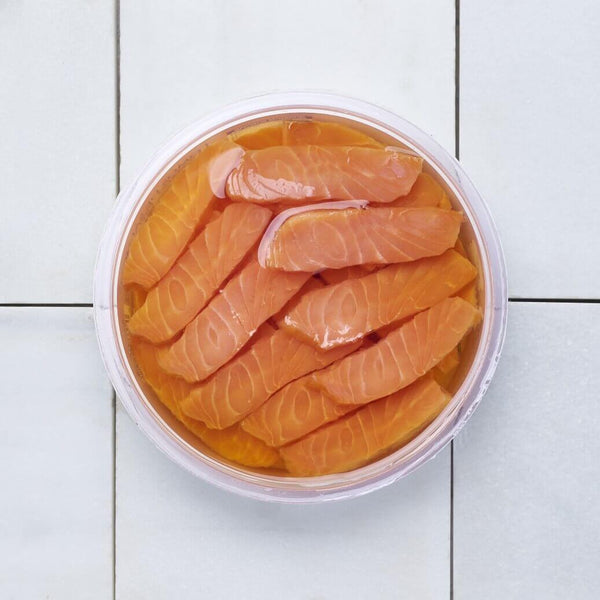
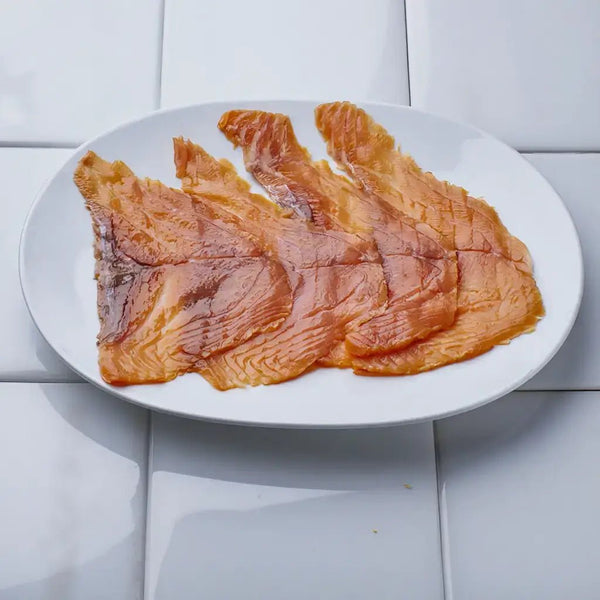
2. The color. Artisan salmon has a variable color — more intense in fatty areas, lighter in muscle streaks. Industrial salmon has a homogeneous, almost artificially uniform color. If all the slices are exactly the same shade, be suspicious.
3. The texture to the touch. Run your finger over the slice. Artisan salmon feels firm and slightly oily. Industrial salmon feels moist and soft, almost spongy. The difference is immediate.
4. The smell. Artisan salmon smells like real wood smoke, with nuances depending on the wood used. Industrial salmon smells like "generic smoke" — a flat smell, sometimes with chemical notes. If it smells like barbecue potato chips, it's liquid smoke.
5. The separation of slices. Artisan slices separate easily because they have their own consistency. Industrial slices stick together due to excess moisture and often break when trying to separate them.
Complete comparison table
| Criterion | Artisan | Industrial |
|---|---|---|
| Salting method | Dry (salt + sugar, 12-36 h) | Brine injection with polyphosphates |
| Smoking type | Cold with real wood (20-28°C, 8-24 h) | Liquid or atomized smoke (2-4 h) |
| Maturation | 24-48 hours in chamber | No maturation |
| Shrinkage | 15-20% | 5-8% |
| Ingredients | Salmon, salt, (sugar) | Salmon, salt, smoke, E451, E452, E202 |
| Added water | 0% | 10-15% |
| Color | Variable, natural | Uniform, possible colorants |
| Shelf life | 15-21 days | 30-45 days |
| Approximate price | €6-9/100g | €2-4/100g |
| Texture | Firm, unctuous, cuts clean | Soft, moist, crumbles |
Reading the label: what nobody tells you
European regulations require ingredient declaration, but brands play with the fine print. Here's what to look for:
Ingredients. Real artisan smoked salmon has 2-3 ingredients: salmon, salt, and at most sugar. If you see E451 (sodium tripolyphosphate), E452 (potassium polyphosphate), or E202 (potassium sorbate), it's industrial. No exceptions.
"Made with" vs "Made in". "Made with Norwegian salmon" can mean that the salmon comes from Norway but is processed in Poland or Lithuania (where costs are lower). "Made in Norway" indicates that processing was done there.
"Smoked" vs "Smoked flavor". If the label says "smoked flavor" or "smoke aroma", it's liquid smoke. The word "smoked" alone does not guarantee real wood — a product can be legally "smoked" with liquid smoke.
Salt content. Artisan usually has 2.5-3.5% salt. Industrial can go down to 2% because it compensates with preservatives. If you see "low salt" on a smoked product, ask yourself what they are adding instead.
The "premium" trap. The word "premium", "selection" or "gourmet" on the package has no legal value. Anyone can put it. What does have value is the smokehouse's seal, the salmon's designation of origin, and the list of ingredients.
All our smoked products indicate origin, method, and complete ingredient list. No tricks. Explore smoked and salted products
Norway vs Scotland vs Alaska
The origin of salmon matters, but not in the way you might think.
Norway. 95% of smoked salmon sold in Spain comes from Norwegian aquaculture. Norwegian farms produce Atlantic salmon (Salmo salar) in fjords with water between 6-14°C. The Norwegian industry is efficient and produces consistent fish with good fat content (12-16%). The problem is not Norway itself — it's that the scale of production favors industrial processes. There are excellent Norwegian smokehouses and there are factories that make commodity products.
Scotland. Scottish salmon has a Label Rouge designation (originally French, adopted by several Scottish farms) and tends to have slower rearing — 24-36 months vs 18-24 in Norway. This results in firmer flesh and a more pronounced flavor. The Scottish Highlands produce some of the best smoked salmon in the world, with smokehouses that have been using the same oak wood process for decades.
Alaska. Here we are talking about wild salmon, mainly Oncorhynchus nerka (sockeye salmon) and Oncorhynchus kisutch (coho). The difference is radical: wild salmon has less fat (6-8%), a firmer texture, and a "cleaner," more mineral flavor. The intense red color is natural — it comes from the astaxanthin in the crustaceans it eats in the wild. It is the salmon with the best nutritional profile (more omega-3, less omega-6) but not everyone prefers its drier taste.
Iceland and the Faroe Islands. Two lesser-known but very high-quality origins. Colder waters, slower rearing, and their own smoking tradition. The Faroes, in particular, produce salmon with exceptional fat content thanks to the North Atlantic currents.
| Origin | Species | Type | Fat | Approx. Price €/kg |
|---|---|---|---|---|
| Norway | Salmo salar | Aquaculture | 12-16% | 25-60 |
| Scotland | Salmo salar | Aquaculture Label Rouge | 13-17% | 40-80 |
| Alaska | O. nerka / O. kisutch | Wild | 6-8% | 50-90 |
| Faroe Islands | Salmo salar | Aquaculture | 14-18% | 45-75 |
| Iceland | Salmo salar | Aquaculture | 12-15% | 40-70 |
How to choose the best smoked salmon
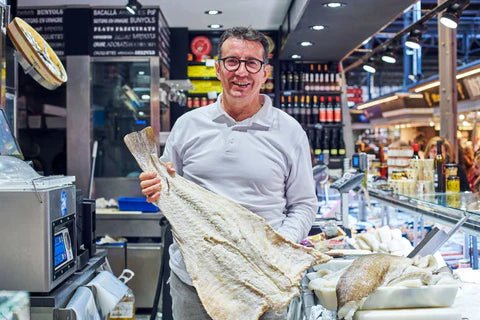
After 35 years selling seafood products at Mercat del Ninot, here are the rules I use:
Rule 1: Read the ingredients, not the marketing. If it has more than 3 ingredients (salmon, salt, sugar), it is not artisan. Period.
Rule 2: Be wary of low prices. Artisan smoked salmon cannot cost less than €5/100g. If it costs €2-3, they are compensating for shrinkage with water and polyphosphates. The math doesn't lie: if fresh salmon at the market costs €8-10/kg and artisan shrinkage is 15-20%, the raw material alone already costs more.
Rule 3: Look for the smokehouse name. Good smokehouses proudly display their name. If the package only says "produced by" followed by a factory code, it's anonymous production.
Rule 4: Choose according to use. To eat plain, with a drizzle of olive oil and lemon, buy the best you can. For cooking — in a quiche, scrambled eggs, or pasta — a decent industrial one works well because heat transforms textures.
Rule 5: Taste before judging. Each smokehouse has its style. Some prefer a mild smoke (beech) and others seek intensity (oak). There isn't one "best" — there's one that suits your palate.
Choose from our varieties of artisan smoked salmon. Refrigerated shipping in 24-48 hours. See smoked salmon at Bacalalo
Frequently asked questions
Is artisan smoked salmon safer than industrial?
Both are safe if the cold chain is maintained. The difference is not in food safety but in organoleptic quality and purity of ingredients. Industrial adds preservatives that extend shelf life, which paradoxically can give a false sense of security if refrigeration is neglected.
How long does smoked salmon last once opened?
Artisan: 2-3 days in the refrigerator (0-4°C), well wrapped in film. Industrial: 3-5 days thanks to preservatives. In both cases, once the vacuum is broken, the clock is ticking. If you notice a sour smell or the surface becomes sticky, discard it.
Can pregnant women eat smoked salmon?
AESAN (Spanish Agency for Food Safety) recommends avoiding cold-smoked salmon during pregnancy due to the risk of Listeria monocytogenes. Cold smoking does not reach a high enough temperature to eliminate it. Hot smoking (above 65°C) is safe. Always consult your doctor.
Can smoked salmon be frozen?
Yes, but it loses texture. Water inside the muscle forms crystals that break down the fibers. If you freeze it, do so in its original vacuum packaging and consume it within a maximum of 2 months. When thawing, do so in the refrigerator (never at room temperature) for 12-24 hours.
What does "smoked with beech wood" mean on the label?
It means that beech wood chips (Fagus sylvatica) have been used to generate the smoke. Beech produces a mild and delicate smoke, less intense than oak. It is the most commonly used wood in continental Europe. However, confirm that it doesn't also say "smoke aroma" in the ingredients — some brands use both.
Does smoked salmon make you gain weight?
100 g of smoked salmon provides about 180-200 kcal, 11-13 g of fat (mostly omega-3), 20-22 g of protein, and 0 g of carbohydrates. It is a nutritionally dense food. What makes you gain weight is not the salmon — it's the 200 g of bread that accompanies it.
Does artisan always mean better?
Not automatically. "Artisan" describes a production method, it does not guarantee quality. An artisan smokehouse with poor raw material or poor temperature control can make a mediocre product. What it does guarantee is the absence of additives and a more respectful process with the product. The combination of good method + good raw material is what makes the difference.