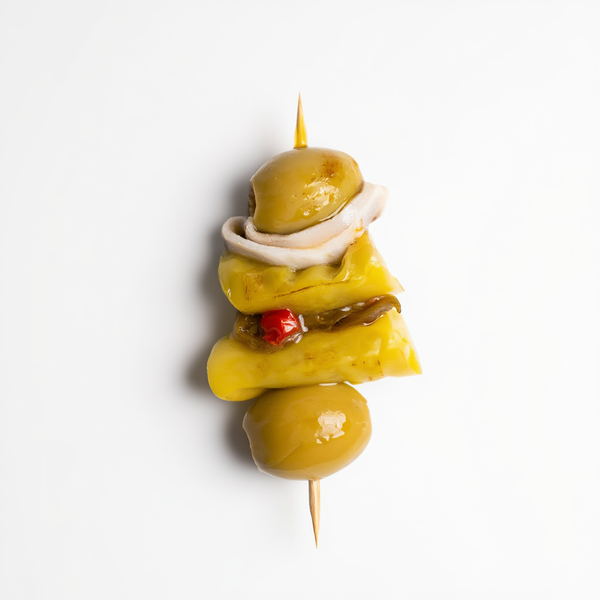
Mercadona's vinegar-marinated anchovies use industrial acidifiers and preservatives to maintain a price of €1.50/100g. Artisan ones are made with real vinegar, long curing times, and no additives, starting from €3-5/100g. Here, we compare ingredients, texture, flavor, and safety against anisakis.
Table of contents
What Mercadona actually sells
Mercadona sells vinegar-marinated anchovies under its Hacendado brand, primarily produced by suppliers like Conservas y Salazones Herpac (Barbate, Cádiz) and other inter-suppliers. You'll find them in the refrigerated section, packaged in plastic trays with modified atmosphere.
The price ranges from €1.20-1.80/100g depending on the format. For that price, the chain needs a fast and scalable process that allows it to produce thousands of trays a day with a shelf life of 20-30 days.
How do they achieve this? The answer lies in the ingredient list: anchovy (Engraulis encrasicolus), vinegar, sunflower oil, salt, citric acid (E330), potassium sorbate (E202). Some batches add acetic acid (E260) to speed up acidification.
The first thing that stands out: sunflower oil, not olive oil. The second detail: citric acid as a fast acidifier. Both are cost decisions, not flavor decisions.
In Mercadona's defense: their product is safe, passes anisakis controls, and complies with regulations. No one says it's bad — the question is whether it's worth paying a little more for a better one.
Industrial vs. homemade process
The industrial process (Mercadona and similar):
1. Reception of frozen anchovies (mandatory to eliminate anisakis: -20°C for 24-72 h). 2. Thawing in salted water. 3. Mechanical cleaning — machines remove head and central bone. 4. Immersion in acidifying solution (vinegar + citric acid) for 4-8 hours. Citric acid accelerates protein denaturation which would normally take 24-48 h with only vinegar. 5. Draining and packaging with sunflower oil and preservative. 6. Modified atmosphere (gas) to extend shelf life.
Total time: 8-12 hours from thawing to packaging.
The artisan process (homemade or workshop):
1. Selection of fresh seasonal anchovies (spring-summer in the Bay of Biscay). 2. Mandatory prior freezing (-20°C, minimum 5 days in a domestic freezer or 24 h industrial). 3. Manual cleaning — each anchovy is opened, bone and viscera are removed by hand. 4. Immersion in pure white wine vinegar for 24-48 hours in the refrigerator. No citric acid, no rush. The protein denatures slowly and the resulting texture is firmer and less "cooked". 5. Draining, dressing with extra virgin olive oil, sliced garlic, fresh parsley, salt. 6. Rest for a minimum of 2-4 hours for the dressing to penetrate.
Total time: 48-72 hours.
The difference in time explains everything. 8 hours vs. 48-72 hours. The industrial shortcut has a cost in flavor and texture that no preservative can compensate for.
Ingredient comparison table
| Ingredient | Mercadona / Industrial | Artisan |
|---|---|---|
| Anchovy | Frozen (variable origin: Morocco, Mediterranean) | Fresh seasonal, frozen at home |
| Vinegar | Wine vinegar + citric acid (E330) | Pure white wine vinegar |
| Oil | Refined sunflower | Extra virgin olive |
| Preservative | Potassium sorbate (E202) | None |
| Garlic | Sometimes powdered or absent | Fresh, sliced |
| Parsley | Dehydrated or absent | Fresh, chopped |
| Time in vinegar | 4-8 hours | 24-48 hours |
| Shelf life | 20-30 days | 3-5 days |
If you're looking for real anchovies, without industrial shortcuts, we have them. See artisan anchovies
Texture and flavor: the ultimate test
Try this yourself. Buy a tray from Mercadona and one from a workshop or market. Put them on separate plates. The differences are obvious:
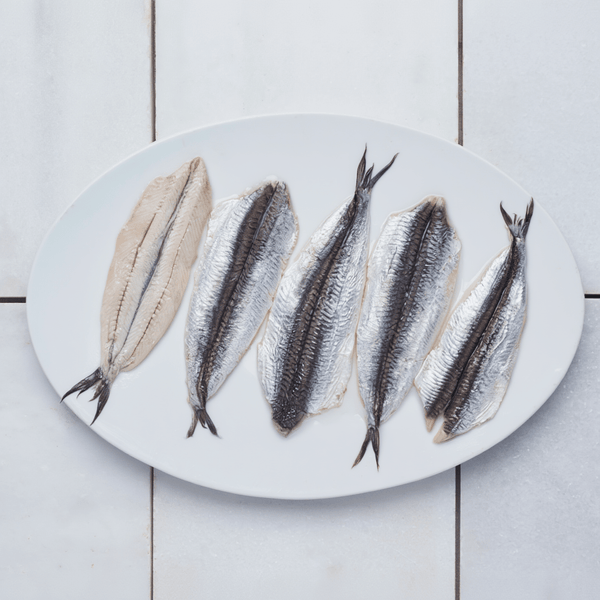
Texture. Industrial anchovies have a soft, almost pasty texture in the center. Rapid acidification with citric acid "cooks" the protein unevenly: white on the outside, sometimes still translucent on the inside. Artisan anchovies have a firm, uniform texture — completely opaque, breaking cleanly when bitten, with a pleasant resistance to the tooth.
Flavor. Industrial ones taste of vinegar and little else. A flat, acidic vinegar, without nuances. Sunflower oil contributes nothing — it's neutral by design. Artisan ones taste of the sea first, then vinegar, and extra virgin olive oil adds a layer of flavor that rounds out the whole. Fresh garlic and parsley are not just decoration — they provide aromas that the industrial version doesn't even consider.
Appearance. Industrial ones tend to have an off-white to grayish color, a consequence of citric acid. Artisan ones maintain a cleaner white with pearly reflections and, when the anchovy is in season, sometimes a slightly pinkish tone in the flesh.
Smell. Industrial ones smell of vinegar and the plastic packaging. Artisan ones smell of vinegar, garlic, parsley, and olive oil — like the classic dish you'd get at a neighborhood bar.
Real price per serving
Let's do the math, which is where things get interesting.
A portion of vinegar-marinated anchovies in a bar in Madrid or Barcelona costs between €8-14 and is usually about 100-120g. In the supermarket, a Mercadona tray costs €1.20-1.80/100g. An artisan tray from a workshop or market costs €3-5/100g.
| Source | Price per 100g | Quality (1-10) | Price/quality |
|---|---|---|---|
| Mercadona (Hacendado) | €1.20-1.80 | 4-5 | Low cost, fair quality |
| Premium supermarket (El Corte Inglés) | €2.50-4.00 | 5-7 | Variable by brand |
| Workshop / market | €3.00-5.00 | 7-9 | Best value for money |
| Bar / restaurant | €7.00-12.00 | 5-9 | You pay for service + location |
| Homemade | €1.50-2.50 | 8-10 | The best option if you have time |
The key fact: making them at home costs between €1.50-2.50/100g (fresh anchovies at €6-10/kg + vinegar + EVOO) and the quality is superior to any commercial option. The only real cost is time — about 48-72 hours of waiting.
Anisakis: myths and reality
This is where most misinformation circulates. Let's look at the facts:
Anisakis (Anisakis simplex) is a nematode parasite present in most marine fish. In Spain, anchovies are the main source of anisakiasis — not because they are the most parasitized species, but because they are consumed raw (marinated in vinegar).
Myth 1: "Vinegar kills anisakis." False. Vinegar does not kill anisakis larvae. It partially inactivates them but does not eliminate them. Studies by the CSIC (2012) showed that larvae submerged in wine vinegar for 48 hours were still viable. Only freezing or cooking safely eliminates them.
Myth 2: "Freezing for 24 hours is enough." It depends. European regulations (EC Regulation 853/2004) require -20°C for a minimum of 24 hours. But most domestic freezers do not reach a true -20°C (they are usually between -15°C and -18°C). That's why AESAN recommends 5 days in a domestic freezer or verifying that your freezer has 3 or 4 stars (****).
Myth 3: "Mercadona's anchovies don't need prior freezing because they are already treated." Correct in this case. Industrial suppliers freeze the fish at -20°C (or lower) for 24-72 hours as part of their process. The industrial cold chain is more reliable than the domestic one.
Real fact: In Spain, about 8,000-10,000 cases of anisakiasis are reported annually, mostly due to homemade vinegar-marinated anchovies without prior freezing. It is the European country with the most cases, well ahead of the 500-1,000 in Japan (sushi). The solution is simple: always freeze before preparing vinegar-marinated anchovies.
Where to buy the good ones
If you don't want to make them at home (which is always the best option), here are the alternatives in order of quality:
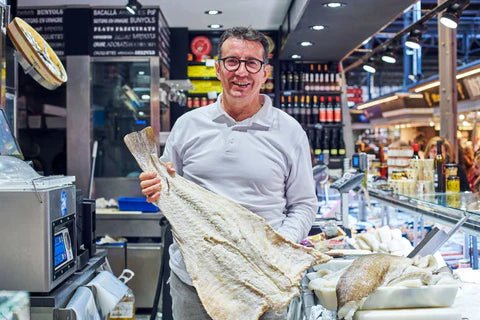
1. Municipal markets. Fish stalls in markets like Mercat del Ninot, La Boqueria, or Mercado de la Paz (Madrid) usually have vinegar-marinated anchovies made daily. Ask when they were prepared — the freshest ones are the best.
2. Workshops and specialized stores. Small producers who work to order or with limited production. You can find them online and in gourmet stores. The price goes up (€4-6/100g) but the quality is consistent.
3. Artisan canneries. Brands like Herpac, La Chanca, or Don Bocarte make vinegar-marinated anchovies packaged in olive oil with remarkable quality. They are more expensive (€5-8/100g) but have the advantage of a longer shelf life without artificial preservatives (the vinegar itself and olive oil preserve them).
4. Online. More and more producers ship refrigerated vinegar-marinated anchovies (24-48 h) throughout Spain. Refrigerated shipping adds €3-5 to the order, but if you buy enough quantity, the cost per serving decreases.
Our anchovy preserves come from artisan producers in the Bay of Biscay. See gourmet Bacalalo preserves
Frequently asked questions
Do Mercadona's vinegar-marinated anchovies contain anisakis?
No. Mercadona's suppliers freeze the anchovies at -20°C or lower for a minimum of 24 hours, which eliminates the larvae. The product is safe in this regard.
Why do Mercadona's use sunflower oil and not olive oil?
Cost. Refined sunflower oil costs €1-2/liter, while EVOO costs between €5-10/liter. In a mass-market product with tight margins, this decision multiplies profit. Sunflower oil is neutral in taste — it adds nothing, but it doesn't spoil it either.
Is it true that citric acid is bad?
It's not bad for your health — citric acid (E330) is naturally found in citrus fruits. What it does is change the flavor profile and accelerate acidification that should be slow. The result is an anchovy with a different texture, not a toxic anchovy.
How long do homemade vinegar-marinated anchovies last?
In the refrigerator (0-4°C), well covered with olive oil, they last 3-5 days. Without oil, 2-3 days. Never leave them at room temperature for more than 2 hours. If they change smell or the texture becomes slimy, discard them.
Can I make vinegar-marinated anchovies with frozen anchovies from the supermarket?
Yes, and it's actually recommended if you don't have access to quality fresh fish. Buy whole frozen anchovies, thaw in the refrigerator for 12-24 hours, clean, and follow the normal process. The freezing has already been done for you.
Is there a difference between boquerón and anchoa?
It's the same fish: Engraulis encrasicolus. "Boquerón" is used for fresh or vinegar-marinated fish. "Anchoa" is used for salt-cured fish. Same species, different preservation process.
Why are the ones from the bar tastier than those from the supermarket?
Good bars make their own anchovies or buy them from local workshops. They use EVOO, fresh garlic, daily parsley, and serve them at room temperature (which releases more aroma). Industrial packaging, modified atmosphere, and the cold from the supermarket refrigerator mute the flavors.