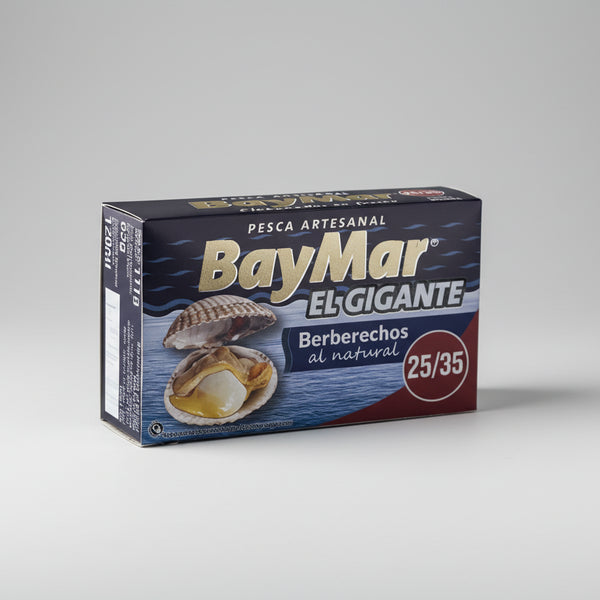
Mercadona (Hacendado brand) cockles cost €0.80-€1.50/can and come from Holland or Denmark with 40-60 pieces/can. Rías Gallegas cockles cost €4-€12/can with 20-35 larger, fleshier pieces with a true sea flavor. The difference is marked by origin, size, and preservation process.
Table of Contents
What are cockles?
The cockle (Cerastoderma edule) is a bivalve mollusk that lives buried in the sand of intertidal zones. It feeds by filtering phytoplankton, and its taste depends directly on the waters where it grows: salinity, temperature, and seabed nutrients.
Spain is the second-largest European producer of cockles (after the Netherlands), and Galicia concentrates most of the national production. The Rías Baixas — Arousa, Vigo, Pontevedra — offer ideal conditions: cold Atlantic waters (12-16°C), freshwater input from rivers, and a sandy seabed rich in nutrients.
Harvesting in Galicia is done by hand, by licensed shellfish gatherers, in natural banks regulated by the fishermen's guilds. It is a limited resource: each shellfish gatherer has a daily quota (usually 6-8 kg), and the season closes when the resource needs to regenerate. This explains the price.
In northern Europe (Holland, Denmark, United Kingdom), cockles are collected with mechanical dredges in large banks. Production is massive, costs are low, and the resulting cockle is smaller, with less flavor and a less firm texture.
Mercadona: what it really offers
Mercadona sells canned cockles under the Hacendado brand in two main formats: a small can (63 g drained) for €0.80-€1.00 and a medium format (111 g drained) for €1.30-€1.80. The main supplier is the canning company Frinsa (Ribeira, A Coruña), although the raw material is not always Galician.
Read the fine print on the label. Most Hacendado cans indicate "cockles" without specifying the origin. When the origin appears, it is usually "Northeast Atlantic" — a denomination that covers from Portugal to Norway. In practice, a good part of Mercadona's cockles come from Holland and Denmark, processed in Spain.
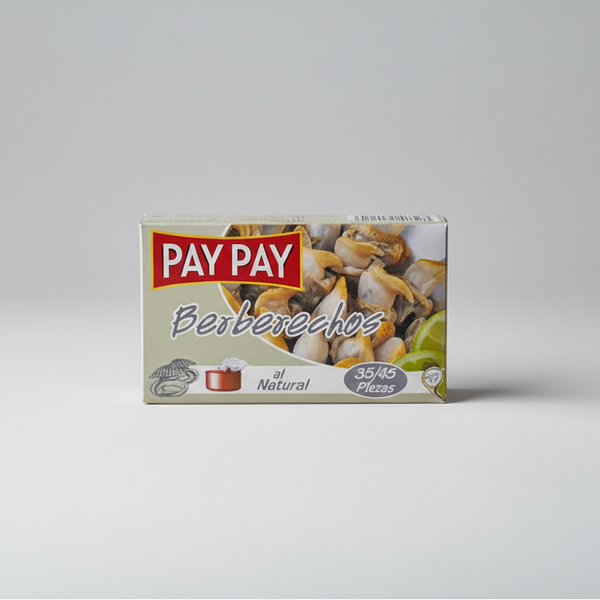
The content of a typical Mercadona can (63 g drained): 40-60 small cockles (size 55/65 or larger), in salted water. The meat is small, rather tough, with a mild flavor — more "canned" than sea-like. It is not a bad product to add to a salad or pasta, but eating it alone as an appetizer is another story.
The effective price per piece: if a €0.90 can has 50 cockles, each cockle costs €0.018. Remember this number.
Rías Gallegas: why they cost more
A can of Rías Gallegas cockles costs €4-€12 (and large sizes can exceed €15). This is not marketing — it is a direct consequence of how it is produced:
Manual harvesting. Each cockle is collected by hand with a rake ("raño") or directly by hand. A shellfish gatherer collects 4-8 kg per day, works with the tides, and depends on the weather. The labor cost per kilo is incomparably higher than that of a Dutch mechanical dredge.
Selection by size. Cockles are hand-sorted by size. The most valued sizes are 25/30 (25-30 pieces per ~120g can) and 30/40 (30-40 pieces). Sizes smaller than 20/25 are exceptional and scarce.
Steam cooking and artisanal canning. Quality Galician canneries (Conservas de Cambados, Rías Gallegas, Real Conservera Española) steam-cook the cockles on the same day they are harvested. They are packaged in their own juice or in seawater, without preservatives. The covering liquid is transparent and tastes like the sea.
Limited resource. Galician fishermen's guilds manage shellfish banks as a sustainable resource. Closed seasons, daily quotas, and dependence on natural climate limit production. You cannot "manufacture" more Galician cockles — there are only as many as there are.
The price per piece: if an €8 can has 30 cockles of size 25/30, each cockle costs €0.27. This is 15 times more than Mercadona's. The question is whether it's worth it.
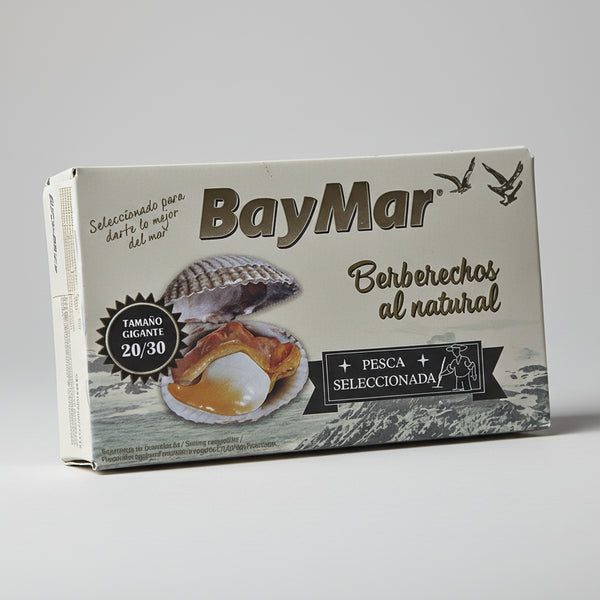
Natural cockles from Rías Gallegas, selected by size. No preservatives. View canned cockles
Complete comparative table
| Criterion | Mercadona (Hacendado) | Rías Gallegas |
|---|---|---|
| Origin | Holland, Denmark, variable | Rías Baixas (Galicia) |
| Harvesting | Mechanical dredge | Manual (shellfish gatherers) |
| Typical size | 55/65 or more | 25/30 - 40/50 |
| Pieces per can (63-120 g) | 40-60 | 20-35 |
| Piece size | Small (1-1.5 cm) | Medium-large (1.5-2.5 cm) |
| Covering liquid | Salt water, sometimes cloudy | Own juice, transparent |
| Texture | Firm to tough, dry | Tender, fleshy, juicy |
| Flavor | Mild, generic | Intense sea flavor, iodized |
| Preservatives | Possible (check label) | None |
| Price per can | €0.80-€1.80 | €4-€12 |
| Price per piece | ~€0.02 | ~€0.25-€0.35 |
Size and pieces per can
Size is the key indicator of quality in cockles. It is expressed as the number of pieces per can (or per kg). The lower the number, the larger the cockle size and the higher the price.
| Size | Pieces per can (~120g) | Size | Approximate price | Quality |
|---|---|---|---|---|
| 15/20 | 15-20 | Extra large | €12-€18 | Exceptional |
| 20/25 | 20-25 | Large | €8-€14 | Premium |
| 25/30 | 25-30 | Medium-large | €6-€10 | Very good |
| 30/40 | 30-40 | Medium | €4-€7 | Good |
| 40/50 | 40-50 | Medium-small | €3-€5 | Correct |
| 55/65 | 55-65 | Small | €1-€3 | Basic |
| 65+ | 65+ | Very small | €0.80-€1.50 | Industrial |
A large cockle is not only fleshier — it also has more flavor because it has lived longer filtering seawater. A size 15/20 cockle can be 3-4 years old, compared to 1-2 years for a size 65+ one. More time in the sea means a greater concentration of mineral and iodized flavors.
How to taste cockles like an expert
If you've never done a comparative cockle tasting, I recommend it. It's revealing. Here's how:
1. Temperature. Take the cans out of the fridge 15-20 minutes beforehand. Cockles release more aroma at room temperature than cold. Don't heat them — just remove them from intense cold.
2. Observe the liquid. Open the can and look at the covering liquid. Rías Gallegas' will be transparent or slightly amber, with a clean sea smell. Industrial ones may be cloudy, with a more neutral or slightly metallic smell.
3. Count and measure. Count the pieces and observe the size. Good-sized Galician cockles fill the can comfortably. Industrial ones look crowded — there are many and they are small.
4. Texture. Bite a cockle in half. The Galician one is tender and juicy, melting softly. The industrial one has a more fibrous texture, sometimes rubbery, with little juiciness.
5. Flavor. The Galician one tastes like the sea — iodine, mineral, a natural salty point, sometimes with sweet notes. The industrial one tastes like "canned": a generic, metallic flavor, with the sea only in the background.
If you want to taste the real difference, start with our natural Rías Gallegas cockles. View gourmet preserves
Where to buy quality cockles
True Rías Gallegas cockles are not found everywhere. These are the best options:
Reference Galician canneries. Conservas de Cambados, Real Conservera Española, Rías Gallegas, Los Peperetes, Frinsa (high-end range). These brands are transparent about the origin, size, and process. If the can says "Rías Gallegas" and the brand is one of these, you can trust it.
Gourmet and delicatessen stores. Both physical and online. Look for stores that specify the size and cannery. Avoid those that say "Galician cockles" without providing more detail — they could be cockles processed in Galicia but with imported raw material.
Directly from the fishermen's guilds. Some Galician guilds sell fresh cockles by order. It is not practical for most, but if you are in Galicia or planning a trip, it is the ultimate experience: cockles steamed on the same day they are harvested.
Online. At Bacalalo, we work with canneries that guarantee Galician origin and size. Each can comes with its indicated size, and you can choose according to your budget and the occasion.
Frequently Asked Questions
Are Mercadona cockles Galician?
Most are not. The label usually indicates "Northeast Atlantic" as the origin, which includes Holland, Denmark, and other countries. Frinsa, their main supplier, processes in Galicia, but the raw material can come from outside. If the can does not specifically say "Rías Gallegas", they are not.
What size is best for an appetizer?
To eat them alone as an appetizer, look for size 25/30 or smaller (20/25, 15/20). These are large and fleshy cockles that are enjoyed piece by piece. For salads, pasta, or rice, a size 40/50 works well and is more economical.
Do cockles have a lot of cholesterol?
100 g of cockles provide about 40-50 mg of cholesterol — less than an egg (200 mg) or a serving of prawns (150 mg). They are rich in iron (28 mg/100 g, more than red meat), vitamin B12, and zinc. Nutritionally, they are an excellent food.
How do you store an opened can of cockles?
Transfer the contents to a glass or ceramic container (never leave food in an open can), cover it with its own liquid, lid, and refrigerate. Consume within 24-48 hours maximum.
Are cockles the same as clams?
No. The cockle (Cerastoderma edule) has a rounded shell with prominent radial ribs. The clam (Ruditapes decussatus or R. philippinarum) has a flatter, oval shell. They are different species with different flavors: the cockle is more iodized and mineral, the clam is milder and sweeter.
Why do some cockles have sand?
Cockles live buried in sand and constantly filter it. Quality canneries purify them in clean seawater for 24-48 hours before cooking them, removing the sand. Cheap preserves may shorten this process, leaving sand residues. If you find sand in a quality cockle, it's a batch fault — it's not normal.
Keep exploring
Discover our premium selection
Seafood products carefully selected since 1990 at Mercat del Ninot, Barcelona. Refrigerated shipping in 24-48h.