

Summary: The gilda is the most iconic Basque pintxo in the world: a skewer of Cantabrian anchovy, Ibarra chilli pepper, and an olive that originated in San Sebastian in the 1940s and has become the quintessential Spanish appetizer. In this guide, you’ll find the original recipe with exact proportions, 10 creative variations, pairing tips, and everything you need to know to prepare or buy the best artisanal gildas.
Table of Contents
- What is a gilda and why is it Spain's most famous pintxo?
- History of the gilda: from San Sebastian to the world
- Original Basque gilda recipe step-by-step
- The 3 key ingredients and how to choose them
- 10 gilda variations you have to try
- Gildas for parties: quantities, advance preparation, and presentation
- Perfect pairing: what to drink with gildas
- Supermarket vs. artisanal gildas: the real difference
- Where to buy quality gildas online
- Frequently asked questions about gildas
What is a gilda and why is it Spain's most famous pintxo?
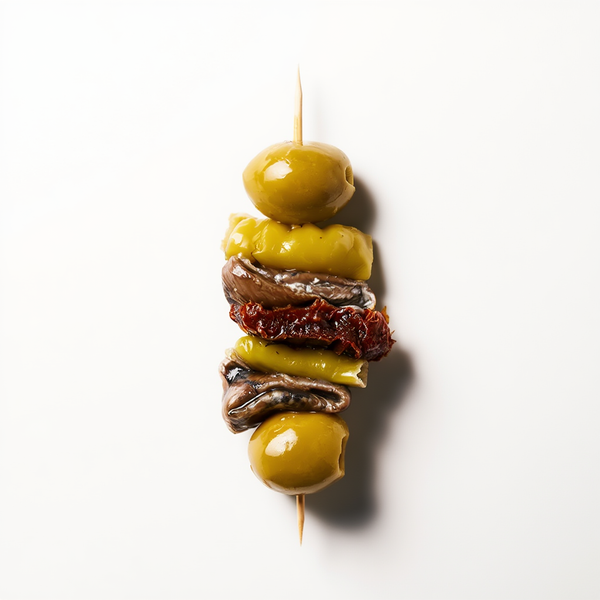
The gilda is a unique bite-sized skewer made of three seemingly simple ingredients: a salt-cured anchovy in oil, a pickled chilli pepper, and an olive. Three elements threaded onto a wooden toothpick that, when combined, create an explosion of flavour that many consider the perfect synthesis of Spanish appetizer cuisine: salty, acidic, slightly spicy, and fatty in perfectly balanced proportions.
There is no pintxo more replicated or debated in Spain. It appears in bars across the country with its own interpretations, local variations, and signature versions by Michelin-starred chefs. But at its core, the gilda remains exactly what it was in 1946: three ingredients, a toothpick, zero complications.
Its popularity is no accident. The gilda brings together several virtues that make it irresistible for appetizer culture: it's eaten in one or two bites, it's mess-free, it holds up well on the bar for hours without losing quality, it can be prepared in advance, and its production cost is low if quality ingredients are used. It is, in gastronomic terms, a perfect design.
At Mercat del Ninot in Barcelona, where we have been working with premium seafood since 1990, gildas are one of the most requested appetizers. Not because we are Basque, but because when the ingredients are good, the result is extraordinary. And that is precisely the argument of this guide: to understand what makes a gilda a true gilda.
Want artisanal gildas at home?
Our gildas are handmade with premium Cantabrian anchovy, Ibarra chilli pepper, and olive. No artificial preservatives. Ready to serve.
View artisanal gildasHistory of the gilda: from San Sebastian to the world
The history of the gilda begins in 1946, at the Casa Vallés bar in San Sebastian, on General Artetxe street. The owner, Blas Vallés, used to place containers with salted anchovies, pickled chilli peppers, and olives on the bar as an appetizer to accompany wine. One day, a customer had the idea of skewering the three ingredients together on a toothpick. It was liked. It was repeated. And it stayed.
The name came shortly after, and here the story gets more interesting. In 1946, the film "Gilda," starring Rita Hayworth, premiered in Spain. The film was a huge scandal for Spain at the time: the character of Gilda was provocative, sensual, "spicy" and "salty," as they said back then. Someone, at some point at the Vallés bar, made the perfect connection: the pintxo was, like Rita Hayworth, "salty, spicy, and a little green." The name immediately caught on and was never changed.
The gilda left San Sebastian with the same speed as good gastronomic ideas travel: through people who tried it and wanted to repeat it. During the 50s and 60s, it spread throughout the Basque Country and Navarre, and by the 70s and 80s, it was a well-known appetizer throughout Spain. The explosion of tourism and the international popularity of Basque cuisine during the 90s and 2000s propelled it to the world.
Today, the gilda appears on the tasting menus of Michelin-starred restaurants, on the tapas bar menus in New York and London, in gourmet shops in Tokyo, and on the counters of traditional markets like Mercat del Ninot in Barcelona. The journey of a toothpick with three ingredients in 80 years of history.
What has not changed is the essence. Basque purists are very clear: a gilda without Cantabrian anchovy is not a gilda. And they are right, as we will see below.
Original Basque gilda recipe step-by-step
The original gilda recipe doesn't allow for major variations in its three basic ingredients. What it does allow for is careful selection of each and precision in assembly. Here is the canonical recipe.
Ingredients for 12 gildas (4 people as an appetizer):
- 12 Cantabrian anchovy fillets in olive oil (large anchovies, 8-10 cm)
- 12 pickled chilli peppers (Ibarra chilli peppers, if possible)
- 12 pitted green olives (Gordal or Manzanilla, firm and fleshy)
- Extra virgin olive oil for finishing
- 12 long wooden toothpicks (minimum 8 cm)
Step 1: Prepare the anchovies. Carefully remove the anchovies from their packaging to avoid breaking them. If they come in direct brine (not in oil), rinse them briefly under cold water and pat them dry with paper towels. Quality olive oil anchovies do not need any prior treatment.
Step 2: Prepare the chilli peppers. Drain the chilli peppers from the vinegar. If you prefer a milder gilda, you can remove the seeds from inside with the tip of a knife, although purists do not recommend it. The vinegar from the chilli peppers is part of the flavour balance.
Step 3: Prepare the olives. Use pitted medium to large olives. Drain them well from the preserving liquid. Gordal olives are the classic choice for their fleshy texture.
Step 4: Assembly — order matters. This is the step that generates the most debate among enthusiasts. The canonical order is:
- First, thread the olive, leaving it at the lower end of the toothpick (it will be at the bottom when eaten)
- Next, tightly roll the anchovy into a spiral and thread it onto the centre of the toothpick
- Finally, place the chilli pepper, folded or rolled, at the upper end (it will be at the front)
Some assemblies reverse the order (chilli-anchovy-olive) or place the anchovy on the outside wrapping everything. There is no single truth, but the classic order makes it easier for the chilli pepper to be the first thing to touch the palate, preparing it for the anchovy.
Step 5: Finish. Once assembled, place the gildas on a tray and finish with a very thin drizzle of extra virgin olive oil. Not too much: the anchovy already provides fat. The ideal serving temperature is between 15 and 18 degrees Celsius. Never cold from the fridge.
Total preparation time: 10-15 minutes for 12 gildas. No cooking. No fuss.
The 3 key ingredients and how to choose them
The final result of a gilda depends 100% on the quality of its three ingredients. No technique can compensate for a mediocre anchovy or a chilli pepper without personality. Here are the criteria for choosing each one well.
Cantabrian anchovy: the soul of the gilda
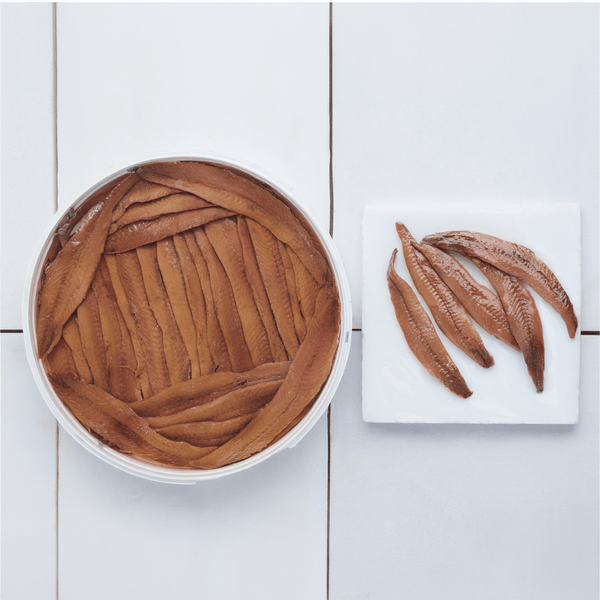
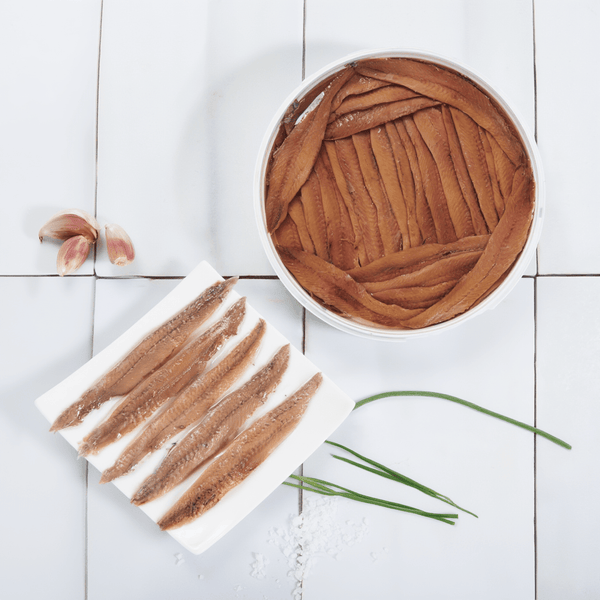
The anchovy is the star ingredient. Without a good anchovy, the gilda does not exist. Cantabrian anchovy (Engraulis encrasicolus) is caught between April and June, when the fish has the highest fat content and its flesh is firmest. The best come from ports such as Santoña, Getaria, Ondarroa, and Laredo.
The curing process is crucial: fresh anchovy is salted and pressed for a minimum of 8-12 months (the best producers cure for up to 18 months). During this process, the fish's own enzymes break down proteins and develop the characteristic umami flavour. Then, they are hand-cleaned, the central bone is removed, and they are preserved in olive oil.
For a gilda, look for large anchovies (category "0" or "00"), with whole fillets without breaks, an intense golden brown colour (not greyish), and a firm texture that bends without breaking. Consult our selection of Cantabrian anchovies to see the references we use in our own gildas.
A premium quality anchovy can cost between 2 and 5 euros per 50-gram jar (8-12 fillets). It is the most expensive ingredient in the gilda, but also the one that makes the most difference. Using Cantabrian anchovy fillets of premium quality is the most important decision you will make when preparing this pintxo.
Ibarra chilli pepper: the character of the gilda
The quintessential Basque chilli pepper is from Ibarra, a town in Navarre that gives its name to this variety. These are elongated chilli peppers, 7-10 cm long, pale green, with a crunchy texture and a moderate spiciness that intensifies at the ends and in the seeds. They are preserved in white wine vinegar, which gives them their characteristic acidity.
An authentic Ibarra chilli pepper has a designation of origin and is distinguished from other pickled chilli peppers by its thinner skin, more complex flavour, and elegant (not aggressive) spiciness. If you can't find Ibarra ones, look for good quality seasonal pickled chilli peppers. Avoid soft, bodyless industrial chilli peppers: they ruin the gilda's texture.
The olive: the balance of the gilda
The olive acts as a fatty and neutral counterpoint that balances the saltiness of the anchovy and the acidity of the chilli pepper. The classic choice is the Manzanilla or Gordal olive, both pitted and medium-large in size. They should be firm, fleshy, and mild in flavour, never bitter or excessively salty.
Anchovy- or pepper-stuffed olives also work well in some variations, but in the original gilda, the olive should be neutral so as not to compete with the other two ingredients. Size matters: a very small olive gets lost in the overall taste; one that is too large unbalances the skewer.
Classic Gilda with Cantabrian Anchovy
Premium Cantabrian anchovy, olive, and chilli pepper. Handmade in Barcelona. No additives. The perfect appetizer.
View gilda with anchovy10 gilda variations you have to try
The original gilda is untouchable, but its structure — a skewer with ingredients combining salt, acid, and fat — invites experimentation. Here are the 10 most interesting variations, from those most respectful of the original to signature creations.
1. Gilda with pickled anchovy (boquerón en vinagre)
Replace the salted anchovy with a pickled anchovy (white marinated anchovy). The result is milder, more acidic, and more delicate. Ideal for those who don't tolerate the intense flavour of cured anchovy well. At Bacalalo, we prepare this variant with boquerón gilda with olive and chilli pepper, also adding a roasted piquillo pepper for sweetness and colour. It's one of the best-sellers at Mercat del Ninot in Barcelona.
2. Gilda with cheese
One of the most popular variations in recent years: a cube of cured cheese (semi-cured Manchego, Idiazábal, or goat cheese) is added to the ensemble. The cheese adds a layer of dairy fat and a richer flavour that perfectly complements the anchovy. Our gilda with cheese, olive, and chilli pepper also includes a piece of sun-dried tomato which adds extra umami. If you want to prepare this version at home, check out our gildas with cheese recipe.
3. Gilda with sun-dried tomato
Sun-dried tomato in oil provides a concentrated sweet-sour flavour that works very well with anchovy. It is threaded between the olive and the anchovy. This variation is especially popular in Catalonia and in bars in central Barcelona.
4. Gilda with smoked salmon
Cold-smoked salmon replaces or accompanies the anchovy. It provides a milder flavour and a different texture. For it to work, the salmon must be good quality and relatively thick-cut (not thin supermarket slices). It is folded accordion-style before skewering.
5. Gilda with quail egg
A boiled quail egg (4 minutes from boiling water), peeled and threaded whole, turns the gilda into a more substantial appetizer. The egg acts as a neutral element that softens the ensemble and adds protein. Popular in modern bar versions.
6. Gilda with mojama
Mojama (salted tuna) is the "ham of the sea" from Murcia. A small piece of mojama instead of anchovy creates a more intense gilda with a drier texture. The contrast with the moist chilli pepper and fatty olive is surprising. Only suitable for lovers of strong flavours.
7. Gilda with Basque piparra
Piparra is the cousin of the Ibarra chilli pepper, but with a slightly different level of spiciness and a thicker skin. Using piparra instead of Ibarra chilli changes the acidity profile of the gilda and makes it somewhat more robust. Technically, it would no longer be an "Ibarra" gilda, but the result is excellent.
8. Vegetarian gilda with caper
Replacing the anchovy with a large caper (or caper berry) creates a fish-free gilda that maintains the original's acidic-salty profile. To enhance the umami without anchovy, a piece of Kalamata black olive can be added. Useful for tables with vegetarian diners.
9. Sweet and spicy gilda with red chilli pepper
Mixing a green Ibarra chilli pepper with a piece of milder pickled red chilli creates a visually appealing gilda with two distinct layers of spiciness. It works well for party presentations where visual impact is important.
10. Haute cuisine gilda: anchovy with txakoli gel and olive sphere
This is the version Basque chefs make when they want to deconstruct the pintxo without betraying it. The olive sphere is made using basic spherification technique (sodium alginate + calcium chloride), the txakoli gel provides the acidity and aroma of the wine, and the anchovy remains at the centre as an intact element. Complex to execute but impressive in results. For those curious about creative cuisine.
For more ideas and detailed recipes, visit our guide to the best gilda recipes, where you'll find step-by-step instructions for the most popular variations.
Gildas for parties: quantities, advance preparation, and presentation
Gildas are one of the most rewarding appetizers to prepare for a crowd. They don't require cooking, hold up well, are quick to assemble, and look good in any presentation. But there are some factors to consider before preparing 100 units for a celebration.
Quantities per person
As a sole appetizer before a meal: 3-4 gildas per person. As part of an appetizer platter with other items (patatas bravas, ham, cheese): 2 gildas per person. As a pintxo at a standing party with other options: 2-3 gildas per person. If gildas are the focus of the appetizer and there are no other dishes: 5-6 per person.
For an event of 20 people with a mixed appetizer platter: prepare 50-60 gildas. For 50 people at a cocktail party: between 120 and 150 units.
Advance preparation
Gildas can be assembled up to 24 hours in advance. Once assembled, place them on a deep tray, cover them with cling film, and store them in the fridge. Take them out 30 minutes before serving to allow them to reach room temperature (between 15 and 18 degrees Celsius). Cold anchovies lose texture, and the oil partially solidifies.
If you prepare them on the same day, you can assemble everything except the final drizzle of olive oil: add it at the last moment. Drained chilli peppers hold up well without softening the olives if you keep them separate until assembly.
Presentation
The classic presentation is on a slate tray, dark wooden board, or white plate. The visual contrast between the green of the chilli pepper and olive, the golden brown of the anchovy, and the shine of the oil already does the job. You don't need additional decoration.
For large events, a very practical option is to stick them into a cork bar or a floral foam block covered with aluminum foil or cling film: they are presented vertically, easy to pick up, and the visual arrangement is impactful.
At Mercat del Ninot in Barcelona, we always serve them with the toothpick facing upwards and the chilli pepper visible at the top. It is the most elegant way and allows the diner to see exactly what they have in their hand before eating it.
Perfect pairing: what to drink with gildas
The pairing of the gilda is one of the richest debates in Spanish appetizer culture. The combination of intense saltiness, the acidity of the chilli pepper, and the fattiness of the anchovy calls for drinks that cleanse the palate without competing with the flavours.
Txakoli: the canonical pairing
There is no combination more Basque or more perfect. Txakoli (Txakolina in Euskera) is a slightly sparkling white wine, with high acidity, low in alcohol (9-11%), and notes of lemon, green apple, and fresh grass. It is poured from a height to oxygenate it and enhance the bubbles. The acidity of txakoli neutralizes the fattiness of the anchovy, its bubbles cleanse the palate, and its low alcohol content makes it the perfect companion for a long pintxo session. Produced in the Txakoli de Getaria, Txakoli de Bizkaia, and Txakoli de Álava appellations.
Vermouth: the Mediterranean option
Red or white vermouth, especially dry Catalan styles or bitter Italian vermouths, work exceptionally well with gildas. The bitterness of wormwood and herbs in vermouth cuts through the anchovy's fat, and dry vermouth adds complexity without excessive sweetness. In Barcelona, where Sunday vermouth is a cultural institution, gildas are the go-to appetizer in bars serving good vermouth. Serve it with ice and an orange slice.
Blonde beer: the universal option
A light, well-chilled blonde beer (4-5% lager or pilsner) is the most democratic option. The carbon dioxide cleanses the palate, the hop bitterness contrasts with the anchovy's saltiness, and the cold temperature refreshes the chilli pepper's heat. It works well, although it's not the most sophisticated choice. For a more interesting version, try a German wheat beer (weissbier): its notes of banana and clove create a surprisingly harmonious pairing.
Asturian or Basque natural cider
Natural cider (without added gas, with pronounced lactic acidity) is another benchmark pairing in northern Spain. It is served poured from a height, chilled, and its pronounced acidity and notes of fermented apple do a similar job to txakoli: they cleanse the palate and balance the fat. Basque cider (Sagardoa) is particularly interesting for its greater tannic complexity.
Cava Brut Nature
If you're looking for a more elegant option for a celebration, Cava Brut Nature (without residual sugar) is an excellent choice. The fine bubbles, acidity, and toasted notes of Cavas with extended aging create a high-level pairing with anchovies. It's the choice of Michelin-starred restaurants that serve premium versions of gildas on their tasting menus.
What to avoid
Avoid young red wines (tannins clash with the iodine of anchovies), white wines with too much oak (oak competes with salt), and very sweet drinks (the contrast is too abrupt). Sparkling water is the only non-alcoholic option that works well.
Supermarket vs. artisanal gildas: the real difference
Since gildas entered mass distribution, the question is inevitable: is the price difference between supermarket gildas and artisanal ones worth it? The short answer is yes. The long answer requires understanding exactly what is different and why.
For an exhaustive analysis, read our complete comparison in Mercadona vs. artisanal gildas. Here is a summary of the key factors.
The anchovy
This is the biggest difference. Supermarket gildas (including those from Mercadona, Lidl, or Carrefour) use medium-low quality Cantabrian anchovy, with smaller fillets, shorter curing (sometimes as little as 6 months), and preserved in sunflower oil or a blend of oils. The flavour is flatter, less umami, and the texture is softer.
Artisanal gildas use size 0 or 00 anchovies (the largest fillets of the season), cured for 12-18 months, and preserved in extra virgin olive oil. The flavour is notably more complex, the texture firmer, and the aftertaste longer-lasting.
The chilli pepper
Industrial gildas often use generic pickled chilli peppers, with little body and inconsistent spiciness. Artisanal ones use Ibarra PDO chilli peppers, with more personality, better texture, and balanced acidity. The difference in taste is notable: industrial ones soften and lose crunch, while artisanal ones maintain their texture even after days in oil.
The oil
The oil in which the assembled gilda is preserved matters more than it seems. Good quality extra virgin olive oil integrates the flavours, provides creaminess, and prolongs preservation. Sunflower oil merely "wets" the ingredients without adding anything.
The price
A mid-range supermarket gilda costs between 0.30 and 0.60 euros per unit. A premium quality artisanal gilda costs between 0.80 and 1.50 euros. The price difference is real, but so is the difference in experience. For everyday appetizers, a supermarket gilda suffices. For a special occasion, a gathering with friends, or simply to enjoy the best possible appetizer, the artisanal version is unparalleled.
Preservation
Industrial gildas contain preservatives (citric acid, potassium sorbate) that extend their shelf life up to 12-18 months. Artisanal ones without artificial preservatives have a shelf life of 3-6 months in the fridge once opened, but their flavour during that period is notably superior. If you consume them immediately, there's no doubt: artisanal always wins.
Where to buy quality gildas online
If you live in Spain (or anywhere in Europe with refrigerated shipping available), you have several options for getting quality gildas without leaving home. Here are the criteria for choosing well.
What to look for when buying gildas online
First, the origin of the anchovy: it should specify "Cantabrian anchovy" and, if possible, the fishing area and size. Second, the type of chilli pepper: Ibarra chilli pepper or Basque chilli pepper are indicators of quality. Third, the preserving oil: extra virgin olive oil is the minimum standard. Fourth, the label ingredients: the fewer additives and preservatives, the better.
Be wary of gildas without traceability of the anchovy's origin, preserved in sunflower oil, or with long lists of ingredients and chemical names.
Bacalalo: artisanal gildas from Barcelona
At Bacalalo, we have been working with the best seafood preserve producers in Mercat del Ninot in Barcelona since 1990. Our gildas are handmade with premium Cantabrian anchovy, Ibarra chilli pepper, and selected olives, without artificial preservatives and in extra virgin olive oil.
We offer three varieties in our collection of gildas and appetizers:
- Classic gilda with Cantabrian anchovy: the canonical version with added sun-dried tomato for greater flavour depth
- Gilda with boquerón: a milder version with pickled anchovy and roasted piquillo pepper, perfect for palates less accustomed to the intensity of anchovy
- Gilda with cheese: a variation with cured cheese, olive, chilli pepper, and sun-dried tomato, ideal for tables where more richness is desired
We ship throughout Spain with refrigerated packaging to ensure that the gildas arrive in perfect condition. The usual delivery time from Barcelona is 24-48 hours.
Bacalalo's 3 artisanal gildas
Classic with anchovy, with boquerón, or with cheese. Handmade in Mercat del Ninot, Barcelona. Refrigerated shipping throughout Spain.
View all gildasFrequently asked questions about gildas
Below we answer the most common questions about gildas, both for those preparing them at home and for those seeking to better understand this pintxo.
How long do homemade gildas last in the fridge?
Assembled gildas keep perfectly for 48-72 hours in the fridge, covered with cling film. If you cover them with olive oil (which acts as a natural preservative) in an airtight container, they can last up to 5-7 days without significant loss of quality. Always take them out 30 minutes before serving to allow them to reach room temperature.
Can gildas be frozen?
It is not recommended. Freezing irreparably alters the texture of the chilli pepper (which softens), the olive, and the anchovy. Gildas are a product intended for fresh consumption or preservation, not for freezing.
What is the difference between Ibarra chilli pepper and piparra?
Both are varieties of Basque pickled chilli pepper, but they have subtle differences. The Ibarra chilli pepper is longer and thinner, with more delicate skin and a milder, more progressive spiciness. The piparra is somewhat shorter and thicker, with more resistant skin and a slightly more immediate spiciness. Both work well in a gilda, although the Ibarra is the more traditional.
Are gildas spicy?
Moderately. Ibarra chilli pepper has a spiciness level of 1-2 on the Scoville scale: it's noticeable, but not aggressive. The spiciness is concentrated in the seeds and the upper part of the chilli pepper. If you remove the seeds before assembly, the spiciness is considerably reduced. Versions with red chilli pepper can be somewhat more intense.
Are gildas gluten-free?
In their original version (anchovy, chilli pepper, olive, oil), gildas are naturally gluten-free. You should check the labels of each ingredient to confirm that there are no traces due to cross-contamination, especially in industrial pickled chilli peppers.
How many calories does a gilda have?
A standard-sized gilda (1 anchovy, 1 chilli pepper, 1 olive) has approximately 25-40 kilocalories, depending mainly on the size of the anchovy and the amount of preserving oil. It is one of the lightest appetizers available compared to croquettes, potatoes, or cured meats.
What is the difference between anchovy and boquerón?
Boquerón and anchovy are the same fish (Engraulis encrasicolus), but cured differently. Boquerón is marinated in vinegar or lemon (acid), which "cooks" the fish cold and gives it a white colour. Anchovy is cured in salt for months, developing the enzymatic process that gives it its golden brown colour and intense umami flavour. For a gilda, anchovy provides more flavour depth; boquerón, more freshness and acidity.
Why is it called "gilda"?
The name refers to the character played by Rita Hayworth in the film "Gilda" (1946), directed by Charles Vidor. The film arrived in Spain that same year and was a cultural phenomenon. The pintxo was named because, like the character, it was "salty, spicy, and a little green" — the three characteristics of Hayworth's character in the film according to popular culture at the time.
Can a gilda be made without anchovy?
Technically yes, but it ceases to be a gilda in the strict sense of the term. There are vegetarian versions with caper berries or black olives replacing the anchovy. These are interesting appetizers, but the flavour profile is notably different. The anchovy is the ingredient that defines the identity of the pintxo.
What is the exact origin of the gilda?
Authorship is largely attributed to Blas Vallés, owner of the Casa Vallés bar in San Sebastian, around 1946. However, as is often the case with popular dishes, it is likely that similar variations existed earlier in other Basque bars. Casa Vallés bar is still open today and can be visited on General Artetxe street, 9, in San Sebastian.
What are the best gildas to buy online without making the recipe at home?
To buy pre-assembled and ready-to-serve gildas, look for artisanal producers who specify the origin of the anchovy (Cantabrian, size 0 or 00), the type of chilli pepper (Ibarra), and the preserving oil (extra virgin olive oil). At Bacalalo, we offer three handmade varieties from Mercat del Ninot in Barcelona, with refrigerated shipping throughout Spain. You can see all options in our collection of artisanal gildas and appetizers.