

Quick Summary: An authentic Cantabrian anchovy must meet 7 verifiable requirements: species Engraulis encrasicolus, origin Cantabrian Sea (FAO 27), minimum curing 6 months (10-14 ideal), size marked on the can, uniform pinkish-brown color, virgin olive oil, and minimum price of €1.20/fillet. If any of these fail, it's likely an Argentine anchovy (Engraulis anchoita) or Japanese anchovy (Engraulis japonicus) deceptively labeled.
The Cantabrian anchovy market is rife with fakes. Some are deceptive by omission — they don't lie directly but hide that their fish comes from the Pacific or South Atlantic. Others are outright fraudulent, falsifying origin to sell a low-quality industrial product at a premium price.
This guide teaches you, step-by-step, how to distinguish an authentic Cantabrian anchovy from a fake with objective tests that any consumer can apply before buying or when opening the can.

Why there are so many fake anchovies on the market
Three reasons explain the abundance of fakes:
- Price difference: Cantabrian anchovy (Engraulis encrasicolus) costs the producer 2-3 times more than Argentine anchovy (Engraulis anchoita) or Japanese anchovy (Engraulis japonicus). Saving on raw material costs while maintaining the selling price is very tempting.
- Permissive labeling: European regulations allow "anchovy" to be used for several species. Only if "del Cantábrico" (from the Cantabrian) or "Mar Cantábrico" (Cantabrian Sea) is added, it must be Engraulis encrasicolus from FAO 27. Some brands play with the name.
- High demand: Cantabrian anchovy is a prestigious product. Global demand exceeds sustainable catches. This creates a parallel market for disguised substitutes.
The good news: with basic knowledge, it's relatively easy to detect fakes. Here's the methodology.
Species: the #1 test
The "world's anchovies" are not all the same. There are three main species that can appear as "anchovy":
| Species | Common Name | FAO Area | Quality |
|---|---|---|---|
| Engraulis encrasicolus | Cantabrian Anchovy | 27 (NE Atlantic) | Premium |
| Engraulis anchoita | Argentine Anchovy | 41 (SW Atlantic) | Medium-low |
| Engraulis japonicus | Japanese Anchovy | 71 (W Pacific) | Low |
| Engraulis ringens | Peruvian Anchovy | 87 (SE Pacific) | Low (industrial) |
The true Cantabrian anchovy is Engraulis encrasicolus caught in FAO 27. Any other species or fishing zone is not Cantabrian, no matter what the label suggests.
By law, in the EU, labels must include the FAO zone. If it says "FAO Zone 41" → Argentine anchovy. If it says "FAO Zone 71" → Japanese anchovy. If no zone is indicated or it only says "anchovy," that's a red flag.
The 7-objective-test method
Apply these seven tests before and after purchasing:
Test 1: species and origin
Look at the label. It must literally say: "Engraulis encrasicolus" + "Mar Cantábrico" or "FAO Zone 27". If it only says "anchovy" without further details, be suspicious.
Test 2: curing months
Authentic anchovies are salt-cured for a minimum of 6 months. Premium ones cure for 10-14 months. Industrial fakes are accelerated with enzymes or high-concentration salt in 2-4 months. If the manufacturer's website or label doesn't mention curing, that's a bad sign.
Test 3: size marked
An authentic anchovy indicates its size: 00, 0, 1, 2. This is because size determines quality. Fake products often don't mark the size, or just use "fillet" without further detail, because they come from industrial mixtures.
Test 4: minimum price
The minimum production cost of an authentic Cantabrian anchovy is €1.00/fillet. If you are offered "Cantabrian anchovies" at €0.40-€0.70/fillet (a 100g can for less than €6-€8), they are not from the Cantabrian Sea. It is mathematically impossible.
Test 5: oil
It must say "virgin olive oil" or "EVOO". If it only says "oil" or "vegetable oil" or "sunflower," the quality is lower. This doesn't disqualify Cantabrian origin, but it does impact premium quality.
Test 6: fillet color and aroma
Upon opening: uniform pinkish-brown, natural sheen, marine aroma. If it's dark irregular brown, it's oxidized or over-smoked. If it smells sour or metallic, poor preservation.
Test 7: texture
When bitten: it yields immediately, without chewiness or hardness. Industrial anchovies are fibrous; authentic ones melt in the mouth after 5-10 seconds. The buttery texture of premium ones (Codesa, Don Bocarte) is unmistakable.
How to read the label like an expert
The label is your best ally. These are the 5 non-negotiable elements:
- Commercial name: "Anchovy" + "Cantabrian" or "Santoña". Without these terms, it's not Cantabrian.
- Scientific name: Engraulis encrasicolus. Mandatory by EC regulation 1379/2013 since 2014.
- FAO Zone: 27 for Northeast Atlantic. Other zones (41, 71, 87) = not Cantabrian.
- Country of processing: Spain (typically Santoña, Laredo, Castro Urdiales, Bermeo). If it says "processed in Morocco" or "Italy," it might be fake.
- Type of oil: EVOO, extra virgin olive oil, virgin olive oil. Anything else is lower quality.
If all five are clearly identified, there's a 90% probability of authenticity. If any are missing, it's doubtful. If two or more are missing, it's almost certainly fake.
Leonardo Exclusive Anchovy 160g — Bacalalo
Engraulis encrasicolus, FAO 27, EVOO, processed in Santoña. 100% verifiable label.
View LeonardoVisual clues on the fillet
If you've already bought and opened the jar/can, look at these details:
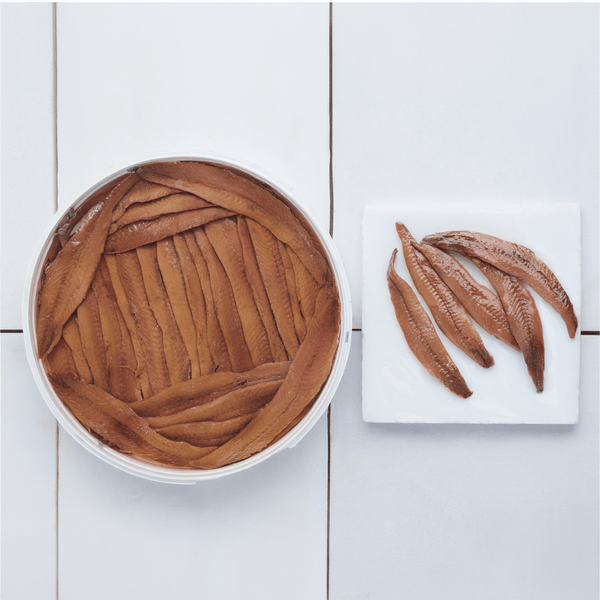
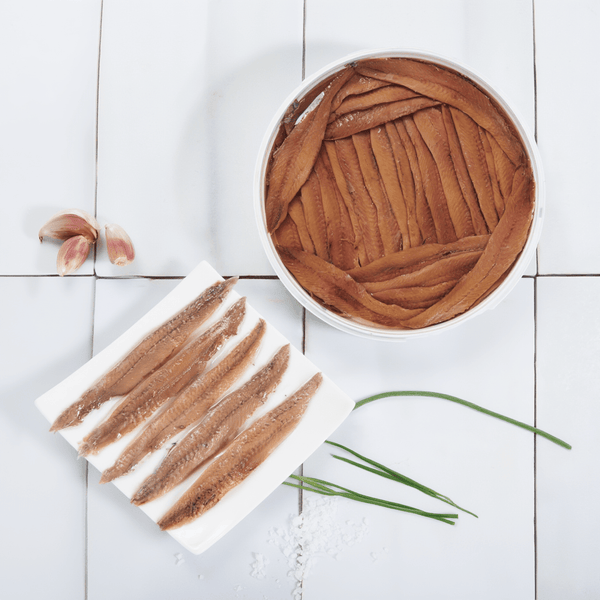
Uniform pinkish-brown color
Authentic ones have a homogeneous, slightly glossy color. Fakes tend to have darker spots, a varnished sheen, or a pale appearance.
Clean central bone
Authentic anchovy has a fine central bone carefully removed. If small scattered bones remain, it indicates aggressive industrial deboning.
Intact fillet
It should be whole, without breaks. Broken fillets are a sign of low quality or insufficient size (calibers 3-4).
Clean oil
The oil should be clear, slightly golden-yellow. Cloudy or very dark oil = poor preservation.
Taste and texture tests
The ultimate test: bite. This is what your palate should perceive:
- First impact: balanced salinity, not aggressive. If it stings the tongue, too salty.
- Texture: yields to the tooth smoothly. Buttery texture in premium ones. If it's fibrous or chewy, fake.
- Flavor: marine, umami, slightly sweet at the end. If it's bitter or metallic, oxidation.
- Aftertaste: persists for 30-60 seconds with sea notes. If it disappears immediately, low quality.
Authentic vs. fake table
| Aspect | Authentic Cantabrian | Fake |
|---|---|---|
| Species | E. encrasicolus | E. anchoita / japonicus / ringens |
| FAO Zone | 27 | 41 / 71 / 87 or not indicated |
| Curing | 6-14 months | 2-4 months (with enzymes) |
| Size marked | Yes (00, 0, 1, 2) | Usually not indicated |
| Price/fillet | €1.20-€2.50 | €0.30-€0.80 |
| Oil | EVOO or virgin | Sunflower / vegetable |
| Color | Uniform pinkish-brown | Irregular brown or pale |
| Texture | Buttery, melts in mouth | Fibrous, chewy |
| Processed in | Santoña / Laredo / Bermeo | Morocco / Italy / not indicated |
Real case: 3 cans analyzed
We bought three cans that were presented as "Cantabrian anchovies" at three different prices in Barcelona supermarkets. Analysis:
Can A: €14.90 / 100g (€1.49/fillet) — Authentic
Label: Engraulis encrasicolus, FAO Zone 27, processed in Santoña, 8 months curing, size 0, EVOO. Verdict: authentic. Buttery flavor, texture yields to the tooth.
Can B: €6.50 / 100g (€0.65/fillet) — Fake
Label: "Anchovies in olive oil." No scientific species. Processed in Italy. No FAO zone. Not virgin olive oil. Verdict: fake. Producer investigation: uses Argentine anchovy (FAO 41). Fibrous texture.
Can C: €3.90 / 100g (€0.39/fillet) — Industrial fake
Label: "Anchovy fillets." Nothing more. Processed in Morocco. No species or FAO. Sunflower oil. Verdict: industrial fake. Most likely Japanese anchovy. Metallic taste, chewy texture.
Conclusion of the real test: if you pay less than €9 per 100g for "Cantabrian anchovy," it's probably fake. The fair price doesn't deceive.
Conclusion
Distinguishing an authentic Cantabrian anchovy from a fake is easy with basic knowledge. Memorize these points:
- Species: Engraulis encrasicolus (mandatory on label)
- FAO Zone: 27 (NE Atlantic)
- Processed in Spain (Santoña/Laredo/Bermeo)
- Minimum price: €1.20/fillet
- Oil: virgin olive oil (EVOO ideal)
- Size marked (00, 0, 1)
- Uniform pinkish-brown color
If you buy from Bacalalo, we guarantee that every anchovy in our Cantabrian anchovy collection meets all seven points. And if you want to broaden your criteria, also read our 2026 blind test ranking and the smoked, cured, and pickled products cluster.
About the author
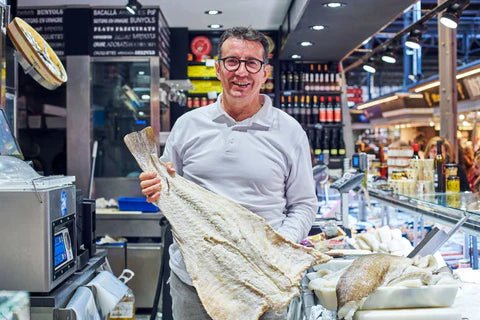
Lalo González Rodríguez is responsible for product selection at Bacalalo. Third generation in Mercat del Ninot since 1990, he has been selecting Cantabrian anchovies directly with producers from Santoña, Laredo, and Castro Urdiales for over 30 years.
Frequently asked questions
Is it legal to sell "anchovy" when it's not from the Cantabrian Sea?
Yes, it is legal to sell Engraulis anchoita or japonicus as "anchovy" as long as the label indicates the scientific species and FAO zone. It is not legal to sell a fish that is not Engraulis encrasicolus from FAO 27 as "Cantabrian anchovy." That is food fraud.
Are supermarket anchovies authentic?
It depends. Well-labeled supermarket brands (Casa Santoña, Catalina, Codesa, Don Bocarte) in premium supermarkets are usually authentic. Low-priced private label brands (€0.50-€0.80/fillet) are almost always Argentine anchovy or Japanese anchovy.
How to know if a "Casa Santoña" anchovy is authentic?
The Casa Santoña brand in its official products is authentic (Engraulis encrasicolus FAO 27). Verify that the label has the scientific species and FAO zone. If you buy from marketplaces with massive discounts (-50%), check that it is not an expired or fake product with falsified packaging.
Why is Cantabrian anchovy more expensive?
Three reasons: (1) catching is regulated with a limited annual quota, (2) curing lasts 6-14 months in salt with storage costs, (3) desalting and deboning is done by hand in Santoña/Laredo. Producing a can of Cantabrian anchovy costs 3-4 times more than an industrial Argentine anchovy.
What should I do if I have bought anchovies that I suspect are fake?
If the product was labeled as "from the Bay of Biscay" and it is not, you can report it to the AESAN (Spanish Agency for Food Safety) or to consumidor.es. You can also request a refund from the distributor with the label as proof. If it only said "anchovy" without "from the Bay of Biscay", legally it can be any species labeled.
Is Argentine or Japanese anchovy worse than Cantabrian anchovy?
"Worse" depends on the use. For pizza or sauce, Argentine anchovies work well and cost less. For eating as an appetizer, canapé or pintxos where quality is noticeable, Cantabrian anchovy is clearly superior due to curing, texture and flavor. The gastronomic difference is remarkable.
Are Leonardo anchovies from Bacalalo real Cantabrian anchovies?
Yes. Leonardo is a Cantabrian brand with Engraulis encrasicolus caught in FAO 27, processed in Santoña with 8-10 months curing in salt and virgin olive oil. The label meets the seven points of the authenticity test.