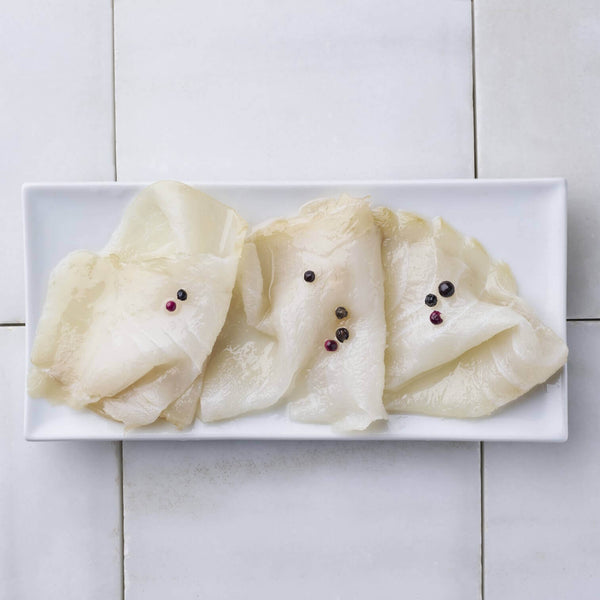
Cod cheeks are one of the most prized parts of a fish: a small, gelatinous muscle located under the lower jaw of cod and hake. With a unique texture unmatched by any other cut, cod cheeks are the base of iconic dishes like pil pil and salsa verde. I'll tell you exactly what they are, what types exist, how much they cost, and how to cook them to get the most out of them.
Contents
- What cod cheeks are exactly
- Anatomy of the cod cheek: why it's so special
- Types of cod cheeks: hake vs. cod
- Cod cheek prices in 2026
- How to choose quality cod cheeks
- The 4 essential cod cheek recipes
- Cod cheeks "al pil pil": step by step
- Cod cheeks in "salsa verde": the Basque recipe
- Breaded and grilled cod cheeks
- Where to buy cod cheeks
- How to store cod cheeks
- Frequently asked questions
- Conclusions
What cod cheeks are exactly
Updated March 2026. What we tell you here comes from serving thousands of customers in Barcelona.
Cod cheeks (also spelled "kokotxas" in Basque) are a small, triangular muscle located on the underside of the fish's head, just below the jaw. They are mainly extracted from cod and hake, although technically any fish has them.
What makes cod cheeks special is their composition: they are made up of muscle fibers intertwined with an exceptional amount of collagen and gelatin. This combination gives them a unique texture, halfway between the firm flesh of fish and the unctuousness of a natural gelatin. No other fish cut is comparable.
Each fish has only two cod cheeks, which explains their high price and their consideration as a luxury item. To obtain 500 grams of cod cheeks, the heads of dozens of fish are needed.
Anatomy of the cod cheek: why it's so special
The cod cheek is the fish's hyoid muscle, which controls the movement of the lower jaw and gills. As a constantly moving muscle (the fish uses it to breathe), it develops a dense network of collagen that gives it its characteristic texture.
Composition of the cod cheek
- Muscle fibers: provide structure and "bite."
- Collagen: up to 30% of its weight, it turns into gelatin when cooked. It is the key to pil pil sauce.
- Intramuscular fat: minimal but sufficient to provide flavor and juiciness.
- Water: high water retention thanks to collagen, which keeps them juicy.
When you cook a cod cheek at a low temperature, the collagen transforms into gelatin and creates that unique texture: firm on the outside, almost melting on the inside. It is this gelatin that, when emulsified with olive oil, produces the pil pil sauce.
Types of cod cheeks: hake vs. cod
The two most valued cod cheeks in Spanish gastronomy are those from hake and those from cod. Although they share the same anatomical location, they are quite different products.
| Characteristic | Cod cheeks | Hake cheeks |
|---|---|---|
| Size | Large (5-8 cm), meatier | Medium (3-5 cm), more delicate |
| Texture | Very gelatinous, firm, more rustic | Fine, silky, more delicate |
| Flavor | Intense, saline, deep | Mild, sweet, marine |
| Gelatin | Abundant (ideal for pil pil) | Moderate (better in salsa verde) |
| Average price/kg | 30-50 €/kg (fresh), 20-35 €/kg (frozen) | 45-80 €/kg (fresh), 30-50 €/kg (frozen) |
| Availability | All year (many frozen) | Seasonal (best in winter) |
| Signature dish | Pil pil | Salsa verde |
| Common origin | Norway, Iceland, North Atlantic | Cantabrian Sea, Atlantic, Namibia |
Cod cheeks: the star product
Cod cheeks are larger, more gelatinous, and have a more intense flavor. They are preferred for pil pil because their high collagen content facilitates emulsification. Being from a larger fish, each cheek has more meat and the mouthfeel is more substantial.
Cod cheeks can be bought fresh (in season), desalted (if they come from salted cod), or frozen. Frozen ones are the most accessible option and maintain good quality if ultra-freezing has been done correctly.
Hake cheeks: the luxury of the Cantabrian Sea
Hake cheeks are smaller but have a finer, silkier texture. They are the star of Basque green sauce and their price is usually higher than cod cheeks, especially if they are from Cantabrian hake caught by hook and line.
Cod cheek prices in 2026
Cod cheeks are not a cheap product, and it's important to understand why. Each fish only has two, which naturally limits the supply. These are the usual price ranges:
| Type of cod cheek | Fresh | Frozen | Notes |
|---|---|---|---|
| Cod (import) | 30-45 €/kg | 20-30 €/kg | Available all year |
| Cod (premium desalted) | 40-55 €/kg | -- | From salted cod, more flavor |
| Cantabrian Hake | 55-80 €/kg | 35-50 €/kg | Season: October-March |
| Namibian/South African Hake | -- | 25-35 €/kg | More economical, less flavor |
For context: a generous portion of cod cheeks is about 200-250g per person. This means that a plate of cod cheeks al pil pil for two people can cost between €10 and €25 in raw materials, depending on the type and quality.
How to choose quality cod cheeks
If you buy fresh cod cheeks, these are the quality indicators:
- Color: pearly white with translucent reflections. If they are yellowish or opaque, they are not fresh.
- Texture: firm to the touch but with some elasticity. If they are soft or viscous, discard them.
- Smell: of clean sea, with no trace of ammonia.
- Size: larger ones come from larger fish, generally of better quality.
- Gelatin proportion: look for cod cheeks with a visible translucent and gelatinous central part. More gelatin = better pil pil.
For frozen cod cheeks, ensure the glaze is thin and even, there are no large ice crystals (indicating poor freezing or refreezing), and the packaging is intact.
The 4 essential cod cheek recipes
Cod cheeks allow for few but glorious preparations. These are the four essential ones:
| Recipe | Best cod cheek | Difficulty | Time |
|---|---|---|---|
| Pil pil | Cod (for the gelatin) | Medium-high | 25 min |
| Salsa verde | Hake or cod | Medium | 20 min |
| Breaded | Both | Low | 15 min |
| Grilled | Cod (meatier) | Low | 10 min |
Cod cheeks "al pil pil": step by step
Pil pil is the recipe that best utilizes the gelatin from cod cheeks. The magic lies in the emulsion: the collagen from the cod cheeks combines with olive oil and garlic to create a thickened sauce without adding any other ingredients.
Ingredients for 2 people
- 400 g cod cheeks
- 150 ml mild extra virgin olive oil
- 4 cloves garlic, sliced
- 1 dried chili (optional)
Preparation
- Bring cod cheeks to room temperature: Take them out of the fridge 20 minutes beforehand. If frozen, thaw in the fridge overnight.
- Confit the garlic: In an earthenware casserole dish, heat the oil over very low heat and brown the sliced garlic and chili until golden. Remove and set aside.
- Cook the cod cheeks: With the oil at 60-70 degrees (it should not smoke), place the cod cheeks skin-side up. Cook for 3 minutes.
- Flip and emulsify: Turn the cod cheeks over and start gently rotating the casserole dish in circles. The gelatin they release will begin to bind with the oil.
- Thicken the sauce: Continue rotating the casserole dish in circular motions for 5-7 minutes. The sauce will thicken and whiten. If it separates, add a tablespoon of cold water and continue stirring.
- Serve: Immediately, with the garlic on top. The sauce should have the consistency of a light cream.
The trick is in the temperature: too much heat and the gelatin won't emulsify properly. Very low heat and patience. You can see our complete recipe for cod cheeks al pil pil with video and additional tips.
Cod cheeks in "salsa verde": the Basque recipe
Salsa verde is probably the most popular way to prepare cod cheeks. It is simpler than pil pil and the result is equally spectacular.
Ingredients for 2 people
- 400 g cod cheeks (hake or cod)
- 100 ml extra virgin olive oil
- 3 cloves garlic, finely chopped
- 1 tablespoon flour
- 150 ml fish stock or clam broth
- A good handful of chopped fresh parsley
- Salt
Preparation
- In a saucepan, sauté the chopped garlic in oil over medium heat until it begins to brown.
- Add the flour, stir for 30 seconds to lightly toast it.
- Gradually add the fish stock, stirring to avoid lumps. Simmer for 3 minutes.
- Add the cod cheeks and parsley. Cook for 5-6 minutes over low heat, stirring the saucepan occasionally.
- The sauce should be green, thickened, and shiny. Adjust salt and serve immediately.
Check out our detailed recipe for cod cheeks in green sauce with variations and pairing suggestions.
Breaded and grilled cod cheeks
Breaded cod cheeks
The simplest way to prepare cod cheeks. Lightly salt them, dredge them in flour and beaten egg, and fry them in hot olive oil (180 degrees) for 2 minutes per side. The thin breading protects the gelatinous texture of the interior.
Grilled cod cheeks
For large cod cheeks. Heat a griddle or cast-iron skillet over high heat with a drizzle of oil. Cook the cod cheeks for 2 minutes on each side. The surface should be golden and crispy, the interior juicy. Season with Maldon sea salt flakes and a splash of extra virgin olive oil.
Where to buy cod cheeks
Cod cheeks are not a product you can easily find in any supermarket. These are the options:
- Market fishmongers: the best option for fresh cod cheeks. Order them in advance, especially Cantabrian hake cheeks.
- Specialized online stores: for quality frozen cod cheeks, with the advantage of having them delivered to your home with a cold chain.
- Supermarkets: some have frozen cod cheeks, but the selection is limited and they don't always specify the origin.
- Fish markets and wholesalers: if you have access, the best prices. But they require minimum purchases.
Our recommendation: for cod cheeks, those frozen at the source are excellent if the cold chain is correct. For hake cheeks, try to get them fresh in season (October-March) if you are near the Cantabrian coast. You can read more in our guide on what cod cheeks are.
How to store cod cheeks
- Fresh: consume within 24-48 hours. Store in the coldest part of the refrigerator, covered with plastic wrap.
- Frozen: up to 6 months in the freezer at -18 degrees. Always thaw in the refrigerator (12-24 hours), never at room temperature or in the microwave.
- Once cooked: pil pil and salsa verde will keep for 24 hours in the refrigerator, but the texture changes when reheated. These are dishes to be eaten immediately.
Frequently asked questions
What are cod cheeks exactly?
Cod cheeks are the fish's hyoid muscle, located under the lower jaw. Each fish has only two. They are characterized by their high collagen and gelatin content, which gives them a unique texture: firm on the outside and almost melting on the inside when cooked.
What is the difference between cod cheeks and hake cheeks?
Cod cheeks are larger, more gelatinous, and have a more intense flavor; they are ideal for pil pil. Hake cheeks are smaller, with a finer and silkier texture, and their flavor is more delicate; they are preferred for salsa verde. Hake cheeks are usually more expensive.
Why are cod cheeks so expensive?
Because each fish only has two, which naturally limits the supply. To obtain 1 kg of cod cheeks, the heads of dozens of fish are needed. In addition, demand is high due to their unique texture and their prominence in Basque cuisine.
Can fresh cocochas be frozen?
Yes, but home freezing breaks down more fibers than industrial flash freezing, which can affect the texture. If you freeze them at home, do so in small portions, wrapped tightly in film, and consume them within a maximum of 3 months.
Can frozen cocochas be used for pil pil?
Yes, they work well for pil pil as long as they have been frozen correctly. The key is to defrost them slowly in the refrigerator (never in the microwave) and dry them well before cooking. The gelatin is reasonably well preserved after freezing.
How many cocochas do I need per person?
For a main course, estimate about 200-250 g per person. This is equivalent to 8-12 cod cocochas or 12-18 hake cocochas, depending on the size. As a starter, 120-150 g per person is sufficient.
Where can I buy quality cocochas online?
From specialized seafood stores that guarantee a cold chain during shipping. It is important that they specify the species (cod vs. hake), origin, and preservation method. At Bacalalo, we offer North Atlantic cod cocochas with refrigerated shipping in 24-48 hours.
Cod Cocochas Pil Pil Recipe: The Definitive Version
If you're looking for a cod cocochas recipe that works the first time, this is the version we've been using after decades of cooking them. The difference from other recipes lies in three details that are not usually well explained.
The 3 secrets that change the result
- The oil temperature: between 55 and 65 °C, never higher. If you don't have a thermometer, quickly dip a finger in — it should be hot but tolerable for 1 second. If it smokes, it's too hot and the collagen won't emulsify.
- The wrist movement: it's not a simple circular motion. It's a gentle rocking motion, like cradling a baby. The movement breaks the gelatin micelles and disperses them in the oil. If you shake it forcefully, the sauce won't thicken.
- The clay pot: it retains heat gradually. In a steel pan, the temperature fluctuates too much and the emulsion breaks. If you don't have a clay pot, use a thick non-stick pan over very low heat.
Complete cod cocochas pil pil recipe (Bacalalo version)
Ingredients for 2-3 people:
- 500 g cod cocochas (large, gelatinous)
- 200 ml mild extra virgin olive oil (Arbequina)
- 5 cloves garlic, thinly sliced
- 1-2 dried chili peppers
- Salt (only if the cocochas are not desalted)
Step-by-step:
- Dry the cocochas with absorbent paper. Surface moisture prevents collagen from properly releasing into the oil.
- Confit the garlic over very low heat in the clay pot with all the oil. When golden (5-6 min), remove them along with the chili peppers. Set aside.
- Turn the heat to minimum. Wait 2 minutes for the oil to cool down.
- Place the cocochas skin-side up. Do not touch them for 3 minutes.
- Flip them over carefully. Now begin the rocking motion: move the pot back and forth, gently, constantly.
- Emulsify for 8-10 minutes. You will see the oil change from transparent to whitish. If the sauce breaks (oil and water separate), add 1 tablespoon of cold water and continue rocking.
- Final point: the sauce should have a light cream consistency, ivory color. Return the garlic on top and serve immediately in the same pot.
Total time: 20-25 minutes. Difficulty: medium (requires patience, not skill).
Variation: Cod Cocochas in Traditional Green Sauce
If you prefer a simpler cod cocochas recipe than pil pil, green sauce is the perfect alternative. You don't need to make an emulsion — the sauce is thickened with flour and fish stock, making it more accessible for beginners.
Ingredients:
- 500 g cod cocochas
- 120 ml extra virgin olive oil
- 4 cloves garlic, very finely chopped
- 1.5 tablespoons flour
- 200 ml fish stock (or fish head broth)
- A large handful of fresh chopped parsley
- 100 ml dry white wine
Quick preparation:
- Sauté the garlic in oil until it begins to brown (3 min).
- Add the flour, stir for 1 minute.
- Pour in the white wine and let it evaporate for 1 minute.
- Gradually incorporate the fish stock, stirring to avoid lumps.
- When the sauce thickens slightly, add the cocochas and parsley.
- Cook for 6-7 minutes over low heat, moving the pot occasionally.
- The sauce should be bright green, thickened, and covering the cocochas.
Tip: if you want the sauce even greener and fresher, reserve half of the parsley and add it in the last 30 seconds of cooking.
🛒 Recommended products in this guide
⭐ 4.9/5 · Cold shipping 24-48h · Since 1990 at Mercat del Ninot
Conclusions
Cocochas are one of those items that justify their price. Their unique texture, halfway between the firmness of muscle and the unctuousness of gelatin, has no equivalent in any other fish cut. They are the base of two of the most iconic dishes in Spanish cuisine: pil pil and green sauce.
For pil pil, choose large, gelatinous cod cocochas. For green sauce, hake cocochas are the classic choice, although cod cocochas also work very well. And if you want something quick but equally delicious, breaded or grilled cocochas are a gastronomic experience in 10 minutes.
It's not marketing: it's anatomy, collagen, and technique. Cocochas are a luxury that, well-chosen and well-cooked, are worth every penny.