Summary: Anchovy butter is the appetizer that separates those who understand gastronomy from those who merely follow it. With three ingredients and ten minutes of preparation, it produces a result that surpasses 90% of what is served in tapas bars across Barcelona. In this guide, we explain the complete recipe, exact proportions, variations with herbs and lemon, and how to serve anchovy butter to impress every time. With 35 years of experience in the Mercat del Ninot selecting raw ingredients.
What is anchovy butter and why it works
Updated March 2026. Based on our 30+ years of experience at Mercat del Ninot, this is what we recommend.
Anchovy butter is a compound preparation that combines softened butter with mashed anchovy fillets to create a homogeneous, unctuous paste with a deep umami flavor unlike any other appetizer. It is also known as "beurre d'anchois" in the French tradition, where its use in classical cuisine is as old as bourgeois cuisine itself.
The reason it works has a precise gastronomic explanation: the butter's fat acts as a vehicle for the anchovy's aromatic compounds, distributing them evenly and softening the saltiness without eliminating it. The result is a product with all the flavor depth of Cantabrian anchovy but without the direct impact of biting into a whole one. It's the most gentle way to introduce someone to the world of artisanal anchovies, and at the same time, one of the most elegant appetizers one can serve.
At Mercat del Ninot in Barcelona, we have seen over 35 years how customers who were initially not anchovy fans become regular buyers after trying well-made anchovy butter. The product you use as a base absolutely determines the final result.
Ingredients and proportions: the base recipe
Anchovy butter allows for variations, but there is a base proportion that serves as a starting point for any palate. These quantities yield about 120g of anchovy butter, enough for an appetizer for 6-8 people or for use in cooking for several days.
- 100 g unsalted butter, good quality, at room temperature (softened)
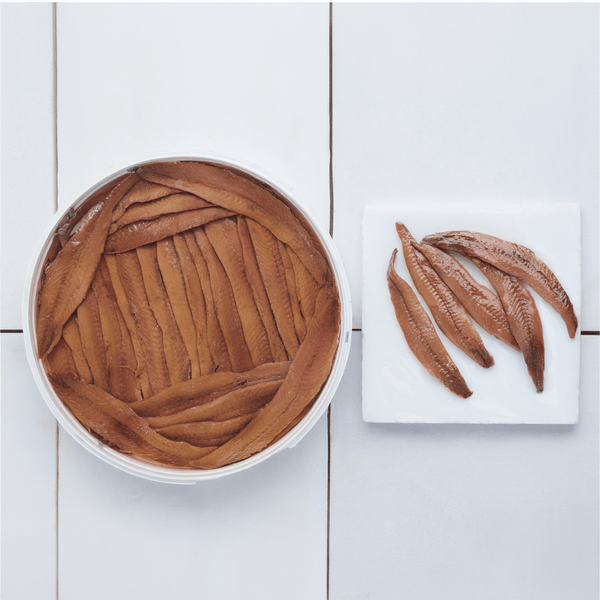
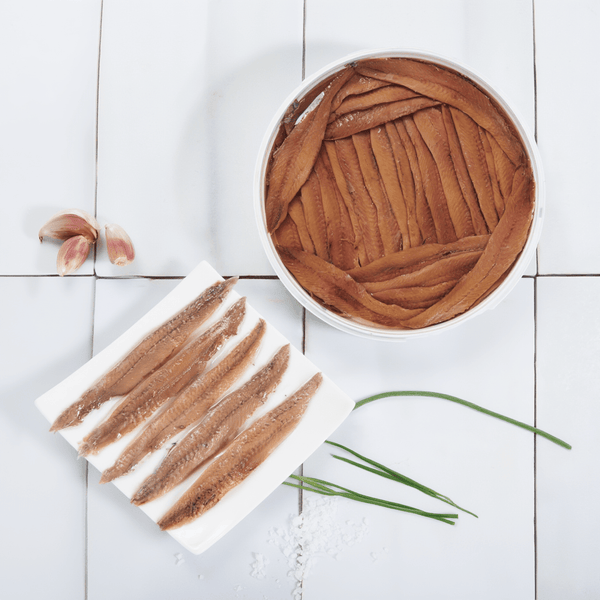
- 4-5 Cantabrian anchovy fillets in olive oil (about 20-25 g)
- A pinch of freshly ground black pepper
- A few drops of lemon juice (optional, but recommended)
The proportion is approximately 4:1 by weight (butter:anchovy). If you want a more potent flavored butter, increase the proportion to 3:1. If you're looking for something more subtle for people unaccustomed to the intense flavor of anchovies, keep it at 5:1.
Regarding butter: quality matters. Good quality butter, with a minimum of 82% fat, produces a silkier softened texture and a cleaner dairy flavor that better serves as a base for the anchovy flavor. Butters with less fat content have more water, and the final texture is less unctuous.
Regarding anchovy: it is the decisive ingredient. With low-quality anchovies — excessively salty, metallic-tasting, rubbery texture — the result will be unpleasantly flavored butter that no one will want to repeat. With artisanal Cantabrian anchovies cured for at least 10 months, the result is a butter with complex flavor layers that reveal themselves in the mouth.
Cantabrian Anchovies for gourmet butter — Bacalalo Selection
To obtain a top-tier anchovy butter, you need fillets with a minimum artisanal curing of 10-12 months. Our "00" Premium anchovies (€24.90) and the Gourmet Selection (€38.90) are the base that makes all the difference. From Mercat del Ninot in Barcelona.
Step-by-step recipe
The process is simple but has a technical detail that makes the difference between homogeneous butter and one with unintegrated anchovy pieces.
Step 1: Butter temperature. The butter must be truly softened — not melted, not cold. Softened means that when pressed with a finger, it yields without resistance but maintains its shape. If the butter is too cold, the anchovy fillets won't integrate well and will leave chunks. If it's melted, the final texture when cooled will be grainy. Ideally, take it out of the fridge 45-60 minutes before working with it.
Step 2: Drain the anchovies. Remove the fillets from the can or jar and drain them lightly on absorbent paper. Do not rinse, do not remove all the oil — a small amount of oil from the can helps with integration. Simply remove the excess so the butter doesn't become too liquid.
Step 3: Mash the anchovies. Finely chop the fillets with a knife until a nearly homogeneous paste is obtained. Alternatively, use the back of a fork to mash them on a cutting board. The goal is a paste with little texture, not whole fillets. For an absolutely smooth texture, use a small mortar and pestle or a food processor.
Step 4: Incorporate with the butter. Place the softened butter in a bowl. Add the anchovy paste. With a spatula or fork, work the mixture with circular motions and pressing against the sides of the bowl until the anchovy paste is completely integrated and the butter has a uniformly beige-pink color. Add pepper and lemon drops at this stage.
Step 5: Shape and refrigerate. Pour the butter onto cling film and roll it into a cylinder shape. Refrigerate for at least 30 minutes before use. This facilitates slicing and improves the final presentation.
Variations: with lemon, with herbs, with garlic
The base recipe allows for several developments that adapt the result to different serving contexts and flavor combinations.
Anchovy butter with lemon and capers
Add a teaspoon of lemon zest and a teaspoon of chopped capers to the base recipe. Lemon adds freshness that balances the richness of the butter; capers add an acidic note and a texture that breaks the creamy uniformity. Ideal for serving with grilled fish or roasted vegetables.
Anchovy butter with garlic and parsley
Half a teaspoon of finely minced garlic and a tablespoon of fresh chopped parsley transform anchovy butter into something closer to a maître d'hôtel butter with a Mediterranean identity. It works exceptionally well melted over a veal chop or a sea bass fillet. The garlic should be very finely minced — almost to a paste — so there is no grainy texture.
Anchovy butter with smoked paprika
A teaspoon of smoked paprika from La Vera adds an earthy and slightly spicy dimension that pairs well with the marine notes of the anchovy. This version works especially well over roasted potatoes or as an accompaniment to grilled chicken.
Anchovy butter with black olives
Add 4-5 pitted and mashed Kalamata olives to the base mixture. The combination with the olive paste produces a flavor profile similar to Provençal tapenade but with more body and complexity. Ideal for serving with rye bread or crackers.
How to serve anchovy butter
The presentation matters as much as the recipe itself. Anchovy butter allows for several serving forms that produce distinct experiences.
Sliced from the cylinder: The classic presentation. Take out the refrigerated cylinder and cut 1 cm slices. Serve two or three slices on a plate with toasted bread on the side. The visual contrast between the pale yellow of the butter and the golden bread is part of the appeal.
Spread directly on a board: For a more informal and generous service, place the butter in a small ceramic bowl and serve with a spreader on the side. Toasted bread, crudités, or rye crackers as vehicles. This is the most common format for group appetizers.
As a base for an elaborate toast: See our article on the 10 anchovy toast combinations where anchovy butter appears as the base for several of the most successful combinations.
Serving temperature: Anchovy butter should be served slightly cooler than room temperature. If it's too soft, it melts onto the bread instead of spreading with control. If it's too cold, it doesn't spread well and breaks the bread. The ideal point: take it out of the fridge 15-20 minutes before serving.
Culinary uses beyond an appetizer
Anchovy butter is one of the most versatile ingredients in a well-organized home kitchen. Once you have a cylinder in the fridge, you have a flavor enhancer ready to use in multiple situations.
On grilled meats: A slice of anchovy butter melted over a beef steak, pork chop, or grilled chicken thigh immediately adds a salty, umami dimension that would normally require a sauce. The collagen of the meat and the fat of the butter combine into something that has no name but works.
In pasta: Dissolve two tablespoons of anchovy butter in freshly cooked pasta with a little of the cooking water. The result is a quick version of anchovy pasta without needing to prepare a full sauce. See also our guide to anchovy pasta: 5 Italian recipes.
In sauces: Add a teaspoon of anchovy butter to any tomato sauce to give it depth of flavor without the result clearly tasting of anchovy. The glutamate in anchovy acts as a natural flavor enhancer and rounds out the acidity of the tomato.
On roasted vegetables: Broccoli, cauliflower, asparagus, green beans — any roasted or blanched vegetable improves with a spoonful of melted anchovy butter on top. It's the trick that makes the biggest difference relative to the effort required.
Anchovies for intensive cooking use — 45 fillets menu size
If you use anchovy butter frequently or prepare it in large quantities, the 45-fillet format gives you the best value for money in the catalog. Cantabrian anchovies, artisanal curing, olive oil. From Mercat del Ninot in Barcelona.
View 45 fillets menu anchovies — €26.95 | View entire collection
Storage and shelf life
Well-prepared anchovy butter lasts between 5 and 7 days in the refrigerator. Wrapping it in cling film in a cylinder shape is the best preservation method because it minimizes air exposure and makes it easy to cut portions without contaminating the rest.
It can also be frozen. Anchovy butter freezes perfectly for up to 3 months. To use directly from the freezer, cut slices with a knife warmed in hot water. To thaw for appetizer use, transfer to the refrigerator the night before.
A sign that the butter has passed its prime: if the color darkens significantly (from beige-pink to dark brown) or if a rancid smell appears in the butter beyond the anchovy smell. In that case, discard it.
Why anchovy quality makes all the difference
We have repeated this several times in this article because it deserves to be repeated. Anchovy butter is a three-ingredient recipe where the main ingredient is anchovy. No culinary technique can compensate for low-quality anchovy in such a simple preparation.
Low-quality anchovy in butter produces a paste with an excessively salty, metallic taste and without the complexity of flavor that makes well-made anchovy butter memorable. An artisanal Cantabrian anchovy cured for 10-14 months, with the correct size and texture, produces a butter with layers of flavor — the initial saltiness, the deep umami that appears afterward, and the buttery nuances that reveal themselves as the mixture melts in the mouth.
At Bacalalo, we have been selecting anchovies at Mercat del Ninot in Barcelona for over 35 years. Our "00" Premium anchovies are the choice for those who want the best anchovy butter possible. Our Gourmet Selection is the unbeatable value-for-money option for frequent use.
To better understand how size and curing affect the final flavor, consult our complete guide to Cantabrian anchovies: sizes and brands.
Premium Seafood Products — Bacalalo
Since 1990, selecting the best of the sea at Mercat del Ninot, Barcelona. Refrigerated shipping 24-48h.
View Cantabrian anchovies →🛒 Products mentioned in this article
⭐ 4.9/5 · Cold shipping 24-48h · Since 1990 at Mercat del Ninot
Frequently asked questions about anchovy butter
Can anchovy butter be made with salt-cured anchovies (not in oil)?
Yes, but it requires an extra step. Salt-cured anchovies must be cleaned, filleted, and soaked in cold water for 20 to 30 minutes to reduce their salinity before being incorporated into the butter. The result often has more flavor complexity than with anchovies in oil, because salt-cured anchovies have had a longer curing process. See our guide on how to prepare homemade anchovies in oil from salt-cured ones.
Does anchovy butter taste too strong for people who don't like anchovies?
It depends on the proportion used. With a 5:1 ratio (butter:anchovy), the flavor is mild, and many people who claim not to like anchovies enjoy the butter without recognizing the ingredient. The relative mildness also depends on the quality of the anchovy: a well-cured artisanal anchovy has a rounder, less aggressive flavor than an excessively salty industrial anchovy.
What bread goes best with anchovy butter?
Toasted sourdough baguette, rye bread, rye crackers, or regañás. The important thing is that the base is crispy and has a neutral or slightly acidic flavor. Sweet bread or bread with perfumed seeds competes with the butter and worsens the result.
Can margarine be used instead of butter?
We do not recommend this substitution. Margarine has a different fat composition and a higher water content that results in an inferior final texture. The flavor is also flatter. For this specific appetizer, real butter has no equivalent.
Does anchovy butter work for a gluten-free diet?
The butter itself does not contain gluten. The problem may be with the accompanying bread. Serve with rice toasts, corn crackers, or vegetable crudités (celery, carrots, cucumbers cut into sticks) for a gluten-free version.