Summary: Premium anchovies from l'Escala and Cantabrian anchovies are two products with their own history, tradition, and gastronomic profile. They are not interchangeable, nor is one objectively superior to the other: they stem from different production cultures, different species in some cases, and culinary uses that do not always coincide. In this honest comparison, we explain the real differences in species, process, flavor, texture, price, and uses, so you can choose wisely according to your needs. With 35 years of selling both types of anchovies at Mercat del Ninot in Barcelona.
Table of Contents
- What are l'Escala anchovies: history and Catalan tradition
- Cantabrian anchovies: the national benchmark
- Differences in species and fish origin
- Differences in the production process
- Differences in flavor and texture: comparative table
- Price differences: how much each costs
- When to choose l'Escala anchovies and when Cantabrian
- Where to buy quality anchovies online
- Frequently asked questions
What are l'Escala anchovies: history and Catalan tradition
Updated March 2026. Every day at Mercat del Ninot, we see what works and what doesn't. This is our real experience.
L'Escala is a coastal municipality in the province of Girona, in Alt Empordà, with an anchovy tradition dating back to the 17th century. The first documented records of anchovy salting in the municipality date from 1633, making l'Escala one of the oldest anchovy centers in the Western Mediterranean. The tradition arrived with Genoese and Sicilian fishermen who settled on the Catalan coast and brought with them salting techniques from southern Italy.
For centuries, anchovy production was a domestic and artisanal activity in l'Escala: fishing families would salt their catch in wooden barrels, let it mature for months, and sell the finished product in local markets. The activity was modestly industrialized at the beginning of the 20th century, and today the municipality has a dozen active canneries that keep the tradition alive with varying levels of craftsmanship.
L'Escala anchovy has a recognized protected geographical indication in Catalonia — although it is not protected at a European level with PDO or PGI, which means the term can be used quite broadly by producers in the area. The most reputable canneries in l'Escala (Anxoves l'Escala, Can Pepet, Soles, among others) work with anchovies caught in the Western Mediterranean and the Gulf of Lion during spring, and follow artisanal curing processes that last between 6 and 14 months.
The product sold in Catalan markets
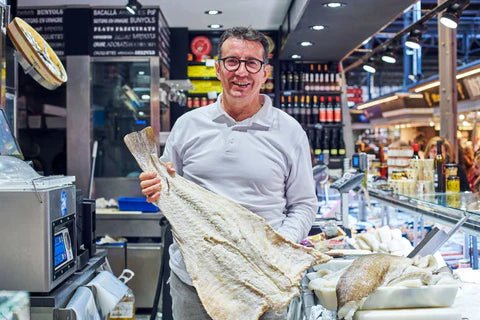
In the municipal markets of Barcelona and throughout Catalonia, l'Escala anchovies are the historical reference product. At Mercat del Ninot, where Bacalalo has been since 1990, traditional Catalan customers ask for l'Escala anchovies as a starting point, while younger customers or those from other regions usually start with Cantabrian anchovies. The coexistence of both in the same market allows for direct comparison — and it is this comparison that we make in this article.
Cantabrian anchovies: the national benchmark
Cantabrian anchovies are those produced in the northern coastal strip of Spain, including Cantabria (especially Santoña, Laredo, Colindres, and Castro Urdiales), the Basque Country (Bermeo, Getaria, Ondarroa), and, to a lesser extent, Asturias. The Cantabrian anchovy industry began in the mid-19th century when families of Sicilian and Neapolitan canners settled in Santoña, attracted by the abundance of anchovies in the Bay of Biscay and the availability of salt and local labor.
In less than a century, Santoña became the world capital of salted anchovies. Italian techniques evolved and adapted to the local product, giving rise to a production method that is now considered the standard reference. Santoña anchovies have gained international recognition through high Spanish cuisine — Ferran Adrià, Juan Mari Arzak, and other avant-garde chefs contributed to elevating the product's status since the late 1990s.
Unlike l'Escala, Cantabrian anchovies also do not have any PDO or PGI at a European level. The term "Cantabrian anchovy" describes the origin of the anchovy and the processing area, but it is not regulated with the same precision that might be expected given the gastronomic value of the product. You can find more information about the world of Cantabrian anchovies in our complete guide to Cantabrian anchovies: brands, sizes, and how to choose.
Differences in species and fish origin
The species is the starting point for any honest comparison. And there is an important nuance here that many articles on the subject omit.
The species in Cantabrian anchovies
Cantabrian anchovies are made from European anchovy, Engraulis encrasicolus, caught in the Cantabrian Sea and the Bay of Biscay during the spring fishing season (April-June). In these cold, plankton-rich waters, the anchovy develops a concentration of intramuscular fat that is unmatched in other areas of its geographical distribution. This fat is responsible for the melting texture and deep umami that characterizes premium Cantabrian anchovies.
The species in l'Escala anchovies
L'Escala canneries work with Mediterranean anchovy, also Engraulis encrasicolus but caught in Western Mediterranean waters (Gulf of Lion, Catalan Sea). Mediterranean anchovy is the same species, but its characteristics differ significantly: Mediterranean waters are warmer than the Cantabrian Sea, which produces a specimen with a different fat profile — generally, less intramuscular fat and a firmer, less melting final texture than Cantabrian anchovy.
This difference in lipid profile is the most relevant factor in the comparison. It is not a matter of quality — it is a matter of style. L'Escala anchovies tend to be firmer, saltier, and have a more direct flavor profile. Cantabrian anchovies tend to be more melting, more complex in aroma, and with greater flavor persistence.
The question of real origin
Both in l'Escala and Cantabria, there is the problem of imported anchovy. Processing anchovies from Argentina in Santoña or anchovies from Morocco in l'Escala is legal, but it produces a different result. The reference canneries in both areas work with local, seasonal anchovy — second-tier brands and lower-priced products usually use imported anchovy. Transparency on the label (indicating the origin of the anchovy, not just the processing area) is key to distinguishing between them.
Differences in the production process
The artisanal production processes for l'Escala and Cantabrian anchovies are essentially similar — barrel salting, slow maturation, manual filleting, canning in oil — but with subtle differences that produce distinct results.
Initial salting
In both traditions, fresh anchovies are gutted, placed in barrels alternating layers of fish and coarse sea salt, and pressed with a weight to apply constant pressure. The differences are subtle at this point: l'Escala canneries typically use slightly higher salt proportions, which results in a final anchovy with a more saline character. Cantabrian canneries tend to refine the salt-to-fish ratio more precisely depending on the season, leading to a result with more variation between batches but with the possibility of greater balance.
Maturation time
L'Escala anchovies from reference canneries mature between 6 and 14 months. Premium Cantabrian anchovies mature between 8 and 18 months. The average difference is about 2-3 months of curing in favor of the Cantabrian, which contributes to a greater flavor complexity in the top-tier Cantabrian final product.
However, this data must be qualified: a 12-month cured l'Escala anchovy can be more complex than an 8-month cured Cantabrian anchovy. Curing time is an important factor, but not the only one.
Filleting and packaging
Both traditions involve manual filleting. L'Escala canneries tend to more frequently use olive oil with a more neutral flavor (mild or refined in medium ranges), while premium Cantabrian canneries usually specify extra virgin olive oil. The oil in which the anchovy is packed significantly affects the perceived flavor profile — an l'Escala anchovy in good extra virgin olive oil might seem more complex than the same anchovy in neutral oil.
Differences in flavor and texture: comparative table
The comparison of flavor and texture is where most consumers need the most guidance, because descriptions are inevitably subjective. What follows is our honest assessment based on decades of tasting and managing customers with different preferences at Mercat del Ninot.
| Characteristic | L'Escala Anchovies (top) | Cantabrian Anchovies (top) |
|---|---|---|
| Texture | Firm, meaty, with defined bite | Melting, buttery, dissolves in the mouth |
| Saltiness | Saltier, pronounced character | Balanced salt, dominant umami |
| Flavor | Direct marine, persistent, straightforward | Complex, layered, buttery notes |
| Aroma | Pronounced marine | Deep, with fermentation nuances |
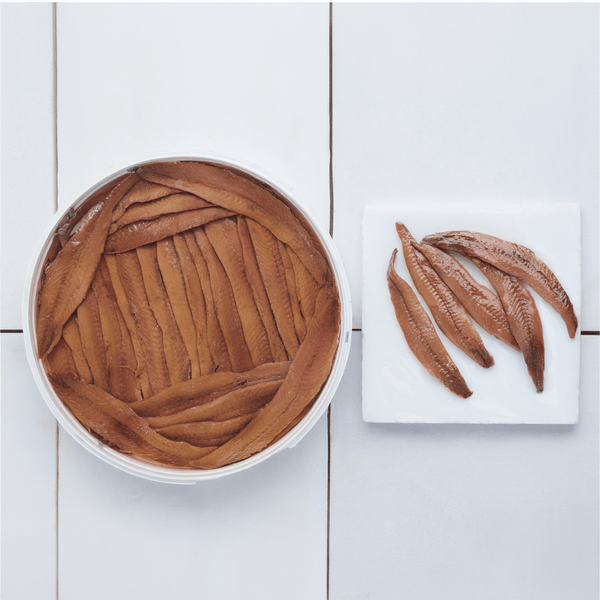
| Color | Dark coppery, sometimes more brown | Pinkish coppery, more vibrant |
| Persistence | Medium-long | Long, with prolonged aftertaste |
| Culinary versatility | Excellent in traditional Catalan cuisine | Excellent as an appetizer and in haute cuisine |
The consumer profile
In our 35 years of experience at Mercat del Ninot, consumers who prefer l'Escala anchovies usually seek a product with more saline personality, more texture, and a direct marine flavor profile without distracting nuances. This is the traditional Catalan profile: anchovy on bread with rubbed tomato and oil, or anchovy in esqueixada. Consumers who prefer Cantabrian anchovies usually value the melting texture, aromatic complexity, and the "umami that lingers" experience more. This is the profile that enjoys anchovies on their own, without competing supports.
Neither preference is objectively correct. They are different styles for different palates.
Price differences: how much each costs
The price differences between l'Escala and Cantabrian anchovies are real, although not as great as might be thought among top-tier products from both traditions.
L'Escala Anchovies: price ranges
L'Escala anchovies from reference canneries cost between €0.60 and €1.20 per fillet, depending on the format and the cannery. Larger formats (jars of 200g or more) are usually more economical per fillet than smaller ones. Quality standard l'Escala anchovies (not artisanal reference) can be found for €0.30-€0.50 per fillet — in that range, the anchovy is usually of non-Mediterranean origin.
Cantabrian Anchovies: price ranges
Premium artisanal Cantabrian anchovies cost between €0.80 and €1.50 per fillet, with larger sizes (00, 000) at the higher end of the range. Premium 00 anchovies can reach €2 per fillet in the most exclusive formats from the most artisanal canneries. To check the updated prices of the anchovies we have available, visit our Cantabrian anchovy collection.
Quality-price ratio in perspective
Comparing price without comparing quality makes no sense. What is relevant is the price per fillet of a top-tier anchovy from each tradition, from the best canneries in each area. In that scenario, the price difference between a reference l'Escala anchovy and a reference Cantabrian anchovy is €0.10-€0.30 per fillet — a small difference that, in practice, is not the determining factor in the choice.
When to choose l'Escala anchovies and when Cantabrian
The practical question we get asked most at Mercat del Ninot is not "which is better?" but "which do you recommend for this use?". The answer depends on the use and the flavor profile desired.
Choose l'Escala anchovies when:
- You want to make a traditional Catalan dish: esqueixada, coca with anchovies, pa amb tomàquet amb anxova
- You are looking for a more direct marine flavor and a texture with more bite
- The use is as an ingredient in a dish where the anchovy shares the spotlight with other elements (escalivada, salad, pasta)
- Your taste reference is the anchovy you've always had in your family's cooking if you come from a Catalan tradition
- You want to give a gift of a product with a specific local and Mediterranean history
Choose Cantabrian anchovies when:
- You want to eat the anchovy alone or on toast, where texture and complexity are the sole protagonists
- You are looking for the maximum expression of umami and melting texture
- The use is as a high-end appetizer, gourmet platter, or paired with quality white wine
- You are making a gilda: the melting texture of Cantabrian anchovies works better in contrast with the firmness of the olive and piparra pepper
- You want the product with the greatest international recognition and the one that appears most often in Spanish haute cuisine
For a gift
If the gift is for someone with a Catalan gastronomic tradition whom you don't know well, l'Escala anchovies are the safest choice — it's the local reference product. If the gift is for someone interested in gourmet gastronomy without a specific geographical reference, 00 Cantabrian anchovies are the choice that generates the most impact. For a gift pack with both, the comparison the recipient can make is in itself a gastronomic experience.