Summary: The question of when children can eat anchovies does not have a simple or single answer. Food safety factors (sodium, salt, histamine), palate development, and fish allergies all play a role. In this article, we provide an answer with updated medical criteria and practical perspective: at what age it is appropriate to introduce anchovies, what quantity is reasonable, what are the most suitable formats for children, and what alternatives exist for those who want to introduce oily fish more gradually.
At what age can babies and children eat anchovies?
Updated March 2026. Since 1990, we have hand-selected every product. This guide reflects that experience.
The direct answer: salted canned anchovies are not appropriate for babies under 12 months and should be introduced with caution up to 2-3 years. There is no absolute prohibition for children from a certain age, but there are important practical restrictions related to sodium that make standard anchovies not the first oily fish to introduce into an infant's diet.
This position is not exclusive to Bacalalo — it is the criterion applied by pediatricians and pediatric nutritionists in Spain and recommended by the Spanish Association of Pediatrics (AEP) in its complementary feeding guidelines. Anchovies in salt or oil are a high-sodium product that the kidneys of babies and young children do not process efficiently.
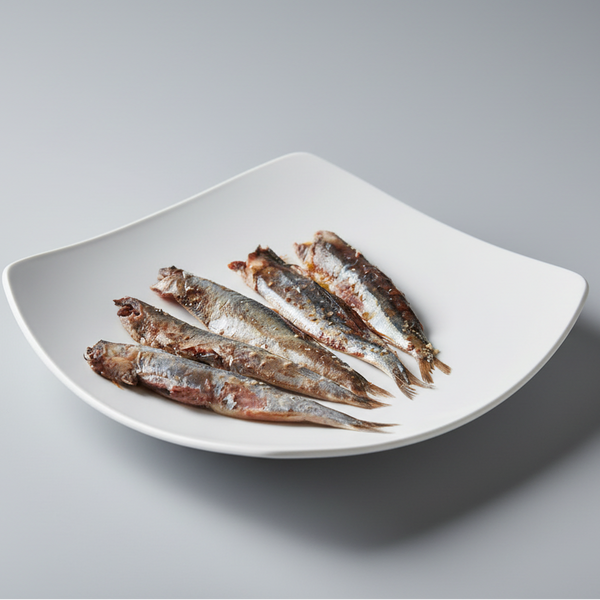
What can be introduced earlier is fresh oily fish (anchovy, sardine, mackerel, horse mackerel), well-cooked and without added salt, from 6-8 months as part of complementary feeding. Fresh oily fish has the same omega-3s and nutritional value as canned anchovies, without the sodium load of the curing process.
The sodium problem: why anchovies are not for babies
Babies' kidneys up to 12 months are not fully developed to process large loads of sodium. The maximum recommended sodium intake for infants 0-6 months is less than 0.4 g/day; for 7-12 months, less than 1 g/day. Breast milk or formula milk alone meets these needs without adding salt.
To put this in context: a single anchovy in oil (a fillet of about 5 g) can have between 200 and 400 mg of sodium, depending on the cannery and curing process. That's equivalent to 50-100% of the maximum daily recommended sodium intake for a 7-12 month old baby. It's too much, and should not be given.
For children aged 1-3 years, the maximum recommended sodium intake is less than 2 g/day (equivalent to less than 5 g of salt). In this age range, a small amount of anchovy (a quarter or half fillet) within a diet with little added sodium may be acceptable occasionally, but not as a regular habit.
From 3-4 years old, with fully developed kidneys and a varied diet, anchovies can be incorporated more freely, always bearing in mind that anchovies already contain enough salt and no more should be added to preparations that include them.
Histamine and fish allergy
Canned anchovies have a higher histamine content than fresh fish as a result of the enzymatic fermentation process during curing. Histamine is a biogenic amine that, in sensitive individuals, can cause reactions ranging from skin rashes and itching to gastrointestinal symptoms.
Histamine intolerance is different from fish allergy. Fish allergy is an immunological reaction to fish proteins (mainly parvalbumins) that can appear at any time during childhood and can be severe in serious cases. Symptoms of fish allergy include hives, swelling, vomiting, and, in extreme cases, anaphylaxis.
To introduce any fish — fresh or canned — into a child's diet, especially if there is a family history of food allergies, the pediatric recommendation is to do so gradually and in small amounts the first time, observing the reaction over the following hours. This applies especially to the first time any form of anchovy or boquerón is given.
If the child has a diagnosed fish allergy, anchovies and any products containing them (pasta with anchovies, pizzas, sauces) should be avoided until the allergist advises otherwise.
Children over 2 years old: how to introduce anchovies
From 2-3 years of age, when kidneys are more developed and the diet is more varied, anchovies can be introduced as part of palate development. The key is to do so gradually and in formats that do not highlight the intense saltiness of the whole anchovy.
The best entry point for children is anchovy as an ingredient in preparations that soften its flavor. A crumbled anchovy over pasta with a little tomato and olive oil provides the nutritional value of oily fish without the child identifying it as "that salty thing." Well-prepared pasta with anchovies, where the fillets dissolve completely in the hot oil, has a flavor that most children aged 3 and up accept without resistance.
Once the child accepts anchovies integrated into recipes, the next step is to present them more visibly: on toast with tomato, over scrambled eggs, in small quantities over vegetables. The goal is for the child to build a positive reference for the taste of anchovies associated with preparations they like, not to be "forced" to eat a whole anchovy as an adult appetizer.
Recommended quantity by age
| Age | Recommendation | Format |
|---|---|---|
| 0-12 months | Not recommended (excessive sodium) | None |
| 1-2 years | Avoid or very occasionally (max 1/4 fillet) | Crumbled in preparations |
| 2-4 years | Occasionally: 1/2-1 fillet, max 2-3 times/week | In pasta, sauces, light toasts |
| 4-8 years | 1-2 fillets per occasion, without exceeding total daily sodium | Free, as part of a varied diet |
| Over 8 years | No special age restriction. Control of total daily sodium | Free |
These recommendations are indicative. The child's pediatrician or pediatric nutritionist should confirm what is appropriate for each individual case, especially if there are pre-existing health conditions.
Most suitable formats for children
Not all anchovy formats have the same intensity of sodium and flavor. For young children who are just starting to get to know the product, some formats are more suitable than others.
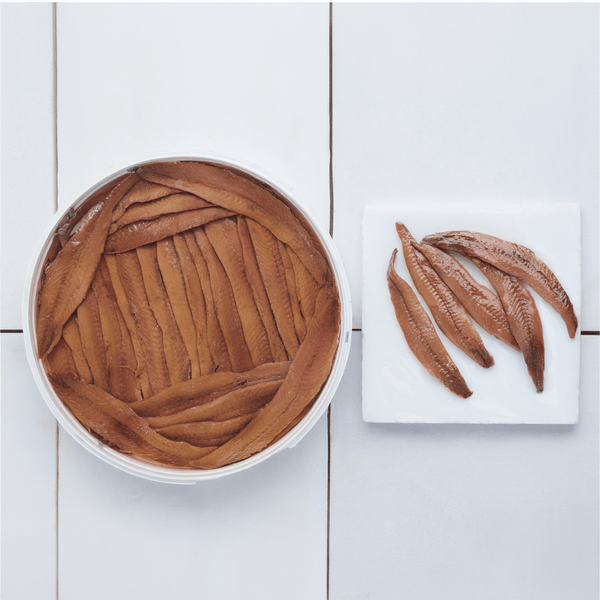
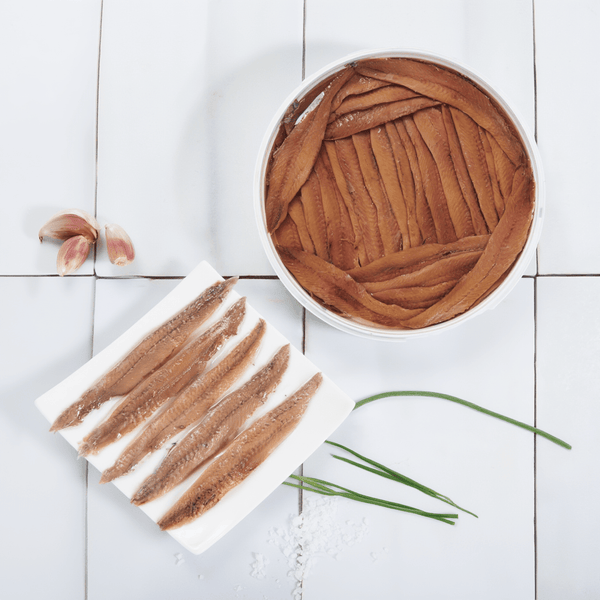
Anchovies in olive oil in small sizes (size 1 or menu) are more suitable than large sizes because they provide less sodium per unit and are easier to integrate in small quantities into recipes. Small fillets break down more easily in hot oil and produce preparations with a more integrated flavor.
Anchovy paste allows for more precise dosing. Half a teaspoon of anchovy paste in a tomato sauce for pasta provides nutritional value without the visual presence of the fillet that some children reject.
What we do not recommend for children under 6 years old: whole anchovies as a direct appetizer (too much sodium in a single bite), anchovies in salt without desalinating (much more sodium than canned), and preparations where anchovy is the dominant flavor and there are no ingredients to moderate its intensity.
Alternatives before canned anchovies
If you want your child to get the benefits of oily fish without the sodium load of canned anchovies, there are excellent alternatives for earlier stages:
Fresh boquerón (anchovy) grilled, without added salt, from 6-8 months in complementary feeding. Rich in omega-3, low in sodium, with a mild flavor when well cooked.
Fresh baked sardines, with bones thoroughly removed, are another excellent source of omega-3 and calcium for young children. Fresh sardines have a milder flavor than canned anchovies and a firmer texture that makes it easier to teach children to identify and remove bones.
Tuna in olive oil (not in brine) has much less sodium than anchovies and is a good bridge for introducing canned fish. Although it has less omega-3 than small oily fish, its flavor profile is more neutral and more accepted by children's palates.
Nutritional benefits of anchovies for older children
Once the sodium restriction stage is passed (generally around 4-6 years of age, with good judgment in quantities), anchovies provide significant nutritional benefits for child development.
Long-chain omega-3 fatty acids (EPA and DHA) are fundamental for neurological and visual development in childhood. DHA in particular is a structural component of the brain's gray matter and the retina. Pediatric dietary guidelines recommend regular consumption of oily fish precisely for this reason — and anchovies, despite their sodium, are a concentrated source of these fatty acids.
The high-quality proteins in anchovies provide all the essential amino acids needed for growth. Heme iron in anchovies is more bioavailable than plant-based iron — relevant for children in periods of rapid growth.
The calcium and phosphorus in anchovies (which includes some calcium from softened bone tissue during curing) contribute to bone development. Although sardines provide more calcium per serving (thanks to soft bones), anchovies make a relevant contribution.
Anchovy recipe ideas for children
For children aged 3-4 and up who are starting to familiarize themselves with the flavor:
Pasta with anchovies and mild tomato: Dissolve 2-3 anchovy fillets in hot oil with garlic before adding the tomato sauce. The result tastes like a deeper, more flavorful tomato pasta, without the anchovy being identifiable. This is the most effective way to introduce the flavor of anchovies without resistance.
Tomato toast with a strip of anchovy: Pa amb tomàquet (Catalan-style bread with tomato) with a small strip of anchovy on top. In Barcelona, at Mercat del Ninot, children accompanying their parents often try a piece of anchovy on toast — and many, to their parents' surprise, ask for more.
Scrambled eggs with anchovy: Crumble an anchovy fillet into beaten eggs before cooking. The heat of cooking integrates the anchovy flavor with the egg and produces a more flavorful scramble that doesn't require additional salt.
For more anchovy recipe ideas for the whole family, see our guide to anchovy recipes: easy and gourmet ideas. For pregnancy context, see anchovies in pregnancy: safety and alternatives.
Premium Seafood Products — Bacalalo
Since 1990, selecting the best seafood at Mercat del Ninot, Barcelona. Refrigerated shipping 24-48h.
View Cantabrian anchovies →🛒 Products mentioned in this article
⭐ 4.9/5 · 24-48h cold shipping · Since 1990 at Mercat del Ninot
Frequently asked questions about anchovies for children
Can anchovies cause allergies in children?
Yes, like any fish. If it's the first time the child is eating anchovies or any anchovy derivative, introduce a small amount and observe the reaction for 24 hours. If there is a family history of fish allergies, consult a pediatrician or allergist before introducing them.
Do fresh anchovies and canned anchovies have the same allergenicity?
They are the same species (Engraulis encrasicolus), so the allergens are the same. An allergy to fresh anchovies implies an allergy to canned anchovies and vice versa. The curing process may slightly modify some proteins, but it does not eliminate the allergens.
How many anchovies can a 5-year-old child eat per week?
There is no specific official recommendation. With a balanced diet and no excess sodium in other foods during the day, 1-2 anchovy fillets on 2-3 occasions per week is a reasonable amount for a 5-year-old child with no pre-existing cardiovascular health conditions. The context of the child's overall daily diet matters more than the quantity of anchovies itself.
Can canned anchovies be contaminated with mercury?
The risk of mercury contamination in small fish like anchovies and sardines is very low compared to large marine predators (bluefin tuna, swordfish, shark). The recommendations of the Spanish Agency for Food Safety and Nutrition (AESAN) restrict the consumption of large predators by children and pregnant women, but not that of small fish like anchovies. Anchovies are safe from a mercury perspective.
Does the anchovy disappear if I mix it with pasta so my child doesn't notice it?
Practically, yes. When properly dissolved in hot oil, the anchovy loses its visual identity and its flavor integrates with the whole. Many children who reject whole anchovies readily accept pasta where the anchovy has dissolved. It's not deception—it's progressive palate learning.