Summary: Preparing homemade anchovies in olive oil from salt curing is a process that takes months but produces a result superior to most commercial preserves available on the market. In this guide, we explain the complete process: from purchasing fresh anchovies during the fishing season or already salt-cured anchovies, through cleaning, desalting, filleting, and packing in oil. With the correct technical criteria and suitable raw materials, any amateur can produce professional-grade homemade anchovies.
Two paths: from fresh anchovy or from salt-cured anchovy
Updated March 2026. After decades working with seafood products, we have learned that quality makes all the difference.
Before diving into the process, you need to choose your starting point. Homemade anchovies in oil can be prepared in two ways with significantly different results in terms of time required and level of involvement.
The first path is the complete process: buying fresh anchovies during the fishing season (April-June), gutting them, salting and maturing them for 8-14 months at home, and then cleaning, filleting, and packing them in oil. This is the process used by artisanal canneries and produces the most authentic result. It requires time, suitable space for barrels, and real patience — but the result is an anchovy with a flavor profile that no commercial can can exactly replicate because you've controlled every variable.
The second path is to buy already salt-cured anchovies (available in specialty food stores, markets, and online) and simply clean, fillet, and pack them in oil. This process takes a few hours, not months, and the result is also excellent — better than most supermarket cans, because you can choose the quality of the salt anchovy and the packing oil.
At Bacalalo, we offer Cantabrian anchovies for cleaning (€5.95) for those who want to follow the second path without the complications of fishing season logistics or prolonged storage. These are already salt-cured anchovies, with verified Cantabrian origin, that only need cleaning and packing in oil.
Path 1: Full salt curing (8-14 months)
This process requires planning months in advance. It is only possible during the Cantabrian fishing season (April-June) or if you can get top-quality Cantabrian anchovies during that period.
Necessary materials
- Food-grade plastic or wooden barrels (5-10 liter plastic tubs work for domestic quantities)
- Generous amount of coarse sea salt (for each kilo of anchovies, you need at least 300-400 g of salt)
- A lid that fits the tub and a weight for pressing
- Cool space (ideally between 8 and 15 °C) — cellar, garage, or refrigerator at a high temperature setting
The salt-curing process
Step 1: Anchovy selection. Anchovies for salt curing must be fresh from the day, large and uniform in size (larger specimens yield 00 and 0 calibers). The anchovy should be shiny, with clear eyes and a fresh sea smell. Anchovies with sunken eyes or an ammonia smell are not suitable for salt curing.
Step 2: Gutting. Remove the head and entrails from each anchovy. This is done by hand, pulling the head with a firm motion that removes the entrails. Do not cut with a knife — cutting leaves an oxidized area that can affect curing. Briefly rinse in salted water.
Step 3: Layer salting. In the tub, place a layer of coarse salt at the bottom. Place a layer of anchovies (perpendicular, in the same direction). Cover with salt. Repeat until all anchovies are used, always finishing with a generous layer of salt. The correct ratio is approximately 1 kg of anchovies per 300-350 g of salt. Too much salt blocks enzymatic activity; too little allows bacterial growth.
Step 4: Pressing. Place the lid on top and the weight on it. The weight should be sufficient to press the anchovies without crushing them — about 2-3 kg for a 5-liter tub. Pressure facilitates the extraction of water from the anchovies and ensures uniform curing.
Step 5: Maturation. Store in a cool, dark place. Check every 2-3 weeks to ensure there is enough brine (liquid extracted from the anchovies by the salt) covering the product. If the brine level drops, add a small amount of concentrated salted water. The minimum maturation for an acceptable result is 8 months. The optimal for high-quality homemade anchovies is 12-14 months.
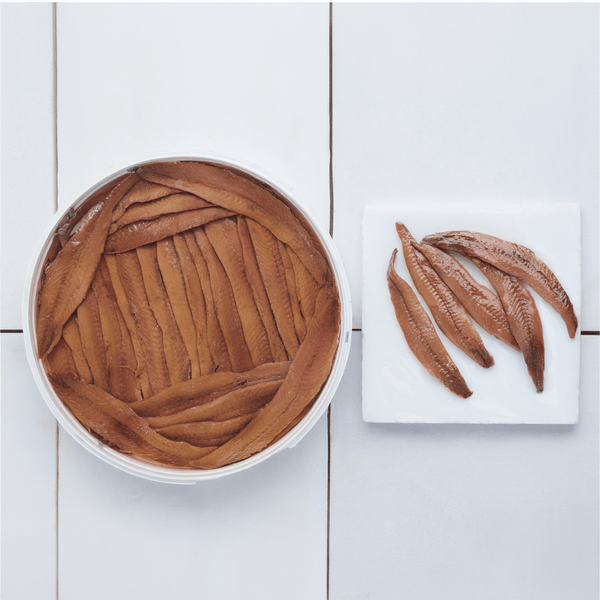
The result after 10-14 months: the grayish anchovy has transformed into reddish-brown anchovies, with a complex aroma and a firm texture that yields to the touch.
Path 2: From purchased salt-cured anchovies
This is the process we recommend for those who want to prepare homemade anchovies in oil without months of waiting. Already salt-cured anchovies are available in various formats and presentations.
Bacalalo's Cantabrian anchovies for cleaning are whole salt-cured anchovies, artisanally cured, that only need cleaning and packing. They guarantee Cantabrian origin and artisanal curing, which makes all the difference in the final result.
Once you have the salt anchovies, the process from this point is the same for both paths: cleaning, filleting, desalting, and packing. It is described in detail in the following sections.
The cleaning and filleting process: step-by-step
This is the most time-consuming step and the one that most determines the visual quality of the result. With practice, one person can clean 100-150 g of salt anchovy in an hour.
Materials: cutting board, bowl with cold water, absorbent paper, a small knife or toothpick to help remove bones.
Step 1: Remove salt. Take a cured anchovy from the barrel and shake off the coarse salt. Briefly rinse under cold water to remove salt residue from the surface. At this point, the anchovy still has its central bone.
Step 2: Separate fillets. Place the anchovy on the board. With your fingers, open the anchovy from the belly area. The central bone should separate easily from the fillets if the curing has been complete — enzymatic proteolysis has partially dissolved the connective tissue that joins the bone to the muscle. If the bone resists, the anchovy may need more desalting time or the curing was insufficient.
Step 3: Remove bone and skin. Remove the central bone by pulling it from tail to head. Remove the tail. With wet fingers, remove the silvery skin covering the fillets — it comes off with gentle friction. Remove any visible residual bones with the toothpick or small knife.
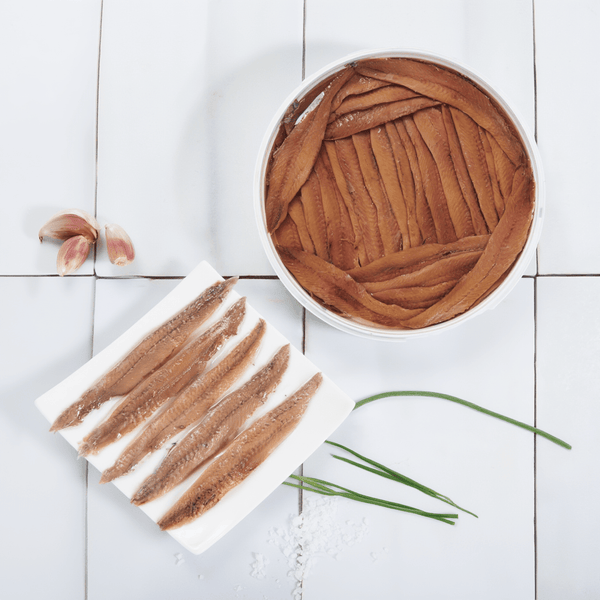
Step 4: Inspection. Run your finger against the grain over the fillet to detect unseen bones. Residual bones must be removed one by one. A boneless fillet, whole and with uniform reddish-brown color, is the standard to achieve.
Cantabrian Anchovies for Cleaning — The starting point for your homemade anchovies
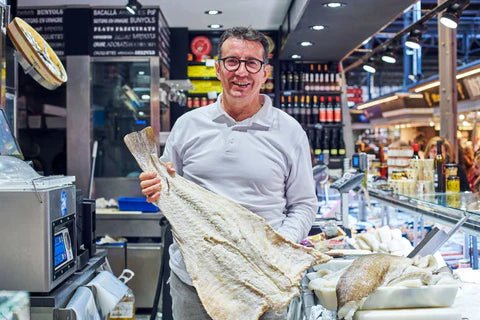
Already salt-cured anchovies, with verified Cantabrian origin. Ready to clean, fillet, and pack in your favorite olive oil. The weekend gastronomic project that produces the best possible result. From Mercat del Ninot in Barcelona.
Desalting: how to do it right
Desalting is the step that most affects the final flavor profile. Salt-cured anchovies have a high salinity that must be reduced before packing in oil. The degree of desalting is a variable you can control according to your preference: more desalting produces a milder, less salty anchovy; less desalting retains more salinity and flavor intensity.
Standard method: Place the clean fillets in a bowl with cold water. Soak for 20 to 45 minutes, changing the water once halfway through the process. Taste a piece of fillet after 20 minutes — if the salinity seems acceptable, remove. If it is still too salty, continue for another 15-20 minutes.
Slow method (better result): Cover the fillets with cold water in the refrigerator and leave for 4-8 hours, changing the water every 2 hours. This more gradual method extracts sodium more uniformly and produces a slightly firmer texture than rapid desalting.
After desalting, carefully dry the fillets on absorbent paper — do not press, as the fillet may break. Let them dry thoroughly: wet fillets in oil shorten the shelf life of the packed product.
Packing oil: what to use
Oil is the second ingredient of the final product, and its quality matters as much as that of the anchovy. Options range from the simplest to the most elaborate:
Mild-flavored extra virgin olive oil: The standard and most recommended option. An extra virgin olive oil with low acidity (less than 0.3°) and a mild fruity flavor (Arbequina, Hojiblanca) does not compete with the anchovy and acts as a preservative and flavor carrier. It is the choice used by the best artisanal canneries in Cantabria.
Extra virgin olive oil with character: A spicy or bitter oil (Picual, Cornicabra) can be used if you are looking for an anchovy with more aromatic complexity. Spicy oil adds herbaceous notes and a spicy finish that anchovy alone does not have. It is an interesting choice for enthusiasts, but it may result in a flavor profile that is too complex for those seeking the classic anchovy.
Flavored oil: Adding a sprig of thyme, a bay leaf, or a lemon peel to the packing oil produces anchovies with additional aromatic nuances. These flavored versions have a more artisanal and unique character.
What not to use: sunflower oil. Although cheaper, it produces a flat result and significantly reduces the product's shelf life. Olive oil has natural antioxidant properties that protect the anchovy's unsaturated fatty acids during storage.
Storage and shelf life
Homemade anchovies in oil, well prepared and packed, last between 2 and 4 weeks in the refrigerator. They are more perishable than commercial pasteurized preserves, which can last for years unopened, because the homemade artisanal process does not include pasteurization.
To maximize shelf life: use sterilized glass jars (boil for 10 minutes before use), ensure the fillets are completely covered in oil at all times, and always keep refrigerated. If the oil level falls below the fillets, add more oil immediately.
Signs that homemade anchovies are no longer good: cloudy and dark oil, rancid or ammonia smell, fillets that fall apart when touched without having been manipulated. If in doubt, discard.
To preserve for a longer period (up to 3-4 months), the process requires pasteurization of the sealed jar — a step that adds technical complexity but significantly extends shelf life. For more information on preservation, see our guide on how to store anchovies correctly.
What to expect from homemade anchovies
Well-prepared homemade anchovies have characteristics that positively differentiate them from standard commercial preserves: greater control over the desalting level (and therefore over the salinity of the final product), superior freshness of the packing oil, and the satisfaction of the artisanal process.
In terms of flavor: if you start with quality artisanal salt anchovies from Cantabria, the result will be clearly superior to supermarket preserves. If you start with our anchovies for cleaning or top-quality raw material, the result can compete with the best preserves on the market.
What homemade anchovies cannot match in comparison to the best artisanal preserves: uniformity of selection by size (canneries have decades of experience selecting perfectly sized fillets) and batch-to-batch consistency. But in terms of oil freshness, personalized desalting level, and process satisfaction, homemade anchovies win.
To compare the result of your homemade anchovies with market references, see our complete guide to Cantabrian anchovies: brands and sizes, and for the context of Santoña and artisanal tradition, see Santoña anchovies: history, preparation, and tradition.
Premium Seafood Products — Bacalalo
Since 1990, selecting the best from the sea at Mercat del Ninot, Barcelona. Refrigerated shipping 24-48h.
See Cantabrian anchovies →🛒 Products mentioned in this article
⭐ 4.9/5 · Cold shipping 24-48h · Since 1990 at Mercat del Ninot
Frequently asked questions about homemade anchovies in oil
Is it safe to make anchovies at home without pasteurization?
Anchovies properly cured in salt (with adequate salt concentration and sufficient curing time) have an acidity and salinity environment that inhibits the growth of most pathogens, including botulism. The risk increases if the curing has been insufficient or if the cleaning process introduces contamination. For consumption within a few weeks and stored in the refrigerator, homemade anchovies are safe if prepared with quality raw materials and a clean process. We do not recommend storing them at room temperature without pasteurization.
How many fillets come from 100g of salted anchovies?
Approximately 50-60g of clean fillets for every 100g of salted anchovies. The rest is salt, heads, entrails, bones, and water extracted during curing. The yield varies according to size: large anchovies yield slightly more because the proportion of meat to bones and skin is greater.
Can the same oil be used to pack several batches?
No. Oil from a previous jar has flavors from the previous curing process and possible contamination. Always use fresh oil for each new jar.
Do homemade anchovies have the same texture as canned ones?
Generally firmer, because the industrial pasteurization process of commercial preserves softens the texture. Homemade unpasteurized anchovies have a firmer, "crunchier" texture that, with proper curing, is very pleasant. The texture also varies according to the desalting time: more desalting produces softer fillets.
Can I make "boquerones en vinagre" instead of anchovies in oil?
"Boquerón en vinagre" (white anchovy in vinegar) is a completely different product from anchovies in oil. Vinegar "cooks" the boquerón through acidity (marinating) without long salting. The result is completely different in flavor, texture, and color. "Boquerones en vinagre" do not require salt curing — they can be prepared with fresh boquerón directly. See the difference in our article on boquerón or anchovy: how to distinguish them.
Discover our premium selection
Seafood products carefully selected since 1990 at the Mercat del Ninot, Barcelona. Refrigerated shipping 24-48h.