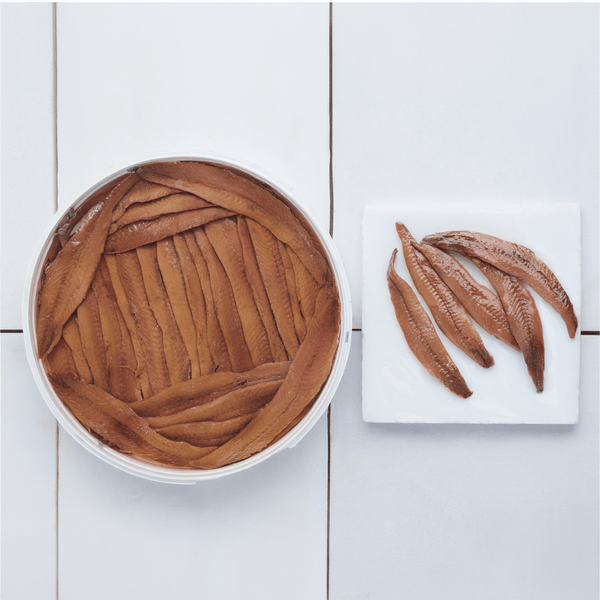
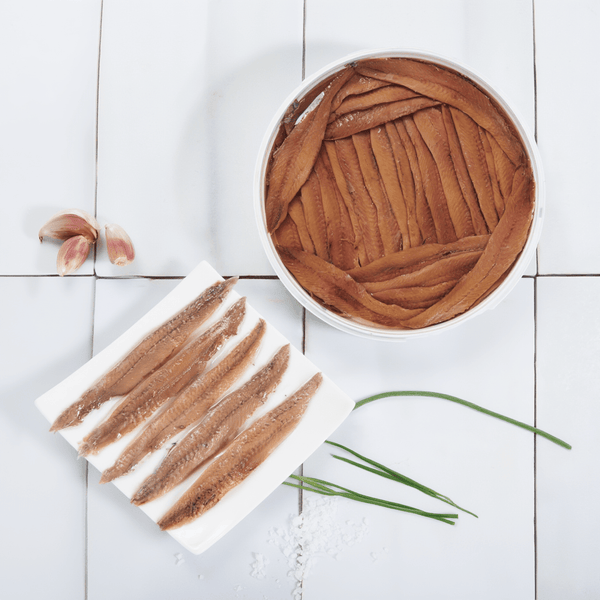
Making homemade Cantabrian anchovies in oil is a slow but simple process that requires fresh anchovies, coarse salt, time, and patience. We explain the recipe step by step: from the initial salting to filleting and preservation in extra virgin olive oil. With exact timings, common mistakes, and what no one tells you about homemade curing.
What are homemade anchovies and how are they different?
Updated March 2026. What we tell you here comes from serving thousands of customers in Barcelona.
Homemade anchovies in oil are anchovy fillets cured in salt for weeks or months, then cleaned, filleted, and preserved in extra virgin olive oil. This is the same process followed by Cantabrian canneries, but on a domestic scale.
The main difference from industrial anchovies is not in the technique (which is the same), but in two factors:
- Curing time: at home, you can cure from 3 weeks (young anchovy, mild flavor) to 12 months (mature anchovy, intense flavor). Canneries usually cure for 6 to 18 months.
- Process control: you decide the salt level, the type of oil, and the exact moment of consumption.
The result, if done correctly, is indistinguishable from a good artisanal anchovy. The key is the quality of the initial anchovy and respecting the timing.
Ingredients: What you need
- 1 kg of fresh anchovies (as fresh as possible, ideally from the same day)
- 500 g of coarse sea salt (non-iodized, not fine)
- Extra virgin olive oil (for preservation, quantity depends on containers)
- A glass or ceramic container with a lid (never metal)
- A weight (plate + jar filled with water, or a clean stone)
About the anchovy
The quality of the final anchovy depends 80% on the initial anchovy. Look for anchovies that are:
- Fresh, from the same day, with bright eyes and firm flesh
- Medium-large size (12-15 cm). Very small ones yield little when filleted
- Seasonal: spring (April-June) is the best time, when they are fattier
- From a fish market or trusted fishmonger, not defrosted
About the salt
Use non-iodized coarse sea salt. Iodized salt can give metallic flavors. Fine salt penetrates too quickly and creates uneven curing. Coarse salt dissolves slowly and allows for uniform curing.
Step 1: Select and clean the anchovies
Remove the head and guts from each anchovy. The most efficient method: hold the anchovy by the body with one hand, twist the head with the other, and pull down. The guts usually come out with the head.
Do not open the anchovies or remove the backbone at this stage. They are filleted after curing, when the flesh is firm and much easier to work with.
Rinse the cleaned anchovies under cold water and dry them with kitchen paper.
Approximate yield: from 1 kg of whole anchovies, you will get about 500-600 g cleaned without head or guts, which after curing and filleting will yield about 250-300 g of anchovy fillets.
Step 2: Salting — the heart of the process
This is the most important step. The salt extracts water from the anchovy, cures it, develops its flavor, and changes its texture from raw to anchovy.
- Place a layer of coarse salt at the bottom of the container (1 cm).
- Arrange a layer of anchovies, all in the same direction, without overlapping.
- Cover with another layer of salt (0.5 cm).
- Repeat: layer of anchovies, layer of salt, until finished.
- The last layer should be coarse salt (1 cm).
- Place a plate or lid that fits inside the container, directly on top of the salt.
- Place a weight on top (1-2 kg). A jar filled with water works.
- Cover the container (without sealing hermetically) and place it in the refrigerator.
In the first 24-48 hours, the anchovies will release a dark brine. This is normal. Some cooks drain this brine and others leave it. If you leave it, the anchovies will be more cured. If you remove it, the result will be milder.

Cantabrian Anchovy Menu - 45 Fillets
Available on Bacalalo.com with refrigerated delivery in 24-48h
Step 3: Curing — patience is mandatory
This is where the magic happens. The salt and the fish's own enzymes transform the raw anchovy into an anchovy. It is an enzymatic maturation process that has no shortcuts.
- Minimum curing (3-4 weeks): young anchovy, mild flavor, pinkish color. Suitable for consumption but without the complexity of a mature anchovy.
- Medium curing (2-3 months): anchovy with a more developed flavor, brownish-pink color. Good balance for homemade anchovies.
- Long curing (6-12 months): mature anchovy, intense and complex flavor, dark brown color. This is what canneries in Santoña do. Requires keeping the container in the refrigerator all the time.
During curing, check the container weekly. If mold appears on the surface of the salt (rare in the refrigerator), remove it with a clean spoon. If the brine smells putrid (instead of anchovy/cured fish), discard the batch.
Step 4: Filleting and cleaning
Once the desired curing point is reached, it's time to fillet. This step requires care and a minimum of manual dexterity.
- Remove the anchovies from the salt and rinse them briefly under cold water. Do not soak them: they would absorb water and lose texture.
- Open each anchovy in half along the central backbone. The cured flesh separates easily.
- Remove the central backbone with your fingers or tweezers.
- Check the fillets for any small bones that may remain.
- Gently dry the fillets with kitchen paper.
The fillets should have a firm appearance, uniform pinkish-brown color, and an intense anchovy aroma (salty, marine, with hints of cured ham). If a fillet looks soft, grayish, or smells bad, discard it.
Step 5: Preserve in olive oil
Place the fillets in a sterilized glass jar, arranged in layers. Cover completely with extra virgin olive oil. No fillet should be exposed to air.
Close the jar and store in the refrigerator. Anchovies need 24-48 hours in oil to balance flavors before consumption.
Choice of oil
- Mild extra virgin olive oil (Arbequina, Hojiblanca): allows the anchovy flavor to shine without competition.
- Intense extra virgin olive oil (Picual): provides bitter and spicy notes that some palates enjoy.
- Sunflower oil: an economical option for large quantities, but loses the richness of olive oil. Not recommended.

Green Olives Stuffed with Anchovy Family Format - 1.5 kg | A92
Available on Bacalalo.com with refrigerated delivery in 24-48h
Time table by method
| Method | Curing time | Flavor | Color | Complexity |
|---|---|---|---|---|
| Short cure (refrigerator) | 3-4 weeks | Mild, salty | Pinkish | Low |
| Medium cure (refrigerator) | 2-3 months | Balanced | Pinkish brown | Medium |
| Long cure (refrigerator) | 6-12 months | Intense, umami | Dark brown | High |
| Professional cannery | 6-18 months | Complex | Dark brown | Very high |

Cantabrian Anchovy Exclusive in Olive Oil Selected Fillets - 160g
Available on Bacalalo.com with refrigerated delivery in 24-48h
Mistakes that ruin homemade anchovies
1. Using stale anchovies. If the anchovy has been at the fishmonger's for 2-3 days, curing begins with degraded raw material. The result will be an anchovy with a soft texture and bitter taste.
2. Too little salt. Salt is not just a flavoring: it's a preservative. If there isn't enough, bacteria proliferate and the process fails. It's better to use too much salt (it can be desalted later) than too little.
3. Not applying weight. The weight compacts the anchovies and ensures uniform contact with the salt. Without weight, curing is uneven: some fillets are more cured than others.
4. Using a metal container. Metal reacts with salt and can impart metallic flavors. Always use glass, ceramic, or food-grade plastic.
5. Impatience. Opening too early, constantly tasting, taking out fillets before they are fully cured. Curing has its own timing and cannot be rushed. Minimum 3 weeks, ideally 2-3 months.
6. Not covering completely with oil. Any fillet exposed to air will oxidize and change flavor. The oil must completely cover every fillet.
Storage and shelf life
- Salt-cured (unfilleted): up to 12-18 months in the refrigerator, in salt. They mature over time.
- In oil (filleted): 3-6 months in the refrigerator, always covered in oil. The more cured they are, the longer they last.
- Freezing: not recommended. Freezing alters the texture of cured anchovies.
Signs that they should be discarded: strong ammonia smell (not anchovy), slimy texture, greenish or grayish color, rancid taste.
Frequently asked questions
Is it safe to make homemade salt-cured anchovies?
Yes, as long as you use fresh anchovies from the same day and enough salt. The high salt concentration (over 20%) prevents the growth of most pathogenic bacteria, including Clostridium botulinum. It is an ancient preservation method.
Do I need to freeze the anchovies first to kill anisakis?
For traditional salting with long curing (more than 6 weeks in salt), the high saline concentration kills anisakis larvae. However, for additional safety, many experts recommend freezing anchovies at -20 °C for 5 days before salting, especially if the curing will be short (3-4 weeks).
How many anchovies do I need for a jar of anchovies?
From 1 kg of fresh anchovies, you will get approximately 250-300 g of anchovy fillets in oil. To fill a medium jar (250 ml), you will need about 800 g - 1 kg of fresh anchovies to start with.
Can I use fine salt instead of coarse salt?
It is not recommended. Fine salt penetrates too quickly, creates uneven curing, and can make the outer layer excessively salty while the inside does not cure properly. Coarse salt dissolves gradually and ensures uniform curing.
How do I know when the anchovies are ready?
Take a fillet and taste it. It should have a firm texture (not soft), a uniform pinkish-brown color, and an anchovy flavor (salty, umami) with no trace of raw fish taste. If it still tastes like raw salty anchovy, it needs more time.
Why don't my homemade anchovies taste like canned ones?
Probably due to insufficient curing time. Canneries cure for 6 to 18 months. If your curing was 3-4 weeks, the flavor will be simpler. The quality of the anchovy also influences: Santoña canneries work with seasonal Cantabrian anchovy, selected by size and fat content.
Are homemade anchovies cheaper than store-bought ones?
In direct cost, yes: 1 kg of fresh anchovies (€5-10) + salt (€1) yields anchovies that would cost €20-40 from a cannery. But the process requires weeks or months of waiting and manual filleting work. If your time is money, buying quality anchovies might be more efficient.
Conclusions
Making homemade anchovies is one of those kitchen projects that connect you with the essence of artisanal canning. The process is simple (salt + time), but the result depends on the quality of the initial anchovy and the patience to let the curing do its job.
If you decide to try, start with a small batch (1 kg of anchovies) and a medium cure of 2-3 months. When you taste your first homemade anchovy and experience that flavor you created yourself with salt and time, you will understand why canners speak of their craft with pride.
And if you prefer to enjoy anchovies cured by professionals with decades of experience, that also has its merits. Not everything has to be made by oneself to be appreciated.
Marc González Sáez has worked with Cantabrian anchovies since 1990 in the Mercat del Ninot, Barcelona. At Bacalalo.com, we select anchovies from canneries with a minimum curing of 6 months, because we know that time is the ingredient that cannot be replaced.