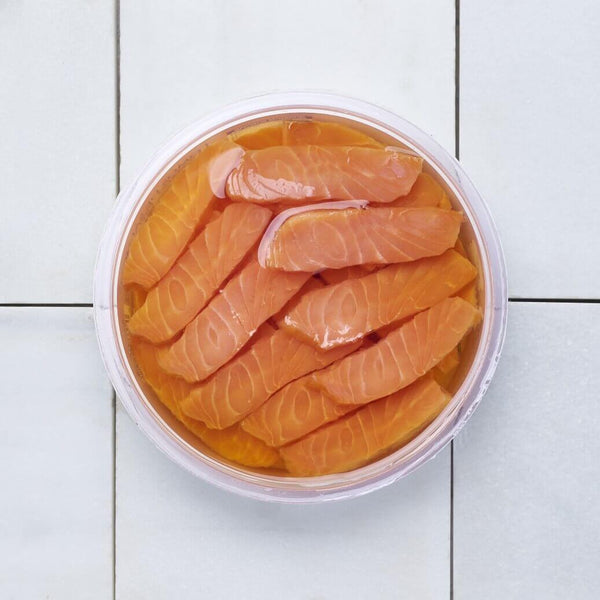
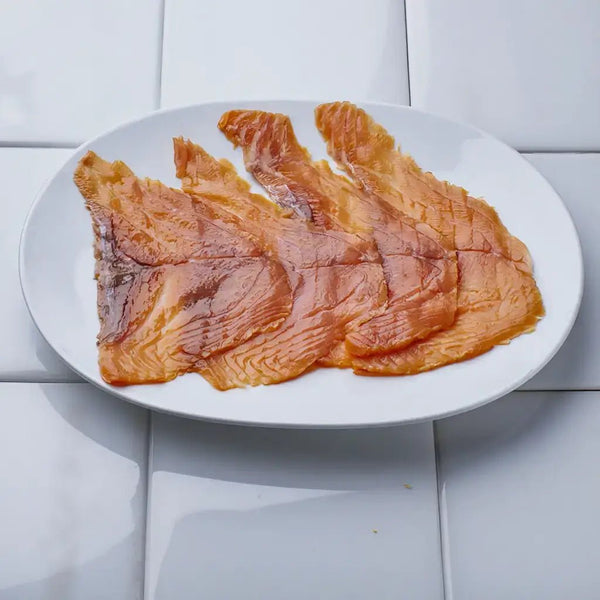
Summary — Smoked Salmon Properties: Smoked salmon has 117-180 kcal per 100g, 18-25g of protein, 1.5-2.5g of omega-3 (EPA+DHA), vitamin D, B12, and selenium. It is a very nutritious food with predominant healthy fats. The main point to monitor is sodium (600-1100mg/100g). It does not cause weight gain, is compatible with keto/Mediterranean diets, and 2-3 servings per week is the optimal frequency.
Nutritional composition of smoked salmon per 100g
Before going into details, here is the complete nutritional information for smoked salmon per 100 grams. The values correspond to cold-smoked salmon, which is the most common type in Spain — the slices you buy in the supermarket or in a specialty store.
| Nutrient | Per 100g | % DRI* |
|---|---|---|
| Calories | 117 kcal | 6% |
| Proteins | 18.3 g | 37% |
| Total fats | 4.3 g | 6% |
| - Saturated | 0.9 g | 5% |
| - Monounsaturated | 1.5 g | — |
| - Polyunsaturated (omega-3) | 1.8 g | — |
| Carbohydrates | 0 g | 0% |
| Fiber | 0 g | 0% |
| Sodium | 784 mg | 33% |
| Vitamin D | 11 mcg | 55% |
| Vitamin B12 | 3.3 mcg | 132% |
| Selenium | 32 mcg | 58% |
| Phosphorus | 164 mg | 23% |
| Niacin (B3) | 4.7 mg | 29% |
*DRI = Daily Recommended Intake for adults (2,000 kcal diet). Data based on USDA FoodData Central and BEDCA (Spanish Food Composition Database).
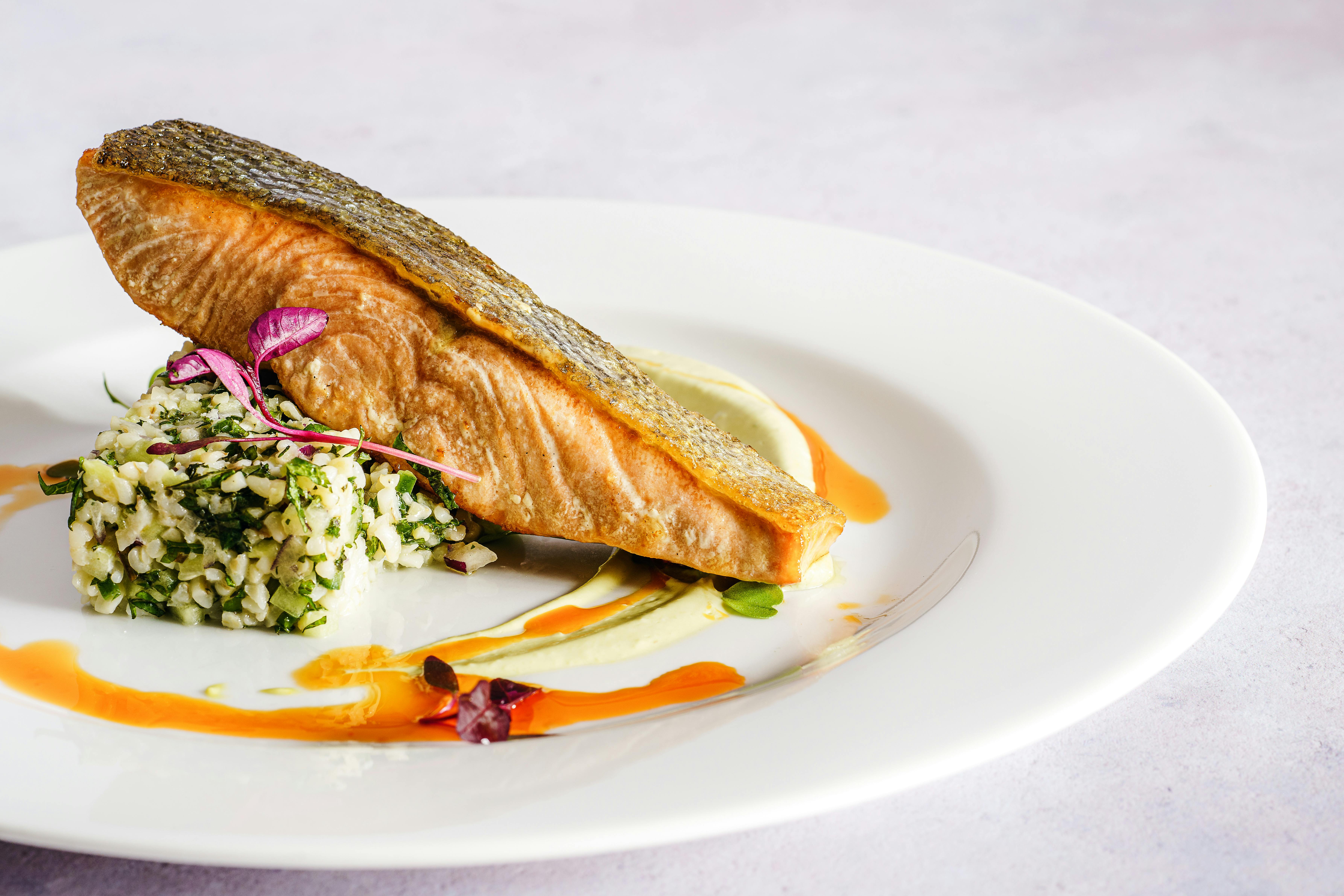
How many calories does smoked salmon have? Detailed analysis
Smoked salmon has approximately 117 kcal per 100 grams in its most common version (cold-smoked). To put it in context:
- A typical appetizer portion (50g, about 3-4 slices): 59 kcal
- A main course portion (100g): 117 kcal
- A standard supermarket package (100-120g): 117-140 kcal
These are moderate calories for such a nutritious food. For comparison: 100g of chicken breast has 165 kcal, a large egg has 155 kcal, and 100g of Manchego cheese has 370 kcal. Smoked salmon provides more nutrients per calorie than most common protein sources.
Caloric variation depends on several factors:
- Type of smoking: Cold smoking retains more moisture and has fewer calories (~117 kcal). Hot smoking loses more water and concentrates nutrients (~180 kcal).
- Species: Farmed Atlantic salmon usually has more fat (and therefore more calories) than wild Pacific salmon.
- Part of the fish: The belly has more fat than the loin. Slices from the central part are the most balanced.
Omega-3: the great benefit of smoked salmon
If smoked salmon stands out for something from a nutritional point of view, it is for its content of omega-3 fatty acids, specifically EPA (eicosapentaenoic acid) and DHA (docosahexaenoic acid). These are not plant-based omega-3s (ALA from flax or walnuts) — they are the active forms that the body can use directly.
100g of smoked salmon provides between 1.5 and 2.5g of combined EPA+DHA. The WHO recommends a minimum of 250-500mg daily. A single serving of smoked salmon covers between 3 and 10 times that recommendation.
What are these omega-3s for?
- Cardiovascular health: They reduce triglycerides, improve lipid profile, and have an anti-inflammatory effect on arteries. Multiple meta-analyses confirm a reduction in cardiovascular risk with regular EPA+DHA consumption.
- Brain function: DHA makes up 40% of the fatty acids in the brain. It is involved in memory, concentration, and mood. There is evidence that regular consumption of omega-3s reduces the risk of cognitive decline.
- Anti-inflammatory: EPA and DHA produce resolvins and protectins, molecules that actively resolve inflammation. Beneficial for joints, skin, and muscle recovery.
- Vision: DHA is a structural component of the retina. Associated with a lower risk of macular degeneration.
The cold smoking process preserves most of the omega-3s because it does not subject the fish to high temperatures. It is one of the most efficient ways to obtain EPA and DHA without cooking.
High biological value proteins
Smoked salmon contains 18-25g of protein per 100g (varies depending on water content). It is a complete protein — it contains all essential amino acids in adequate proportions. Its amino acid profile is comparable to that of red meat or eggs.
Notable among these are:
- Leucine: The key amino acid for muscle protein synthesis. Smoked salmon provides ~1.5g per 100g.
- Lysine: Essential for collagen production and calcium absorption. 1.8g per 100g.
- Tryptophan: Precursor to serotonin and melatonin. Contributes to good mood and sleep.
The digestibility of smoked salmon protein is high (PDCAAS of 0.95 out of 1.00) — the body utilizes almost all the protein ingested. It is a particularly efficient protein source.

Key vitamins and minerals
Beyond proteins and omega-3s, smoked salmon is a notable source of micronutrients that many people are deficient in:
Vitamin D — 11 mcg/100g (55% DRI)
Vitamin D is one of the most deficient in the Spanish population (and European in general). It is mainly obtained from sun exposure, and dietary sources are limited. Smoked salmon is one of the best dietary sources of vitamin D available. A 100g serving covers more than half of the daily needs.
Vitamin B12 — 3.3 mcg/100g (132% DRI)
Essential for red blood cell formation, neurological function, and DNA synthesis. B12 deficiency is common in people over 50 and vegetarians. 100g of smoked salmon more than covers the daily requirement.
Selenium — 32 mcg/100g (58% DRI)
Powerful antioxidant that protects cells from oxidative damage. Essential for thyroid function. The selenium in salmon has high bioavailability — it is absorbed better than selenium from plant sources.
Phosphorus — 164 mg/100g (23% DRI)
Fundamental for bone and dental health, along with calcium. It also plays a role in cellular energy metabolism.
Niacin (B3) — 4.7 mg/100g (29% DRI)
Involved in energy metabolism and DNA repair. Contributes to maintaining healthy skin, digestive system, and nervous system.
Nutritional comparison with other foods
| Food (100g) | kcal | Protein | Omega-3 | Vit. D | Sodium |
|---|---|---|---|---|---|
| Smoked salmon | 117 | 18g | 1.8g | 11 mcg | 784 mg |
| Fresh salmon (grilled) | 208 | 20g | 2.2g | 11 mcg | 59 mg |
| Chicken breast | 165 | 31g | 0.1g | 0.1 mcg | 74 mg |
| Canned tuna (in oil) | 198 | 29g | 0.3g | 2 mcg | 396 mg |
| Serrano ham | 241 | 31g | 0g | 0.2 mcg | 2300 mg |
| Boiled egg | 155 | 13g | 0.1g | 2 mcg | 124 mg |
Smoked salmon stands out for its nutritional density: maximum omega-3 and vitamin D per calorie. It is the food with the best omega-3/calorie ratio on this list. And its sodium, while higher than fresh salmon, is lower than Serrano ham.
For a complete overview of smoked salmon types, qualities, and how to choose, see our complete guide to smoked salmon.
7 science-backed benefits of smoked salmon
- Cardiovascular protection: Regular consumption of EPA/DHA omega-3s reduces blood triglycerides by 15-30% (2019 meta-analysis, Journal of the American Heart Association). 2 weekly servings of oily fish reduce the risk of cardiovascular death.
- Brain health: DHA is essential for neuronal structure. Longitudinal studies associate regular consumption of oily fish with a 20-30% lower risk of Alzheimer's and cognitive decline.
- Muscle protein: Salmon protein has high bioavailability and contains leucine, the amino acid that activates muscle protein synthesis. Ideal for athletes and older adults who need to maintain muscle mass.
- Natural Vitamin D: In a country where 40% of the adult population has vitamin D deficiency (paradoxically, despite the sun), smoked salmon is an exceptional dietary source.
- Anti-inflammatory effect: Omega-3s produce anti-inflammatory mediators (resolvins, protectins) that help resolve chronic low-grade inflammation — associated with obesity, type 2 diabetes, and autoimmune diseases.
- Skin health: Omega-3s, selenium, and vitamin D contribute to skin hydration, elasticity, and protection against sun damage. There is evidence that regular consumption of omega-3s improves conditions such as dermatitis and psoriasis.
- Satiety and weight control: The combination of protein and healthy fat generates high satiety. Studies show that meals rich in protein and omega-3s reduce appetite in the following hours more than carbohydrate-rich meals.
Smoked salmon and premium smoked products
Hand-cut smoked salmon, smoked trout, smoked cod — a selection of artisanal smoked products with the flavor and properties of the traditional process.
The Sodium Issue: Myths and Reality
The most debated point about smoked salmon is its sodium content. At 600-1100 mg per 100g (depending on the manufacturer), it is significantly higher than fresh salmon (50-60 mg/100g). But there are important nuances:
- Serving Context: A typical serving of smoked salmon is 50-80g (not 100g). That's 390-880 mg of sodium — 16-37% of the maximum recommended daily intake (2,300 mg). It's relevant but not alarming if the rest of your diet isn't excessively salty.
- Fair Comparison: Cured ham has 2,300 mg/100g (3 times more). Manchego cheese, 1,200 mg. Industrial bread, 500 mg. Smoked salmon is not the saltiest food in your diet — it's probably the bread.
- Who should monitor: People with diagnosed hypertension, kidney failure, or a strictly low-sodium diet prescribed by a doctor. For the rest of the population, moderate consumption of smoked salmon (2-3 times/week) does not pose a sodium problem.
- Trick to reduce salt perception: Acid reduces the perception of saltiness. Serving smoked salmon with lemon, vinaigrette, or acidic ingredients (capers, pickles) makes it seem less salty without changing its composition.
Smoked Salmon and Specific Diets
| Diet | Compatible? | Notes |
|---|---|---|
| Keto / Low carb | Perfect | 0g carbohydrates, rich in healthy fats |
| Mediterranean | Ideal | Dietary staple: oily fish 2-3 times/week |
| Paleo | Compatible | Protein and fat of natural origin |
| DASH (hypertension) | In moderation | Beneficial Omega-3 but monitor sodium |
| Calorie deficit | Excellent | 117 kcal/100g with high satiety |
| Pescetarian | Perfect | Star source of protein and omega-3 |
| Vegan/Vegetarian | No | It is an animal product |
| Pregnancy | Only hot smoked | Cold smoked not recommended due to Listeria risk |
For more information on smoked salmon and pregnancy, we have a specific guide on smoked salmon during pregnancy with all food safety recommendations.
How much and how often to eat smoked salmon?
The recommendation based on current scientific evidence:
- Optimal frequency: 2-3 servings of 50-80g per week. This covers the needs for omega-3 (EPA+DHA) and provides vitamin D and B12 without exceeding sodium recommendations.
- Minimum recommended: 1 weekly serving of oily fish (salmon, sardine, mackerel, anchovy). WHO, EFSA, and AHA all agree on this minimum recommendation.
- Prudent maximum: There is no strict documented limit, but more than 4-5 servings per week could lead to a sodium intake and potential contaminants (mercury, although salmon has low levels) that offers no additional benefits.
A practical serving: 2-3 slices of smoked salmon (50-60g) is a perfect serving as an appetizer or part of breakfast. 4-5 slices (80-100g) as a main course for a salad or a light meal.
🛒 Related Bacalalo Products
⭐ 4.9/5 · Cold shipping 24-48h · Since 1990 at Mercat del Ninot
Conclusion
Smoked salmon is a food with an exceptional nutritional profile: complete protein, abundant omega-3, vitamin D, B12, selenium, and all with only 117 kcal per 100g. It doesn't cause weight gain, is compatible with most diets, and has cardiovascular, brain, and anti-inflammatory benefits backed by science.
The only point of concern is sodium — something easily managed with moderate portions and balancing the rest of the diet. For the vast majority of people, 2-3 servings of smoked salmon per week is a nutritionally smart addition.
And as with everything, quality matters. Hand-cut artisan smoked salmon not only tastes better — it tends to have a better nutritional profile because the artisanal process uses fewer additives and respects the raw material more. Consult our complete guide to smoked salmon to choose wisely.
Quality artisan smoked products
Hand-cut smoked salmon, smoked trout and more. Traditional process that preserves flavor and nutritional properties.
Frequently asked questions about smoked salmon properties
How many calories does smoked salmon have?
Approximately 117 kcal per 100g (cold smoked) and up to 180 kcal (hot smoked). It is comparable to chicken breast in calories but with much more omega-3 and vitamin D.
Does smoked salmon make you gain weight?
No. Its 117 kcal/100g are moderate, its fats are mostly unsaturated (omega-3), and its high protein content promotes satiety. What adds calories are the accompaniments.
Is smoked salmon good for dieting?
Excellent. High in protein, rich in omega-3, zero carbohydrates, healthy fats. Compatible with keto, Mediterranean, paleo, low-carb, and caloric deficit diets.
How much omega-3 does smoked salmon have?
Between 1.5-2.5g of EPA+DHA per 100g. One serving covers several times the WHO daily recommendation (250-500mg).
Does smoked salmon have a lot of salt?
More than fresh salmon (600-1100mg vs 50-60mg/100g), but less than cured ham (2,300mg). With moderate servings of 50-80g, sodium is manageable.
Is it safe to eat smoked salmon during pregnancy?
Hot smoked salmon yes. Cold smoked salmon (slices) is not fully cooked and may contain Listeria. Consult your gynecologist.
How many times a week can you eat it?
2-3 servings of 50-80g per week is optimal. It covers omega-3 without exceeding sodium. Minimum recommended: 1 weekly serving of oily fish.
What is the nutritional difference with fresh salmon?
More sodium (due to curing), similar omega-3 and vitamins. Cold smoking preserves most of the nutrients of fresh salmon. The main difference is sodium.