

Summary
Spain celebrates Holy Week in very different ways depending on the region. Processions change, music changes, and food changes too. In this guide: What to eat during Holy Week in Spain: one country, many traditions, Northern Spain: cod, "fabada de vigilia" and "filloas", Central Spain: "potaje", "torrijas" and battered cod.
What to eat during Holy Week in Spain: one country, many traditions
Spain celebrates Holy Week in very different ways depending on the region. Processions change, music changes, and food changes too. What unites all tables is a constant: fish as the main dish and sweets to finish.
The abstinence from meat on Fridays of Lent (and especially on Good Friday) has shaped the culinary traditions of each community for centuries. Each area has used its local resources to create dishes that began as a religious obligation and are now gastronomic heritage.
This tour takes you through the Holy Week tables from north to south, and from east to west.
Northern Spain: cod, "fabada de vigilia" and "filloas"
Basque Country
Cod is the absolute king. Basques have turned Icelandic cod into haute cuisine with preparations such as "pil pil", "vizcaína" and "bacalao al club Ranero" (with green peppers and tomato sauce). On Good Friday, practically all Basque homes eat cod in one of these versions.
Galicia
Galicia combines local seafood with cod. "Pulpo á feira", cod empanada and Galician broth with turnip greens are the star dishes. For dessert, "filloas": thin crêpes filled with cream or honey, heirs to the Carnival tradition that extends until Holy Week.
Asturias and Cantabria
The "fabada de vigilia" replaces the meats of Asturian "fabada" with cod and clams. The result is just as hearty. In Cantabria, Cantabrian salted anchovies play a special role: they are eaten as an appetizer or on toast.
Central Spain: "potaje", "torrijas" and battered cod
Castile and León
"Potaje de vigilia" (chickpeas, spinach and cod) is the dish that defines Castilian Lent. Simple, nutritious and cheap: three virtues that have kept it on tables for centuries. "Hornazos" (pies filled with egg and sausage) are prepared for Easter Sunday, marking the end of abstinence.
Madrid
Madrid adopts the Castilian "potaje" and adds battered cod ("soldaditos de Pavía") as the star Holy Week tapa. Madrid's "torrijas", soaked in milk and coated in sugar and cinnamon, are sold in bars, bakeries and workshops throughout the season.
Castile-La Mancha
"Atascaburras" (shredded cod with mashed potatoes, crushed garlic, hard-boiled egg and walnuts) is a hearty Manchego dish. It resembles French brandade but with its own character. For dessert, fried flowers and aniseed "roscos".
Southern Spain: cod with tomato, "potaje" and "pestiños"
Andalusia
Andalusian Holy Week is as intense in the streets as it is at the table. Cod with tomato, spinach with chickpeas, bean stew with cod and "tagarninas esparragadas" are dishes that are repeated throughout the community. For dessert, "pestiños" bathed in honey and wine "torrijas".
Extremadura
Extremadura shares many dishes with Andalusia and Castile. "Chanfaina" (stew of offal, but in a Lenten version replaced by cod), garlic soups and "pestiños" are common. "Repápalos" (fried bread balls soaked in milk) are a unique dessert of the area.
Murcia
The Murcian "caldero" is adapted with cod. Murcian fishermen prepare a soupy rice with cod that is a marvel. The "pastel de cierva" (filled with meat, but adapted with tuna in a Lenten version) appears on the most traditional tables.
Eastern Spain: rice dishes, fritters and Easter Monas
Catalonia
In Catalonia, "bacallà a la llauna" (baked cod with garlic, parsley and paprika) is the classic Lenten dish. Also "bunyetes" (sweet fritters) and "coca de llardons". On Easter Sunday, the "mona" is given as a gift: a cake decorated with chocolate eggs that the godfather offers to his godchild.
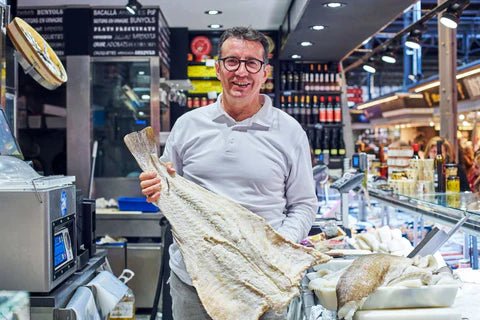
At Bacalalo, from our stall in the Mercat del Ninot in Barcelona, we experience this tradition first-hand. Every Holy Week, our sales of premium Icelandic cod multiply.
Valencian Community
Pumpkin fritters are the Valencian sweet for Holy Week (and Fallas, which coincide in dates). "Olleta de Cuaresma" (chickpea, bean, spinach and cod stew) is the Valencian version of Castilian "potaje". Here too, the Easter "mona" is given as a gift, with local variations.
Aragon
"Almojábanas" (fresh cheese and aniseed rings) and "crespillos de borraja" (borage leaves battered and fried with sugar) are unique Aragonese desserts. For the main course, "bacalao ajoarriero" (shredded with tomato, pepper and garlic) dominates Zaragoza tables.
Islands: own traditions between sea and tradition
Balearic Islands
"Panades" (dumplings filled with fish and vegetables) and "robiols" (sweet dumplings with fresh cheese or angel hair) are the protagonists in Mallorca. In Menorca, sweet "formatjades" are prepared for Easter.
Canary Islands
The Canary Islands have a strong tradition of cod and salted fish inherited from centuries of Atlantic trade. Canarian "sancocho" (salted fish cooked with wrinkled potatoes and "mojo") is the star dish of Good Friday. Sweet potato "truchas" (sweet potato dumplings) accompany as dessert.
The common thread: cod
From north to south, from east to west, cod appears in all Spanish Holy Week traditions. It is no coincidence. Salted cod was the fish that could be transported and preserved in inland Spain, far from the sea. Affordable, versatile and nutritious, it became the Lenten ingredient par excellence.
Today, with modern logistics, you can receive premium Icelandic cod at your home in 24-48 hours, ready to prepare any of these regional recipes.
Frequently asked questions
Why is fish eaten during Holy Week
The Catholic Church establishes abstinence from meat on Fridays of Lent and Good Friday. Fish is not considered meat for the purposes of this rule. For centuries, this made fish (and especially salted cod) the main food during these dates.
What is "potaje de vigilia"
It is a chickpea stew with spinach (or chard) and shredded cod, seasoned with a sofrito of garlic, paprika and tomato. It is the most representative dish of Lent in central Spain. Each family has its own version, but the basic ingredients are always the same.
Do all regions of Spain eat cod during Holy Week
Practically yes. Salted cod was for centuries the only fish accessible in inland areas. Even in coastal areas with access to fresh fish, cod maintains its prominence due to tradition. Each community prepares it differently.
What sweets are eaten during Holy Week in Spain
The most widespread are "torrijas" (all of Spain), "pestiños" (Andalusia, Extremadura), "filloas" (Galicia), "buñuelos de viento" (Castile), Easter "monas" (Catalonia, Valencia, Murcia), fried "roscos" (Castile-La Mancha) and sweet "panades" (Balearic Islands).
Discover more