Salmon Roe (Ikura): What It Is, How to Use It, and 5 Recipes
Salmon roe is one of those ingredients that elicits two opposing reactions from people: those who have never tried it feel a certain apprehension (they are orange pearls that burst in the mouth, a product that challenges the familiar), and those who know it cannot imagine an elegant appetizer platter without them. This guide is intended to bring the former into the latter's camp.
We explain exactly what salmon roe is, the difference between ikura and other roes, how it is produced, how to store it, how to use it in cooking, and five specific recipes to make the most of it. All with a reference product: Tanit Keta Premium salmon roe available at Bacalalo.
What are salmon roe and what is ikura?
Updated March 2026. In our over 30 years of experience at Mercat del Ninot, this is what we recommend.
Salmon roe are the eggs of salmon, extracted from the female's egg sac (known as a "skein") before fertilization. Each egg is a sphere between 4 and 7 millimeters in diameter, with an intense orange to red-orange color depending on the salmon species and degree of maturity.
The term ikura is the Japanese word for salmon roe cured in soy sauce (and sometimes sake and mirin). In Japan, ikura is one of the most prized ingredients in sushi and sashimi, and is widely used in high-level Japanese cuisine. In the Western context, "ikura" is sometimes used more broadly to refer to any salmon roe, even those simply salted without the Japanese process.
Keta roe specifically refers to the roe of keta salmon (Oncorhynchus keta), also called chum salmon. They are the largest and most intensely flavored among commercially available salmon roes. Their size of 6-7 mm makes the burst in the mouth very prominent, which makes them especially attractive as a topping and for presentation.
The difference between ikura, masago, tobiko, and caviar
When talking about roe and fish eggs in a gastronomic context, there are several terms that are frequently used and important to distinguish:
- Ikura: Salmon roe. Large (4-7 mm), orange, sweet-savory flavor with marine notes. The most visually striking.
- Masago: Capelin roe (a small fish from the North Atlantic). Very small (1-2 mm), orange, mild flavor. Frequently used as a garnish in low-cost sushi. Often artificially colored.
- Tobiko: Flying fish roe. Small (1-1.5 mm), crunchy, with a more intense flavor than masago. Comes in various colored versions (wasabi green, squid ink black, red).
- Caviar: Sturgeon eggs (Acipenser sp.). Different species, different preparation, different price. Beluga, osetra, or sevruga caviar is not interchangeable with salmon roe in either flavor or price. Some brands use "salmon caviar" as a commercial name for salted salmon roe, which is technically incorrect but very widespread in the Spanish market.
How salmon roe is produced
Quality salmon roe undergoes a production process that determines its final flavor and texture. The basic process includes:
- Extraction: The roe is carefully extracted from the skein to avoid breaking the pearls. A broken roe contaminates the flavor of the batch with the internal liquid.
- Washing: They are washed in cold water to remove the membrane and skein remnants.
- Salting: The roe is salted in a controlled concentration brine for a specific period. Salting adds flavor, acts as a preservative, and firms the outer membrane texture of the roe.
- Draining and packaging: The roe is drained and packaged, usually in glass jars or hermetic plastic containers, with or without additional preservatives depending on the producer's process.
The Keta roe from the Tanit line we offer at Bacalalo follows a production process that prioritizes the absence of artificial additives and the freshness of the product: the result is a roe with a firm membrane (which gives the characteristic burst), clean marine flavor, and intense natural color.
How to store salmon roe
Salmon roe is a delicate product that requires correct handling to maintain its quality:
- Unopened: In the refrigerator between 0 and 4 degrees Celsius, in the coldest part (usually the bottom shelf). Before its expiration date indicated on the package.
- Once opened: Consume within a maximum of 2-3 days, stored tightly covered in the refrigerator. Opened roe oxidizes quickly, and the membrane begins to lose firmness.
- Freezing: Salmon roe can be frozen before opening if specified by the producer. Once thawed, the texture becomes slightly softer. Do not refreeze under any circumstances.
- Serving temperature: Take out of the refrigerator 10-15 minutes before serving. If too cold, the flavor flattens. At too high a room temperature (above 20 degrees Celsius), they begin to lose firmness. The ideal serving temperature is between 8 and 12 degrees Celsius.
How to use salmon roe in cooking: the basic guide
Salmon roe has some usage restrictions that should be known before incorporating it into recipes:
- Never with direct heat: Salmon roe is not cooked. Heat destroys the membrane, the internal contents spill out, and the roe loses all its appeal. It is always used cold or at room temperature, as a finishing element.
- At the end of preparation: Always incorporate it just before serving, never during the preparation of the dish.
- With non-metallic utensils: Metal interacts with the roe membrane and can slightly alter the flavor. Use mother-of-pearl, wood, or plastic spoons to serve and handle the roe.
- In reasonable quantities: Roe is flavorful and salty. A teaspoon is enough as a topping for an individual portion. More quantity dominates the dish.
The 5 salmon roe recipes
Recipe 1: Blinis with creme fraiche and salmon roe
The most classic recipe and the one that best demonstrates why roe is a perfect appetizer ingredient. Prepare blinis (or use good quality store-bought blinis, warmed at the moment): small, fluffy, slightly bitter buckwheat pancakes. Place half a tablespoon of creme fraiche (or sour cream, or mild cream cheese) on each blini. On top, a teaspoon of Tanit Keta salmon roe. A pinch of fresh dill.
The result is one of the most elegant and easiest canapés that exist. The warm blini contrasts with the freshness of the creme fraiche and the roe. The lactic fat of the cream cheese softens the saltiness of the roe. The burst of each roe in the mouth releases a marine liquid that blends with the creme fraiche and the blini in a single, perfectly balanced bite. For a gathering of 8 people, a 100g jar of roe is sufficient for 20-25 canapés.
Recipe 2: Salmon sashimi with roe and ponzu
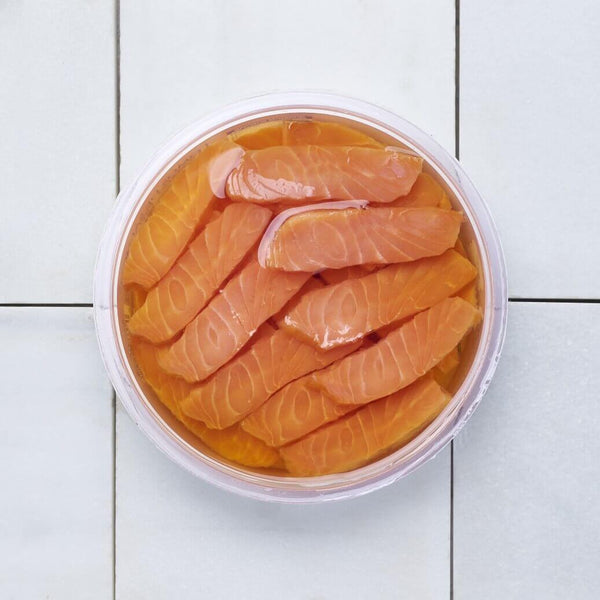
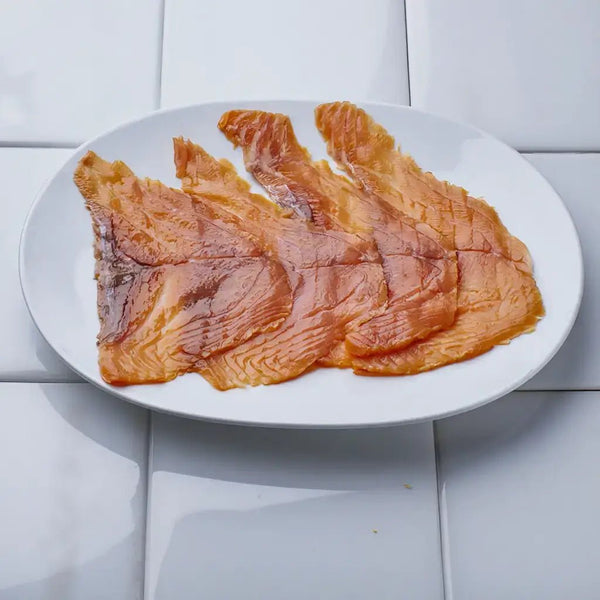
A Japanese-inspired recipe but with seafood from Northern Europe and the Atlantic. Slice the 150g smoked salmon sashimi into 5-7 mm slices if it's not already pre-sliced. Arrange it on a cold plate in a fan shape. On top of each slice, place half a teaspoon of salmon roe. Pour a tablespoon of homemade ponzu sauce (or soy sauce with a touch of yuzu or lemon) around the salmon, not on top to avoid drowning the roe. Finish with finely chopped chives and a few drops of sesame oil.
The smoked salmon-salmon roe combination is an intra-species pairing that has coherence: two completely distinct textures (the firm and laminar of smoked salmon, the spherical and explosive of the roe) with the same basic marine profile. The ponzu provides the acidity that balances the richness of the whole.
Recipe 3: Avocado toast with salmon roe and lemon
Avocado toast is already a classic of contemporary brunch. Salmon roe transforms it into something of another dimension. Toast sourdough or thick rye bread. Mash ripe avocado with salt, pepper, and lemon juice (do not use guacamole with onion or tomato: plain avocado is more versatile here). Spread the avocado on the toast. On top, place a generous teaspoon of salmon roe. Finish with lemon zest, a pinch of Maldon salt, and fresh dill.
Avocado and roe is a combination that appears in many trendy restaurants precisely because it works: the neutral and creamy fat of the avocado is the perfect backdrop against which the roe shines in flavor and texture. The toast provides the necessary crunch for the ensemble to have a variety of textures in a single bite.
Recipe 4: Salmon tartare with roe as a crown
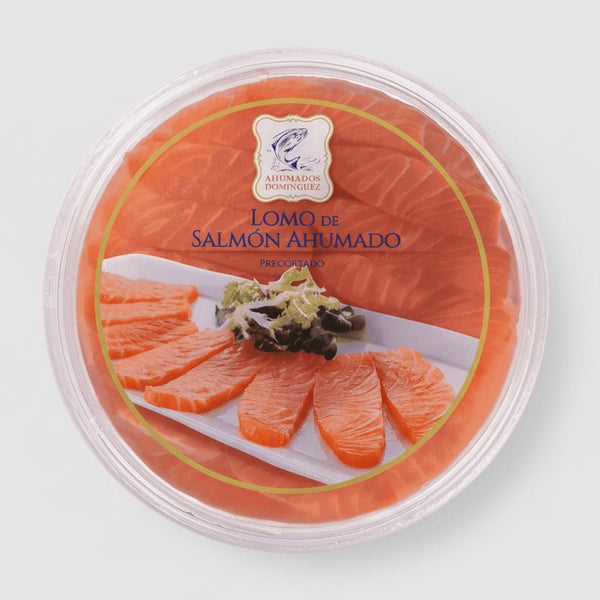
Salmon tartare with roe is the dish where the roe fulfills its function of a "crown": the visual and flavorful flourish that finishes the dish and elevates it to the next level. For the tartare: cut smoked salmon loin into 5 mm cubes. Gently mix with a teaspoon of sesame oil, a teaspoon of soy sauce, a few drops of lemon juice, and finely chopped spring onion. Form the tartare in a round mold on the plate (or simply in a quenelle with two spoons). On top of the tartare, place a heaped teaspoon of salmon roe.
Visually, the intense orange of the roe on the pink-orange of the salmon is one of the most attractive platings in marine product cuisine. In terms of flavor, the two layers of salmon (cured-smoked below, fresh marine from the roe above) create a tasting experience where you start with one flavor and finish with another, both coherent and complementary.
Recipe 5: Pasta with butter, lemon, and salmon roe
This recipe demonstrates the use of roe as a topping for a hot main dish, with the caution of always incorporating it off the heat. Cook quality pasta (linguine or tagliolini work well) al dente. Drain and mix with unsalted butter, lemon zest and juice, and black pepper. Serve immediately on hot plates. On top of the pasta, at the last moment, place a teaspoon of salmon roe and a few dill sprigs.
The contrast between the hot pasta and the cold roe is one of the most interesting effects of this recipe: the roe warms slightly upon contact with the pasta, which softens its membrane and makes the burst more delicate without actually cooking them. The butter and lemon are the neutral base that allows the roe to be the flavor you remember. An Italian-Japanese restaurant pasta in 15 minutes.
Salmon roe on the appetizer platter
Salmon roe is the most visually striking element of any seafood appetizer platter. Its intense orange color contrasts with the pink-orange of smoked salmon, the dark color of mojama (dried tuna), and the white of asparagus. On the platter, serve it in its original jar or in a small glass bowl with a mother-of-pearl spoon. Place the bowl in a prominent spot on the platter, surrounded by blinis or toasts that serve as a natural base for the roe.
For a platter for 6 people, 100g of roe is the right amount: enough for everyone to generously sample without too much leftover, as opened roe should be consumed on the same day.
🛒 Products used in this recipe
⭐ 4.9/5 · Cold shipping 24-48h · Since 1990 in Mercat del Ninot
Frequently Asked Questions about Salmon Roe
Is salmon roe caviar?
No. Caviar, in the strict sense, is exclusively from sturgeon. Salmon roe is a different product, with its own identity and uses. Some brands use "salmon caviar" as a commercial designation, which is imprecise but very widespread. In any case, premium quality salmon roe is an excellent product in its own right, without the need for comparison with sturgeon caviar.
Can salmon roe be consumed during pregnancy?
Salmon roe is a raw product that may contain Listeria or other microorganisms. Health authorities recommend avoiding raw or minimally processed seafood products during pregnancy. Consult your doctor or midwife for specific guidance based on your situation.
How much does salmon roe weigh in a teaspoon?
A level teaspoon of salmon roe is approximately 10-12 grams. A heaped teaspoon is 15-18 grams. For blini canapés, a level teaspoon is the correct proportion per piece.
Can salmon roe be used in hot cooking?
Not as an ingredient that receives direct heat. Always as a finishing element off the heat. In the pasta we described in the recipes, the residual heat of the pasta warms them slightly: this is the maximum tolerable temperature limit for the roe without losing texture and flavor.
What is the nutritional difference between salmon roe and smoked salmon?
Salmon roe is an extraordinarily concentrated source of omega-3, vitamin D, and vitamin B12 per gram of product. 30g of salmon roe can contain as much omega-3 as 100g of salmon. They are also rich in choline, an essential nutrient for brain function that many people consume insufficiently. They are saltier and consumed in smaller quantities, but nutritionally they are one of the most dense sources of essential nutrients available.
Find the best salmon roe at Bacalalo
The Tanit Keta Premium salmon roe is the product with which we have worked all the recipes in this guide. Their quality of preparation, the firmness of the membrane, and the intensity of the flavor make them the ideal starting point for exploring ikura in home cooking.
Combine them with smoked salmon loin, smoked salmon sashimi, and the rest of the products from our smoked salmon collection to build the complete seafood menu that these ideas deserve. At Mercat del Ninot, we have been helping our customers discover ingredients that transform everyday cooking into something more since 1990.