Abstract: White asparagus from Navarre and Cantabrian anchovies are two of the most prized products in Spanish gastronomy. Separately, each is exceptional. Together, they create one of the most perfect flavor balances in seasonal cuisine: the earthy sweetness of asparagus merges with the salty umami of anchovies, and a citrus vinaigrette unites them with a thread of brilliant acidity. This recipe is elegant, ready in 25 minutes, and works equally well as a starter for a special dinner or as a side dish for a main course.
Table of Contents
- Why asparagus and anchovies are a perfect combination
- Ingredients with quantities
- Preparing the asparagus: perfect cooking step by step
- Preparing the citrus vinaigrette with anchovies
- Plating the dish
- Variations: with smoked salmon, with poached egg
- Presentation to impress
- Frequently Asked Questions
Why asparagus and anchovies are a perfect combination
Updated March 2026. Every day at Mercat del Ninot we see what works and what doesn't. This is our real-world experience.
Some pairings work by contrast: acidic against fatty, sweet against bitter. And some pairings work by complementarity: two products that share a common denominator and mutually reinforce each other. White asparagus and Cantabrian anchovies belong to the second category, and understanding why makes for a better chef and a more discerning diner.
The umami denominator
White asparagus has a concentration of glutamic acid (the amino acid that creates the sensation of umami) that surpasses many other vegetables. In tasting, this umami is perceived as a long, complex "background flavor," different from the simple sweetness of a carrot or the acidity of a tomato. Cantabrian anchovies, cured in salt for 10 to 12 months, are literally an umami bomb: the curing process breaks down the proteins of the anchovy into free amino acids, including glutamate, in very high concentrations.
When you put asparagus and anchovies in the same bite, the two umamis add up: this is the principle of umami synergy that molecular gastronomy scientists have been documenting for decades. The result is a more intense and longer-lasting background flavor than each ingredient produces separately. It's not that one covers the other; it's that they amplify each other.
The balancing contrast
If umami were the only element at play, the dish would be heavy. Here enters the contrast: white asparagus is soft, slightly sweet, with a delicate bitterness at the end that makes it interesting. Anchovy is intense, salty, fatty. If you serve anchovy directly on asparagus without mediation, the intensity of the anchovy crushes the asparagus. The citrus vinaigrette is the mediator: its acidity softens the salt of the anchovy, the emulsified oil creates continuity with the fat of the fillet, and the citrus adds freshness that balances the power of the whole.
White asparagus from Navarre: why origin matters
White asparagus from Navarre has a protected designation of origin since 1986. It is characterized by a large diameter (minimum 11 mm), uniform white color, firm texture, and a sweeter, less bitter taste than asparagus from other origins. The Navarrese cultivation system (aterrado, meaning covered with soil to prevent photosynthesis and maintain its white color) produces asparagus with a specific organoleptic profile that is not replicated in Peruvian or Chinese asparagus found in supermarket aisles. For this recipe, the quality of the asparagus is as important as that of the anchovy: industrial white asparagus with a spongy texture and watery taste will not yield the expected result.
At Bacalalo, we have been at the Mercat del Ninot in Barcelona for over 35 years, choosing the best seafood products for our customers. We apply the same attention to origin to anchovies as we do to everything we recommend in our recipes.
Ingredients with quantities
This recipe serves 4 people as a starter or 6 as a side dish. Asparagus is the star, anchovy the conductor, and vinaigrette the link. Do not skimp on any of the three.
For the asparagus
- 800 g of fresh white asparagus from Navarre (or, failing that, quality canned white asparagus, well drained)
- Plenty of water for cooking
- 1 tablespoon coarse salt
- 1 teaspoon sugar (optional, to reduce natural bitterness)
- 1 tablespoon extra virgin olive oil (for cooking)
For the citrus vinaigrette with anchovies
- 6-8 Cantabrian anchovy fillets in olive oil (depending on size: if they are 00, 6 is enough; if smaller, use 8)
- 4 tablespoons extra virgin olive oil (a mild, not very intense oil)
- 2 tablespoons freshly squeezed orange juice
- 1 tablespoon lemon juice
- 1 teaspoon orange zest (only the orange part, without the white)
- 1 teaspoon Dijon mustard
- 1 teaspoon acacia honey or agave (to balance acidity)
- 1 tablespoon fresh chopped chives
- Freshly ground black pepper
To finish the dish
- Fresh flat-leaf parsley (leaves only, no stems)
- Fleur de sel or Maldon salt to finish
- Freshly ground black pepper
- A drizzle of quality extra virgin olive oil to finish
Preparing the asparagus: perfect cooking step by step
Fresh white asparagus has a narrow cooking window. Too little time and it remains raw, with a woody texture and untamed bitterness. Too much time and it becomes spongy, loses structure, and the flavor flattens. The key is to know the product you are working with: the thickness of the asparagus determines the cooking time.
Step 1: peel the asparagus
Fresh white asparagus is always peeled, unlike green asparagus. The outer skin is fibrous and bitter, and although heat partially softens it, the mouthfeel is better without it. Use a vegetable peeler or a thin serrated knife. Peel from 2 cm below the tip to the base, rotating the asparagus. Do not peel the tip: it is the tenderest part and does not need it. Cut off the tough end of the base (1-2 cm), which is usually fibrous regardless of caliber.
Step 2: tie into bundles (optional but recommended)
Tying asparagus into bundles of 4-5 pieces with kitchen twine makes it easy to put them in and take them out of the water without breaking them, and ensures they all receive the same cooking time. This is a step that restaurants always use and that makes a difference in presentation at home.
Step 3: the cooking water
Bring a large pot of water to a boil. Add the coarse salt, sugar (sugar counteracts the natural bitterness of the asparagus without sweetening the final result), and a tablespoon of olive oil. The oil helps the asparagus retain its white color during cooking.
Step 4: cooking by caliber
Place the asparagus (in bundles or loose) into the boiling water and count from when the water returns to a boil:
- Very thick caliber asparagus (more than 18 mm): 8-10 minutes
- Standard caliber asparagus (12-18 mm): 6-8 minutes
- Thin caliber asparagus (less than 12 mm): 4-5 minutes
The correct cooking test: insert the tip of a knife into the thickest part of the asparagus. It should enter with slight resistance but effortlessly. The tip should yield without bending. If the tip bends, it is overcooked.
Step 5: stop cooking in ice water
As soon as the asparagus is done, remove it immediately and submerge it in cold water with ice. This step stops the cooking at the exact moment and fixes the color. Without this step, the asparagus continues to cook with residual heat, and in 2-3 minutes it can go from perfect to slightly overcooked. Leave the asparagus in the ice water for 1-2 minutes, remove them and dry them well with kitchen paper.
Canned asparagus: the valid shortcut
If it's not fresh asparagus season or you can't find good white asparagus, quality canned white asparagus from Navarre is a perfectly valid option for this recipe. Drain them well, dry them with kitchen paper, and proceed directly to assembly (no additional cooking needed). The final result with good canned asparagus is very close to that of perfectly cooked fresh asparagus.
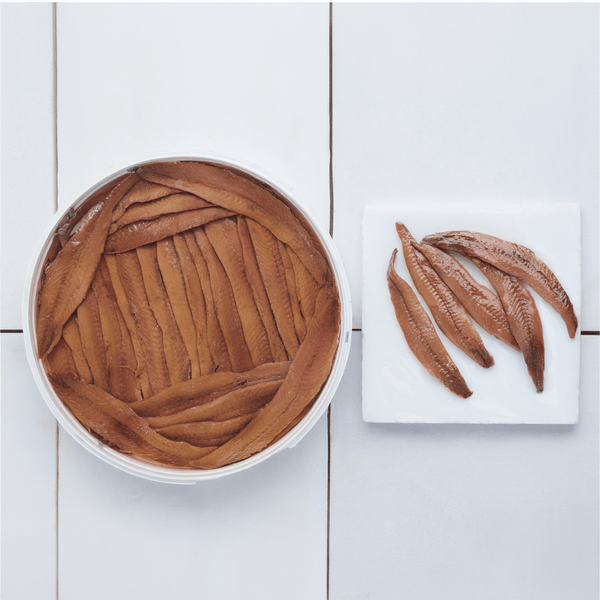
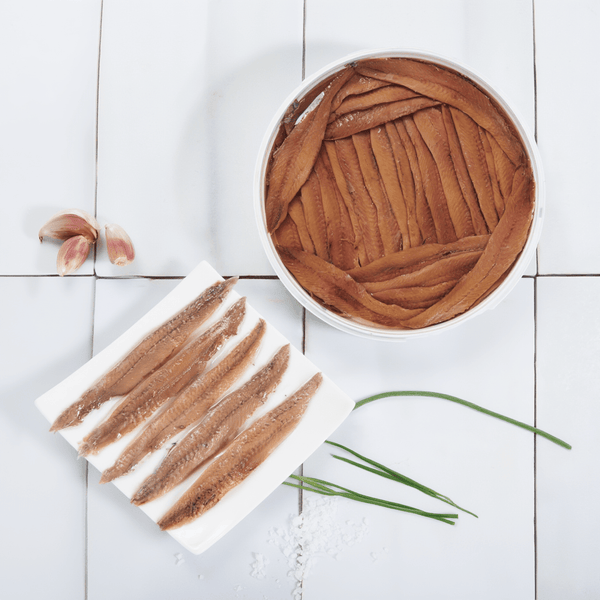
Cantabrian Anchovies "00" Premium — The fillet that elevates any recipe
Double-zero caliber anchovy fillets, cured for 10-12 months, hand-filleted, in extra virgin olive oil. The base of the vinaigrette that makes this recipe memorable. Since 1990 at Mercat del Ninot in Barcelona.
Preparing the citrus vinaigrette with anchovies
This vinaigrette is not a secondary dressing. It is the heart of the recipe: the piece that integrates asparagus and anchovies into a coherent gastronomic discourse. The key is emulsification and managing the intensity of the anchovy.
Step 1: mash the anchovies
Drain the anchovy fillets from their oil and place them in a mortar or a small bowl. Mash them with a pestle or the back of a fork until you get a homogeneous paste. It doesn't have to be a perfect purée: small pieces of anchovy add texture to the vinaigrette. This step distributes the intensity of the anchovy evenly in the vinaigrette, instead of having a whole fillet that dominates the bite. The anchovy oil (which has spent months absorbing the flavor of the fillet) is valuable: you can add 1 tablespoon to the vinaigrette.
Step 2: emulsify the vinaigrette
In a small jar or bowl, combine the anchovy paste, Dijon mustard, orange juice, lemon juice, and honey. Mustard and honey are natural emulsifiers that will keep the oil and juice integrated. With a small whisk or fork, mix well until the anchovy is distributed in the liquids. Add the olive oil in a thin stream while continuing to whisk. The result should be a vinaigrette that doesn't separate immediately when you stop whisking, with a slightly creamy texture and a golden-orange color.
Step 3: add the zest and chives
Stir in the orange zest and chopped chives. The zest is the element that provides the floral citrus aroma (which juice alone doesn't have) and turns a correct vinaigrette into a memorable one. Chives add herbaceous freshness and a visual color that livens up the dish. Mix and taste: it should be distinctly acidic, with the anchovy present but not aggressive, and the citrus well-defined. Adjust with salt (you generally won't need much) and pepper.
Vinaigrette temperature
This vinaigrette is served at room temperature, never cold from the fridge. Cold flattens the essential oils of the citrus and slightly solidifies the olive oil, making the vinaigrette dense and less aromatic. If you prepare it in advance and store it in the fridge, take it out 20 minutes before serving to allow it to come to room temperature.
Plating the dish
This recipe allows for two presentations: individual or on a platter for sharing. For a more formal dinner, individual is more elegant. For a family meal or with friends, a platter facilitates serving and creates that generous shared table atmosphere that characterizes Spanish cuisine at its best.
Individual presentation
On a white or cream-based flat plate, arrange the asparagus in parallel, with the tips oriented in the same direction. The standard number is 4-5 thick asparagus or 6-7 medium asparagus per serving. Pour 2-3 tablespoons of vinaigrette in a stream over them, allowing some to fall onto the side of the plate to create visual movement. Place 1-2 whole anchovy fillets over the asparagus, diagonally, so that it is visually clear that the anchovy is a protagonist and not an ingredient hidden in the vinaigrette. Add a few flat-leaf parsley leaves and a touch of fleur de sel. Finish with freshly ground black pepper and a thin drizzle of quality olive oil.
Platter presentation
Arrange the asparagus on the platter in a single layer, slightly overlapping. Pour the vinaigrette in a stream over the entire dish. Distribute the whole anchovy fillets irregularly (not symmetrically: asymmetry is more elegant in this type of dish). Add the parsley, fleur de sel, and oil. Serve immediately or within 5 minutes: asparagus in contact with acidic vinaigrette begins to change color over time.
Serving temperature
White asparagus is served warm or at room temperature, never hot or cold. If hot, the vinaigrette heats up with them and the olive oil loses its freshness. If cold, the texture of the asparagus hardens and the flavor flattens. The ideal point is the "fresh out of ice water" temperature: cool to the touch but not icy, between 15 and 20 degrees Celsius.
Variations: with smoked salmon, with poached egg
The base of this recipe is solid enough to allow for variations that adapt it to different contexts and occasions.
Variation 1: asparagus with smoked salmon and anchovy vinaigrette
Instead of directly incorporating anchovies into the vinaigrette and placing whole fillets on top, use a citrus vinaigrette without anchovies (just oil, orange juice, lemon, mustard, and honey) and add slices of smoked salmon next to the asparagus. Place the whole anchovy fillets between the salmon and asparagus, as a visible link between the two proteins. The anchovy acts as a seasoning for both the salmon and the asparagus. The result is a richer, more substantial dish, suitable as a single appetizer or even a light main course.
Variation 2: asparagus with poached egg and anchovy vinaigrette
This is a classic French bistronomic dish (asperges sauce gribiche) reinterpreted with anchovy vinaigrette. Poach one egg per person: bring water to a boil with a splash of vinegar, reduce to a gentle simmer until the water barely trembles, create a whirlpool with a spoon, and pour the egg into the center. 3-4 minutes for a liquid yolk, 5 for a creamy yolk. Place the poached egg over the asparagus and break the yolk before serving: the liquid yolk mixes with the vinaigrette, creating a spontaneous sauce that enriches the dish. A very elegant brunch or informal lunch dish.
Variation 3: grilled asparagus with anchovy vinaigrette
If you prefer a toastier, less delicate result, sear the cooked asparagus on a very hot griddle with a little oil, 1-2 minutes per side until grill marks appear. The toasting adds Maillard notes (the same bitter, toasted notes as coffee or bread) that contrast with the citrus vinaigrette differently than simply cooked asparagus. A more summery and rustic version of the same dish.
Cantabrian Anchovy Collection — To choose the fillet that best fits your recipe
From 00 caliber for high-level presentations to menu format for everyday cooking. All with Cantabrian anchovies, long curing, and olive oil. Discover which one is yours.
Presentation to impress
The presentation of a dish of white asparagus with anchovies may seem simple, but it has its tricks. These are the details that make the difference between a correct homemade dish and a restaurant-quality dish.
The plate as a canvas
Use white or neutral-toned plates. White asparagus on dark-colored plates loses visual impact. White creates contrast with the golden color of the vinaigrette, the coppery anchovy, and the green of the chives and parsley. If you have artisan white or cream-colored ceramic plates, use them: they give a much higher presentation dimension than industrial plates.
Asymmetry as a principle
Perfectly symmetrical dishes look like industrial catering. Arrange the asparagus with a slight irregularity: not perfectly parallel, but with small variations in angle. Distribute the vinaigrette so that it covers some more than others. Place the anchovy diagonally, not centered. This "controlled imperfection" gives a signature cuisine look that professional chefs actively seek.
The final touches that transform
The three touches that have the most impact are: fleur de sel (visible, not dissolved), a drizzle of quality olive oil (shiny, visible), and fresh citrus zest added at the last moment. These three elements don't just add flavor: they add texture, shine, and color that make the dish visually appealing before the first bite. Flat-leaf parsley or chervil leaves (if you have them) add a fresh green that completes the picture.
The time between plating and serving
This recipe doesn't wait. White asparagus in contact with acidic vinaigrette for more than 10 minutes begins to change color (the pectin in the skin reacts with the acid) and loses some texture. Plate the dish just before bringing it to the table. If you are both the cook and the host, prepare all elements in advance and assemble at the last minute: 2-3 minutes of work per plate when everything is ready. To explore more anchovy recipes, check out our guide to easy and gourmet anchovy recipes.
Frequently Asked Questions
Can canned white asparagus be used instead of fresh?
Yes. Good quality canned white asparagus from Navarra is a perfectly valid substitute when fresh is not in season (the natural season is from March to May). Drain them well, pat them dry with kitchen paper, and use them directly in the assembly without cooking. The result is very close to well-cooked fresh asparagus. Avoid canned goods of unknown origin or very cheap ones: small caliber asparagus in unsalted water have little texture and flat flavor.
How many anchovy fillets are needed per person?
For the vinaigrette, use 2 fillets per person in the emulsion (6-8 for four people). For the presentation on top of the dish, 1-2 whole fillets per person are sufficient: the anchovy should accompany the asparagus, not dominate it. If you use 00 caliber anchovies (very large), 1 fillet per serving is enough. If they are smaller caliber, use 2. Adjust according to your preference for anchovy intensity.
What type of olive oil is best for the vinaigrette?
For this vinaigrette, use a mild-flavored extra virgin olive oil: an Arbequina or an olive oil from the Les Garrigues (Lleida) area or the Sierra de Cádiz. An overly intense oil (e.g., a very green Extremaduran picuda) would overpower the anchovy and citrus. The oil should be the vehicle of flavor, not a dominant flavor itself. If you only have intense oil, reduce the quantity to 3 tablespoons instead of 4 and add 1 of mild sunflower oil to balance it.
Can the vinaigrette be prepared in advance?
Yes. The citrus anchovy vinaigrette lasts 24-48 hours in the refrigerator in an airtight container. The emulsion tends to separate when resting: shake or whisk again before using. Orange zest, if you included it, can become slightly bitter after 24 hours: if you notice that bitterness, strain it before serving. What should not be prepared in advance is the final plating of the dish: asparagus, vinaigrette, and anchovy are combined at the last moment.
Do white asparagus need to be peeled?
Always, if fresh. The outer skin of fresh white asparagus is fibrous and has a pronounced bitterness that does not disappear with cooking. Peeling is what differentiates a well-treated asparagus from a neglected one. If they are canned asparagus, they come already peeled and ready. If they are very thin white asparagus (less than 10 mm in diameter), peeling is optional because the skin is thin and the texture is tender without peeling.
Can the recipe be made without anchovies for a vegetarian version?
Yes, with adaptations. To maintain the umami provided by the anchovy, add to the vinaigrette: 1 teaspoon of white miso paste (shiro miso), which has an umami profile similar to anchovy but without animal origin. Miso does not give the specific flavor of anchovy, but it does provide the body and depth that would be needed in the vinaigrette. Alternatively, use 1 tablespoon of finely chopped quality black olives: they have umami from aging and add a Mediterranean flavor that complements the asparagus.
What wine pairs best with asparagus and anchovies?
White asparagus is one of the most difficult ingredients to pair with wine because its high concentration of aspartic acid clashes with many wines, making them taste metallic or bitter. Options that work: Albariño from Rías Baixas (high acidity, mineral, citrus), Austrian Grüner Veltliner (herbaceous and mineral profile that coexists well with asparagus), and sparkling wines such as Cava Brut or Champagne Blanc de Blancs. The anchovy adds salt which enhances the acidity of the wines: avoid very tannic or very alcoholic wines, which will amplify that salt unpleasantly.
Premium Seafood Products — Bacalalo
Since 1990, selecting the best from the sea in Mercat del Ninot, Barcelona. Refrigerated shipping 24-48h.
View Cantabrian anchovies →🛒 Related Products from Bacalalo
Cantabrian Anchovies "00" Gourmet Selection
Premium 00 caliber, artisanal preparation
38,90€
View product →⭐ 4.9/5 · Cold shipping 24-48h · Since 1990 at Mercat del Ninot
Conclusions
White asparagus with citrus vinaigrette and anchovies demonstrates that elegance in cooking does not require technical complexity. It requires quality ingredients, an understanding of flavor balance, and respect for the product. White asparagus from Navarra, Cantabrian anchovy, and fresh citrus are three ingredients that harmonize from the first bite.
- For the classic recipe: "00" Premium anchovy fillets — from €24.90. The fillet that makes the dish memorable.
- To explore all calibers: Bacalalo's complete selection of Cantabrian anchovies. From entry-level to premium selection.
- For more anchovy recipes: our guide to easy and gourmet anchovy recipes.
At Bacalalo, we have been selecting the best Cantabrian anchovies season after season since 1990 at Mercat del Ninot in Barcelona. The same selection criteria we apply at the counter are applied to what we sell online. If you have any questions about which anchovy to use for this recipe or any other, we are available to advise you.