

Table of Contents
- Why Iran: The Southern Caspian and its Sturgeons
- The Three Types of Iranian Caviar
- Beluga 000: The World's Most Exclusive Caviar
- Osetra: The Connoisseurs' Favorite
- Sevruga: Intense and Accessible
- CITES Certification: What it Guarantees and Why it Matters
- How to Serve Iranian Caviar Correctly
- How to Taste Caviar: A Sensory Guide
- Storage and Preservation
- Pairing: Champagne, Vodka, and Beyond
- Iranian Caviar Prices: Why it Costs What it Costs
- Conclusion
- Frequently Asked Questions
Why Iran: The Southern Caspian and its Sturgeons
The Caspian Sea is the largest lake in the world and the natural habitat of sturgeons that produce the most valued caviar on the planet. But not all of the Caspian is the same. The southern sector — the Iranian coast — presents unique conditions that no other geographical area can replicate.
The waters of the southern Caspian are deeper, warmer, and have higher salinity than those in the north (Russia, Kazakhstan). The rivers that flow into this area — Sefid Rud, Gorgan, Tajan — carry nutrients from the Elburz mountains that feed a rich and diverse food chain. Sturgeons that live and reproduce in these waters develop roe with a more complex flavor profile, with marine, nutty, and buttery nuances that experts immediately recognize.
Iran has been regulating sturgeon fishing since the 1920s. While Russia and other Caspian countries overfished their populations to the brink of extinction, Iran established strict quotas, fishing bans, and a dedicated scientific body — the IIFRO (Iranian International Fisheries Research Organization) — that monitors the state of populations with real data.
It is important to understand that Iranian caviar is not "the best" by tradition or marketing. It is the global reference because the environmental conditions of the southern Caspian produce superior raw material and because the Iranian control system has preserved both the species and the quality of the product when other countries failed on both fronts.
The Three Types of Iranian Caviar
The three main types of Iranian caviar are differentiated by the sturgeon species that produce them. Each species yields a distinct egg in terms of size, color, flavor, and texture. There isn't one "better" than another in absolute terms — there is one more suitable for each palate and occasion.
| Characteristic | Beluga | Osetra | Sevruga |
|---|---|---|---|
| Sturgeon | Huso huso | Acipenser persicus / gueldenstaedtii | Acipenser stellatus |
| Grain Size | 3.0-3.5 mm (largest) | 2.5-3.0 mm (medium) | 1.5-2.0 mm (smallest) |
| Color | Light grey to pearl grey (000 = lightest) | Golden to dark brown | Dark grey to black |
| Flavor | Subtle, buttery, long finish | Nutty, marine, complex | Intense, iodized, direct |
| Texture | Creamy, melts in the mouth | Firm, clean pop | Firm, crunchy |
| Sturgeon Maturation | 18-25 years | 12-15 years | 7-10 years |
| Estimated Price (30 g) | €120-250 | €80-150 | €50-90 |
Beluga 000: The World's Most Exclusive Caviar
Beluga (Huso huso) is the largest sturgeon in existence — it can exceed 4 meters in length and weigh over 1,000 kg — and produces the largest and most prized roe in the world of caviar. Within Iranian Beluga, the "000" (triple zero) classification designates the lightest-colored grains — pearl grey, almost silver — representing the most exclusive quality.
The reason for its stratospheric price is not just the grain size. It's time: a female Beluga does not produce roe until she is 18-25 years old. This means that each tin of Beluga 000 represents two decades of growth of an animal that can live for over a century. There is no way to accelerate this biological cycle without changing the species.
The flavor of Iranian Beluga 000 is unmistakable: extremely subtle, with a buttery creaminess that coats the palate and a long, clean finish, with nutty and marine notes appearing seconds after the first contact. It is not the most intense caviar — it is the most elegant. Connoisseurs compare it to a great white Burgundy: the complexity lies in the nuances, not in the power.
Annual production of Iranian Beluga is very limited. Combined with global demand and CITES restrictions on trade in protected species, this makes Beluga 000 one of the rarest and most expensive foods in the world.
Osetra: The Connoisseurs' Favorite
If Beluga is the caviar of luxury and exclusivity, Osetra is the caviar of pure gastronomic pleasure. Produced by the Acipenser persicus sturgeon (endemic to the southern Caspian) and Acipenser gueldenstaedtii (Russian, but also present in Iranian waters), Iranian Osetra is the caviar most appreciated by professional chefs and experienced aficionados.
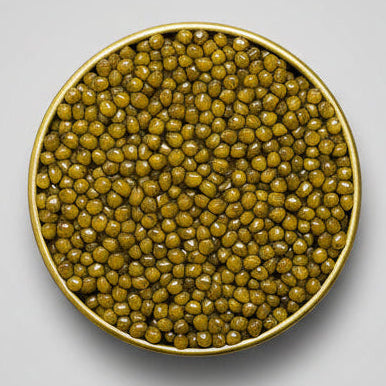
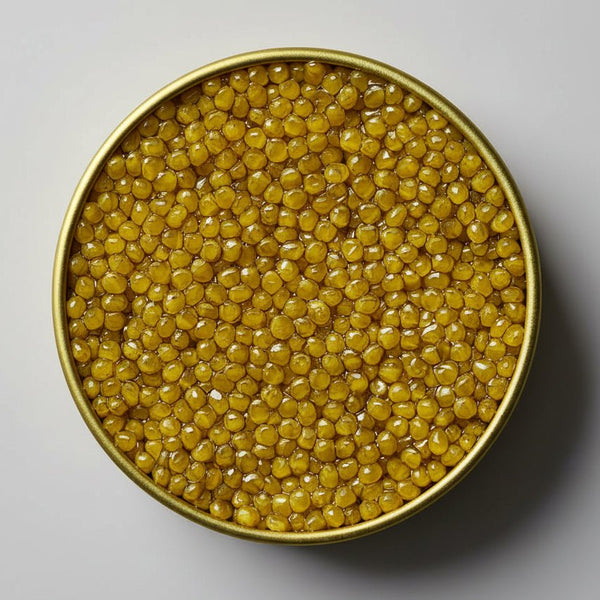
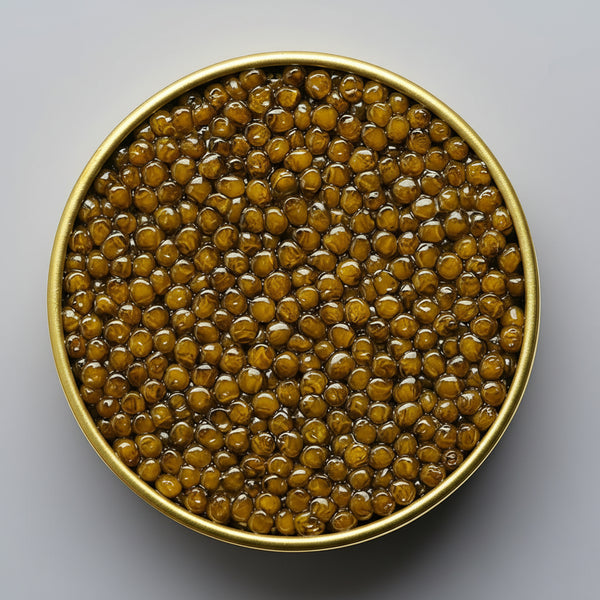
Osetra grains are medium (2.5-3 mm), with a clean and defined "pop" when pressed against the palate — that sensation of controlled burst that instantly releases the flavor. The color varies greatly: from intense gold (light roe, called "Royal" or "Imperial," are considered the most valuable) to dark brown. Color does not determine quality per se, but lighter grains usually come from older sturgeons and produce more complex flavors.
The flavor profile of Iranian Osetra is the most complex of the three: notes of nuts (almond, hazelnut), clean marine, a hint of minerality, and a long finish with a buttery aftertaste. It is the caviar that most benefits from slow tasting — each second in the mouth reveals a new nuance.
For those who want to start with premium caviar with a product that combines complexity, relative affordability, and gastronomic versatility, Iranian Osetra is the smartest choice. It is also the one that works best in pairings with fine dining — from classic blinis to more creative preparations with fresh pasta or eggs.
Sevruga: Intense and Accessible
Sevruga (Acipenser stellatus) is the smallest of the three great Caspian sturgeons and the one that matures fastest — it produces roe at 7-10 years old, compared to Beluga's 18-25 years. This makes it more abundant and, therefore, more affordable. But "more affordable" does not mean "lower quality" — it means a different flavor profile.
Sevruga grains are the smallest (1.5-2 mm) and darkest (dark grey to black). The texture is firm and crunchy. But the real difference is in the flavor: Sevruga is the most intense and iodized of the three, with an immediate burst of marine flavor, pronounced saline notes, and a complexity that is surprising given its lower price. It is the most direct-flavored caviar — it doesn't need seconds to reveal itself.
Iranian Sevruga is perfect for those who already know caviar and seek a powerful flavor, for cooking (it tolerates heat better than Beluga or Osetra), and as a gateway to Caspian caviar for those coming from aquaculture caviars who want to experience the difference without the expense of Beluga.
CITES Certification: What it Guarantees and Why it Matters
CITES (Convention on International Trade in Endangered Species of Wild Fauna and Flora) has regulated the global caviar trade since 1998. All sturgeon species are listed in CITES Appendices I or II, meaning their international trade is strictly controlled.
CITES certification on a tin of caviar guarantees:
- Complete traceability: each tin has a unique code that identifies the country of origin, sturgeon species, production year, and processing plant.
- Legal origin: the caviar comes from regulated fishing or authorized aquaculture, not from poaching.
- Controlled quotas: production respects established quotas to protect sturgeon populations.
- Standardized labeling: country code (IRI for Iran), species code (HUS for Beluga, PER for Persian Osetra, STE for Sevruga).
Buying caviar without CITES certification is not only illegal in the EU — it contributes to the extinction of species that have been on the planet for over 200 million years. The CITES code is the only verifiable guarantee that the caviar is what it claims to be. Without it, there's no way to know if "Iranian Beluga" is actually Beluga, actually Iranian, or actually legal.
How to Serve Iranian Caviar Correctly
How caviar is served directly affects the experience. It's not empty protocol — every detail has a functional reason.
Temperature
Caviar is served cold, between 0 and 4 °C. The traditional way is to place the open tin on a bed of crushed ice (not ice cubes — irregular contact damages the tin and presentation). Take the caviar out of the refrigerator just before serving. At room temperature, the fat in the caviar melts quickly and the flavor changes — becoming more intense but losing elegance.
Utensils
Always use a mother-of-pearl spoon, bone, glass, or even plastic. Never metal — stainless steel, silver, and other metals react with the fats in caviar and produce an unpleasant metallic aftertaste that ruins the experience. The mother-of-pearl spoon is not an aesthetic whim: it is the tool that does not interfere with the flavor.
Classic Accompaniments
- Blinis: small buckwheat pancakes, warm, with a spoonful of crème fraîche and caviar on top. The absolute classic.
- Thin toast: very thin brioche or sandwich bread, lightly toasted, without butter (or with very little).
- Plain: the purest way. A mother-of-pearl spoonful directly to the back of the hand (between the thumb and forefinger) and from there to the mouth. Body temperature releases the aromas. This is how professionals taste it.
What to Avoid
Avoid accompaniments with strong flavors that mask the caviar: raw onion, excessive lemon, chopped hard-boiled egg. These are accompaniments that became popular with low-quality caviar to compensate for flavor defects. With quality Iranian caviar, the less you add, the better.
How to Taste Caviar: A Sensory Guide
Tasting caviar correctly doesn't require being an expert — it requires paying attention to four sensory phases.
- Visual: observe the size, uniformity, and sheen of the grains. The grains should be whole, uniform in size, and have a pearlescent sheen. Broken, dull, or irregularly sized grains indicate poor handling or inferior quality.
- Olfactory: bring your nose close to the open caviar. It should smell of clean sea, of a sea breeze. If it smells strongly of fish, metal, or ammonia, the caviar is not in good condition.
- Texture: place a few grains on your tongue and press them against your palate. Look for the "pop" — that clean burst that releases the contents of the grain. The skin should be thin but perceptible. If it dissolves without resistance or if the skin is hard, there is a problem.
- Flavor: after the pop, let the flavor spread in your mouth without chewing. Identify the notes: sea? nut? butter? mineral? Is the flavor clean or does it leave an aftertaste? The length on the palate (how many seconds the flavor persists) is the most reliable indicator of quality.
If you are interested in delving deeper into tasting and the world of caviar, our caviar guide for beginners covers the fundamentals, and the article on why Iranian caviar is the best explains the geological and biological reasons in detail.
Storage and Preservation
Caviar is a fresh and delicate product that requires strict storage conditions:
- Unopened tin: in the coldest part of the refrigerator (0-4 °C), never in the freezer. Caviar does not freeze — freezing destroys the texture of the eggs. Shelf life according to producer: 4-8 weeks.
- Opened tin: consume within 2-3 days maximum. Close the tin with its original lid (or cover with cling film in direct contact with the eggs) and return to the refrigerator immediately. Contact with air oxidizes fats and deteriorates the flavor.
- Transport: always with an insulated bag and dry ice or cold packs. Caviar should not exceed 4 °C at any point in the chain.
The most common mistake is storing caviar in the refrigerator door (where the temperature fluctuates every time it's opened). Place it at the back, on the lowest shelf, where the temperature is more stable and colder.
Pairing: Champagne, Vodka, and Beyond
Caviar allows for a wider range of pairings than the stereotype of champagne and nothing else suggests.
Champagne and Sparkling Wines
The classic pairing for a reason: the acidity and bubbles of champagne cleanse the palate between spoonfuls and highlight the nuances of the caviar. Look for a Blanc de Blancs brut nature or extra brut — the absence of residual sugar is key. A sweet or semi-dry champagne competes with the salty notes of the caviar instead of complementing them. Quality brut nature Cava works equally well.
Vodka
The traditional Russian-Iranian pairing. The key is that the vodka should be very cold (from the freezer) and of high quality — neutral, clean, with no added flavors. Iced vodka acts as a palate "reset" that allows you to enjoy each spoonful of caviar as if it were the first. Lukewarm vodka or flavored vodkas do not pair well.
White Wine
A Chablis Premier Cru (pure minerality, no oak), a quality Sancerre, or a Galician Albariño with good acidity work magnificently. The key is to avoid whites with too much oak, excessive ripe fruit, or sweetness — the fat in caviar needs acidity as a counterpoint, not more richness.
Sake
The most surprising and increasingly popular pairing among Japanese and European chefs. A junmai daiginjo served cold has the gentle acidity, silky texture, and subtlety needed to complement Osetra or Beluga caviar without competing.
Iranian Caviar Prices: Why it Costs What it Costs
The price of Iranian caviar reflects real factors, not market whims:
- Biological time: a Beluga sturgeon needs 18-25 years to produce roe. Osetra, 12-15. Sevruga, 7-10. No other food industry works with such long production cycles.
- Real scarcity: CITES quotas strictly limit production. Global demand far exceeds legal supply.
- Artisanal process: malossol curing (with little salt) requires master caviar specialists with decades of experience. The exact amount of salt, the maturation point, and the grading of the eggs are evaluated manually.
- Cold chain: from the Caspian to the final consumer, caviar needs constant refrigeration (0-4 °C). Logistics costs are significant.
- Certification and regulation: complying with CITES, EU sanitary controls, and full traceability adds costs that illegal producers do not incur.
An Iranian Beluga 000 at less than €100/30g should raise suspicion. An Iranian Osetra below €60/30g, too. Prices significantly below market usually indicate aquaculture caviar repackaged as wild, caviar from a different origin than declared, or an expired product.
For a more detailed comparison between brands and origins, consult our ranking of caviar brands in Spain and the complete guide to Beluga caviar.
Discover our premium selection
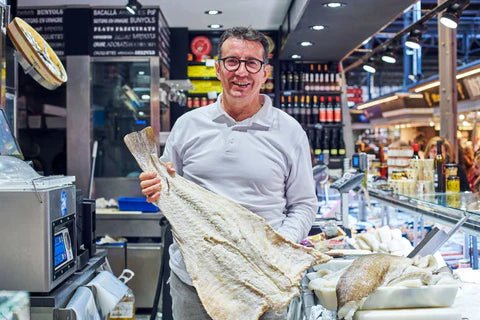
Seafood selected with discernment since 1990 at Mercat del Ninot, Barcelona. Refrigerated shipping in 24-48h.
Conclusion
Iranian Caspian caviar is the gold standard of global caviar for reasons that go beyond tradition: the geology of the Southern Caspian, the biology of its sturgeons, a curing process perfected over centuries, and a control system that has preserved both the species and the quality of the product.
Choosing between Beluga, Osetra, and Sevruga is a matter of personal preference, not an absolute hierarchy. Beluga is subtlety and elegance; Osetra is complexity and versatility; Sevruga is intensity and character. All three are exceptional gastronomic experiences when from the correct origin, properly preserved, and served with respect for the product.
Always demand CITES certification, buy from suppliers who guarantee the cold chain, and above all, try it before judging the price. A spoonful of well-served Iranian Osetra caviar is enough to understand why this product has been considered the world's most luxurious food for centuries.
Frequently Asked Questions
What is the difference between Beluga, Osetra, and Sevruga caviar?
They come from three different species of sturgeon. Beluga (Huso huso) produces the largest eggs (3-3.5 mm), with a subtle, creamy flavor. Osetra (Acipenser persicus) has medium eggs (2.5-3 mm), with a nutty, sea flavor. Sevruga (Acipenser stellatus) produces the smallest eggs (1.5-2 mm) with an intense, iodized flavor. All three are legitimate Caspian caviar — they differ in sensory profile and price.
Why is Iranian caviar more expensive than aquaculture caviar?
Three main reasons: 1) The natural conditions of the Southern Caspian produce a flavor profile that aquaculture cannot replicate. 2) Wild or semi-wild sturgeons from the Caspian need 7-25 years to mature. 3) Production is limited by CITES quotas. Aquaculture (China, Italy, France) can produce in higher volume but with a distinct sensory profile — more neutral, less complex.
How do I know if Iranian caviar is authentic?
The CITES label is the only verifiable guarantee. Look for the code on the tin: it starts with "IRI" (Iran) followed by the species code (HUS=Beluga, PER=Persian Osetra, STE=Sevruga), year of production, and lot number. Without this label, the caviar is not legally marketable in the EU, and its origin cannot be verified.
Can caviar be frozen?
No. Freezing destroys the structure of the eggs — upon thawing, the eggs break and release their contents, resulting in a watery paste that has nothing to do with the original product. Caviar is always stored refrigerated (0-4 °C), never frozen. It is a fresh product with a limited shelf life.
Why can't a metal spoon be used with caviar?
Metals (steel, silver, aluminum) chemically react with the unsaturated fats in caviar, producing an unpleasant metallic aftertaste that ruins the experience. Mother-of-pearl, bone, glass, or ceramic spoons are inert materials that do not alter the flavor. It is not a whim — it is functional.
How much caviar is served per person?
The standard measure is 30g per person as a starter or appetizer. For a tasting where caviar is the absolute star, 50g per person is ideal. With 10-15g, you can make a toast or an individual canapé. A 30g tin serves one person generously or two people as a shared appetizer.
What does "malossol" mean in caviar?
"Malossol" is a Russian word meaning "little salt." It refers to the traditional Iranian and Russian curing method that uses between 3% and 5% salt — the minimum necessary to preserve the product without masking its natural flavor. It is the technique that preserves the complexity of caviar. Caviar with more than 5% salt is usually of lower quality, where salt is used to compensate for freshness defects.
Can pregnant women eat caviar?
Pasteurized caviar is considered safe during pregnancy. Fresh (unpasteurized) caviar, like most premium Iranian caviar, presents a theoretical risk of Listeria due to being a raw product without heat treatment. Consult your doctor. If you choose to consume it, ensure that the cold chain has remained intact.
Lalo González Rodríguez
Seafood and premium preserves specialist. Collaborator of Bacalalo from Mercat del Ninot in Barcelona, where the González family has been selecting cod, anchovies, caviar, and gourmet seafood products since 1990. Each article reflects decades of experience buying, tasting, and selling the best products to customers who demand real quality.