


The Lofoten Islands (68°N, within the Arctic Circle) have been the epicenter of global cod fishing for over 1,000 years. Vikings already dried Skrei cod in the cold air between February and May to produce stockfish, a key food for their Atlantic expeditions. Today, Lofoten remains the only place on the planet where three elements converge: the spawning grounds of Norwegian-Arctic cod, perfect climatic conditions for natural drying (0–10 °C, dry wind), and a continuous, millennia-old fishing culture.
Lofoten: geography and island by island (68°N)
Lofoten is an archipelago in Norway located between 67° and 68° North latitude, within the Arctic Circle, about 200 km from Tromsø. It forms a chain of mountainous islands stretching ~160 km out into the sea to the southwest, separated from the mainland by the Vestfjorden.
The 7 main islands:
| Island | Area | Key locations |
|---|---|---|
| Austvågøya | 527 km² | Svolvær (regional capital) |
| Vestvågøya | 411 km² | Leknes, Stamsund |
| Flakstadøya | 109 km² | Ramberg |
| Moskenesøya | 186 km² | Reine, Å (final village) |
| Værøy | 18 km² | Værøy (stockfish island) |
| Røst | 11 km² | Røst (the most remote) |
| Gimsøya | 46 km² | Vinje |
The atypically mild climate for this latitude (thanks to the Gulf Stream) maintains average winter temperatures of -1 to 2 °C and summer temperatures of 10–14 °C. This is key for fishing: warm waters for fish, cold dry air perfect for drying stockfish.

1,000 years of fishing: Vikings and stockfish
The documented history of cod in Lofoten begins in the 9th century. Vikings discovered that cod dried in the cold air on open structures (hjell) lasted for months without spoiling and was lightweight — perfect as provisions for their Atlantic expeditions.
Verifiable historical milestones:
- 875–1000 AD: Stockfish trade between Lofoten and continental Europe via Viking merchants.
- 1100–1300: Lofoten stockfish reaches Bergen, the main export port in the North Atlantic.
- 1361: The Hanseatic League establishes a factory in Bergen and monopolizes Norwegian stockfish trade until the 18th century.
- 1500–1700: Norwegian stockfish becomes a key food for Portuguese sailors during Atlantic exploration.
- 1900: Beginning of industrial salting (klippfisk) in Lofoten, complementing stockfish.
- 2014: "Tørrfisk fra Lofoten" receives PGI designation from the European Union.
The Lofotfiske: current traditional fishing
The Lofotfiske is the name given to the annual Skrei cod fishing season in Lofoten (January to April). It is one of the oldest and most technically documented artisanal fisheries in the world.
Lofotfiske 2025 data (Norwegian Directorate of Fisheries):
- Total seasonal catch: ~58,000 tons
- Registered vessels: 590
- Active fishermen: ~2,200
- Villages with main activity: 11
- Gear mix: 80% selective (hook, longline, gillnet), 20% regulated trawling
Stockfish PGI: air-dried cod
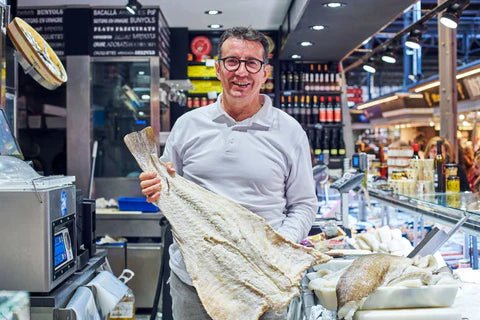
Stockfish (tørrfisk in Norwegian) is cod dried in cold air, without added salt, on open wooden structures for 6–12 weeks (February–May). The method has not changed in a thousand years.
Technical process:
- Catching Skrei (January–March).
- Immediate beheading, evisceration, and tying by the tail with string.
- Hanging in hjell (horizontal outdoor wooden structures).
- Natural drying for 6–12 weeks at 0–10 °C with dry wind.
- Storage in cellar for 3–9 months for maturation.
- Classification by size and quality (8–10 official grades).
The "Tørrfisk fra Lofoten" PGI stockfish requires local capture, drying in Lofoten, and a documented process. Annual production: ~30,000 tons. Main export destinations: Italy (40%, especially Genoa and Veneto), Nigeria (35%), Croatia, and Sweden.

Fishing villages: Henningsvær, Reine, Å
Three villages define Lofoten's fishing identity:
- Henningsvær: 460 inhabitants, on the island of the same name, connected by bridge. "Venice of Lofoten" for its canals. Still 25 active fishing boats in the Lofotfiske.
- Reine: 314 inhabitants, on Moskenesøya. Considered one of Norway's most photogenic villages. Maintains operational rorbuer (traditional red fishing cabins) during the Skrei season.
- Å i Lofoten: 100 inhabitants. The final village on European road E10. Home to the Norwegian Fishing Village Museum. It is practically a living museum of traditional Norwegian fishing.

Current fishing economy (2025)
Fishing remains Lofoten's economic engine, complemented by tourism and aquaculture:
| Sector | % regional GDP | Notes |
|---|---|---|
| Cod fishing (Skrei + coastal) | ~70% | Jan–Apr concentrates value |
| Other fisheries (haddock, saithe) | ~10% | Year-round |
| Salmon aquaculture | ~8% | Farms in fjords |
| Tourism | ~10% | Mainly June–September |
| Other | ~2% |
Total annual fishing volume: ~4.5 billion NOK (~€400 million).
Visiting Lofoten: museums and routes
To understand the cod culture in Lofoten:
- Norwegian Fishing Village Museum (Å): fishing shacks, operational stockfish hjell, traditional crafts. Open all year.
- Lofotr Viking Museum (Borg): reconstruction of a Viking longhouse (83 m, the largest in the world). Historical context of early stockfish trade.
- Lofoten Stockfish Museum (Sørvågen): dedicated exclusively to stockfish, its production and historical trade.
- Complete E10 route: 230 km from Fiskebøl to Å. Allows you to see fishing villages, cod hjell, and fjords. Best time: March (active Skrei) or June (24-hour polar light).
How to buy Lofoten cod in Spain
Spanish consumers rarely find cod specifically labeled "from Lofoten" — most is sold as "Norwegian cod" without specifying the sub-regional origin.
📌 Honest note: Most salted cod sold as "Norwegian" in Spain comes from processing plants in Lofoten and Vesterålen, but sub-regional traceability rarely reaches the end consumer. If you want certainty of Lofoten origin, look for PGI label "Tørrfisk fra Lofoten" on stockfish (not salted cod).
For dried-salted cod from the North Atlantic (which often includes Lofoten):

Related articles
- Cod Norway vs Iceland — honest comparison
- Types of cod: Gadus morhua, Skrei, Iceland and Faroe
- View entire Bacalalo cod collection
- Desalted cod ready to cook
- Traditional dried salted cod
Frequently Asked Questions
Where exactly are the Lofoten Islands?
Lofoten is an archipelago in Norway located between 67° and 68° North latitude, within the Arctic Circle, about 200 km from Tromsø. It is made up of 7 main islands (Austvågøya, Vestvågøya, Flakstadøya, Moskenesøya, Værøy, Røst, and Gimsøya). Capital city: Svolvær. Population: ~24,500 inhabitants.
Why is Lofoten the epicenter of world cod?
Three unique factors converge here. First, biological: the Norwegian-Arctic Gadus morhua stock migrates annually from the Barents Sea to the Lofoten fjords to spawn (January–April). Second, climatic: the Gulf Stream effect maintains waters at 4–6 °C and dry air at 0–8 °C, ideal for natural curing without salt. Third, historical: continuous fishing culture since the Viking Age (9th century).
What is stockfish and is it still produced in Lofoten?
Stockfish (tørrfisk in Norwegian) is cod dried in cold air on open wooden structures (hjell), without salt, between February and May. It takes 6–12 weeks. Lofoten still produces ~30,000 tons of stockfish annually, exported mainly to Italy (Genoa, Veneto) and Nigeria. It has a PGI (EU Protected Geographical Indication) since 2014: "Tørrfisk fra Lofoten."
What is the difference between stockfish and salted cod?
Stockfish: only air-dried in cold air, with no added salt. Klippfisk (salted and dried cod, what is called "bacalao salado" in Spain): first wet-salted, then dried. Stockfish is harder, has a more concentrated flavor, and can be preserved for years. Klippfisk has been the basis of traditional Spanish cod since the 15th century.
What was traditional cod fishing like in Lofoten?
Until 1980, "Lofotfiske" dominated: small boats (sjark) went out daily between January and April with hook-and-line (juksa) and gillnets (garn). Each boat caught 1–3 tons/day. Entire towns (Henningsvær, Reine, Å) depended on this seasonal fishing. Even today, 80% is fished with selective gear: hook, longline, and gillnet. Only 20% is caught by trawling.
How many fishermen are there in Lofoten today?
Approximately 2,200 fishermen and 590 registered vessels participated in the Lofotfiske 2025. Total catch for the season: ~58,000 tons of Skrei (preliminary data from Fiskeridirektoratet). The number has stabilized after decades of decline due to sector consolidation.
Can you visit Lofoten to see the fishing?
Yes. The "Norwegian Fishing Village Museum" in Å and the Lofotr Viking Museum in Borg are open all year round. The best time to see active fishing and the "hjell" with cod drying is March–April. The peak tourist season is June–August, but there is no active fishing then.
Does the cod I buy in Spain come from Lofoten?
Partially. The Norwegian salted cod sold in Spain comes largely from processing plants in Lofoten and Vesterålen, but also from Finnmark and Troms. Pure Lofoten stockfish (PGI) is a niche and expensive product (60–120 €/kg). Classic Norwegian salted cod is usually from the same stock but processed in industrial plants.
Does Lofoten only produce cod?
No. Although cod is the main fishery in economic value (~70% of the total), Lofoten also fishes haddock (hyse), saithe (sei), halibut (kveite), Arctic shrimp, and herring. It also has significant salmon aquaculture. The total fishing industry generates approximately 4.5 billion NOK annually (~400 M€).