


![Anchoas de Mercadona: Análisis Completo y Comparativa [2026]](http://bacalalo.com/cdn/shop/articles/anchoa-del-cantabrico-exclusive-en-aceite-de-oliva-160-g-8181953_c57d8ec1-72a2-4fc3-8541-ad4412d5f95f.webp?v=1774815695&width=480)
Quick Summary: Mercadona sells several anchovy options through its intersupplier brands (Hacendado and associated brands). These are functional anchovies at an accessible price—the cheapest on the market in some cases. They are suitable for cooking, but there is a considerable difference compared to artisanal Cantabrian anchovies. In this article, we analyze what you'll find on the shelf, where they really come from, when they are sufficient, and when it's worth looking for something better.
What anchovies does Mercadona sell? The complete range
Mercadona works with an intersupplier model that changes periodically. The available anchovies usually include:
Anchovy fillets in olive oil (Hacendado): the most economical and best-selling option. Available in can or glass jar format, olive oil (not always extra virgin), small fillets. This is the anchovy millions of Spaniards buy every week.
Cantabrian anchovy fillets (Hacendado): the premium range within Mercadona. It carries the "del Cantábrico" (Cantabrian) designation on the label and a higher price than the standard. Slightly larger fillets, more careful presentation.
Anchovies in sunflower oil: the absolute cheapest option. Small fillets, sunflower oil, mild and not very complex flavor. This is the entry-level anchovy for those who want to try the product without a significant financial commitment.
Specific formats and brands may vary between stores and seasons, as Mercadona rotates intersuppliers. This means that the anchovy you bought three months ago may not be exactly the same as what you find today, even if the packaging is similar.

Where do Mercadona's anchovies come from?
This is the point that most interests informed consumers and where transparency is most limited.
Mercadona works with several intersuppliers for its anchovy preserves. Historically, some of these suppliers have been Cantabrian canneries that also sell higher-end products under their own brand. This creates a curious situation: the same manufacturer can produce a premium anchovy for €15 under its name and a distributor's anchovy for €4 for Mercadona.
Is it the same anchovy? No. The distributor contract specifications are different: smaller size, shorter maturation, lower-cost oil, wider tolerances for uniformity. The manufacturer is the same; the product is not.
For the range labeled "del Cantábrico" (Cantabrian), the raw material should come from catches in the Cantabrian Sea (Engraulis encrasicolus). For the standard range without that denomination, the origin can be Mediterranean, Morocco, Argentina, or any other fishing area for the same fish. The label of each batch must indicate the FAO capture area; checking it is the only way to know for sure.
Quality analysis: what to expect at this price
Visual aspect
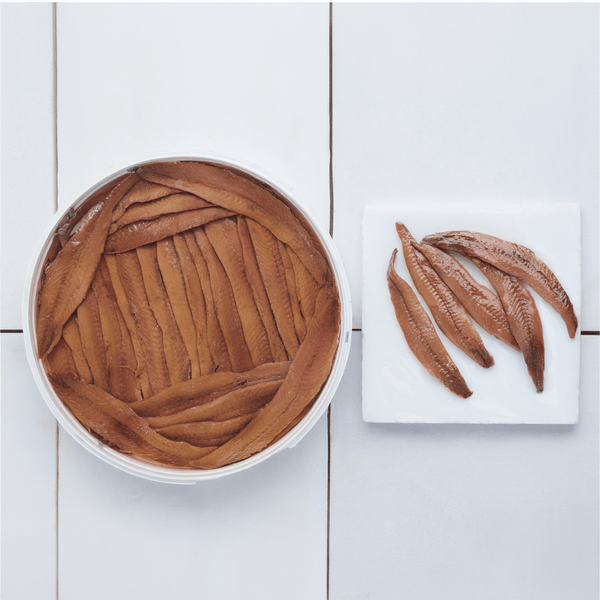
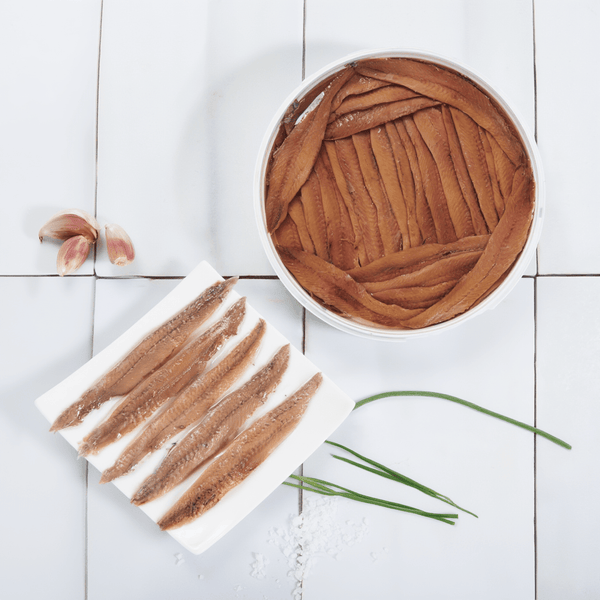
The fillets in Mercadona's standard range are usually small and narrow, with a color ranging from pale pink to light golden. The color uniformity between fillets in the same can can be irregular, indicating mixed batches or non-homogeneous maturation. The fillets in the "del Cantábrico" range are generally darker and more uniform, but still do not reach the deep golden-reddish hue of an artisanal anchovy with long maturation.
Texture
Tendency to be soft in the standard range. The fillets easily fall apart, making them difficult to use in gildas or toasts where you need the fillet to maintain its integrity. The "del Cantábrico" range has a bit more firmness but without the fleshy, silky texture that defines artisanal 00-grade anchovies.
Flavor
Mild and linear. Saltiness is the dominant flavor, with little development of complex umami notes. There is no long finish in the mouth that characterizes anchovies with 6+ months of maturation. In the "del Cantábrico" range, there is a bit more depth, but it is still a basic flavor profile compared to specialized brands.
Oil
The standard range uses olive oil that is rarely extra virgin. The sunflower oil range is what it is: a neutral preservative that adds nothing to the anchovy's flavor. In no case will you find the synergy between anchovy and extra virgin olive oil that defines premium preserves.
🐟 Our Cantabrian Anchovies
Hand-selected at Mercat del Ninot since 1990. 00 grade, artisanal preparation, incomparable flavor.
View Anchovies →Comparative table: Mercadona vs alternatives
| Characteristic | Mercadona Standard | Mercadona "Cantabrian" | Ortiz Standard | Bacalalo 0 Selection |
|---|---|---|---|---|
| Caliber | Less than 0 | 0 | 0 | 0 |
| Oil | Olive / sunflower | Olive | EVOO | EVOO |
| Origin | Variable | Cantabrian (declared) | Cantabrian | Santoña (verified) |
| Price ~50g drained | 2-4€ | 4-7€ | 7-10€ | 10-14€ |
| Flavor complexity | Low | Medium-low | Medium | Medium-high |
| Best use | Cooking | Cooking / tapas | Tapas / gildas | Gildas / tasting |

When are Mercadona anchovies sufficient?
For cooking as a base ingredient: absolutely. If you are going to dissolve the anchovy in a sofrito for puttanesca, a meat sauce, or a vinaigrette, Mercadona anchovies are perfectly functional. The umami provided by an anchovy dissolved in hot oil does not depend on the size or maturation complexity—it depends on the glutamate concentration, which is present in any salted anchovy.
For homemade pizza: the "del Cantábrico" range works well. The small fillets are easily distributed over the dough and the flavor is sufficient in the context of a pizza where it competes with tomato, cheese, and other ingredients.
For a salad: the standard is sufficient if the anchovy is a complement, not the main ingredient.
When are they NOT sufficient?
Gildas: the fillets are too small and soft for a serious gilda. They fall apart when skewered and lack the visual presence or flavor that a gilda needs.
Toasts with butter: Mercadona's anchovy on butter looks pale—both literally (the pink color) and in flavor. An anchovy toast with butter needs a fillet with character.
Charcuterie boards: if you are preparing a gourmet board for guests, Mercadona anchovies lower the overall quality. It's worth investing in better quality in this case.
Tasting on its own: it is not the right product. Without the context of other ingredients to compensate, the limitations in flavor and texture are evident.
The price factor: do we really save that much?
A calculation few consumers make: the price per gram of real anchovy (drained weight, subtracting the oil).
A can of Mercadona anchovies at €3 with 25g drained weight comes out to €0.12/g of anchovy. An artisanal Santoña can at €15 with 50g drained weight comes out to €0.30/g. The real difference is 2.5x, not 5x as it appears at first glance.
And there's an additional factor: yield per fillet. A large 00-grade fillet covers an entire toast; you need 2-3 Mercadona fillets for the same effect. In practice, if you use Mercadona anchovies in preparations where anchovy is the main ingredient, you consume more quantity for the same result.
The savings are real when anchovy is a base ingredient. They diminish when anchovy is the star.
How Bacalalo anchovies compare
We won't pretend that our anchovies compete in price with Mercadona. They don't, and we don't intend for them to. They are products from different segments with different purposes.
Our "0" and "00" Gourmet Selection Cantabrian anchovies cost between 3x and 5x more than Mercadona's standard anchovies. The difference translates into: verified size, exclusively extra virgin olive oil, traceable Santoña origin, long maturation, and a flavor profile that is not comparable.
If your budget allows for the investment—and you plan to consume the anchovy in a context where quality is appreciated—the difference is worth it. If you need anchovy for a Tuesday night sofrito, Mercadona is sufficient and there's no point in spending more.
Honesty is this: knowing when a premium product provides real value and when it is an unnecessary expense. With discernment, not slogans.
🛒 Our premium alternative
Cantabrian Anchovies "00" Gourmet Selection
Premium 00 grade, artisanal preparation
38,90€
View product →⭐ 4.9/5 · 24-48h cold shipping · Since 1990 at Mercat del Ninot
Frequently Asked Questions
Are Mercadona anchovies from the Cantabrian Sea?
Mercadona sells various ranges. Only the one that indicates "del Cantábrico" (from the Cantabrian Sea) on the label declares that origin. The standard range may come from other fishing areas (Mediterranean, Morocco, etc.). Always check the FAO capture area that must appear on the label of each can.
What brand manufactures Mercadona's anchovies?
Mercadona works with intersuppliers who may change periodically. The cannery code on the can can identify the manufacturer, but Mercadona does not publicly release the brand-supplier relationship. It is possible that different batches come from different manufacturers.
Are Mercadona anchovies good for cooking?
Yes. For use as a base ingredient (sauces, sofritos, vinaigrettes, pizza), Mercadona anchovies are perfectly functional. The umami they provide when dissolved in hot oil does not depend on the size or maturation complexity of the fillet.
How much do anchovies cost at Mercadona?
Prices vary between €2-3 for the most basic range in sunflower oil and €5-7 for the "del Cantábrico" range. Exact formats and prices may vary between stores and seasons, as Mercadona adjusts prices and suppliers periodically.
Are there Mercadona anchovies in extra virgin olive oil?
It is uncommon. Most Mercadona anchovies use olive oil (refined) or sunflower oil. Extra virgin olive oil has a significantly higher cost and is rarely found in the price ranges offered by Mercadona. Always check the label of each specific product.
Related articles
🎁 Anchovy Tasting Pack
Try and compare the best Cantabrian anchovies. A selection curated by experts from Mercat del Ninot.
View Gift Packs →


![¿Cuánto Cuesta el Caviar? Guía de Precios por Tipo [2026]](http://bacalalo.com/cdn/shop/articles/caviar-beluga-imperial-irani-4723678_bd3d4d30-a8d3-462c-864d-1c216f60156c.webp?v=1774815835&width=480)
