

Summary: Not all canned anchovies are created equal. Differences between types (in oil vs. salted), oil types (EVOO vs. olive vs. sunflower), formats (tin vs. jar vs. coceta), and sizes result in completely different flavors and prices. This guide teaches you to read an anchovy label like a pro.

The two main types: anchovies in oil vs. salted anchovies
Before talking about brands, sizes, or prices, it is important to understand the fundamental division in the world of canned anchovies. These are two products with distinct characteristics and uses:
Anchovies in olive oil
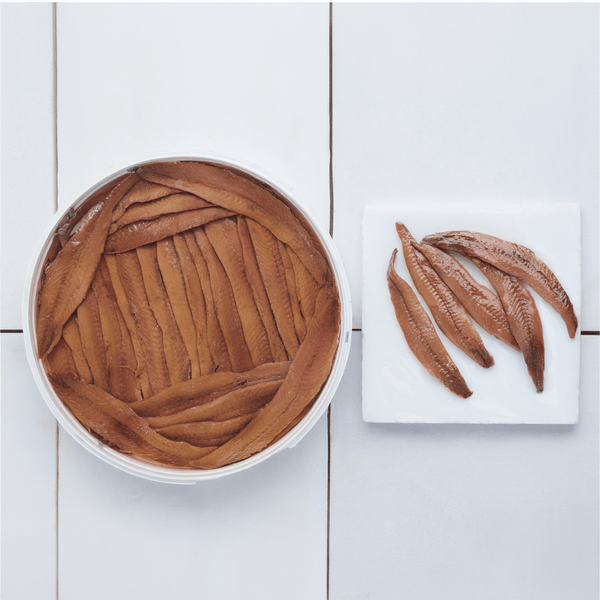
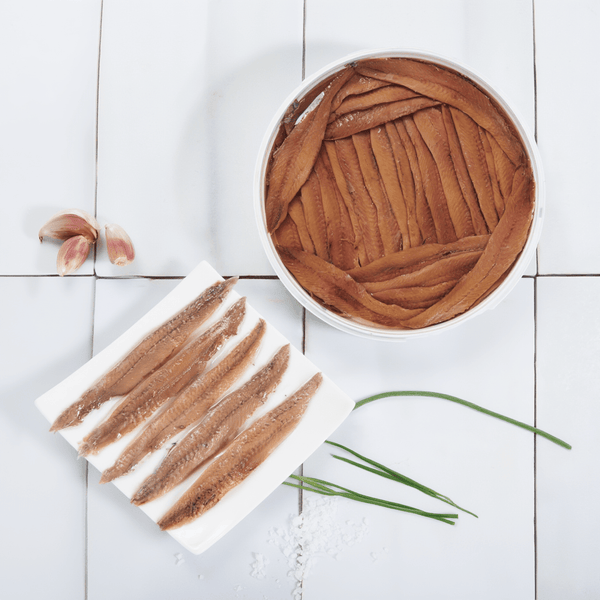
This is the most well-known and best-selling format. The anchovy has gone through the entire process: capture, gutting, salting for a minimum of 6 months, cleaning, filleting, and packing in olive oil. It is ready to consume directly, without any prior treatment.
The oil serves three functions: it preserves the fillet by isolating it from oxygen, moderates the saltiness, and adds smoothness to the flavor profile. A good anchovy in extra virgin olive oil is a finished product, with a balance of salt, umami, and fat that makes it irresistible on its own or on a piece of bread.
Unopened shelf life: 3-5 years. Does not require refrigeration when unopened (although a stable and cool temperature is ideal). Once opened, consume within 3-5 days, always refrigerated and with the fillets covered in oil.
Salted anchovies
This is the product mid-way through the process: cured in salt but not filleted, not cleaned, not packed in oil. They are sold in cocetas (cylindrical containers, usually food-grade plastic or metal) or in large tins with visible salt.
Before consumption, they must be: desalted under a stream of cold water for 15-20 minutes, fillets separated from the central bone, skin removed, thoroughly dried with paper towels, and, optionally, submerged in olive oil before serving.
The result is an anchovy with a more potent, more direct, and saltier flavor than the oil-packed version. The texture is slightly firmer. This format is preferred by professional caterers because it allows them to control the salt level and final presentation.
Unopened shelf life: many months in the refrigerator. Salt acts as a natural preservative. Once the coceta is opened, the anchovies will last for weeks if kept covered in salt and refrigerated.
The oil matters more than you think
The oil in which anchovies are packed is not just a filler. It accounts for 30% to 45% of the tin's contents, and its quality directly affects the final flavor of the product. Three categories:
Extra virgin olive oil (EVOO)
The quality standard. A good EVOO provides fruity nuances, a slight bitterness, and a subtle spiciness that complement the intensity of the anchovy without masking it. This is the oil used by serious artisanal producers. Its cost is significantly higher than generic olive oil, and this is reflected in the price of the tin.
Important note: some producers use an Arbequina variety EVOO (mild) while others use Hojiblanca or Picual (more intense). There isn't one "better" option: it depends on the flavor profile you are looking for. Arbequina allows the anchovy to take center stage; Picual adds its own character.
Olive oil
"Olive oil" without the "extra virgin" qualifier is a blend of refined olive oil with a small proportion of virgin oil. It has a neutral flavor, without the fruity notes or bitterness of EVOO. It's not bad, but it doesn't add anything to the product: it simply preserves it without adding or detracting from the flavor.
If the label says "olive oil" alone, you're looking at a mid-range product that has economized on the oil. It can be a perfectly acceptable anchovy if the fillet is good, but it's not the gourmet standard.
Sunflower oil
Sunflower oil is the clearest sign of a low-end product. It has a neutral to slightly sweet taste that completely flattens the anchovy's profile. It loses nuances, complexity, and elegance. A size 00 anchovy in sunflower oil yields an inferior result to a size 0 anchovy in EVOO.
Simple rule: if the oil is sunflower, skip it. Regardless of the size, brand, or what the label says about the origin.
🐟 Our Cantabrian Anchovies
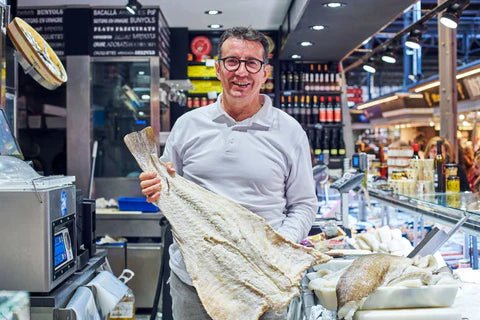
Hand-selected at the Mercat del Ninot since 1990. Size 00, artisan production, incomparable flavor.
View Anchovies →Formats: tin, jar, coceta, and others
The packaging is not just about presentation. It has implications for preservation, price, and consumption experience:
Metal tin
The most common format. Advantages: total protection from light (which oxidizes the oil), transport resistance, low packaging cost. The standard format is the round 50g drained weight tin, although there are rectangular formats of 80-120g and oblong ones.
Disadvantage: once opened, do not store anchovies in the tin. Open metal can affect the taste with prolonged contact. Transfer the contents to a glass container.
Glass jar
Advantages: you can see the product before consuming it (and before buying it in a physical store), glass does not interact with the oil or the anchovy, it is reusable. Slightly longer shelf life than the tin in the long term.
Disadvantages: heavier, more fragile during transport, generally more expensive than the equivalent tin due to packaging cost. And light affects it: store it in a dark place.
Salted coceta
Professional format for salted anchovies. Cylindrical containers from 1 to 5 kg. Lowest price per gram on the market. Ideal for catering or for consumers who prepare their own anchovies in oil at home.
Vacuum packaging
Some producers vacuum-pack anchovy fillets, without oil or with a minimal amount. The product is more concentrated in flavor but needs added oil to serve. It is not the most common format but has its niche among professionals.

How to read an anchovy label
An anchovy label should provide at least this information. If any is missing, be wary:
- Product name: "Anchovy fillets in extra virgin olive oil" is what you want to see. "Anchovies" alone is imprecise.
- Fish origin: "Cantabrian," "Santoña," or the specific area. "Origin: Spain" is too vague.
- Oil type: "Extra virgin olive oil" > "Olive oil" > "Vegetable/sunflower oil."
- Net weight and drained weight: both should be listed. Drained weight is what matters for calculating the real price.
- Size (calibre): if specified (0, 00, 000), even better. If not, it's probably size 0 or smaller.
- Production date: more informative than the expiration date. Anchovies improve during the first 2 years.
- Ingredients: anchovy, salt, extra virgin olive oil. Period. If there are preservatives, acidulants, or any other additives, it is not an artisanal product.
Drained weight: the metric that matters
We insist on this point because it's where consumers are most often misled:
A tin might say "100g" on the front. Those 100g include the oil. The drained weight—the actual amount of anchovy you will eat—can be 55g, 60g, or 70g, depending on the producer's anchovy/oil ratio.
An honest producer maximizes the drained weight: more anchovy, less oil, more value per euro. A producer who wants to maximize profit does the opposite: more oil (cheap) and less anchovy (expensive).
To compare tins from different brands, always calculate:
€ per gram = Price of the tin ÷ Drained weight in grams
This is the only metric that allows for a fair comparison. Don't be fooled by the size of the tin or the absolute price.

Other formats: anchovy paste, rolled fillets, in vinegar
Anchovy paste: anchovies crushed and mixed with olive oil to form a spreadable paste. Useful as a condiment for sauces, dressings, and marinades. Not for eating alone: it's a concentrated flavor enhancer. Good option for cooking if you don't want to buy fillets just to dissolve them.
Rolled fillets (with caper): an Italian classic adopted in Spain. Anchovy fillet rolled around a caper, packed in oil. Beautiful presentation, interesting flavor combination (the acidity of the caper against the umami of the anchovy). Generally small size.
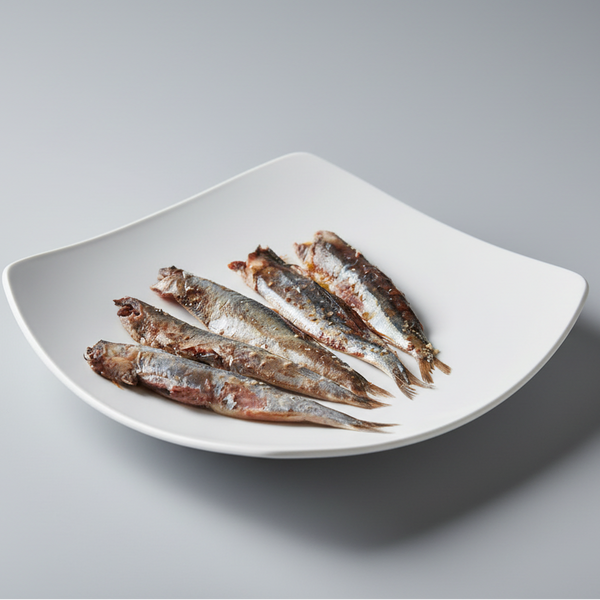
Anchovies in vinegar: technically it's boquerones in vinegar, not canned anchovies. A fresh or semi-preserved product that requires refrigeration and quick consumption. Not to be confused with salt-cured anchovies.
Storage by format
- Unopened tin: 3-5 years at room temperature (15-25°C), in a dry and dark place. Improves during the first 2 years.
- Unopened jar: same as the tin, but protect from direct light.
- Opened tin/jar: 3-5 days in the refrigerator. Transfer to a glass container, ensure fillets are covered in oil. If there isn't enough oil, add EVOO.
- Unopened salted coceta: months in the refrigerator.
- Opened coceta: weeks in the refrigerator if anchovies remain covered in salt.
- Opened anchovy paste: 2-3 weeks in the refrigerator, well-sealed.
Never freeze anchovies in oil. Freezing destroys the texture of the fillet. There's no point in freezing a product that lasts for years unopened.
Quick guide: which format to choose depending on your use
- Direct consumption (toasts, gildas, appetizers): anchovies in extra virgin olive oil, 50-80g tin or jar, size 00.
- Cooking (pasta, sauces, sofritos): anchovies in oil, size 0, large format (100-120g) for better price/gram.
- Professional catering: salted coceta. Maximum control over salt and presentation, best price.
- Condiment for dressings: anchovy paste or economical size 0 fillets.
- Gift: glass jar, size 00 or 000, good presentation.
- First try: small tin from a reliable producer. Spend little, try, and decide if you want to go up in size.
At Bacalalo you will find our selection of Cantabrian anchovies in extra virgin olive oil, in sizes 0 and 00 Gourmet Selection. Selected directly from Santoña producers with whom we have worked for years.
More information: Complete Guide to Cantabrian Anchovies | Prices by Size and Brand 2026 | 15 Recipes with Anchovies
🛒 Our premium alternative
Cantabrian Anchovies "00" Gourmet Selection
Premium size 00, artisanal production
€38.90
View product →⭐ 4.9/5 · Cold shipping 24-48h · Since 1990 at Mercat del Ninot
Frequently asked questions
What types of canned anchovies are there?
The two main types are anchovies in oil (clean fillet packed in olive oil, ready to eat) and salted anchovies (cured in salt, not filleted, requiring desalting). Within anchovies in oil, quality varies according to the type of oil (EVOO, olive, sunflower), the fillet size (0, 00, 000), and the origin of the fish.
Are anchovies better in a tin or a glass jar?
Both formats preserve the product well. The glass jar allows you to see the anchovy before buying, and glass does not interact with the oil. The tin protects better from light. In terms of product quality, the packaging format matters less than the size, oil, and origin.
How long do unopened canned anchovies last?
Anchovies in oil last between 3 and 5 years unopened at room temperature. Salted anchovies last months in the refrigerator. Anchovies in oil even improve during the first 2 years after production, like wine in a barrel.
Which oil is best for anchovies?
Extra virgin olive oil (EVOO) is the quality standard. It adds nuances that complement the anchovy without masking its flavor. Generic olive oil is neutral. Sunflower oil flattens the flavor and is a sign of a low-end product. If you have to choose between large anchovies with sunflower oil or smaller anchovies with EVOO, always choose EVOO.
What does drained weight mean for anchovies?
It is the weight of the anchovy alone, without the oil. It is the actual amount of product you eat. Always calculate the price per gram of drained weight, not the total weight of the can, to make fair comparisons between brands and formats.
Do canned anchovies contain preservatives?
Quality artisanal anchovies do not contain any preservatives: just anchovy, salt, and olive oil. Salt and oil are natural preservatives. If the label includes preservatives, acidulants, or other additives, it is an industrial product.
🎁 Anchovy Tasting Pack
Taste and compare the best anchovies from the Cantabrian Sea. Selection curated by experts from Mercat del Ninot.
View Gift Packs →Discover our premium selection
Seafood products selected with discernment since 1990 at Mercat del Ninot, Barcelona. Refrigerated shipping in 24-48h.