Summary: Anchovy and boquerón are the same fish (Engraulis encrasicolus), but completely different gastronomic products. Boquerón is the fresh or vinegar-marinated fish; anchovy is the result of months of salting and curing. Same species, different flavors, textures, and culinary uses. Here, we explain everything straightforwardly.
The same fish: Engraulis encrasicolus
Let's make it clear from the first line: anchoa (anchovy) and boquerón are exactly the same animal. The Engraulis encrasicolus is a small, pelagic fish of the Engraulidae family, inhabiting from the northeastern Atlantic to the Mediterranean. When you take it out of the water and place it on a plate fresh or in vinegar, you call it boquerón. When you cure it in salt for months and pack it in oil, you call it anchoa.
They are not two species. They are not genetic variants. It is not a matter of size or capture area. It is a matter of process. And that difference in process radically transforms the final product: color, flavor, texture, nutritional value, price, and culinary uses.
The confusion has a linguistic root. In English, anchovy designates both the fresh and cured fish. In French, anchois does the same. In Spanish, we are fortunate to have two distinct words for two distinct products, but even here, confusion persists because not everyone is clear about what each term designates.
In some areas of Spain, "anchoa" is also used to refer to the fresh fish. In Andalusia, "boquerón" can designate both the fish in vinegar and the fried one. Context matters, but the technical distinction is precise: boquerón = fresh or in vinegar; anchoa = cured in salt.

What changes everything: the process
The transformation from boquerón to anchoa is one of the oldest and most sophisticated food preservation processes in the Mediterranean. It's not simply "adding salt": it's a controlled enzymatic fermentation that completely modifies the biochemistry of the fish's muscle tissue.
Fresh and vinegar-marinated boquerón
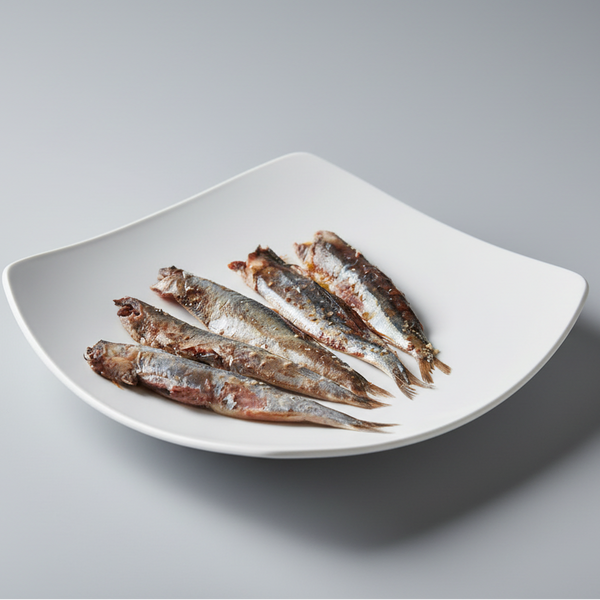
Fresh boquerón is consumed the same day it's caught, or at most the next day if the cold chain is good. It can be prepared fried (the classic Andalusian fried boquerón), grilled, or marinated in vinegar.
Boquerón in vinegar is a semi-preserved product: the cleaned and filleted fish is marinated in a mixture of white wine vinegar, olive oil, garlic, and parsley for a minimum of 24-48 hours. The acetic acid from the vinegar "cooks" the fish proteins (protein denaturation), changing it from translucent and soft to opaque white and firm. Due to health regulations, before applying vinegar, the fish must be frozen at -20°C for at least 48 hours to eliminate the risk of anisakis.
The result is a fresh, acidic, seafood-flavored product with a firm texture and a silvery-white color. Its refrigerated shelf life is 3 to 5 days.
Salted anchovy
The anchovy process is radically different. The fresh fish is eviscerated (head and guts removed) and arranged in alternating layers with coarse sea salt in containers called cocetas. A weight is placed on top of the layers to maintain constant pressure throughout the curing process.
The minimum salting time for quality anchovy is 6 months. Artisanal producers in Santoña work with times of 8 to 12 months. During this period, deep biochemical transformations occur:
- Osmotic dehydration: salt extracts water from the muscle tissue, concentrating flavors.
- Proteolysis: the fish's natural enzymes break down proteins into peptides and free amino acids, generating the characteristic umami flavor.
- Lipolysis: fats redistribute and oxidize in a controlled manner, generating the complex aromas of cured anchovy.
- Non-thermal Maillard reaction: the interaction between amino acids and residual sugars produces the golden-reddish color that visually defines anchovy.
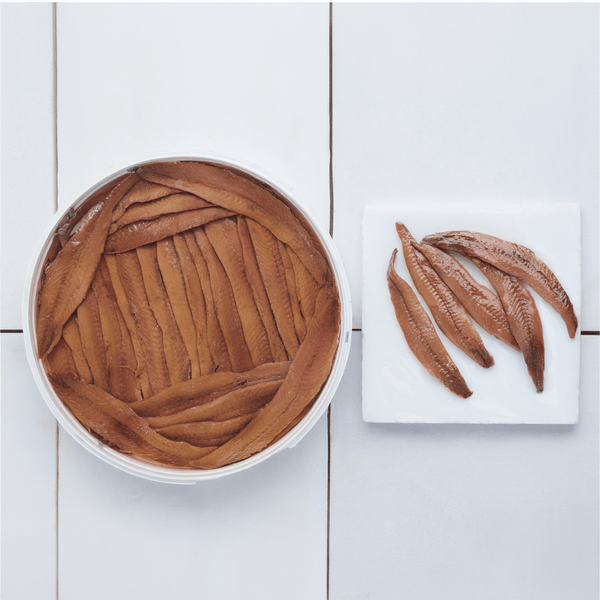
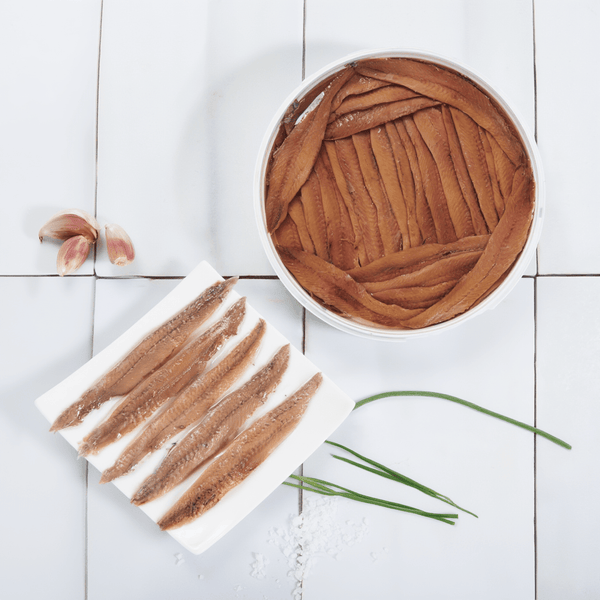
After curing, the anchovies are cleaned, hand-filleted, bones and skin removed, and packed in olive oil (ideally extra virgin). The resulting product has a shelf life of 3 to 5 years unopened.
Differences in flavor and texture
If you place a vinegar-marinated boquerón and a Cantabrian anchovy on a plate side by side, it's hard to believe they come from the same animal. The differences are total:
- Color: boquerón is silvery white; anchovy is dark golden-reddish.
- Texture: boquerón is firm and slightly elastic; anchovy is silky, fleshy, melting in the mouth.
- Flavor: boquerón is fresh, acidic, marine; anchovy is intense, umami, salty, with notes of controlled fermentation comparable to aged cheese.
- Aroma: boquerón smells of sea and vinegar; anchovy has a deep, concentrated aroma with aromatic complexity.
- Persistence: the flavor of boquerón disappears quickly; that of anchovy can linger for several minutes.
The intensity of anchovy is explained by concentration. During salting, a boquerón loses between 40% and 60% of its water content. Everything that remains—proteins, fats, minerals, free amino acids—is much more concentrated than in the fresh fish. It's the same principle that turns grapes into raisins or fresh tomatoes into sun-dried tomatoes: less water = more flavor per gram.
🐟 Our Cantabrian Anchovies
Hand-selected at Mercat del Ninot since 1990. Size 00, artisanal production, incomparable flavor.
View Anchovies →Nutritional differences
The biochemical transformation from boquerón to anchoa significantly modifies the nutritional profile. The data per 100g of drained product is approximately:
- Calories: fresh boquerón ~130 kcal; anchovy in oil ~200-250 kcal (oil adds energy).
- Proteins: boquerón ~20g; anchovy ~25-29g (concentration due to dehydration).
- Fat: boquerón ~5g; anchovy ~10-15g (part is concentrated own fat, part is absorbed oil).
- Sodium: fresh boquerón ~100mg; anchovy in oil ~3,000-5,000mg. This is the most relevant difference for health.
- Omega-3: both are rich in EPA and DHA, but anchovy has a higher concentration per gram of product due to dehydration.
- Calcium: anchovy provides more calcium because in some formats, the fine bones are consumed.
The nutritional conclusion is clear: both are healthy foods, rich in omega-3 and protein. The relevant difference is sodium. People with hypertension or salt restriction should limit their consumption of preserved anchovies or, alternatively, lightly desalt the fillets before consuming.

The confusion of regional names
Spain is a country where the naming of fish varies enormously depending on the autonomous community. With boquerón and anchoa, the chaos is considerable:
- Andalusia: "boquerón" for everything: fresh, fried, in vinegar. "Anchoa" only for the salted preserve.
- Basque Country: "antxoa" (anchoa) for the preserve; "bokarta" for the fresh fish.
- Catalonia: "anxova" (anchoa) for the preserve; "seitó" for the fresh fish.
- Cantabria: "anchoa" dominates for both the fish and the cured product, although professionals distinguish.
- Valencia: "aladroc" for the small fresh fish.
- Galicia: "bocarte" for the fresh fish.
In Italian, it's acciuga (cured anchovy) and alice (fresh fish). In Portuguese, anchova. If you travel around the Mediterranean, it helps to know that the cured and fresh products have different names in most Romance languages.
To avoid confusion in this article and in our store, we use the most widespread convention: boquerón = fresh or in vinegar; anchoa = cured in salt and packed in oil.
When to use each in cooking
The most common mistake is trying to substitute one for the other. They are not interchangeable. Each product has its culinary territory, and forcing an exchange produces mediocre results.
Uses of boquerón
- Boquerón in vinegar: the classic tapa, perfect as an appetizer with bread and beer. Vinegar provides freshness and acidity.
- Fried boquerón: coated in fine flour and fried in hot olive oil. Crispy on the outside, tender on the inside. Emblematic of Andalusian cuisine.
- In salad: boquerón in vinegar works well on fresh salads with tomato, onion, and olives.
- In tempura: a modern version of classic fried fish, with a lighter, crispier batter.
Uses of anchovy
- Gilda: the quintessential Basque pintxo. Anchovy + guindilla (pickled pepper) + olive. Here, the 00 size makes all the difference.
- Toast with butter: quality bread, unsalted butter, anchovy on top. Supreme simplicity.
- Pasta puttanesca: anchovies dissolved in hot oil are the umami base of the sauce.
- Flavor enhancer: one or two anchovies dissolved in a sofrito improve any stew, sauce, or casserole without their direct presence being noticed.
- Caesar: the original Caesar salad has anchovy in the dressing. It's what gives it the punch.
- Bagna càuda: the Piedmontese sauce of anchovies, garlic, and olive oil for dipping vegetables.
The practical rule: if you are looking for freshness and acidity, use boquerón. If you are looking for umami and depth, use anchoa. If you are looking to enhance a dish without the ingredient being noticed, dissolve anchovy in oil.

Storage and shelf life
The differences in preservation are enormous and determine how to plan your purchase:
- Fresh boquerón: consume the same day or the next day. Cold chain is mandatory. Freeze before preparing in vinegar (anisakis).
- Boquerón in vinegar: 3-5 days in the refrigerator, well-covered. Do not freeze once prepared.
- Anchovy in oil (unopened): 3-5 years at room temperature. Improves during the first 2 years like wine in a barrel.
- Anchovy in oil (opened): 3-5 days in the refrigerator, covered with oil in a glass container.
- Salted anchovy: months in the refrigerator unopened. Requires desalting before consuming.
From a pantry perspective, anchovy is one of the most practical foods: it lasts for years unopened, doesn't need refrigeration, and having it at home guarantees you can improvise a flavorful dish at any time.
What to buy depending on your goal
If you're deciding what to put in your shopping cart, the choice depends on what you want it for:
- Summer appetizer with beer: boquerón in vinegar, no doubt. Freshness and acidity.
- Elegant tapa with white wine: Cantabrian anchovy on toast or gilda.
- Cooking pasta, sauces, stews: anchovy in oil, size 0 is perfect.
- Tasting or gourmet gift: anchovy size 00 or 000. Consult our gourmet selection.
- Quick frying: fresh boquerón from the fishmonger.
At Bacalalo, we work with selected Cantabrian anchovies from Mercat del Ninot since 1990. If you're looking for quality cured anchovies — those made with months of artisanal salting, extra virgin olive oil, and verified sizes — you'll find them in our store. No slogans, just good judgment.
To delve deeper into the world of anchovies, we recommend our guides: Cantabrian Anchovies: Complete Guide, Anchovies 00 (Double Zero): What They Are and If They're Worth It, and Canned Anchovies: Types and Formats.
🛒 Our premium alternative
Cantabrian Anchovies "00" Gourmet Selection
Premium 00 size, artisanal preparation
38,90€
View product →⭐ 4.9/5 · Cold shipping 24-48h · Since 1990 at Mercat del Ninot
Frequently asked questions
Are anchovy and boquerón the same fish?
Yes. Both are Engraulis encrasicolus. The difference is the process: boquerón is the fresh fish or marinated in vinegar; anchovy is the same fish after months of salting and curing in oil. The process completely transforms the flavor, color, texture, and nutritional properties.
Why is anchovy more expensive than boquerón?
Because anchovy requires a production process of at least 6 months (up to 12 months for artisanal products), skilled labor for manual filleting, raw material selected by size, and extra virgin olive oil. Fresh boquerón is sold directly after capture with no additional processing.
Can anchovy be substituted for boquerón in a recipe?
Not directly. If a recipe calls for anchovy (like puttanesca pasta or Caesar dressing), boquerón doesn't provide the concentrated umami flavor the recipe needs. If it calls for boquerón in vinegar, anchovy would add too much salt and intensity. They are products with opposite flavor profiles even though they come from the same fish.
Can boquerón in vinegar cause anisakis?
Yes, if not previously frozen. Spanish regulations require freezing fish at -20°C for at least 48 hours before preparing it in vinegar. Vinegar alone does NOT eliminate anisakis larvae. Salted anchovy, on the other hand, does not pose this risk because the salt concentration over months is lethal to the parasite.
Which has more omega-3, anchovy or boquerón?
Both are excellent sources of omega-3 (EPA and DHA). Per gram of product, anchovy has a higher concentration because dehydration during salting concentrates the nutrients. However, anchovy also has much more sodium. For an omega-3 intake without excessive salt, fresh or vinegar-marinated boquerón is the best option.
Why do some places call the fresh fish "anchoa"?
It's a regional matter. In some areas of Spain (especially Cantabria and the Basque Country) and in most European languages, "anchoa" can refer to both the fish and the cured product. In the most widespread Spanish culinary tradition, a distinction is made: boquerón for fresh/vinegar, anchovy for salt-cured. In the canning industry, "anchoa" always designates the cured product.
🎁 Anchovy Tasting Pack
Taste and compare the best anchovies from the Cantabrian Sea. Selection curated by experts from Mercat del Ninot.
View Gift Packs →