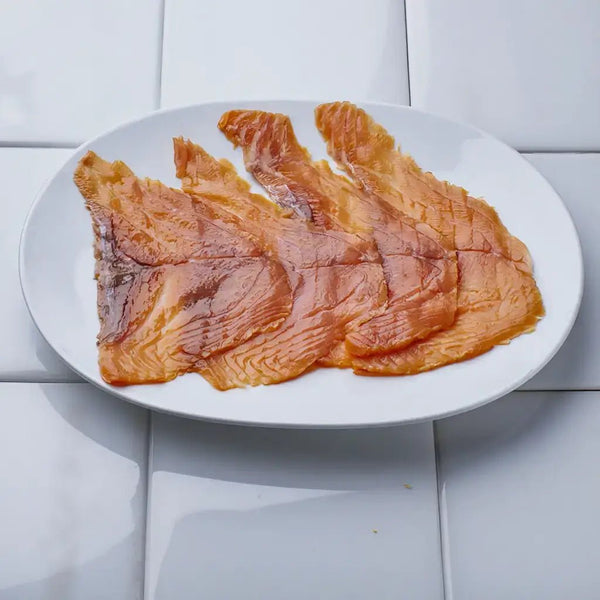


Salt-cured fish products are one of the Mediterranean's oldest gastronomic heritages: fish cured in salt that concentrate flavor to extraordinary levels. From mojama (salt-cured tuna) to Cantabrian anchovies, including mullet roe and salt cod, this guide explores the main types, their differences, actual prices, and how to enjoy them.
Contents
- What are salt-cured fish products?
- Mediterranean history of salt-cured fish products
- Types of salt-cured fish products: comparative table
- Mojama (salt-cured tuna)
- Mullet and tuna roe
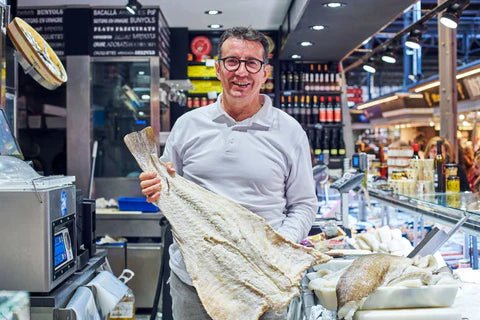
- Salt cod
- Cantabrian anchovies
- Dried bonito (muxama)
- Prices and where to buy
- How to serve and store
- Frequently asked questions
- Conclusions
What are salt-cured fish products?
Updated March 2026. What we tell you here comes from serving thousands of customers in Barcelona.
Salt-cured fish products are fish (or parts of fish) that have been cured with salt. The salt extracts water from the muscle tissue through osmosis, reducing bacterial activity and concentrating the flavor of the original product. It is one of humanity's oldest food preservation techniques, predating refrigeration, smoking, and canning.
The principle is simple: salt dehydrates. Fish that had 75% water will have 40-50% after salting. This loss of water concentrates proteins, fats, and free amino acids (especially glutamate, responsible for the umami flavor). That's why salt-cured products have such an intense flavor: they are concentrated fish.
In the Mediterranean, salt-cured products are not just a preservation method: they are a gastronomic category with its own identity. Mojama is not "dried tuna": it is mojama. Anchovies are not "salted boquerones": they are anchovies. Each salt-cured product has its specific process, tradition, and consumption method.
Mediterranean history of salt-cured fish products
Salt-cured fish products date back to Phoenician, Greek, and Roman civilizations. The Phoenicians established salt-curing factories along the entire Mediterranean coast more than 3,000 years ago. The ruins of Baelo Claudia, in Bolonia (Cádiz), are among the best preserved of the Roman world and show the pools where garum, the fermented fish sauce that was the universal condiment of Roman cuisine, was made.
Spain has an uninterrupted tradition of salt-cured products extending from Roman times to today. The coasts of Murcia, Alicante, Cádiz, Huelva, and the Cantabrian Sea continue to produce salt-cured products with methods that have evolved technically but retain the essence of centuries ago.
The salt route
Salt-cured products need salt, and lots of it. The salt pans of the Spanish Mediterranean (Torrevieja, San Pedro del Pinatar, Santa Pola, Sanlúcar de Barrameda) were for centuries as economically important as gold mines. Salt production and salt-cured product production were inextricably linked: where there was salt, there was a salt-curing industry.
Types of salt-cured fish products: comparative table
| Salt-cured product | Base fish | Part used | Process | Texture | Price/kg |
|---|---|---|---|---|---|
| Mojama | Bluefin tuna | Loin | Salt + air drying | Firm, sliced | 80-200 € |
| Mullet roe | Mullet | Roe sac | Salt + pressing + drying | Compact, grated or sliced | 100-250 € |
| Tuna roe | Tuna | Roe sac | Salt + pressing + drying | Similar to mullet, more intense | 80-180 € |
| Anchovies | European anchovy | Fillet | Salt + maturation 6-12 months | Tender, unctuous | 60-150 € |
| Salt cod | Cod (Gadus morhua) | Whole piece/loins | Salt + drying | Firm, flakes | 15-40 € |
| Dried bonito (muxama) | Albacore tuna | Loin | Salt + drying | Similar to mojama, softer | 60-120 € |
| Salted sardine | Sardine | Whole | Salt + pressing | Firm, needs desalting | 8-15 € |
| Dried capellán | Capellán | Whole | Salt + sun drying | Dry, crunchy | 20-40 € |
Mojama (salt-cured tuna)
Mojama is probably the best-known and most internationally appreciated Spanish salt-cured product. It is made from the loins of bluefin tuna (Thunnus thynnus), which are cured in salt for 2-3 days and then air-dried for 2-3 weeks.
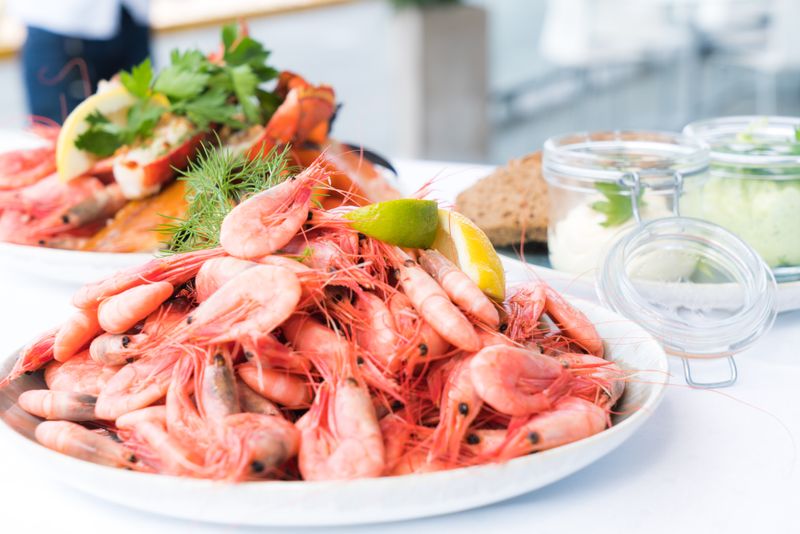
The result is a dark red, almost garnet-colored piece, with a firm but not hard texture, which is cut into thin slices and eaten as an appetizer with olive oil and almonds. The flavor is intensely marine, with a sweet undertone and a long aftertaste reminiscent of cured ham.
The two main mojama regions in Spain
- Barbate and Isla Cristina (Cádiz/Huelva): Mojama from almadraba bluefin tuna. This is the most prestigious. The tuna is caught during the almadraba season (May-June) and processed immediately. Price: 120-200 €/kg.
- Murcia and Alicante: Murcian tradition using tuna from various sources. Quality varies but there are excellent producers. Price: 80-150 €/kg.
Quality mojama is distinguished by its color (uniform dark red, no spots), its texture (firm but yielding to the bite, never hard or dry) and its flavor (intense, clean, without bitter aftertaste). Good mojama needs nothing more than a drizzle of olive oil to shine.
Mullet and tuna roe
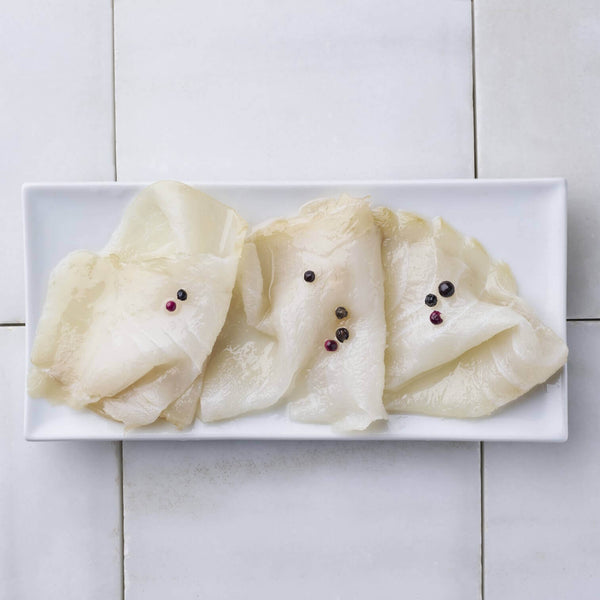
Mullet roe (also called bottarga in Italian) is the complete roe sac of the mullet, cured in salt, pressed, and dried to obtain a compact, dark amber block. It is grated over pasta, sliced thin as an appetizer, or used as a condiment.
Its flavor is extraordinarily intense: salty, marine, with an umami undertone comparable to Parmesan cheese. It is one of the most flavor-concentrated products in the Mediterranean.
Mullet roe vs. tuna roe
| Appearance | Mullet roe | Tuna roe |
|---|---|---|
| Color | Golden amber | Dark red-brown |
| Flavor | More subtle, sweet, nutty | More intense, saltier |
| Texture | More waxy | Firmer and drier |
| Primary use | Grated over pasta | Sliced as an appetizer |
| Price | 100-250 €/kg | 80-180 €/kg |
Both are excellent. Mullet roe is more versatile in cooking due to its waxy texture that grates easily. Tuna roe has more personality as a sliced appetizer.
Salt cod
Salt cod is, in terms of volume, the most important salt-cured product in the world. Millions of tons of cod (Gadus morhua) are salted and dried annually for consumption in Portugal, Spain, Brazil, Italy, and Caribbean countries.
Unlike other salt-cured products that are consumed directly, salt cod requires a prior desalting process (48-72 hours in cold water, changing the water every 8-12 hours) before cooking. It is an ingredient, not a final product. But this salting-desalting process transforms the cod's texture in a way no other method achieves: the proteins reorganize, creating that unmistakable flaky structure.
Quality salt cod is distinguished by the thickness of the piece (thick loins = better), the whiteness of the flesh (yellowing indicates oxidation), and the smell (saline and clean, never rancid).
Cantabrian anchovies
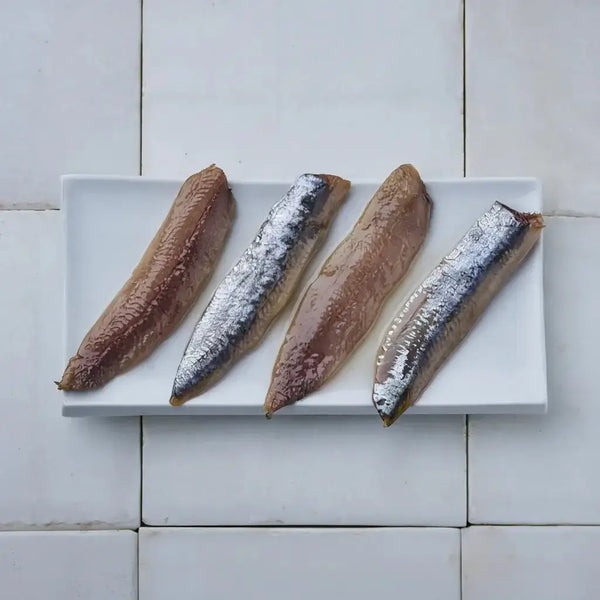
Salted anchovies are boquerones (Engraulis encrasicolus) cured in salt for a period of 6 to 12 months. During this time, the fish's natural enzymes transform the raw protein into a pink, tender flesh with an extraordinary umami flavor.
The process is unique among salt-cured products: it is not just preservation by salt, but a controlled enzymatic fermentation that completely transforms the product. A fresh boquerón and a salted anchovy are nothing alike.
Quality factors in anchovies
- Maturation: Minimum 6 months in salt, ideally 10-12 months. "Fast" anchovies (3-4 months) have not completed the enzymatic transformation and have a raw flavor and incorrect texture.
- Size: Measured in fillets per tin. "00" (8-10 fillets/tin) are the largest and most valued. "0" (10-14 fillets/tin) offer the best value for money.
- Color: Uniform pink-brown, never gray or with dark spots.
- Origin: Santoña, Laredo, Castro Urdiales (Cantabria) and the Basque Country are the reference areas.
Dried bonito (muxama)
Dried bonito, known as muxama in the Basque Country, is a close cousin of mojama but made with albacore tuna (Thunnus alalunga) instead of bluefin tuna. The process is similar: salting and air-drying.
The result has a less intense flavor than bluefin tuna mojama but is more delicate and has a more pronounced sweet undertone. It is a lesser-known product than mojama but highly appreciated in the Basque Country and Cantabria.
Price: 60-120 €/kg, generally more accessible than bluefin tuna mojama due to the greater availability of the raw material.
Prices and where to buy
| Salt-cured product | Average price (2026) | Best place to buy |
|---|---|---|
| Bluefin tuna mojama (almadraba) | 120-200 €/kg | Barbate producers, gourmet stores |
| Mojama (standard) | 80-120 €/kg | Markets, specialized stores |
| Mullet roe | 100-250 €/kg | Murcian producers, online gourmet |
| Tuna roe | 80-180 €/kg | Cádiz producers, markets |
| Cantabrian anchovies (50g tin) | 5-15 € (equiv. 100-300 €/kg) | Santoña canneries, supermarkets |
| Salt cod | 15-40 €/kg | Fishmongers, markets, online |
| Dried bonito (muxama) | 60-120 €/kg | Basque Country, specialized stores |
Key tip: Salt-cured products are high-flavor concentration products consumed in small quantities. 100g of mojama can make 4-6 servings as an appetizer. Seen this way, the price per serving is more reasonable than the price per kilo suggests.
How to serve and store
Serving
- Mojama: In thin slices with extra virgin olive oil and Marcona almonds. Also excellent with cherry tomatoes.
- Roe: Grated over pasta (spaghetti with oil, garlic, and grated roe). In slices with oil and lemon as an appetizer.
- Anchovies: Directly on bread with tomato. In pintxos. As an ingredient in salads, pizzas, pasta.
- Cod: Requires prior desalting. Then cooked: baked, in a stew, fried, in croquettes.
- Dried bonito: Like mojama: thinly sliced with oil.
Storage
- Mojama and roe (whole piece): In the refrigerator wrapped in cling film or a damp cloth. Lasts 2-4 weeks. Do not freeze.
- Sliced mojama: Consume within 2-3 days. The cut surface oxidizes quickly.
- Anchovies (open tin): In the refrigerator covered with olive oil, 1-2 weeks.
- Salt cod: In the refrigerator, for months. It is a cured product preserved by the salt itself.
🛒 Recommended products in this guide
Cantabrian Anchovies "00" Gourmet Selection
Premium 00 size, artisanal preparation
38,90€
View product →⭐ 4.9/5 · Cold shipping 24-48h · Since 1990 at Mercat del Ninot
Frequently asked questions
Are salt-cured products healthy or do they have too much salt?
Salt-cured products are rich in protein, omega-3, and vitamins, but they do contain a lot of salt (1.5-5 g of sodium per 100g depending on the type). For people without high blood pressure, consumed in typical quantities (30-50g as an appetizer), they do not pose a problem. If you have sodium restrictions, consult your doctor. Mojama, for example, has less salt than anchovies because some of the salt is removed during drying.
What is the difference between mojama and tuna cecina?
They are the same product with a different regional name. "Mojama" is the most widespread term (of Arabic origin, "musama"). "Tuna jerky" is occasionally used but can cause confusion with beef jerky. The process is identical: tuna loin cured in salt and air-dried.
Can you make salted fish at home?
Some you can: homemade mullet roe and homemade salted anchovies are feasible projects with patience. Mojama is more complex (it needs controlled drying conditions). For homemade anchovies: whole anchovies in coarse salt, pressed, in the fridge for 6-12 months. It's a long but simple process.
Why is mojama so expensive?
Three factors: 1) The raw material (bluefin tuna) is scarce and expensive (fishing quotas are strict). 2) The yield is low: from a 200 kg tuna, only 8-12 kg of mojama is obtained. 3) The drying process lasts weeks with a weight loss of 40-50%. A kilo of mojama requires almost 2 kg of fresh bluefin tuna loin.
What is the difference between anchovies and marinated anchovies (boquerones en vinagre)?
They are the same fish (Engraulis encrasicolus) with completely different processes. Anchovies are cured in salt for months (enzymatic fermentation) and served in fillets with oil. Marinated anchovies (boquerones en vinagre) are marinated in vinegar and oil, consumed fresh, and have a sour taste and crispy texture. They are two distinct products that share only the raw material.
Do salted fish products have an expiration date?
Yes, although their shelf life is long. Whole mojama and roe last for weeks in the fridge. Canned anchovies, years. Salted cod can last months when properly stored. However, all salted fish products lose quality over time: they oxidize, dry out, or lose nuances of flavor. Ideally, they should be consumed as fresh as possible after purchase.
What is the best salted fish product for someone who has never tried any?
Cantabrian anchovies are the most accessible entry point: intense but not aggressive flavor, widely available, and with a reasonable entry price (a can of good anchovies for 5-8 €). From there, the next natural step is mojama: sliced thinly with oil and almonds, it's a revelation for anyone trying it for the first time.
Salted fish products are one of Spain's most undervalued gastronomic treasures. We have mojama that competes with any ham in flavor complexity, roe that rivals Italian bottarga, anchovies that are the best in the world, and a tradition of salted cod that fed generations. All of this, produced artisanally and with methods that are thousands of years old.
Getting to know salted fish products, knowing how to differentiate them, and learning how to serve them is a gastronomic investment that returns much more than it costs.
Related articles:
Written by Marc González Sáez, seafood expert since 1990, Mercat del Ninot, Barcelona.