Summary
Every year, when Easter Week arrives, millions of people switch from meat to fish. We do it almost instinctively. But we rarely stop to think why. In this guide: The origin of eating fish during Easter Week, Abstaining from meat: what the Church says, Fish in the Bible: more than just food.
The origin of eating fish during Easter Week
Every year, when Easter Week arrives, millions of people switch from meat to fish. We do it almost instinctively. But we rarely stop to think why.
The answer has its roots in the early centuries of Christianity. Early Christians adopted fish as a symbol of their faith. The Greek word for fish, ichthys (ΙΧΘΥΣ), was an acronym for "Iesous Christos Theou Yios Soter" (Jesus Christ, Son of God, Savior). In the catacombs of Rome, fish carvings can still be seen, which Christians used as a secret sign to identify themselves.
But the practice of eating fish during Easter Week is not just symbolic. It has to do with fasting, penance, and a series of practical decisions that marked centuries of culinary history in Europe.

Abstaining from meat: what the Church says
The ecclesiastical rule is clear: during Lent and especially during Easter Week, the faithful must abstain from eating meat. This rule dates back to the 4th century, when the Council of Nicaea (325 AD) established Lent as a period of preparation for Easter.
Meat was considered a food associated with pleasure and abundance. Giving it up was a form of penance. Fish, on the other hand, was seen as a more humble food. Fish were "cold-blooded" creatures and, according to medieval theology, were not subject to the same restrictions as warm-blooded animals.
This distinction may seem arbitrary today, but it had enormous consequences. It created a massive demand for fish that transformed entire economies.
Which specific days do you not eat meat?
According to the current Code of Canon Law:
- Ash Wednesday: abstinence from meat and fasting.
- All Fridays of Lent: abstinence from meat.
- Good Friday: abstinence from meat and fasting.
For those over 14 years old. Fasting (one main meal a day) applies to those between 18 and 59 years old. These rules have been considerably relaxed since the Second Vatican Council (1962-1965), which eliminated the obligation to abstain from meat every Friday of the year.
Fish in the Bible: more than just food
Fish appears at key moments in the New Testament. Jesus multiplied the loaves and fish to feed 5,000 people. Several of his apostles were fishermen from the Sea of Galilee: Peter, Andrew, James, and John left their nets to follow him.
After the resurrection, Jesus prepared roasted fish for his disciples on the shore of Lake Tiberias. This episode, narrated in the Gospel of John (21:9-13), reinforced the association between fish and the Christian faith.
The fish became one of the first symbols of Christianity, even before the cross. During the Roman persecutions (1st-3rd centuries), drawing a fish in the sand was a discreet way for believers to recognize each other.
The Middle Ages: when fish moved empires
With the consolidation of Christianity in Europe, the demand for fish during Lent multiplied. It should be noted that Lent lasts 40 days, plus all Fridays of the year, plus the vigils of important holidays. In total, medieval Europeans had to eat fish between 130 and 180 days a year.
This created a gigantic market. Coastal cities prospered. Fishermen ventured further and further into the ocean. And preservation techniques were developed that allowed fish to be transported hundreds of kilometers from the sea.
Herring: the people's fish
In northern Europe, herring was the most consumed Lenten fish. It was salted, smoked, or pickled in barrels. The cities of the Hanseatic League (Lübeck, Hamburg, Bergen) built much of their wealth on the herring trade.
Cod: the discovery that changed everything
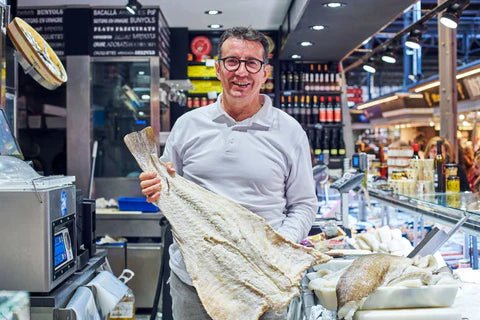
When Basque and Portuguese fishermen discovered the cod banks of Newfoundland in the 15th century, they found a fish perfect for preservation. Dried and salted cod could last for months without refrigeration. It was cheap, nutritious, and did not spoil on long overland journeys.
Cod became the quintessential Lenten fish in southern Europe. Spain, Portugal, and Italy developed hundreds of recipes that are still alive today.
Easter Week traditions in Spain
Each region of Spain has its own gastronomic traditions for Easter Week, but fish is the common thread in all of them.
- Basque Country: Bacalao al pil pil, bacalao a la vizcaína, bacalao Club Ranero. Cod is almost a sacred ingredient in Basque cuisine.
- Castile: Potaje de vigilia with chickpeas, spinach, and cod. Garlic soups with poached egg.
- Andalusia: Easter Week stew with cod and spinach, pavías de bacalao (battered cod with saffron), soldaditos de Pavía.
- Catalonia: Bacallà amb mongetes (cod with beans), bunyols de bacallà, esqueixada (salad of shredded cod with tomato and onion).
- Galicia: Cod empanada, caldeirada, pulpo á feira (octopus Galician style).
- Levante: Rice with cod and cauliflower, all i pebre de anguila (eel stew), esgarraet (cod salad with roasted pepper).
Interestingly, most of these recipes use salted cod, not fresh fish. The reason is historical: for centuries, inland Spain was too far from the sea to receive fresh fish in good condition. Salted cod was the only option.
Does it still make sense to eat fish during Easter Week today?
The religious obligation is increasingly less strict. Pope Paul VI already simplified fasting rules in 1966. Today, many Catholics only abstain on Good Friday.
But the tradition persists. And it makes sense beyond the religious. Reducing red meat consumption has cardiovascular health benefits. Fish provides high-quality protein, omega-3s, and minerals like iodine and selenium.
Furthermore, Easter Week recipes are a gastronomic heritage worth preserving. Potaje de vigilia, bacalao al pil pil, or buñuelos de bacalao are as much a part of Spanish culinary identity as paella or gazpacho.
At Bacalalo, we believe that tradition is alive when it's cooked. You don't have to be religious to enjoy a good plate of cod during Easter Week. It's enough to appreciate an extraordinary product and recipes perfected over centuries.
Frequently Asked Questions
Why is fish not considered meat during Easter Week?
The distinction comes from medieval theology. Land animals (warm-blooded) were considered "meat" in the strict sense. Fish, being cold-blooded and living in water, were outside the prohibition. This classification was maintained in canon law.
Is it mandatory to eat fish during Easter Week?
It is not mandatory to eat fish. What is mandatory for Catholics is to abstain from meat on certain days (Ash Wednesday, Fridays of Lent, and Good Friday). Meat can be replaced by fish, eggs, vegetables, or legumes.
Since when has fish been eaten during Easter Week?
The custom dates back to the 4th century, when Lent was formalized as a period of fasting and abstinence. Early Christians already associated fish with their faith from the 1st century, but the ecclesiastical norm was consolidated in the councils of the 4th and 5th centuries.
Why is cod the most popular fish during Easter Week?
Because of its preservation capacity. Salted and dried cod can be stored for months without refrigeration. This allowed it to reach inland Spain and Europe when there was no cold chain. In addition, its intense flavor and versatility in cooking made it a favorite.
Is fish also eaten during Easter Week in other countries?
Yes. In Portugal, Italy, Greece, Poland, Brazil, Mexico, the Philippines, and practically all countries with a Catholic tradition. Cod is the most consumed fish in Portugal (bacalhau), Italy (baccalà), and Spain. In Scandinavia, lutefisk (cod treated with lye) is traditional at Christmas.
What other foods are typical of Easter Week besides fish?
Sweets play a very important role: torrijas, pestiños, roscos de anís, flores fritas, bartolillos, leche frita, and buñuelos de viento. Legume stews, garlic soups, and potato omelets are also common. Each region has its specialties.
Discover more