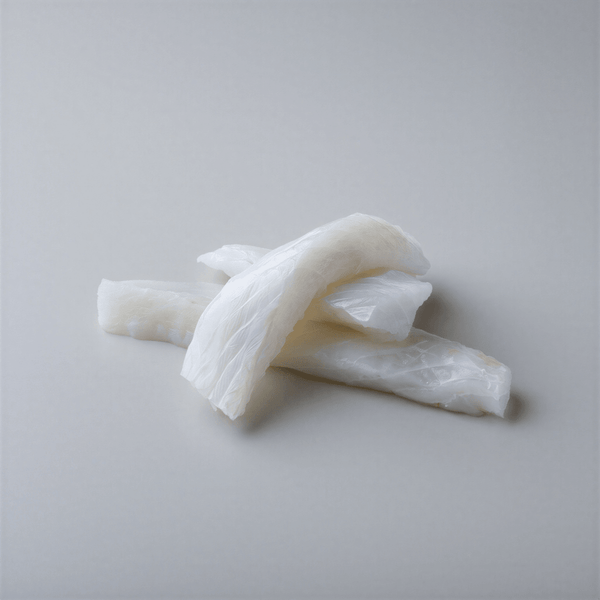
Summary: White fish is any species with less than 2% fat in its flesh: cod, hake, monkfish, sole, sea bass, sea bream, and more. It has fewer calories than oily fish, is rich in highly bioavailable protein, and is the most versatile option in cooking. Here is the complete list with real nutritional data and criteria for choosing.
Table of contents
What is white fish
The classification "white fish" has nothing to do with the color of the skin or the external appearance of the animal. It is a nutritional classification based on the fat content of the muscle. A fish is considered white when its intramuscular fat percentage is less than 2%. It's that simple.
This low fat concentration has a direct biological explanation: white fish store their lipid reserves in the liver, not in the muscle. The most extreme example is cod (Gadus morhua), whose liver can contain up to 60% fat while its loins have barely 0.7%. This is where the famous cod liver oil comes from, which for generations was the main source of vitamins A and D in Northern Europe.
This fat distribution has direct consequences in cooking:
- Milder flavor: Less fat = less aromatic intensity. White fish has clean, delicate flavors that absorb marinades and sauces easily.
- Firm and flaky texture: Lean meat separates into defined flakes. This is ideal for steaming, baking, or grilling, but requires care to avoid drying out.
- Lower caloric content: A 150g hake fillet provides about 120 kcal. The same weight of salmon exceeds 250 kcal. If you're looking for low-calorie protein, white fish wins.
What white fish does NOT have in abundance is omega-3 EPA and DHA. These fatty acids are concentrated in intramuscular fat, which is precisely what it lacks. For omega-3s, you need oily fish (salmon, sardines, mackerel). But for clean and versatile protein, white fish is king.
Difference from oily fish
The boundary between white and oily is not a color, it's a number: 2% fat. Below, white. Above 5%, oily. Between 2 and 5%, there is an intermediate category that some call "medium-fat" - this includes species such as sea bream or trout.
| Characteristic | White Fish (<2% fat) | Oily Fish (>5% fat) |
|---|---|---|
| Fat storage | In the liver | In the muscle (infiltrated) |
| Calories per 100g | 70-90 kcal | 150-230 kcal |
| Omega-3 (EPA+DHA) | 0.1-0.3 g/100g | 1.0-3.0 g/100g |
| Protein per 100g | 17-20 g | 18-22 g |
| Flavor | Mild, clean | Intense, fatty |
| Texture | Firm, flaky | Juicy, unctuous |
| Fresh preservation | 1-2 days | 1 day (oxidizes quickly) |
| Tail shape | Rounded or straight | V-shaped (forked) |
| Typical examples | Cod, hake, monkfish, sole | Salmon, sardine, mackerel, tuna |
A fact that surprises many people: the fat content of the same fish varies with the season. A sardine in July (fattening season) can have 12% fat. The same sardine in February can drop to 4%. The white/oily classification is based on the annual average, but nature doesn't understand fixed categories.
Nor should you confuse "white = worse" or "oily = better". They are different nutritional profiles for different needs. If you need omega-3s, oily fish. If you need lean protein, white fish. The ideal diet includes both 2-3 times a week, alternating.
Is it white or oily fish? Answer by species
One of the most frequent doubts when choosing fish is whether a particular species is white or oily. The key, as we have seen, is the percentage of fat in the muscle: below 2%, white; above 5%, oily; in between, semi-fatty. Here is the direct answer for the most commonly consulted species:
| Species | Classification | Why |
|---|---|---|
| Cod | White | 0.7% fat in the loin. Stores fat in the liver, not in the muscle. |
| Hake | White | 1.8% fat. One of the leanest and most consumed white fish. |
| Sea bass | White | 2% fat, on the border but classified and cooked as white. |
| Sea bream | Semi-fatty (counted as white) | 2-3% fat. On the borderline; profile closer to white. |
| Corvina (Croaker) | White | Less than 2% fat. Firm flesh ideal for ceviche. |
| Turbot | White | 1.9% fat. Lean and gelatinous flatfish. |
| Salmon | Oily | 13% fat. It is the reference oily fish, rich in omega-3. |
| Tuna | Oily | Between 6 and 12% fat depending on the season. Clearly oily fish. |
| Sardine / Anchovy | Oily | 8-12% fat in season. Oily fish par excellence. |
A quick visual trick when you have the whole fish in front of you: oily fish usually have a V-shaped (forked) tail and a fusiform body for swimming long distances; white fish tend to have a straighter or rounded tail and live closer to the bottom. It's not foolproof, but it works in most cases.
Complete list of white fish
Here are the main white fish available in Spain, with their scientific names and distinguishing characteristics:
Cod (Gadus morhua)
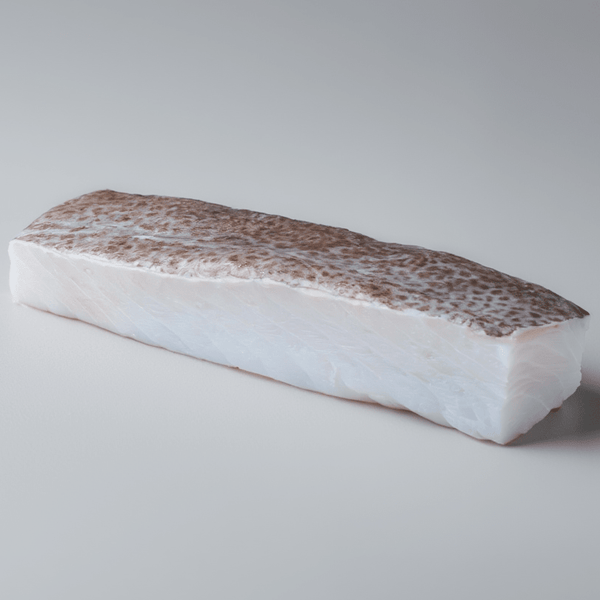
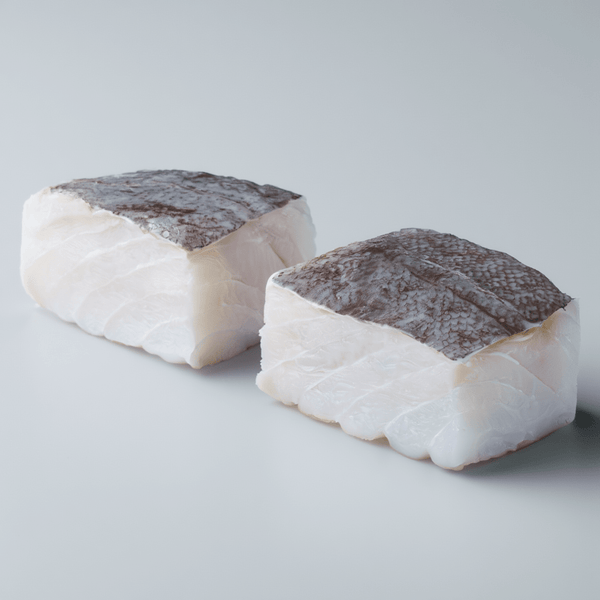
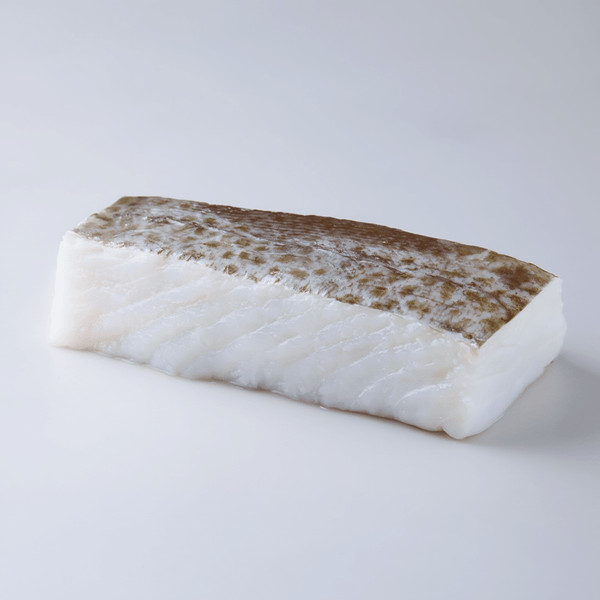
The king of white fish. White, firm flesh that flakes into large pieces. It is the most versatile fish on the list: it works baked, fried, in stews, in salads, and even raw in esqueixada. North Atlantic cod (Iceland, Norway) is of the highest quality. Fresh, it has a mild, sweet flavor; salted and desalted, it gains depth and texture. It is the basis of iconic dishes throughout the Mediterranean basin: bacalao al pil-pil, bacalao a la vizcaína, brandada, bacalao a la llauna, cod fritters.
Hake (Merluccius merluccius)
The most consumed white fish in Spain. Tender flesh, almost gelatinous when fresh. Ideal for gentle cooking (steaming, poaching, green sauce). Hake kokotxas (the lower part of the jaw) are a delicacy with a unique gelatinous texture due to their high collagen content. European hake (line-caught) is superior to Pacific hake.
Sole (Solea solea)
Flatfish with extremely fine and delicate flesh. It is the most expensive white fish on the market and, for many, the most elegant. It is cooked whole grilled or baked, with butter and lemon. Its flesh is so subtle that powerful sauces overwhelm it. If you buy it, let the product speak for itself.
Monkfish (Lophius piscatorius)
The meatiest of the white fish. Firm, almost meat-like texture, boneless. It is the only white fish that withstands long cooking without falling apart: stews, rice dishes, casseroles. Monkfish tail is the commercial part (the head, which is huge and ugly, is used for broths). It has one of the highest protein contents: 18.7 g per 100 g with only 0.7 g of fat.
Sea bass (Dicentrarchus labrax)
Firm, white flesh, with a clean and slightly sweet flavor. It is the star fish of Mediterranean cuisine when baked (sea bass in salt is a classic). Wild sea bass has a noticeably superior flavor to farmed sea bass, but the price triples. A 1.5 kg sea bass baked with potatoes is one of the noblest dishes you can serve.
Sea bream (Sparus aurata)
Technically semi-fatty (2-3% fat), but commonly included among white fish. Firm, juicy flesh, with a more pronounced flavor than sea bass. Sea bream baked in salt or 'a la espalda' is a classic on the Spanish coast. There is a lot of farmed sea bream on the market - it's not bad, but wild sea bream has a perceptible flavor difference.
Turbot (Scophthalmus maximus)
Another flatfish, considered the Galician sole for its importance in northwestern cuisine. White, firm flesh, with a gelatinous quality that makes it exceptionally juicy. It is expensive (30-50 euros/kg wild), but it is a celebratory fish. Baked whole, with potatoes, it is unbeatable.
Grouper (Epinephelus marginatus)
Large rock fish with firm, compact flesh. Strong flavor for a white fish. It is increasingly scarce and expensive in the wild - fishing is regulated in many areas of the Mediterranean. It is cooked baked or in a stew.
Perch (Perca fluviatilis)
Freshwater white fish, popular in Central Europe. Delicate and fine flesh. It is not common in Spain, but appears as imported Nile perch fillet (Lates niloticus), which is a different product and less valued gastronomically.
Megrim (Lepidorhombus whiffiagonis)
A flatter, cheaper fish than sole. Thin flesh, somewhat softer. It is a good fish for getting started with flatfish without the price of sole. Ideal fried or grilled.
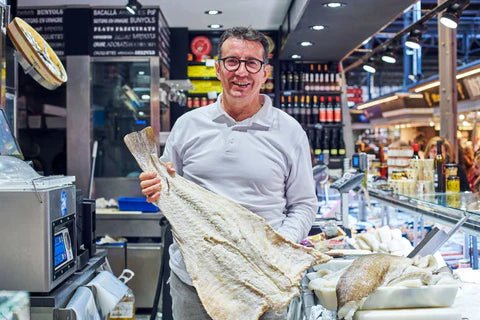
At Bacalalo, we specialize in premium desalted cod, ready to cook. We work with Icelandic cod (Gadus morhua) cured in sea salt and desalted artisanally. Direct selection from the producer at Mercat del Ninot since 1990.
Comparative nutritional table
Values per 100g of edible raw portion. Source: BEDCA database (Spanish Food Composition Data Base) and USDA FoodData Central.
| Species | Calories (kcal) | Protein (g) | Total fat (g) | Omega-3 (g) | Cholesterol (mg) |
|---|---|---|---|---|---|
| Cod (G. morhua) | 82 | 18.0 | 0.7 | 0.15 | 50 |
| Hake (M. merluccius) | 86 | 17.2 | 1.8 | 0.20 | 67 |
| Sole (S. solea) | 81 | 16.9 | 1.4 | 0.18 | 50 |
| Monkfish (L. piscatorius) | 76 | 18.7 | 0.7 | 0.10 | 25 |
| Sea bass (D. labrax) | 97 | 18.4 | 2.0 | 0.30 | 80 |
| Sea bream (S. aurata) | 100 | 19.7 | 2.5 | 0.35 | 73 |
| Turbot (S. maximus) | 95 | 16.5 | 1.9 | 0.25 | 55 |
| Grouper (E. marginatus) | 92 | 19.4 | 1.0 | 0.20 | 40 |
| Megrim (L. whiffiagonis) | 78 | 16.0 | 1.2 | 0.15 | 48 |
| Salmon (comparison) | 208 | 20.4 | 13.4 | 2.50 | 55 |
What this table clearly shows: white fish has an exceptional protein/calorie ratio. Monkfish, for example, provides 18.7 g of protein with only 76 kcal - one of the best ratios of any natural food. For context: 100 g of chicken breast has 165 kcal and 31 g of protein, a ratio of 5.3 kcal/g of protein. Monkfish has 4.1 kcal/g of protein. It is literally more efficient than chicken.
Which to choose based on the recipe
Not all white fish are interchangeable. The fat, texture, and firmness of each make it optimal for specific techniques:
| Cooking technique | Best option | Why |
|---|---|---|
| Baked (whole piece) | Sea bass, sea bream, turbot | The skin protects the flesh and the fat (little, but enough) maintains juiciness |
| Fried (battered/breaded) | Cod, hake, megrim | Flesh that flakes well and contrasts with the crispy exterior |
| Stew / casserole | Monkfish, grouper, cod | Firm flesh that doesn't fall apart with prolonged cooking |
| Grilled | Sole, sea bass, sea bream | Crispy skin + flesh that separates cleanly from the bone |
| Steamed / poached | Hake, cod, sole | Delicate textures enhanced by gentle cooking |
| Raw (ceviche/tartare) | Sea bass, desalted cod | Firm flesh that holds up to thin slicing and acid without falling apart |
| Rice / paella | Monkfish, grouper | Pieces that retain their shape after 20 min of cooking with rice |
| Green sauce / pil-pil | Cod, hake (kokotxas) | The gelatin from the cod emulsifies the sauce; kokotxas have natural collagen |
A common mistake: using hake where you need monkfish. Hake falls apart easily - it's perfect for gentle cooking but turns to mush in a long stew. Monkfish, on the other hand, has such a dense muscle structure that it can withstand almost any culinary abuse.
Price per kilo: what to expect
The price of white fish in Spain varies enormously depending on the species, origin (wild vs. aquaculture), and season. These are indicative ranges for fishmongers and markets (April 2026):
| Species | Wild (euros/kg) | Aquaculture (euros/kg) | Comment |
|---|---|---|---|
| Fresh cod | 15-22 | - | Not farmed; salted is cheaper per usable kg |
| Hake | 12-25 (line-caught) | - | Line-caught is premium; trawl-caught is 8-14 |
| Sole | 30-50 | 18-25 | The most expensive; wild can exceed 50 euros/kg |
| Monkfish | 15-25 (tail) | - | Price per clean tail; whole is cheaper but yields less |
| Sea bass | 25-40 | 8-12 | Biggest wild/aquaculture difference on the market |
| Sea bream | 20-35 | 6-10 | Abundant aquaculture; wild is far superior in flavor |
| Turbot | 30-50 | 12-18 | Galicia is the main aquaculture producer |
| Grouper | 25-40 | - | Scarce; regulated in many areas |
| Megrim | 8-14 | - | The economical option among flatfish |
A note on salted cod: although the price per kilo may seem high (15-25 euros/kg), it should be considered that salted cod is dehydrated and concentrated. When you desalinate it, it absorbs water and gains 30-40% in weight. This means that 1 kg of salted cod is equivalent to 1.3-1.4 kg of fresh cod in terms of edible portion. The real cost per serving is competitive.
Our Icelandic cod is Gadus morhua from the North Atlantic, caught in cold waters and cured in sea salt. Available in different cuts and salt levels. Chilled shipping throughout the peninsula.
The Most Sustainable
Fish sustainability depends on three factors: stock status, fishing method, and fisheries management. Not all white fish are in the same situation:
Good situation:
- Icelandic and Norwegian Cod: Populations of Gadus morhua in the Northeast Atlantic have recovered remarkably since the collapses of the 1990s. Icelandic fisheries management (transferable individual quotas) is considered a global model. Icelandic cod is MSC (Marine Stewardship Council) certified in most fisheries.
- European Hake: Populations of Merluccius merluccius in Atlantic waters have improved with reduced quotas. Longline hake (caught one by one with a hook) has the lowest possible environmental impact.
- Farmed Sea Bass and Gilthead Bream: When they come from well-managed farms with ASC certification, they are sustainable options. The impact depends on the origin of the feed and effluent management.
Compromised situation:
- Grouper (Epinephelus marginatus): Species classified as "endangered" by the IUCN in the Mediterranean. It is slow-growing and late-maturing, making it very vulnerable to overfishing. Consume in moderation and only from certified sources.
- Baltic Cod: Unlike Icelandic cod, Baltic populations are in a critical state. Avoid cod from this area.
- Wild Sole: Populations are stable, but the trawling method used to catch them damages the seabed. Farmed sole is a more sustainable alternative.
The practical guide: look for MSC (wild-caught) and ASC (aquaculture) labels on the product. They are not perfect, but they are the most reliable standard available. And when you buy at a fishmonger's, ask about the origin — a good fishmonger always knows where their product comes from.
Conclusion
White fish is nature's most efficient protein: maximum protein, minimal fat, minimal calories, maximum versatility in cooking. You don't need to learn the complete list — you need to know 3-4 species that suit your cooking style and buy the best quality you can afford.
If you had to choose just one, cod (Gadus morhua) is unbeatable in terms of quality-versatility-availability. It works in almost any preparation, preserves exceptionally well when salted, and its real price per serving is competitive. It's not the most glamorous (that title belongs to sole), but it is the most complete.
The golden rule: less is more. Good white fish, simple cooking, extra virgin olive oil, and lemon. You don't need more to dine better than in most restaurants.
Frequently Asked Questions
How many times a week should I eat white fish?
The WHO and AESAN recommend consuming fish 3-4 times a week, alternating between white and oily fish. Two servings of white fish and 1-2 of oily fish is a good balance. White fish provides lean protein; oily fish provides omega-3s. Both complement each other.
Does white fish have omega-3?
Yes, but in significantly smaller amounts than oily fish. Cod has 0.15 g of omega-3 per 100 g; salmon has 2.5 g. If your main goal is omega-3 (cardiovascular health, anti-inflammatory), oily fish is a better source. White fish excels in lean protein and low caloric intake.
Which white fish is best for children?
Hake and sole are the most recommended due to their mild flavor, few bones (in fillet form), and tender texture. Avoid large species such as grouper or swordfish for children under 10 (they accumulate more mercury due to their position in the food chain). AESAN has a specific guide for fish consumption by age.
Is gilthead bream white or oily fish?
Technically it is semi-oily: it has between 2 and 3% intramuscular fat, which places it on the borderline. In practice, it is classified and cooked as white fish. Its nutritional profile (100 kcal, 19.7 g protein per 100 g) is closer to white fish than oily fish. The classification is not binary — it's a spectrum.
Which white fish is the cheapest?
Megrim (Lepidorhombus whiffiagonis) at 8-14 euros/kg wild, and farmed gilthead bream or sea bass at 6-12 euros/kg. Salted cod, although it seems expensive per kg, yields more after desalting (it gains 30-40% in weight) and there is no waste. Calculate the price per edible portion, not per gross kg.
Can I substitute one white fish for another in a recipe?
It depends on the recipe. For frying: cod, hake, and megrim are interchangeable. For whole baked fish: sea bass and gilthead bream substitute well. For long stews: only monkfish and grouper hold up. Never substitute monkfish for hake in a stew — hake will fall apart. The rule: substitute within the same firmness group.
Does salted cod lose nutrients compared to fresh?
The salting and subsequent desalting process slightly modifies the profile: it increases residual sodium (although good desalting reduces it to 1-2%) and can reduce some water-soluble vitamins (B1, B6). But proteins, minerals (phosphorus, selenium, iodine) and the amino acid structure remain intact. The real nutritional difference is minimal.