Table of contents
The griddle: material matters more than you think
Not all griddles are created equal. The material determines how heat is distributed, how much it retains, and whether the fish will stick or not.
Cast iron: The queen of griddles. Brutal heat retention — when you put a fillet on, the temperature barely drops. Needs seasoning to create a natural non-stick surface. Weight: 4-6 kg for a 35 cm griddle. Price: €30-70. If you take good care of it, it lasts decades.
Carbon steel: Similar to cast iron but lighter and with better temperature response. Seasoned the same way. This is what most professional kitchens use. Price: €25-50.
Stainless steel: Does not need seasoning, does not retain odors, is hygienic. But the fish sticks like glue if you don't handle the oil and temperature technique well. For experienced professionals.
Non-stick (Teflon/ceramic): The fish doesn't stick, but it never reaches the temperatures needed for a quality sear. Griddle marks don't form. It's the "safe" but limited option. Also, quality non-stick griddles cost €40-80 and last 2-3 years — in the long run, it's more expensive than cast iron.
My recommendation: Cast iron or carbon steel. Learn how to season them (oil + oven at 200 °C for 1 hour, 3-4 times) and you'll have the best surface for grilled fish for the rest of your life.
Preparing the fish: what you do before turning on the heat
80% of grilled fish success is decided before it even touches the hot metal.
1. Take it out of the fridge 15-20 minutes beforehand. A fish at 4 °C placed on a griddle at 230 °C drops the surface temperature by 40-50 °C instantly. The result: it sticks, doesn't sear, and cooks unevenly. At room temperature, the thermal shock is manageable.
2. Dry it thoroughly. Kitchen paper, pressing firmly on both sides. Water is the enemy of searing — as long as there is water on the surface, the temperature does not exceed 100 °C (boiling point) and the Maillard reaction (browning) that starts at 140 °C does not occur.
3. Score it if necessary. For skin-on fillets, make 2-3 shallow cuts on the skin with a sharp knife. This prevents the fillet from curling — the skin contracts with heat, and without cuts, the fillet arches, touching the griddle only at the edges.
4. Salt 5 minutes beforehand. Not 30 minutes before (extracts too much moisture) nor at the moment (doesn't penetrate). 5 minutes allows the salt to start denaturing the surface protein, facilitating searing.
Oil: before or after — the big question
There are two schools of thought, and both are right — for different things:
Oil on the fish (not on the griddle): Brush the fillet with a thin layer of mild olive oil. The oil heats evenly with the fish surface and acts as a lubricant between the protein and the metal. This is the technique that works best for 90% of situations.
Oil on the griddle: Works if the griddle is properly seasoned. The problem is that oil on a griddle at 230 °C will smoke immediately if you use EVOO. If you use this technique, use mild olive oil with a paper towel, spreading a minimal layer.
What NEVER works: pouring a stream of oil on the hot griddle and placing the fish on top. The oil forms puddles, the fish fries instead of grilling, and the result is oily and soft.
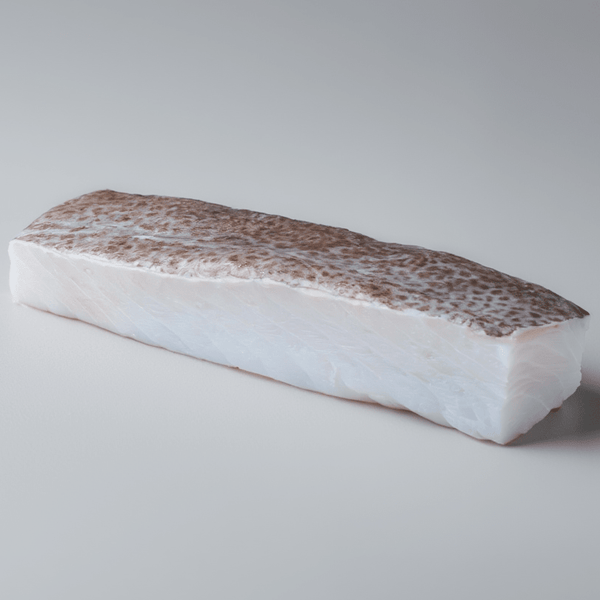
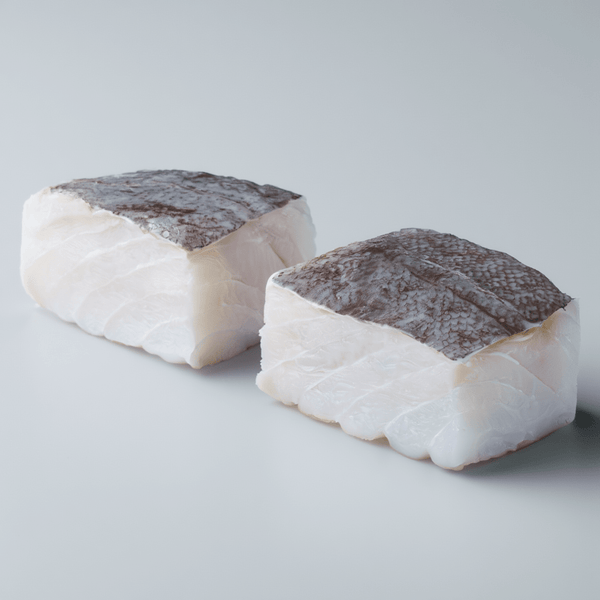
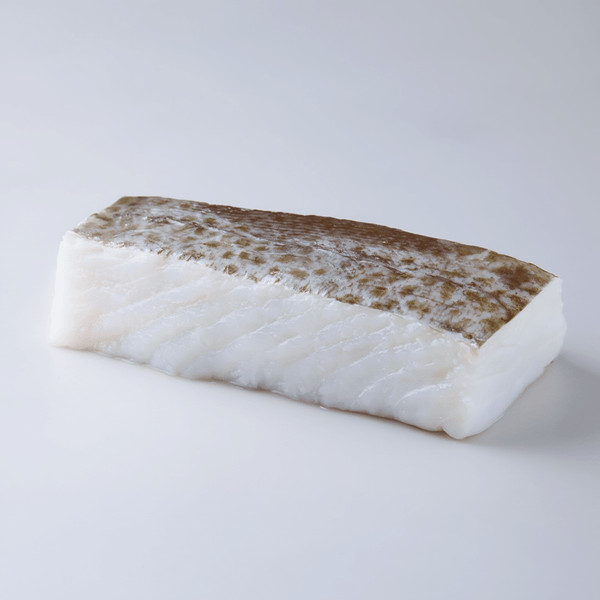
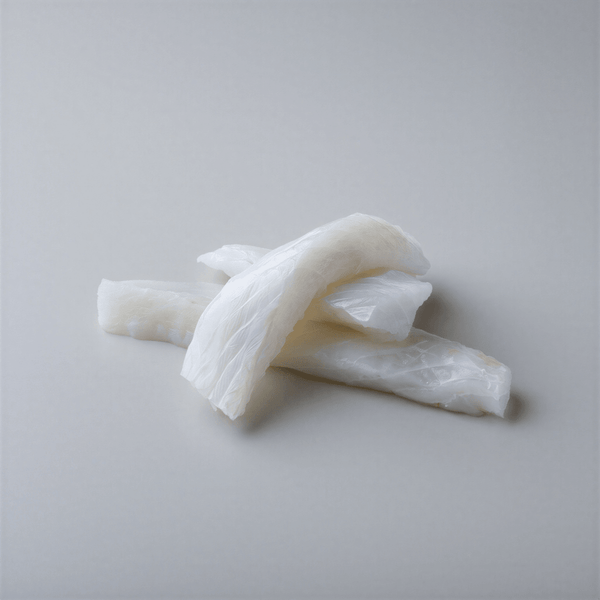
Grilled desalted cod is one of the most elegant and simple dishes that exist — a good cod loin, well-heated griddle, 4 minutes on the skin side. Try our artisanal desalted cod and see for yourself.
Griddle cooking times by species
These times are for fillets/steaks of the indicated thickness, on a very hot cast iron griddle (230-250 °C surface). Adjust +30 sec if using non-stick.
| Species | Cut and thickness | Side 1 (skin) | Side 2 | Rest |
|---|---|---|---|---|
| Gilt-head bream | Fillet with skin, 1.5 cm | 3 min | 1-1.5 min | 1 min |
| Sea bass | Fillet with skin, 1.5 cm | 3 min | 1 min | 1 min |
| Salmon | Loin with skin, 2.5 cm | 4 min | 2 min | 2 min |
| Desalted cod | Loin with skin, 3 cm | 4-5 min | 2 min | 2 min |
| Hake | Steak, 2 cm | 3 min | 2 min | 1 min |
| Red tuna | Medallion, 2.5 cm | 90 sec | 90 sec | 1 min (pink interior) |
| Monkfish | Medallion, 2 cm | 3 min | 2-3 min | 2 min |
| Swordfish | Steak, 2 cm | 2.5 min | 2 min | 1 min |
| Prawn | Split in half | 2 min | 1 min | — |
| Cuttlefish | Whole cleaned, 1 cm | 2-3 min | 1-2 min | 1 min |
| Octopus (cooked) | Cut tentacles | 2 min | 1 min | — |
| Sardine | Whole, descaled | 2 min | 1.5 min | — |
Universal rule: 70% of the time on the skin side, 30% on the other. The skin protects the flesh from direct heat and becomes crispy. If you flip too early, the skin sticks and tears off.
The perfect doneness: how to tell when it's done
Times are approximate — every griddle, every heat source, and every piece of fish is different. Here are reliable indicators:
Finger test: Gently press the center of the fillet with your finger. Soft and gelatinous = raw. Firm with a slight bounce = perfect. Hard = overcooked. With practice, this test is foolproof.
Visual test: Look at the side of the fillet. You'll see a cooking line moving from the bottom (the griddle) upwards. When that line reaches 2/3 of the height, flip it. When the opaque color almost reaches the top but there's a millimeter of translucence in the center, remove it.
Knife test: Insert the tip of a thin knife into the center of the fillet for 3 seconds. Remove it and touch it to your lower lip. Warm = perfect. Cold = raw. Hot = overcooked.
The ideal internal temperature for most white fish is 55-60 °C. For tuna and salmon you want pink inside, 45-50 °C. With a probe thermometer, these figures are accurate.
Side dishes that complement without competing
A well-grilled fish doesn't need sauce — it needs contrast. These side dishes work because they provide acidity, texture, or freshness that balance the fat and umami of the fish:
- Grilled vegetables: Green asparagus, zucchini, roasted red peppers. Same technique, minimal oil, salt, and doneness.
- Warm salad: Arugula, cherry tomatoes, thin red onion, and lemon vinaigrette. Acidity cuts through the fat.
- Smashed potatoes: Cooked potatoes, smashed with a fork, browned on the same griddle with oil and rosemary.
- Grilled lemon: Cut a lemon in half and place it face down on the griddle for 2 minutes. The heat caramelizes the sugars, and the juice squeezed over the fish is something else.
- Pil-pil or ajada: Sliced garlic browned in EVOO with chili. Pour over the fish fresh from the griddle.
Smoked salmon doesn't need a griddle — but if you want grilled salmon with a smoky touch, try marinating it for 30 minutes with our smoked salmon as inspiration for Nordic flavors.
The mistakes everyone makes on the griddle
- Moving the fish. Place it and don't touch it. If you try to move it and it sticks, it's NOT time to flip it. Wait — when it's seared, it will release on its own.
- Griddle not hot enough. If you put your hand 10 cm away and don't feel intense radiant heat, it's not ready. Preheat for 5 minutes over high heat.
- Flipping more than once. Only one flip. Turn it over once. If you flip 3-4 times, you break the seared crust and the fish loses juices.
- Not letting it rest. Like meat, fish needs 1-2 minutes of rest off the griddle. Juices redistribute. If you cut it immediately, they'll drain onto the plate.
- Fillet too thin. Fillets less than 1 cm will overcook in seconds. For grilling, a minimum of 1.5 cm. If your piece is thinner, a pan with butter is better.
- Covering the griddle. Never. The lid traps steam and the fish steams instead of grilling. You lose the Maillard reaction and the crispiness.
Keep exploring
Perfect fried fish technique · Perfect grilled tuna recipe · Desalted cod · Smoked salmon
Frequently asked questions
How to prevent fish from sticking to the griddle?
Three keys: very hot griddle (230 °C+), well-dried fish (thoroughly with paper towels), and oil on the fish, not on the griddle. If the griddle is well-seasoned cast iron, the natural non-stick surface does the rest. And don't touch the fish — if it sticks when you try to flip it, it's not ready.
Do you put the fish skin-side down first?
Yes, always skin-side down first. The skin protects the flesh, becomes crispy, and makes subsequent flipping easier. 70% of the cooking time is on the skin side. When flipped, the other side only needs 1-2 minutes.
How long do you cook salmon on the griddle?
For a 2.5 cm loin: 4 minutes skin-side down, 2 minutes on the other side, 2 minutes rest. The inside should be translucent pink. If you want it more well-done, 5+3 minutes, but you'll lose juiciness.
Can you grill fish without oil?
Technically yes, on a non-stick griddle, but the result is worse. Oil not only prevents sticking — it acts as a thermal conductor that improves contact between the fish and the hot surface. Without oil, searing is uneven and the flavor is flatter.
Which fish is best for grilling?
Firm-fleshed fish: gilt-head bream, sea bass, salmon, tuna, cod, monkfish, swordfish. Very delicate fish (sole, John Dory) are difficult to handle on the griddle because they fall apart. For these, a pan with butter is better.
Why does my grilled fish turn out dry?
Two main causes: overcooking (go over by 1 minute and the difference is brutal) or insufficient fish thickness. For grilling, a minimum of 1.5 cm thick. And remember: fish continues to cook from residual heat after being removed — take it off a little before you think it's done.