

Table of Contents
Not crab: the most misleading name in the supermarket
Let's get straight to it: "crab sticks" contain no crab. Not a single molecule. The name is a commercial euphemism that has worked for decades because it sounds better than "processed fish paste stick with artificial crustacean flavoring."
Spanish law requires these products to be labeled as "surimi — crab flavor" or "surimi preparation," but in the popular imagination, they are still "crab sticks." And many brands take advantage of this: the packaging displays images of crabs, red and white colors that evoke seafood, and a name that leads to error.
In Japan, where modern surimi was invented in the 1960s, no one confuses kanikama (literally "crab kamaboko") with real crab. They know it's a processed imitation and use it as such. In Spain, for 40 years, we've been believing we're buying seafood when we're buying industrial fish with flavoring.
Who loses? The consumer who doesn't read labels. And also the real seafood market, because surimi competes in price with products that have nothing to do with it.
Surimi: what exactly it is and how it's made
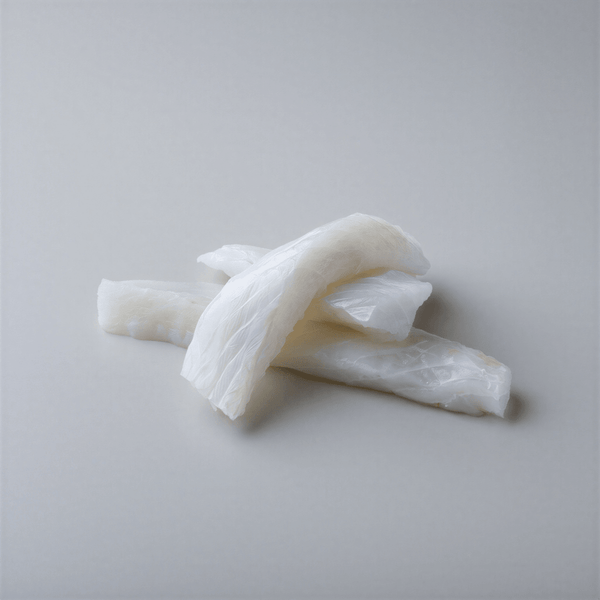
Surimi is not an ingredient — it's a technique. The Japanese word "surimi" (すり身) literally means "ground meat." It is a paste of washed and processed fish protein used as a base to make seafood imitations.
The manufacturing process:
- Fish selection: Primarily Alaskan pollock (Gadus chalcogrammus, formerly Theragra chalcogramma). Pacific hake, horse mackerel, and other inexpensive white fish are also used. Fatty fish are avoided because fat oxidizes and changes the color.
- Filleting and washing: Skin, bones, and blood are removed. The flesh is repeatedly washed with cold water to remove fat, blood, and soluble proteins. This washing is key: it removes the fishy taste and smell, leaving a neutral protein.
- Pressing: Excess water is removed using presses. A white, elastic paste remains.
- Addition of cryoprotectants: Sugar (sorbitol, sucrose) and polyphosphates are added to prevent the protein from degrading during freezing.
- Freezing: It is frozen in 10 kg blocks. This is the "base surimi" that crab stick factories buy.
- Manufacture of the final product: The block is thawed, mixed with starch (wheat or tapioca), egg white, salt, sugar, monosodium glutamate, crab flavoring (synthetic), and red coloring (carmine or paprika). It is molded into a stick shape, steamed, and packaged.
The result is a product with a fibrous texture vaguely reminiscent of crab, a mild and sweet taste, and minimal production cost. The original fish has completely lost its identity.
Real ingredients: read the label
The typical ingredients of Mercadona crab sticks (Hacendado brand):
- Fish surimi (35-45%): Alaskan pollock
- Water
- Wheat and/or tapioca starch (10-15%)
- Vegetable oil (sunflower or rapeseed)
- Egg white
- Sugar and sorbitol
- Salt
- Flavor enhancers: monosodium glutamate (E621)
- Flavorings: crab flavoring (synthetic)
- Colorings: paprika extract, carmine (E120)
- Stabilizers: polyphosphates (E452)
If you add it up: less than half of the product is fish. The rest is water, starch, oil, and additives. You pay between €6 and €9/kg for a product that has 350-450 g of real fish per kilo.
Nutritional table: what it provides and what it doesn't
| Nutrient | Crab sticks (100 g) | Real crab (100 g) | Fresh hake (100 g) |
|---|---|---|---|
| Calories | 95-105 kcal | 87 kcal | 76 kcal |
| Protein | 7-9 g | 18.1 g | 17.2 g |
| Fats | 0.5-1.5 g | 1.1 g | 0.7 g |
| Carbohydrates | 13-16 g | 0 g | 0 g |
| Sugars | 5-7 g | 0 g | 0 g |
| Salt | 1.5-2 g | 0.8 g | 0.1 g |
| Omega-3 | Negligible | 0.4 g | 0.2 g |
Relevant data:
- Protein: Sticks have half the protein of real fish or seafood. Normal — only about 40% of the product is fish.
- Carbohydrates: Real fish or seafood has 0 g of carbohydrates. Sticks have 13-16 g due to added starch and sugar. If you follow a low-carb diet, crab sticks are not your friend.
- Sugar: 5-7 g of sugar per 100 g. More sugar than a slice of bread. In a product people think is seafood.
- Salt: 1.5-2 g per 100 g. The WHO recommends less than 5 g per day. Two sticks already provide almost 1 g of salt.
- Omega-3: Practically non-existent. The intensive washing of surimi removes fat (and with it, omega-3).
Nutritional conclusion: Crab sticks are an ultra-processed food disguised as a healthy food. They are not poison, but nutritionally they resemble neither fish nor seafood.
Uses in cooking: when it makes sense (and when it doesn't)
We are not going to demonize surimi. It has its place — as long as you know what it is and don't pretend it's something else.
It works for:
- Cold salads: The classic — chopped sticks with lettuce, corn, and mayonnaise. It is what it is: a quick Tuesday salad. It doesn't pretend to be haute cuisine.
- Homemade sushi (California roll): The California roll was invented in the 1960s with surimi. This is its original use. It works because the texture fits with the rice and nori.
- Empanada fillings: Mixed with béchamel and gratinéed, it works as an economical filling.
It doesn't work for:
- Any recipe where "seafood" is the star: Paella, seafood salad, seafood cocktail. Surimi does not provide the flavor or texture of real seafood.
- Presenting it as seafood to guests: No one deserves to be fooled.
- Frequent child feeding: The high content of sugar, salt, and additives is not ideal for regular consumption by children.
Real seafood alternatives: the genuine product
If you want real seafood flavor, these are the options, ordered from most affordable to most premium:
| Alternative | Approx. price | Advantage over surimi |
|---|---|---|
| Canned mussels | €3-5/can (110 g) | Real seafood, omega-3, iron |
| Canned sardines | €2-4/can (120 g) | Maximum omega-3, calcium from bones |
| Canned cockles | €4-8/can (110 g) | Exceptional iron, complete protein |
| Canned tuna (bonito) | €4-8/can (112 g) | Complete protein, omega-3 |
| Cantabrian anchovies | €8-20/can (50 g) | Extreme umami flavor, omega-3 |
| Frozen shrimp (peeled) | €10-15/kg | Real seafood, versatile |
| Frozen cooked octopus | €15-20/kg | Protein, texture, sea flavor |
Canned mussels are probably the smartest alternative to surimi: accessible price, superior nutrition (iron, B12, omega-3, zinc), and authentic seafood flavor. A can of pickled mussels with bread is infinitely better than 10 crab sticks.
If you want real seafood in your pantry, gourmet preserves are the most practical alternative. From pickled mussels to natural cockles, always available and always caught in season. Discover our gourmet preserves collection.
Keep exploring
Properties of mussels · Canned sardines: properties · Canned mussels · Canned cockles
Frequently asked questions
Do crab sticks contain crab?
No. Zero crab. They are surimi — a fish paste (usually Alaskan pollock) mixed with starch, sugar, salt, glutamate, and artificial crab flavoring. The name is commercial, not descriptive.
Is surimi bad for your health?
It is not toxic, but it is an ultra-processed food with 13-16 g of carbohydrates (including 5-7 g of sugar), 1.5-2 g of salt per 100 g, and only 7-9 g of protein. It is not nutritionally comparable to real fish or seafood. Occasional consumption is fine; as a regular source of marine protein, it is a poor choice.
What kind of fish is surimi made from?
Mainly Alaskan pollock (Gadus chalcogrammus), an inexpensive and abundant white fish from the North Pacific. Pacific hake and other white species are also used. The fish is repeatedly washed to remove color, odor, and flavor, leaving only the myofibrillar protein.
Do crab sticks contain gluten?
Most do. They contain wheat starch as an ingredient. Some brands use tapioca or potato starch (gluten-free), but you must check the label of each brand. Celiac individuals should specifically look for a certified "gluten-free" mention.
How many calories do crab sticks have?
Between 95 and 105 kcal per 100 g. Fewer calories than many foods, but those calories come largely from carbohydrates (starch and sugar), not protein. A hake fillet has fewer calories (76 kcal) and twice the protein.
Which is better: crab sticks or a can of tuna?
A can of tuna is superior in every way: more protein (25 g vs 8 g), zero carbohydrates, real omega-3, no added sugar. And the price per gram of protein is better. Sticks only win in convenience (no need to open a can) and in recipes where their texture fits (homemade sushi).