Summary: A good can of pickled mussels is one of the most versatile appetizers on the market: it lasts for years, is ready in seconds, and is high in protein and omega-3. Key criteria for choosing: Galician origin from rafts, size 8/14 or 12/16, olive oil, minimal ingredients, honest drained weight. We show you 8 tapas and appetizers in 5 minutes with no cooking that instantly elevate any vermouth, snack, or weekend appetizer.
Why buy canned mussels (and when)
There's an absurd prejudice against canned goods: "if it's from a can, it can't be good." The reality is the opposite. Premium canned seafood is one of the most underrated gastronomic products in Spain — and, paradoxically, one of the most exported to high-end restaurants.
Real reasons to choose canned over fresh:
- Concentrated and consistent flavor: pickled mussels cured for months in a can develop nuances impossible to achieve with fresh ones.
- Permanent availability: fresh mussels depend on the season and health regulations. Canned mussels are always available.
- Zero effort: open and serve. No cleaning beards, no cooking, no discarding shells.
- Cost-benefit: a 3-5 € gourmet can yields 4-6 servings of an elegant appetizer.
- Strategic pantry item: when surprise guests arrive, a premium can provides a high-level appetizer in 90 seconds.
When NOT to choose canned:
- You're cooking rice, paella, or soup where you want steamed mussels opened on the plate.
- You're looking for the tender texture of freshly cooked mussels.
- You have immediate freshness guaranteed (market, same day).
How to choose the right can: 5 criteria
80% of the final quality is decided before opening the can. These are the professional criteria we apply at Mercat del Ninot:
1. Origin — the most important factor
Look on the label for:
- Rías Gallegas / Rías Bajas / Galicia: gold. 90% of the best mussels in Europe come from here.
- Eastern Cantabrian Sea: good, less common.
- Generic "European Union": yellow flag — mixed origins.
- "From EU and non-EU origin": probably mixed with Chile. Only if it's a trusted brand.
- "Chile" / "South America": industrial, flatter taste. Acceptable for mass consumption, not for serious appetizers.
2. Size (Caliber)
The number in "X/Y" format indicates pieces per can:
- 6/8 and 8/14: large premium pieces. For individual tapas, montaditos.
- 12/16: medium. Versatile, ideal for all uses.
- 20/30 and 25/35: small. Salads, snacking in quantity.
For elegant appetizers, 8/14 is the professional choice. For salads and volume, 12/16 or 20/30.
3. Oil and covering liquid
- Extra virgin olive oil: top, maintains nuances and adds its own quality.
- Olive oil (refined): acceptable, neutral.
- Vegetable oil / sunflower oil: industrial, masks flavor.
- Traditional escabeche: oil + vinegar + paprika + bay leaf. This is the classic formula.
4. Minimal ingredient list
A serious can contains: mussel, oil, vinegar, salt, spices. And nothing else. Red flag: monosodium glutamate (E-621), sweeteners, preservatives E-200/202, "aroma", colorants E-150d. These are not illegal but indicate a low-cost industrial product.
5. Honest drained weight
In a small can (OL 120 format), an honest drained weight is 70-90 g. If it says "net weight 120 g, drained weight 50 g," they are mostly selling you water/oil. 1/4 can (115 g net) → drained 75-85 g. Calculate price per gram of real product, not per can.


Serious brands vs. white label brands: the real difference
Frequent question at the counter: "Isn't Mercadona Hacendado the same as BayMar?" Short answer: no, not at all. Concrete differences, in order of importance:
| Aspect | Supermarket white label brand | Premium Galician canned food |
|---|---|---|
| Origin | White label: usual EU-Chile mix | BayMar / Dardo: 100% Galician estuaries |
| Size | White label: 30/40, small | Premium: 8/14, 12/16 — larger pieces |
| Oil | White label: sunflower/vegetable oil mix | Premium: olive oil, sometimes extra virgin |
| Cooking | White label: automated industrial | Premium: artisanal, controlled production |
| Escabeche flavor | White label: minimal paprika, neutral | Premium: spiced, complex, full-bodied |
| Drained weight | White label: 40-50 g | Premium: 70-85 g (similar format) |
| Can price | 1.00-1.50 € | 3.00-5.00 € |
| Price per gram of product | 0.025-0.030 €/g | 0.040-0.055 €/g |
| Real cost difference | — | ~1.5x more, not 5x more (when comparing real grams) |
Our realistic recommendation: combine both. White label for quick daily consumption (Russian salad, informal snacking). Premium canned goods for guest appetizers, Sunday vermouth, gourmet gifts. The difference is like between a 4 € and a 12 € red wine: both make sense in different contexts.
Quick guide: which can for which use
| Use | Recommended type | Bacalalo Example |
|---|---|---|
| Guest appetizer / Sunday vermouth | 8/14 traditional escabeche, olive oil | BayMar Gourmet, Dardo Premium |
| Individual tapas with bread | 8/14 or 12/16, escabeche or olive oil | BayMar, Dardo |
| Toasts with cheese/ham | 12/16 mild or moderately spicy flavor | Spicy Dardo, mild BayMar |
| Russian salad / mixed salad | 12/16 or 20/30 natural or mild | BayMar 8/14 (if you want luxury), white label options |
| Rice, final paella | Canned goods are not ideal — use fresh steamed | — |
| Regular informal snack | Any correct escabeche | Decent white label or entry-level BayMar |
| Gourmet gift / holiday basket | 8/14 premium, nice can | BayMar Gourmet, Dardo Premium |

8 tapas and appetizers in 5 minutes with no cooking
These are the 8 ideas that are most successful at Ninot when customers ask us "what do I do with this can?" All in a maximum of 5 minutes, without turning on the stove.
1. Mussel, ripe tomato, and EVOO toast
Toasted crystal bread · rubbed ripe tomato · 3 mussels · drizzle of EVOO · black pepper · parsley. The Catalan classic adapted to Galician escabeche. Time: 3 minutes. Pairs with cold beer or Albariño.
2. Mussels a la sidrera (without cooking)
Pickled mussels + a splash of cold natural cider + finely chopped red onion + parsley. Serve in a small bowl, eat with a spoon. Time: 3 minutes. Tip: if the cider is too acidic, a drop of olive oil will soften it.
3. Guernican pintxo
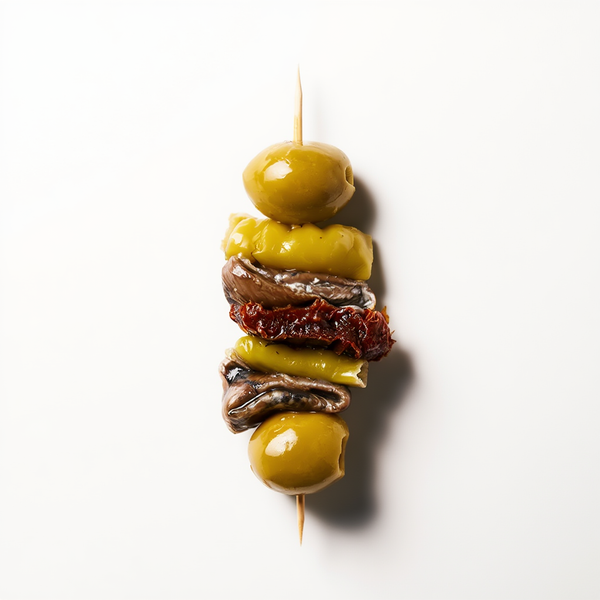
Rustic bread · canned roasted green pepper · mussel · piparra · toothpick. Inspired by the Gilda but with mussels instead of anchovies. Serve at room temperature, not cold.
4. Chinese spoon with avocado
Individual spoon with: 1 spoonful of mashed avocado · 1 mussel · Maldon sea salt flakes · a drop of lemon · a sprig of cilantro. Elegant, easy, fresh. Serves up to 12 at a time.
5. Mussel, white bean, and vinaigrette salad
Drained can of white beans + very thin red onion + 1 can of mussels with their escabeche + chopped parsley + a splash of sherry vinegar. Mix, let rest for 5 min. Refreshing, substantial, no cooking.
6. Crackers with cream cheese and spicy mussels
Cracker or dry toast · natural cream cheese · 1 spicy mussel (Dardo) on top · smoked paprika · parsley. The creaminess of the cheese dampens the spiciness — an addictive combination with beer.
7. Stuffed cherry tomatoes
Hollow out large cherry tomatoes. Stuff with cream cheese mixed with the mussels' own escabeche + half a mussel on top. Elegant appetizer. Time: 8-10 min (this is the slowest of the 8).
8. Improvised Galician picada
On a wooden board: pickled mussels · canned octopus · piquillo peppers · tetilla cheese · corn bread · Galician white vermouth. This is the table any Galician improvises in 4 minutes when visitors arrive. Result: it looks like you've been cooking for hours.


Pairing: Wines, Vermouth, and Beer
White Wines
- Young Albariño (Rías Baixas): the unbeatable classic. Saline acidity interacts with the escabeche.
- Godello (Valdeorras): unctuous, mineral. Excellent for large 8/14 mussels.
- Txakoli: vibrant acidity, perfect in a pintxo.
- Treixadura (Ribeiro): aromatic, smooth. For more complex dishes.
Sherry Wines (Generosos)
- Manzanilla (Sanlúcar): salinity cleans the oil's richness. Top for an aperitif.
- Chilled Fino (Jerez): dry oxidative, a perfect contrast.
Vermouth
- Well-made red vermouth: bitter herbs and subtle sweetness cushion the vinegar. Perfect weekend combination.
- Galician white vermouth: drier, ideal with mussels from the region itself.
Beer
- Craft lager or pilsner: clean, refreshing without overpowering.
- Mild IPA: hops interact with the paprika in the escabeche.
- Sweet beer or stout: NO. It overpowers the escabeche.
5 Mistakes That Ruin a Good Canned Food
Mistake 1: Serving Directly from the Fridge
Extreme cold masks the nuances of the escabeche. Take the can out 15-20 minutes beforehand and let it warm up. The flavor improves noticeably.
Mistake 2: Discarding the Escabeche
The liquid is liquid gold — vinegar + oil + mussel juices + cooked paprika. Use it in vinaigrettes, dip bread in it, add it to salads. Throwing it away means losing 30% of the can's value.
Mistake 3: Combining with Overpowering Flavors
Industrial mayonnaise, sweet sauces (honey, jam), very aged intense cheeses. Canned food has a delicate nuance beneath the strength of the escabeche — mask it and all the nuance disappears.
Mistake 4: Inadequate Bread
Sliced bread, soft industrial bread, brioche. Mussels need rustic bread with a crunchy crust that can hold the escabeche without getting soggy.
Mistake 5: Always Buying the Cheapest
A €1 Hacendado can empties the plate without emotion. A €4 BayMar can triggers "where is this from?". For a serious appetizer, step up a grade — the extra cost is €2.
How to Store an Opened Can
- Transfer any leftover mussels to a small glass jar with an airtight lid.
- Cover with all their escabeche. If it doesn't cover them, add olive oil until they are covered.
- Close airtight and refrigerate at 0-4 °C.
- Consume within 3-5 days maximum.
- DO NOT return mussels you have already touched or plated to the jar.
If you're going to take longer, it's better to consume them and buy fresh — the quality drops with time once opened.
Discover our premium selection
Seafood products carefully selected since 1990 at Mercat del Ninot, Barcelona. Refrigerated shipping in 24-48h.
Conclusion: The Perfect Pantry Appetizer
A good can of escabeche mussels is the difference between "I have nothing to offer" and an appetizer that will be remembered. It costs €3-5, lasts for years unopened, yields 4-6 servings, and allows for eight different preparations without turning on the stove.
If you take away three recommendations:
- Buy Galician from "batea", 8/14 or 12/16 caliber, olive oil.
- Let them warm up for 15-20 minutes before serving.
- Use the escabeche, don't throw it away.
In our gourmet canned food collection, we only select Galician mussels from "batea", from small canneries with tradition — the option we keep at home, those of us who live by the sea.
Related articles
- Mussels: properties, benefits, and superfood
- Mussels in escabeche: homemade recipe step-by-step
- Gourmet seafood preserves: a guide to choosing
- Best Galician preserves: ranking by category
- 12 gourmet canned food recipes
- Gourmet gifts: 15 original ideas