Bacalao al pil-pil (cod in pil-pil sauce) has been one of the most feared challenges in the history of MasterChef Spain. The pil-pil emulsion—that silky sauce formed by binding oil with the cod's gelatin—has eliminated more contestants than any other technique. In this article, we explain how to master this recipe step-by-step, with the tricks we've learned in over 35 years of working with cod at Mercat del Ninot in Barcelona. If pil-pil has defeated MasterChef contestants, with this guide, it won't defeat you.
Pil-pil in MasterChef: the elimination challenge
Bacalao al pil-pil has become the quintessential elimination challenge on MasterChef Spain. It has appeared in one form or another in almost every season, always with the same result: nerves, failures, and dishes returned to the judges with separated oil instead of the creamy emulsion that defines authentic pil-pil.
The reason is simple: pil-pil seems easy. It only has four ingredients. There are no complex cutting techniques, no elaborate sauces, no multiple cooking stages. But the emulsion requires precise control of movement, temperature, and patience, which, under the pressure of the MasterChef clock, is almost impossible to maintain.
Pepe Rodríguez, a jury member, explained in one season why they insist on using pil-pil as a challenge: "Pil-pil is the perfect test because it measures three things: whether you know your product, whether you control the heat, and whether you have the composure not to force things. It's cooking in its purest form."
What pil-pil truly is and why it works
Pil-pil is a natural emulsion that occurs when the collagen and gelatin from the cod dissolve in warm olive oil and, through constant circular motion, bind both elements into a creamy, unctuous sauce.
Scientifically, it works just like mayonnaise: fat particles suspended in an aqueous medium thanks to an emulsifier. In mayonnaise, the emulsifier is egg lecithin. In pil-pil, it is the natural gelatin from the cod, which is especially concentrated in the skin and the most gelatinous parts of the fish.
That's why pil-pil only works well with quality cod: pieces with more collagen and gelatin produce more natural emulsifier, and the sauce binds faster and more stably. Poor quality cod with little gelatin simply won't emulsify.
Conditions for pil-pil to work:
- Oil temperature: 50-60 °C (122-140 °F). Enough to dissolve the gelatin, but not so much as to aggressively cook the cod.
- Constant circular motion: by shaking the clay pot with a back-and-forth or circular motion, gelatin particles disperse evenly in the oil.
- Time: the emulsion does not form instantly. It needs between 10 and 20 minutes of constant motion.
- Cod with skin and gelatin: without skin, the amount of available gelatin is drastically reduced, and the emulsion is much harder to achieve.
Ingredients (only 4)
The greatness of pil-pil lies in its absolute minimalism:
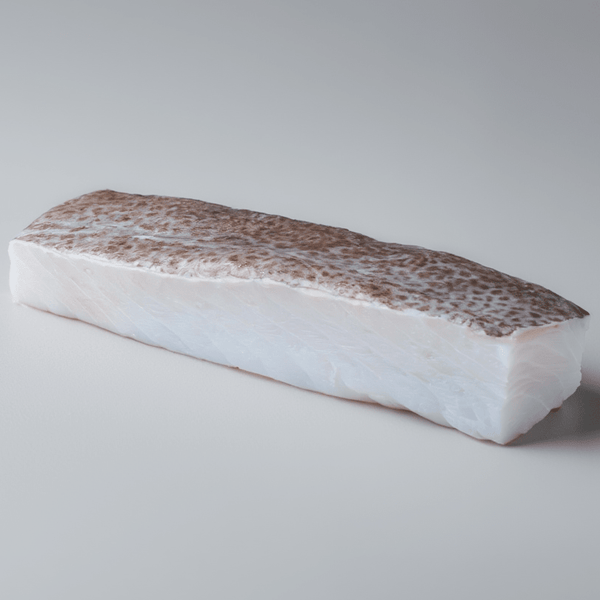
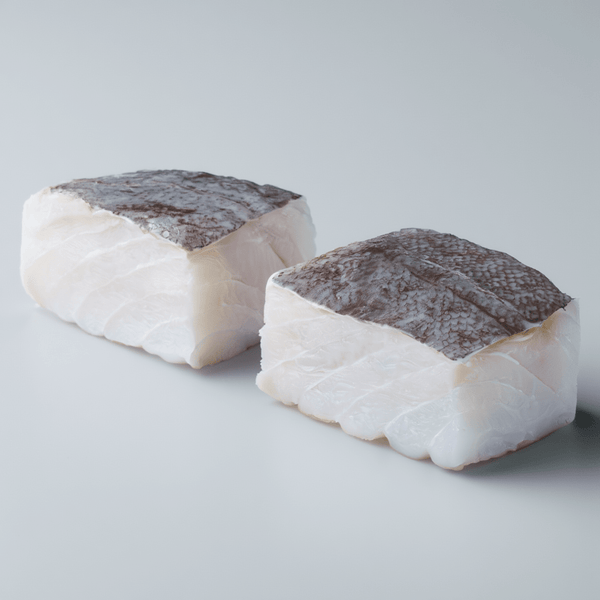
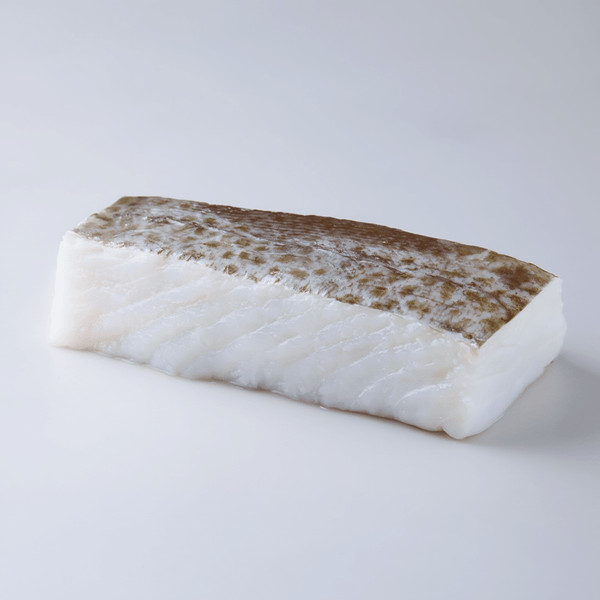
- 4 desalinated cod loins with skin (180-200g each, from the thick central part)
- 300 ml extra virgin olive oil
- 6 thinly sliced garlic cloves
- 1-2 dried chilies (cayenne or piparras)
Nothing more. It contains no broth, no flour, no egg, and no thickener. The sauce is formed exclusively from the cod's gelatin and the oil. If you need to add anything else to thicken it, something has gone wrong.

The secret to pil-pil is the cod.
Available at Bacalalo.com with refrigerated 24-48h shipping
Desalting: the unmentioned preliminary step
On MasterChef, contestants receive the cod already desalinated. At home, desalting is your responsibility, and it's a step that determines the final result as much as the emulsifying technique.
For pil-pil, desalting must be precise but not excessive:
- Submerge the loins in plenty of cold water, in the refrigerator.
- Change the water every 8 hours.
- Total time: 48 hours for thick loins, 36 hours for thinner pieces.
- Cod for pil-pil should have a noticeable but pleasant saltiness. Excessive desalting results in tasteless cod and, even worse, less available gelatin (some is lost in the water).
Professional tip: during the last 8 hours of desalting, add a splash of milk to the water. The casein in the milk helps extract surface salt without affecting the internal gelatin.
Step-by-step: the perfect emulsion
Follow these steps precisely. Do not skip any:
- Pat the loins dry with paper towels. External moisture causes splattering and hinders emulsion.
- Heat the oil in a clay pot over medium-low heat. Add the sliced garlic and chilies. Brown the garlic until lightly golden (2-3 minutes). Remove them with a slotted spoon and set aside. Also remove the chilies.
- Reduce heat to minimum. Place the cod loins skin-side up in the oil. The temperature should be low: the oil should not boil or bubble actively. Only very gentle bubbles around the cod.
- Cook for 8-10 minutes over very low heat. You will see the cod release a white, gelatinous substance into the oil. This is the gelatin. Do not remove it: it is the key ingredient for the sauce.
- Carefully remove the loins (with a wide spatula) and set them aside on a plate, covered with aluminum foil to keep warm.
- Now begin the emulsion: with the pot off the heat (or on minimum heat), start moving the pot with a constant circular motion. You can use a fine-mesh strainer, moving it within the oil, or simply shaking the pot with both hands.
- Patience: the oil will gradually change in appearance. First, it will become cloudy. Then it will begin to thicken. Finally, it will acquire a creamy texture and a pale green-yellow color. This process takes between 10 and 20 minutes.
- If the emulsion doesn't start: add a teaspoon of the gelatinous juice that the cod has released on the reserved plate. This concentrated gelatin acts as an emulsion activator.
- Return the loins to the sauce, baste with the emulsion, and heat for 2 minutes over minimum heat.
Errors made on MasterChef
These failures have been repeated season after season:
- Too high heat: the most frequent error. With the clock ticking, contestants turn up the heat to go faster. Result: the cod fries instead of gently confiting, proteins denature too quickly, and gelatin is destroyed before it can emulsify.
- Too aggressive motion: violently shaking the pot does not speed up the emulsion. It breaks it. The movement must be circular, constant, and gentle.
- Attempting to emulsify with the cod inside: pil-pil emulsifies best with the pot free of fish. Moving the pot with the cod inside causes the pieces to break and flake, ruining the presentation.
- Giving up too soon: the emulsion can take 15-20 minutes to form. Many contestants give up after 5 minutes, thinking it won't work.
- Adding water or broth: a fatal mistake. Any watery liquid breaks the fatty emulsion. Pil-pil is only oil and gelatin.
Professional tips for a foolproof emulsion
After decades of preparing bacalao al pil-pil, these are the tricks that really work:
- Use a clay pot: clay retains and distributes heat evenly and gently, much better than steel or aluminum. Pil-pil was born in a clay pot and works best in a clay pot.
- The strainer trick: insert a fine-mesh strainer into the oil and move it in circles. The mesh fragments the gelatin particles and speeds up the emulsion. This is the technique used by many professional Basque chefs.
- Room temperature: take the cod out of the refrigerator 30 minutes beforehand. If you put it cold in the oil, the gelatin takes longer to dissolve.
- Save trimmings and skin: if you have cod trimmings or extra skin, briefly cook them in the oil before starting. They will provide extra gelatin that will facilitate the emulsion.
- Plan B — cod juice: while the cod rests on the plate, it releases gelatinous juice. If the emulsion doesn't start, add this juice teaspoon by teaspoon. It's pure gelatin and activates the emulsion almost instantly.
Plating and presentation
Pil-pil is served in its own clay pot. It's a dish that calls for rusticity and authenticity, not the minimalism of a Michelin-starred restaurant. However, there are details that elevate the presentation:
- Place the loins skin-side up, the most photogenic part.
- Generously bathe with the pil-pil sauce, which should have a creamy, glossy appearance.
- Distribute the golden garlic and chilies on top.
- A touch of finely chopped fresh parsley adds color and freshness.
- Serve immediately: pil-pil loses texture when it cools; the emulsion breaks with cold.
Accompany with good quality bread for dipping in the sauce. It's mandatory. Wasting pil-pil sauce is a gastronomic sin.
Variations of classic pil-pil
- Kokotxas pil-pil: kokotxas (hake cheeks) have even more gelatin than loins, so the emulsion forms faster and with more body. It's the most luxurious version of pil-pil.
- Pil-pil with choricero peppers: add rehydrated choricero pepper pulp to the oil before emulsifying. The result is an intense red pil-pil with a more complex flavor.
- Green pil-pil: replace part of the oil with a parsley-infused oil (parsley pureed with oil and strained). Spectacular color and herbaceous flavor.
- Kokotxas and squid ink pil-pil: a modern Basque version that incorporates squid ink when emulsifying. Visually striking, with an intense marine flavor.
🛒 Products used in this recipe
⭐ 4.9/5 · Cold shipping 24-48h · Since 1990 at Mercat del Ninot
Conclusion: pil-pil is about patience, not difficulty
Bacalao al pil-pil has eliminated MasterChef contestants not because it's an impossible technique, but because it requires something television doesn't allow: patience. At home, without a timer or cameras, you have all the time in the world to make a perfect pil-pil. You only need four ingredients, a clay pot, constant circular motion, and cod with enough gelatin. If you start with premium quality cod from the North Atlantic, the emulsion is half won before you even turn on the heat.
Why is my pil-pil emulsion not forming?
The most common causes are: too high a temperature (the oil should not boil), low-quality cod with little gelatin, too aggressive or insufficient movement, or having added water or another liquid. Try adding the gelatinous juice that the cod releases when resting: it's a natural emulsion activator.
Can pil-pil be made with fresh cod?
Technically yes, but the result is inferior. Salted and desalinated cod has more available gelatin than fresh because the salting process partially denatures proteins, facilitating emulsion. Additionally, the flavor of salted cod is more concentrated and intense.
How long does it take for the emulsion to form?
Between 10 and 20 minutes of constant motion. If it hasn't emulsified after 20 minutes, add a teaspoon of the gelatinous cod juice or a small piece of cod skin to the oil and keep moving. Don't give up before 15 minutes: often the emulsion forms suddenly after a period where it seems nothing is happening.
Can bacalao al pil-pil be reheated?
It can, but with care. Reheat over very low heat, gently moving the pot to re-emulsify the sauce. Never use a microwave: it will completely destroy the emulsion. The result will never be the same as freshly made, which is why pil-pil is a dish to be eaten immediately.
What kind of pot is best for pil-pil?
A clay pot, always. Clay retains and distributes heat gradually and evenly, which is exactly what pil-pil needs. Steel or cast-iron pots transmit heat too quickly and unevenly, making temperature control difficult.
In which season of MasterChef was pil-pil made?
Bacalao al pil-pil has appeared in multiple seasons of MasterChef Spain, both in the original and Celebrity versions. It is a recurring challenge precisely because it tests pure technique, patience, and knowledge of the product. It has been an elimination challenge, a technical challenge, and part of Michelin-starred restaurant menus.