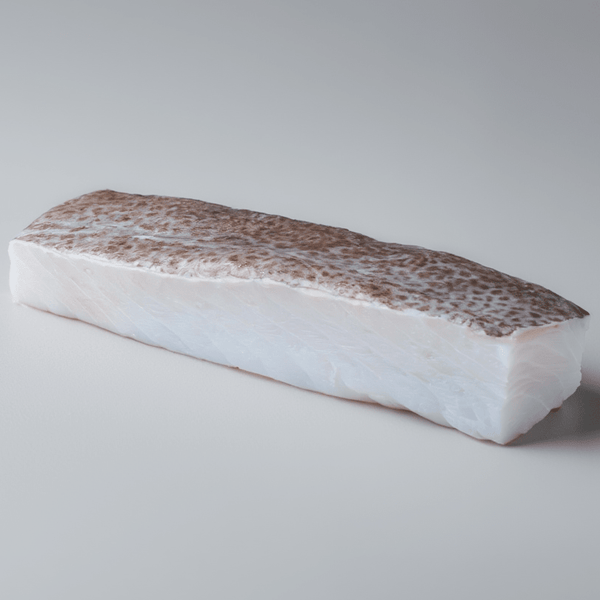
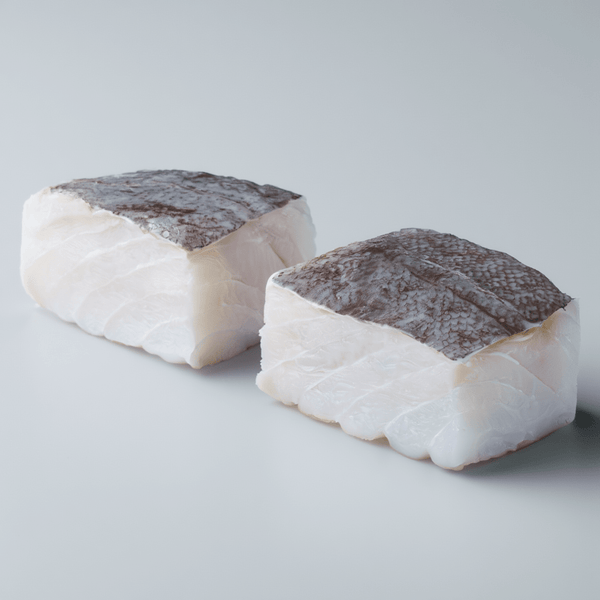
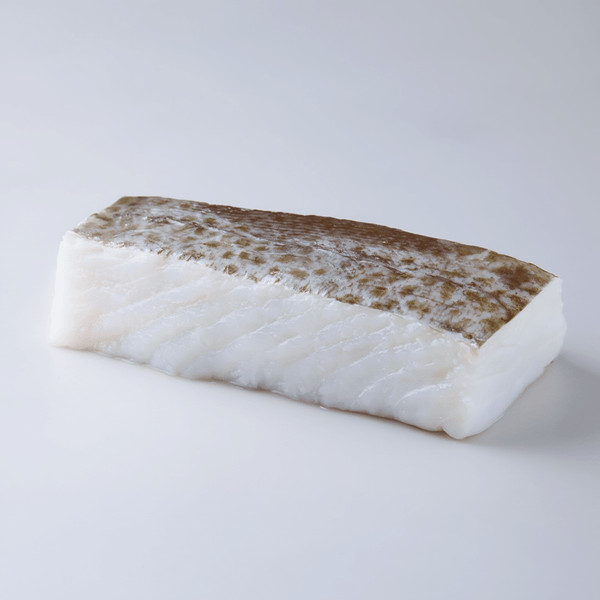
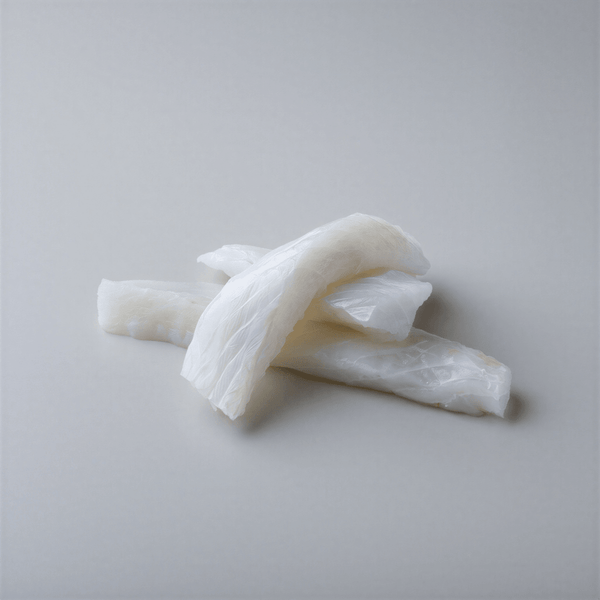
Cod cheeks are the best-kept secret of Basque cuisine: the cut of the belly — the fatter, more gelatinous abdominal part of the cod with a more intense flavor than the loin. While the loin garners attention in classic recipes, cod cheeks are what those who truly understand cod ask for. In this recipe, we prepare them in green sauce with asparagus and peas, following Basque tradition but with details that mark the difference between a correct execution and a memorable one.
What are cod cheeks
The cheek (also written "hijada" or called "ventresca de bacalao") is the abdominal cut of the cod: the area from the ribs to the ventral line. Anatomically, it is the muscle that protects the fish's viscera, and due to its function, it has unique characteristics that radically differentiate it from the loin.
Characteristics of the cheek
- Higher fat content: the cheek accumulates more intramuscular fat than the loin (up to 2-3% compared to 0.5-1% for the loin). This gives it superior juiciness and flavor.
- Gelatinous texture: it has more collagen than the loin, which transforms into gelatin when cooked. It's that "creamy" texture that Basques adore.
- Shorter fiber: the meat flakes into smaller, more tender pieces than the loin.
- Irregular shape: it's not a clean rectangle like the loin. It has a triangular shape and variable thickness, which requires adjusting cooking times.
- Thinner skin: the skin of the cheek is thinner than that of the loin and releases gelatin more easily, which facilitates the emulsification of sauces.
In the Basque Country, cod cheeks are considered a noble part of the cod. In many cider houses and steakhouses, cod cheeks are priced the same (or more) than the loin. It is not an "inferior" cut — it is a different cut, preferred by gourmets.
Difference between cheek, kokotxa, and loin
Cod is cut into several parts, each with its culinary personality:
| Cut | Location | Texture | Fat | Best preparation |
|---|---|---|---|---|
| Loin | Fish back | Firm, flaky | Low (0.5-1%) | Pil-pil, a la vizcaína, baked |
| Cheek/Belly | Abdomen | Melt-in-your-mouth, gelatinous | Medium (2-3%) | Green sauce, grilled, confit |
| Kokotxa | Under the jaw | Very gelatinous | High in collagen | Pil-pil, green sauce |
| Tail | Caudal end | Fibrous, dry | Very low | Stews, fritters, brandade |
| Snout | Head | Gelatinous | High in collagen | Green sauce, stews |
The cheek shares with the kokotxa that gelatinous texture which is the hallmark of Basque cod cuisine. The difference is that the kokotxa is a small and expensive bite (there are only two per cod), while the cheek is a generous piece that allows for full servings at a more reasonable price.
Where to buy quality cod cheeks
Cod cheeks are not usually found in conventional supermarket displays. It is a cut found in:
- Specialized cod shops: shops dedicated to cod (such as those in Mercat del Ninot, San Miguel, or La Boqueria) always have cod cheeks. This is where professional chefs buy them.
- Market fishmongers: market stalls that sell salted cod usually have cod cheeks if you ask for them specifically. Sometimes they are not displayed but they have them.
- Specialized online stores: online shopping allows access to cod cheeks from Iceland, Norway, or the Faroe Islands without depending on local stock.
Look for cod cheeks from Iceland or Norway (Gadus morhua), salt-cured for at least 3 months. Farmed cod cheeks (there are few, but they exist) do not have the same depth of flavor because the fish has not had to accumulate fat to survive cold waters.
Ingredients for 4 people
- 600 g of desalinated cod cheeks — cut into 150 g portions
- 8 green asparagus spears — blanched and cut into 4 cm pieces
- 150 g fresh or frozen peas
- 4 cloves of garlic — thinly sliced
- 1 dried chili pepper (optional)
- 200 ml fish stock (or stock from cod bones)
- 150 ml extra virgin olive oil
- 1 tablespoon flour
- 100 ml dry white wine
- A generous bunch of fresh parsley
- Salt (with caution: desalinated cheeks already have residual salt)
Specific desalting of cod cheeks
Cod cheeks desalinate faster than loins because they are thinner and more porous. While a thick loin might need 48-72 hours, cheeks are ready in 36-48 hours.
- Place the cheeks in a large container with cold water. The skin should face upwards (osmosis works better on the muscle side).
- Refrigerate and change the water every 8 hours (minimum 3 changes).
- To check the doneness, cut a small piece from the thickest end and taste it. It should be salty but pleasant, not pure salt.
Tip: add a splash of milk to the last desalting water. The milk softens the fibers and provides an extra creaminess that is noticeable in the final cooking. It is a common technique in Basque kitchens.
Basque green sauce: the basic recipe
Basque green sauce is deceptively simple: oil, garlic, flour, fish stock, wine, and parsley. It does not contain cream, cheese, or butter. Its body comes from the emulsion of oil with flour and the gelatin from the fish. It is an honest sauce that depends on the quality of each ingredient.
The emulsion: the secret to the texture
The green sauce should be thickened but not too thick. It is not a béchamel: it is an emulsion in which the oil, the water from the fish stock, and the gelatin from the cheek form a sauce that coats the fish without drowning it. The flour acts as a stabilizer, not a thickener.
Movement is key: during cooking, you must move the pot in circles (do not stir with a spoon, which breaks the fish). This constant back and forth is what emulsifies the sauce. Basques call it "making the pil-pil" although it is not exactly the same technique.
Step-by-step recipe
- Prepare the aromatic oil: In a wide clay pot (a clay pot retains and distributes heat better than steel), heat the oil over medium heat. Add the sliced garlic and chili. Cook until the garlic is lightly golden (2-3 minutes). Remove garlic and chili and set aside.
- Make the sauce base: Reduce the heat to minimum. Add the flour to the hot oil and stir with a wooden spoon for 1 minute to cook the flour without letting it brown. This is a very light white roux.
- Incorporate liquids: Raise the heat to medium and add the white wine. Reduce for 2 minutes until the alcohol evaporates (when it no longer smells of wine). Gradually add the hot fish stock, stirring to avoid lumps.
- Place the cod cheeks: When the sauce is gently simmering, place the cod cheeks skin-side up. The skin protects the flesh from direct heat and releases gelatin into the sauce.
- Cooking and emulsifying: Cook over low heat for 12-15 minutes, moving the pot in circles every 2-3 minutes. Do not use a spoon or spatula on the fish. The sauce will gradually thicken.
- Add asparagus and peas: After 10 minutes, add the blanched asparagus and peas. They only need 3-5 minutes to heat through and integrate.
- Add parsley: Off the heat, add the finely chopped parsley and the reserved garlic. Move the pot a couple more times to integrate.
- Rest: Let rest for 3 minutes before serving. The sauce continues to thicken off the heat.
Asparagus and peas: the classic accompaniment
The combination of green sauce with green asparagus and peas is a classic of Basque spring. Each ingredient has a purpose:
- Green asparagus: provides a mild bitterness and crisp texture that contrasts with the creamy texture of the cheek. Use wild asparagus (thin) cut into 4 cm sections. Blanch for 2 minutes in boiling salted water and cool in ice water to set the color.
- Peas: provide vegetable sweetness and specks of color. Fresh ones are ideal (spring); frozen ones work perfectly and are an honest option out of season.
Classic variation: replace green asparagus with Navarran white asparagus. The flavor is softer and more delicate, but the presentation loses the contrast of green color on green sauce.
Professional chef's tips
Homemade fish stock
If you bought the whole cod and have the bones, make a fish stock: boil bones + head + leek + carrot + bay leaf in 1 liter of water for 20 minutes. Strain. This stock has natural gelatin that enhances the emulsification of the green sauce.
The clay pot
Basque green sauce is made in a clay pot for a technical reason: clay retains heat gradually and evenly, preventing hot spots that would curdle the gelatin. It works in stainless steel, but you need lower heat and more attention.
The temperature of the fish stock
Add the fish stock hot, never cold. Cold fish stock lowers the oil temperature and breaks the emulsion. Heat it in a separate saucepan before incorporating.
The final rest
Do not serve immediately. The 3-5 minutes of resting allows the sauce to finish thickening with the gelatin that the cheek continues to release. A freshly made green sauce is good; a green sauce rested for 3 minutes is perfect.
Variations on green sauce
With clams
Add 300 g of clams after 8 minutes of cooking. The clams open in 3-4 minutes and release a salty juice that enriches the sauce. The combination of cheek + clams + green sauce is one of the great dishes of Basque cuisine.
With kokotxas
If you can get kokotxas, add 4-6 pieces along with the cod cheeks. Kokotxas release even more gelatin than cheeks, and the sauce becomes doubly creamy.
Dark green sauce
For a green sauce with a more intense color and flavor, blend the parsley with a little fish stock and add this green cream at the end. The color changes from pale green to intense green, and the herbaceous flavor is multiplied.
Nutritional value of cod cheeks
Cod cheek is nutritionally different from the loin:
| Nutrient (per 100 g) | Cod cheek | Cod loin |
|---|---|---|
| Calories | 95-100 kcal | 78-82 kcal |
| Protein | 17 g | 18 g |
| Total fat | 2.5-3 g | 0.7-1 g |
| Omega-3 | 0.8-1 g | 0.2-0.3 g |
| Collagen | High | Moderate |
The higher fat content is not a defect: it is concentrated omega-3. The cheek is, paradoxically, the most nutritious part of the cod in terms of essential fatty acids. And the additional collagen is beneficial for joints and skin.

Desalted Cod Kokotxas - 500g
Available at Bacalalo.com with refrigerated delivery in 24-48h
Frequently asked questions
Are cod cheeks more expensive than the loin?
It depends on the market. In the Basque Country, where demand is high, cod cheeks can cost the same or more than the loin. In Catalonia and the rest of Spain, they are usually 10-20% cheaper because demand is lower. This is an opportunity for those who know: a better product at a lower price.
Can cod cheeks be made pil-pil style?
Yes, and the result is spectacular. Cod cheeks release more gelatin than the loin, which facilitates the emulsification of the pil-pil. The process is identical: confit in oil with garlic over low heat and then move the pot in circles to emulsify. The pil-pil sauce from cod cheeks is denser and creamier than that from the loin.
What is the difference between "ijada" and "ventresca de bacalao"?
They are the same cut with different names depending on the region. "Ijada" is the term used in the Basque Country and Navarre. "Ventresca" is more common in Catalonia, Aragon, and Castile. In Portuguese, it is called "barriga de bacalhau". Same piece, same flavor.
Why doesn't my green sauce thicken?
The most common causes: heat too high (the emulsion breaks above 80-85 °C in the sauce), cold fish stock added (thermal shock), or lack of movement (the pot must be moved every 2-3 minutes). If the sauce breaks, remove the fish and whisk the sauce off the heat with energetic circular movements. It usually recovers.
Can I freeze cod cheeks in green sauce?
Yes, but the texture of the sauce changes slightly upon thawing (it may separate). To reconnect the emulsion, heat gently in a pot, moving in circles. The cod itself freezes well once cooked.
How many cheeks come from a whole cod?
Two: one on each side of the abdomen. On a large cod (8-10 kg fresh), each cheek weighs 200-300 g after salting and desalting. This is a limited amount per fish, which explains why they are not always available.
🛒 Related products from Bacalalo
⭐ 4.9/5 · Cold shipping 24-48h · Since 1990 at Mercat del Ninot
Discover our premium selection
Seafood products selected with care since 1990 at Mercat del Ninot, Barcelona. Refrigerated shipping in 24-48h.
Conclusion
Cod collars in green sauce are a dish that separates those who eat cod from those who understand cod. This abdominal cut, fatter and more gelatinous than the loin, is exactly what Basque green sauce needs to reach its full expression. The gelatin from the collar naturally binds the sauce, the asparagus adds freshness, and the peas sweetness. It's not a difficult dish, but it requires attention: low heat, earthenware casserole, circular motion, and patience. If you master these four parameters, you master one of the great dishes of Basque cuisine.