Summary: Few products generate as much terminological confusion as sturgeon roe and caviar. The terms are used interchangeably, restaurant menus don't always help, and the price difference between "sturgeon roe" and "caviar" can be tenfold depending on who sells what.
This guide clarifies the terminology, explains the legal and real difference between these products, introduces Riofrío caviar as a Spanish benchmark, and teaches you how to taste it correctly. Because caviar – or sturgeon roe, as the case may be – is one of those products that deserves to be understood before it is bought.
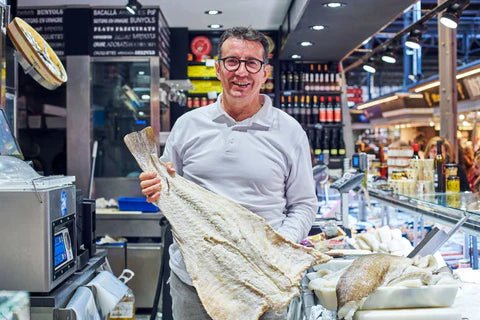
At Bacalalo, we have been in Barcelona's Mercat del Ninot since 1990, selecting high-quality seafood products. Caviar and sturgeon roe are part of our gourmet selection, and we know firsthand how much confusion there is surrounding these terms.
The Terminology: Caviar vs. Sturgeon Roe
What the Law Says
Since 1983, the International Council for the Exploration of the Sea (ICES) and subsequently the European Union have been restricting the use of the term "caviar" to sturgeon roe. European regulations (EC Regulation 2406/96 and subsequent ones) establish that "caviar" refers exclusively to the roe of sturgeon from the Acipenseridae family, processed with salt.
This means:
- Caviar = sturgeon roe (Acipenser spp., Huso spp.) salted and processed according to specific standards.
- Sturgeon roe = a broader product that can refer to the roe before or after processing, or to less elaborate products.
- Caviar substitutes = roe from other fish (lumpfish, salmon, trout, etc.) that CANNOT be called "caviar" even if sold in similar jars.
In practice, in Spain and on the international market, the term "caviar" is sometimes loosely used to refer to any processed premium roe. Legally, this practice is incorrect when it does not involve sturgeon.
Why the Distinction Matters
Because it directly affects price and expectations. If you buy something labeled "lumpfish caviar" or "salmon caviar," you should know that it is not caviar in the strict sense – it is lumpfish roe or salmon roe, which are completely different products in terms of taste, texture, and price. They are not inferior products in themselves, but they are not caviar.
Sturgeon Species: Which Produce the Best Caviar
There are more than 25 species of sturgeon (Acipenser and Huso). The best known in the world of caviar:
Beluga (Huso huso)
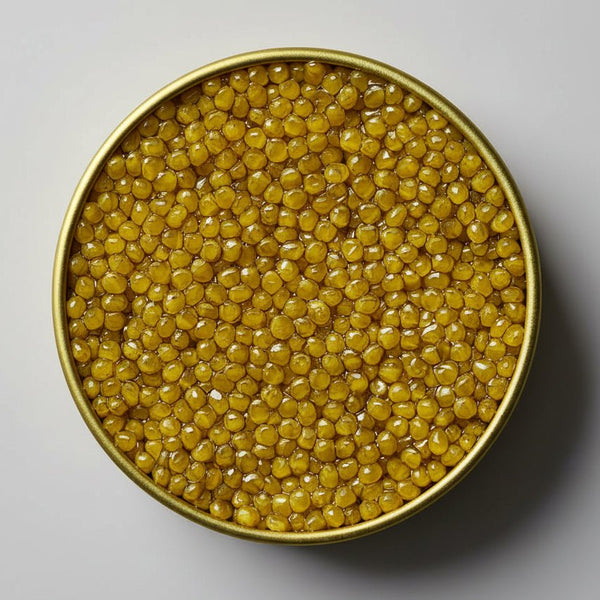
The largest species and the one that produces the most highly valued caviar. Large eggs (up to 3.5mm in diameter), color ranging from dark gray to almost black, delicate and creamy flavor. Beluga caviar is protected under CITES (Convention on International Trade in Endangered Species) and its commercial production is highly regulated. Wild Beluga from the Caspian Sea is practically prohibited from commercialization.Reference price: among the highest on the market. More than €3,000-5,000/kg from high-end sources.
Ossetra (Acipenser gueldenstaedtii)
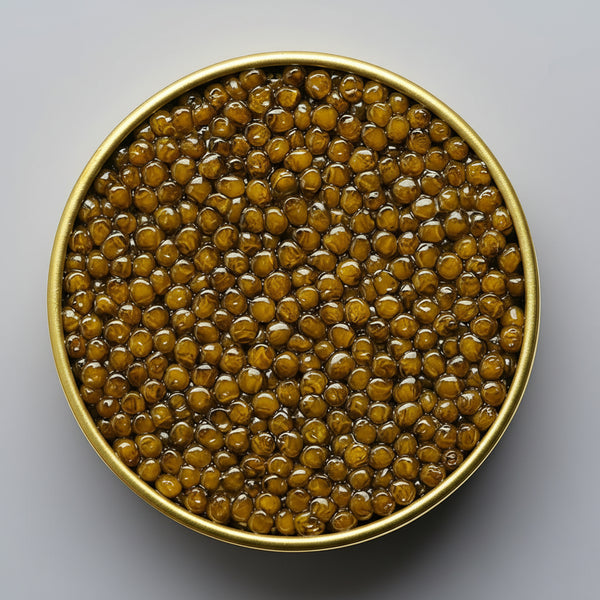
Medium-sized eggs (2.5-3mm), color ranging from golden to dark brown, flavor with notes of nut and butter. Considered by many gourmets to be the best balance of flavor, texture, and price.Reference price: €800-1,500/kg depending on origin and quality.
Sevruga (Acipenser stellatus)
The smallest of the three classic species. Small eggs (1.5-2mm), more intense and saline flavor, more accessible price than Beluga or Ossetra.Reference price: €400-800/kg.
Siberian Sturgeon (Acipenser baerii)
This is the most widely used species in aquaculture, including in Spain. Small-medium eggs, more neutral flavor. It is the "entry point" for farmed caviar – more accessible price and controlled production.White Sturgeon (Acipenser transmontanus)
The most common in aquaculture in the USA and Western Europe. Medium-sized eggs, mild flavor.Riofrío Caviar: The Spanish Benchmark
Spain has its own caviar, of internationally recognized quality: Riofrío caviar, produced in Granada (Andalusia).
Who is Riofrío
The Riofrío fish farm, in the municipality of the same name (Granada), has been producing sturgeon since the 1960s. It is one of the oldest fish farms in Europe. In the 1990s, caviar production began, and today it is one of the world's leading certified organic caviar producers.
What distinguishes Riofrío caviar:- The only caviar fish farm with organic certification in Spain (and one of the few in the world)
- Spring water (not surface water): sturgeon grow in ultra-pure water from the Granada mountains
- No growth hormones or antibiotics
- Long maturation process (sturgeon take 10-15 years to mature)
- Certifications: EU organic, Kosher, Halal
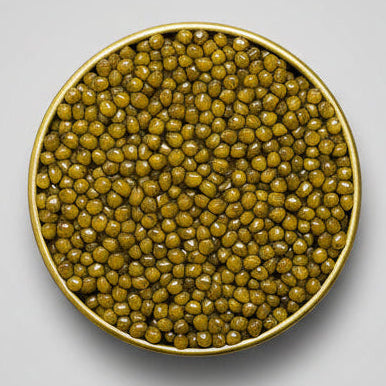
Riofrío caviar mainly works with Acipenser naccarii (Adriatic sturgeon) and Acipenser sturio, species historically present in Iberian rivers. In organoleptic terms, it produces a delicate caviar profile, with vegetal notes and a smooth finish – different from the more powerful profile of Caspian Sea caviars.
Information based on public sources (Riofrío website, specialized gastronomic press, Feb 2026).
Related Bacalalo Products


Recommended Products

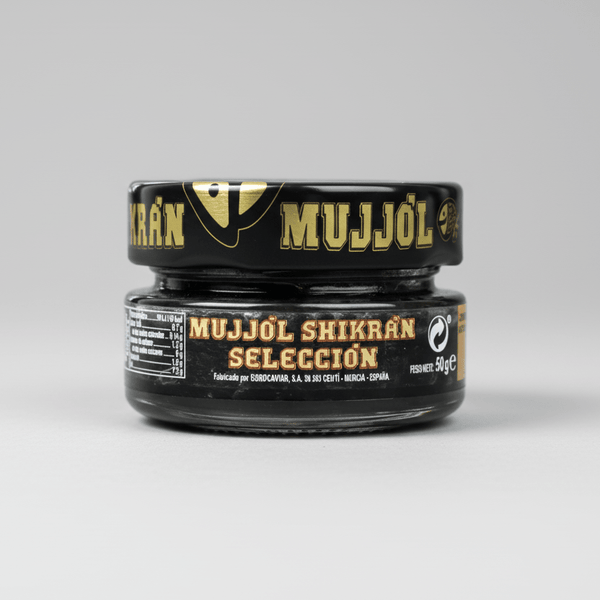
Shikran Mullet Selection - Premium Roe with Smoked He...
6,95 €

Assortment "The Great Beluga Gift"
227,91 €

Shikran Black Mullet 550g - Smoked Herring and Mu...
27,95 €

Sevruga Caviar
100,00 €
Refrigerated shipping 24-48h throughout the Peninsula
The Caviar Production Process
1. Sturgeon Maturation
Sturgeon are one of the longest-living fish. Depending on the species, females do not mature sexually until 7-15 years of age. This means that caviar producers are investing more than a decade in their raw material – which explains the price.
2. Roe Extraction
Extraction is carried out when the sturgeon has reached sexual maturity and the roe is at its optimal point. The traditional method involves sacrificing the animal. More recent methods (massage, cesarean section) allow roe to be extracted without killing the fish, although they generate debate about the quality of the result.
3. Cleaning and Screening
The roe is separated from the ovary by sieving, washed in cold water, and classified by size and color.
4. Salting (Malossol)
High-quality caviar is salted using the malossol technique (Russian: "little salt"), with a maximum of 3-4% salt. The goal is to enhance the flavor without masking it or acting as a strong preservative. More salt = lower quality (and greater need to mask mediocre flavors).
5. Maturation in Can
Caviar is packed in cans or jars, generally plastic or glass for higher qualities. It matures briefly before commercialization.
Caviar vs. Substitutes: The Real Difference
Understanding what you are buying is fundamental in this market.
| Product | Species | Is it caviar (legal) | Reference price |
|---|---|---|---|
| Beluga Caviar | Huso huso | Yes | +++++ |
| Ossetra Caviar | A. gueldenstaedtii | Yes | ++++ |
| Sevruga Caviar | A. stellatus | Yes | +++ |
| Baerii Caviar (aquaculture) | A. baerii | Yes | ++ |
| Riofrío Caviar | A. naccarii | Yes | ++ |
| Lumpfish roe ("lumpfish caviar") | Cyclopterus lumpus | No (substitute) | + |
| Salmon roe | Salmo spp. / Oncorhynchus spp. | No (substitute) | + |
| Trout roe | Salmo trutta | No (substitute) | + |
| Tobiko (flying fish) roe | Exocoetidae | No (substitute) | + |
How to Taste Caviar Correctly
Temperature
Caviar is served cold, between 0°C and 4°C. Never frozen (destroys membranes), never at room temperature (oxidizes aromas quickly).
To serve: place the tin or bowl on ice.
The Container and Utensil
Caviar should not come into contact with metal (silver, steel). Metal reacts with the fats in caviar and produces an unpleasant metallic taste. Traditional utensils are made of mother-of-pearl, bone, high-quality plastic, or glass.
The Quantity
A tasting portion is 10-15g per person. A generous portion is 30g. More than 50g per person in one serving is for very special occasions or for true connoisseurs of the product.
The Accompaniment
The finest caviar is eaten on its own, from the hand or wrist, to capture its nuances without interference.
If an accompaniment is desired:- Blini (small buckwheat pancakes, warm): the traditional Russian accompaniment
- Toast Melba (very thin, toasted bread): a classic Western accompaniment
- Neutral, unsalted cracker
- Cold boiled potato: surprisingly ideal due to its neutrality
What NOT to use: bread with strong yeast, savory crackers with their own flavor, seed crackers. Any accompaniment with its own strong flavor competes with the caviar, and one or the other loses out.
The Drink
- Brut Champagne: a classic combination. Acidity and bubbles cleanse the palate. Brut or extra brut is better than demi-sec.
- Brut nature Cava: the Spanish alternative. Blindly, in combination with Riofrío caviar, it is difficult to notice the difference from Champagne.
- Iced Vodka: the traditional Russian combination. A clean vodka (Belvedere, Grey Goose, Ketel One), iced, as a shot. Radically cleanses the palate.
- Still mineral water: if you don't want alcohol, cold still water. Avoid sparkling water (the bubbles can interfere with the delicate caviar membranes).
Avoid: red wine (tannins are incompatible with caviar fat), acidic citrus juices, any sugary drinks.
Caviar in Cooking: Beyond Direct Tasting
High-end caviar is not used in hot cooking – heat destroys its organoleptic properties. But there are uses that make sense:
On very soft scrambled eggs: the contrast of temperature (warm scrambled, cold caviar) and texture (silky vs. firm) is extraordinary.
In cold velouté: as a finishing touch on a cold cauliflower or pea cream.
On oysters: a grain of caviar on a fresh oyster is a classic combination of marine flavors that mutually enhance each other.
In sushi/temaki: tobiko (flying fish roe) is the most common in sushi. Sturgeon caviar in sushi is possible but rarely justified by price.
For culinary uses where caviar will be cooked or mixed hot, it is appropriate to use quality substitutes (salmon roe, trout roe) that hold up better to the process and cost a fraction of the price.
Where to Buy Quality Caviar and Sturgeon Roe in Spain
The Spanish caviar market has grown significantly in the last decade. Riofrío has put Spain on the global caviar map and has generated a local demand that was previously minimal.
Purchase channels:
- Specialized gourmet stores: with staff who can explain the product and guarantee the cold chain
- Direct online from producers: Riofrío has direct online sales, as do other specialized distributors
- Specialized seafood stores: such as Bacalalo, where the context of high-quality seafood also includes caviar in our gourmet selection
See caviar and gourmet products at Bacalalo
Frequently Asked Questions about Sturgeon Roe and Caviar
1. Is "lumpfish caviar" sold in supermarkets real caviar? No. Lumpfish roe (Cyclopterus lumpus) is a caviar substitute: a different, cheaper product, often dyed black or red to imitate the appearance of caviar. It is not necessarily an inferior product, but it is not sturgeon caviar.
2. Why is caviar so expensive? For three main reasons: 1) Sturgeon takes 7 to 15 years to mature, so each can of caviar represents years of investment. 2) Production is limited — the amount of roe per female is small. 3) The species are protected, which restricts production and trade.
3. Is Riofrío caviar as good as Caspian Sea caviar? They have different profiles. Caspian caviar (especially high-quality Beluga and Osetra) has a complexity and depth of flavor that is hard to match. But Riofrío caviar has its own identity — more delicate, with vegetal notes — and the enormous advantage of traceability and certified organic production.
4. How do I know if the caviar I buy is fresh and of good quality? Indicators: whole roe (not broken or mushy), clean marine aroma without ammonia smell, flavor that evolves on the palate (sea, nutty, buttery notes depending on the species). Bad caviar smells strong, has broken roe, and leaves a bitter or metallic aftertaste.
5. How long does caviar last once opened? Opened malossol caviar lasts 2 to 3 days in the refrigerator, always covered and in its airtight container. Pasteurized caviar (more stable, although with a slight loss of quality) lasts longer once opened, up to 5-7 days.
6. Can caviar be frozen? It is not recommended. Freezing breaks the membranes of the roe and produces a mushy texture when thawed. Caviar is stored in refrigeration, not frozen.
7. How much caviar is needed per person for a tasting? For a first experience or appetizer tasting: 10-15g per person. To make it the main course: 30-50g. It is a high-impact product on the palate — more is not always better.
8. Is caviar high in sodium? Yes. The salting process (even malossol "low salt") involves a significant sodium content. For people with dietary sodium restrictions, caviar should be consumed in moderation and in consultation with their doctor.
9. Which sturgeon species produces the most suitable caviar to start with? For a first experience, Acipenser baerii (farmed Siberian sturgeon) caviar or Riofrío caviar are the most recommended: more accessible price, balanced flavor, traceable production. Approaching Beluga as a first experience is like learning to ski on a black diamond slope.
10. What is the difference between "malossol" caviar and "pasteurized" caviar? Malossol: minimal salt (3-4%), no heat treatment. It is the highest quality fresh caviar. Requires a cold chain and has a short shelf life. Pasteurized: subjected to gentle heat to extend shelf life. It loses some texture and complexity but is more stable and easier to market.
11. Is farmed sturgeon caviar sustainable? Sturgeon aquaculture, when well managed, is a sustainable alternative to wild sturgeon (many species critically endangered). Riofrío and other certified fish farms are a model of responsible production.
12. Are there restrictions on importing caviar? Yes. The international trade of sturgeon and caviar is regulated by CITES (Convention on International Trade in Endangered Species). Importing caviar of certain species from certain countries requires specific permits. In Spain, the purchase and sale of legal aquaculture caviar is permitted without restrictions for the final consumer.
🛒 Products mentioned in this article
⭐ 4.9/5 · 24-48h chilled delivery · Since 1990 at Mercat del Ninot
Discover our premium selection
Seafood selected with discernment since 1990 at Mercat del Ninot, Barcelona. Refrigerated shipping within 24-48h.
Conclusion
The world of sturgeon roe and caviar is fascinating, but it requires context to navigate it wisely. The difference between "caviar" and "caviar substitute" is not just semantic: it is the difference between years of investment in a protected species and a conventional fish market product.
Riofrío caviar has shown that Spain can produce international quality caviar with rigorous ecological criteria. It is a product worth knowing, especially for those who want to approach the world of caviar from a local and traceable reference.
At Bacalalo, we select premium caviar and roe with the same criteria we apply to all seafood products: known origin, quality process, and a taste that justifies the price. Since 1990, at Mercat del Ninot in Barcelona.
See caviar and gourmet products at Bacalalo
Products you might be interested in