Summary
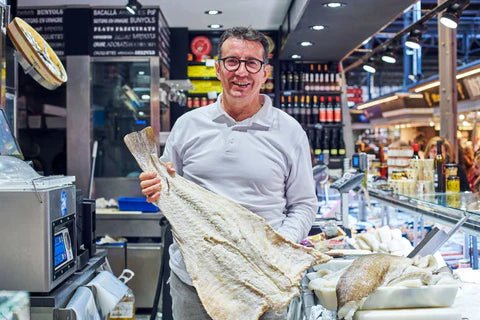
At the Bacalalo counter, in Barcelona's Mercat del Ninot, questions about caviar types by color frequently arise. In this guide: Why caviar has different colors, Black caviar: the gold standard, Red caviar: what it is and what it isn't.
Black, Red, and Golden Caviar: Differences That Matter
At the Bacalalo counter, in Barcelona's Mercat del Ninot, questions about caviar types by color frequently arise. "Is red the same as black?" "Is golden better?" "Why do some cost twice as much as others?" These are legitimate questions because the caviar market mixes denominations, origins, and qualities in a way that can be confusing even for those who have tried caviar before.
This guide serves as a clear reference. It explains what determines caviar color, what each type means, how they differ in taste and price, and when to choose one over another. Without artificial hierarchies, using real data.
Why caviar has different colors
Caviar color is not a producer's decision: it is a direct consequence of the species, the animal's age, its diet, and the curing process. Understanding this helps to interpret labeling more critically.
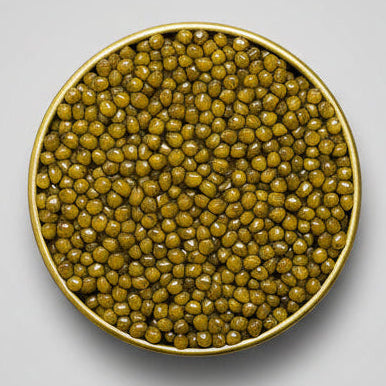
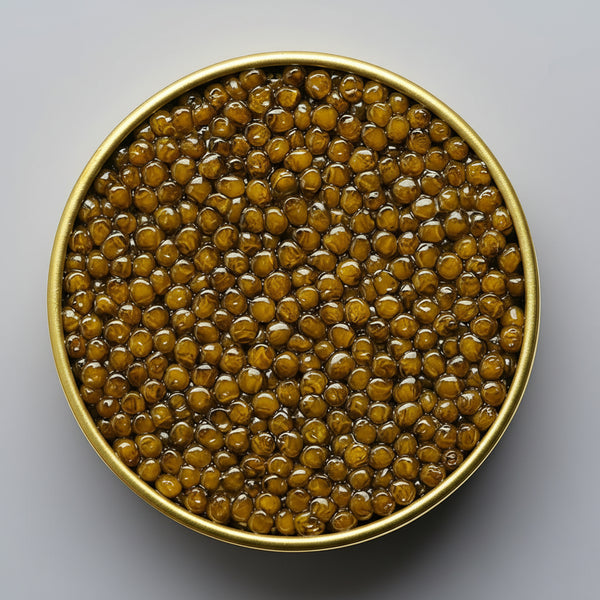
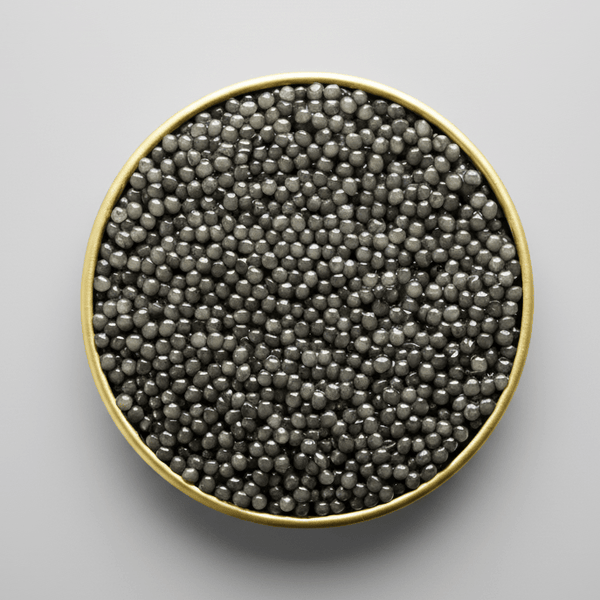
In the case of sturgeon caviar (the "true" caviar according to strict definition), the color varies from black to dark gray, passing through olive, brown, and, in exceptional cases, golden or yellow tones. No two batches are exactly alike. The same species can produce lighter or darker grains depending on the individual and the harvest year.
The color in caviars from other species (salmon, trout, lumpfish, capelin) is determined by the natural pigmentation of the roe of each species. The orange-red of salmon ikura comes from carotenoids accumulated by the fish; the intense black of lumpfish is characteristic of that particular species.
What should be clear from the start: color is not an indicator of quality within the same species. A light gray beluga caviar is not inferior to a black one of the same species. What does determine quality is grain size, membrane firmness, flavor profile, and the curing process.
Black caviar: the gold standard
When someone says "black caviar," they generally refer to sturgeon caviar, regardless of whether the actual color may be dark gray, true black, or olive. The three classic types of black caviar are beluga, osetra, and sevruga, all from the genus Acipenser and Huso.
Beluga (Huso huso): The largest sturgeon, with grains of 3-4 mm, the largest of all sturgeon caviars. Color varies between light gray, dark gray, and black. Smooth, creamy taste, with a remarkable persistence. It is the most expensive and the rarest. In the current European market, a gram of quality farmed beluga costs between €3 and €6, meaning €3,000-€6,000/kg at the highest levels.
Osetra (Acipenser gueldenstaedtii): Grains from 2.5 to 3.5 mm, color ranging from gray to golden brown. More complex flavor than beluga, with notes of nut, marine butter, and a persistent aftertaste. Many tasters prefer it to beluga for its complexity. Price: €1,500-€4,000/kg depending on origin and quality.
Sevruga (Acipenser stellatus): The smallest of the three classics, with grains of 1.5-2.5 mm, intense black color. More pronounced and intense flavor, with higher salinity and marked mineral notes. The most affordable of the three in price. Price: €800-€2,000/kg depending on origin.
European farmed sturgeon caviar types (including those from Riofrío, Nacarii, Sturia, and Calvisius) all fall into the "black caviar" category, although their actual colors vary. They are sturgeon caviar produced outside the wild environment but with the same biology.
Red caviar: what it is and what it isn't
"Red caviar" is the colloquial name for salmon roe, also known as ikura in its Japanese denomination. It is not sturgeon caviar and technically should not be called "caviar," although the popular use of the term is widespread throughout Europe and is not going to change.
The differences with black sturgeon caviar are fundamental:
- Species: Salmon (Oncorhynchus spp. or Salmo salar) versus sturgeon (various genera).
- Grain size: 4-7 mm in salmon versus 1.5-4 mm in sturgeon. Salmon roe is visually much larger.
- Color: Intense orange to orange-red in salmon. Black, gray, or golden in sturgeon.
- Flavor: Red caviar has a more direct, less complex marine flavor, with noticeable salinity and a "burst" of fatty liquid when bitten. Black sturgeon caviar has greater complexity, persistence, and more subtle notes.
- Price: "Red caviar" costs between €15 and €35 per 100g. Quality black sturgeon caviar starts at €80-€100 for 30g.
This does not mean that red caviar is inferior. It is a different product, with its own culinary uses and its own flavor profile. For toasts, sushi, pasta, and appetizers, salmon roe works wonderfully and is much more accessible. For a classic caviar experience, sturgeon has no direct substitute.
Bacalalo Products

Mújol Shikrán Selection - Premium Roe with Smo...
€6.95

Assortment "The Great Beluga Gift"
€227.91

Black Mújol Shikrán 550g - Smoked Herring and...
€27.95

Sevruga Caviar
€100.00
Refrigerated shipping 24-48h throughout the Peninsula
Golden caviar: the rarest and most coveted
Golden caviar is the rarest and most misunderstood category. There are two distinct phenomena that produce golden-colored caviar, and it's important not to confuse them.
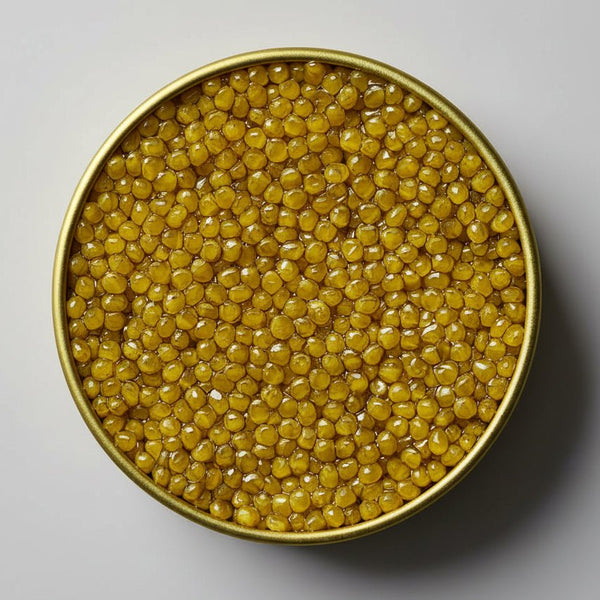
Golden or Imperial Osetra: Within the osetra species (Acipenser gueldenstaedtii), some individuals produce roe of a golden to honey-yellow color. This occurs naturally in a small percentage of females, associated with a genetic variation. Golden osetra caviar, historically called "Imperial" or "Golden Osetra," was caviar reserved for the Tsar's table in imperial Russia and has maintained an aura of exceptionality to this day. The flavor is similar to standard osetra but with greater creamy intensity. The price can double or triple that of regular osetra: €4,000-€8,000/kg for the best batches.
Almas: The most extreme variation is Almas caviar (meaning "diamond" in Persian and Turkish), produced by albino beluga sturgeon (Huso huso with a lack of pigmentation). The grains are cream to pale golden in color. The flavor is exceptionally delicate and of unparalleled smoothness. Availability is minimal: only some albino specimens in controlled aquaculture farms produce this roe. The price exceeds €25,000/kg for the purest batches. It is not a product that regularly appears in the Spanish market.
Golden trout caviar: There is also "golden caviar" produced by some varieties of trout, especially rainbow trout (Oncorhynchus mykiss) under certain rearing conditions. The grains are orange or yellow-orange, 3-4 mm, with a milder flavor than salmon ikura. It is not sturgeon caviar, but it offers an interesting visual and taste experience at a very accessible price (€8-€20 per 100g).
Other types of caviar by color: the complete map
Beyond the three main colors, the market includes other products labeled as "caviar" even though they correspond to very different species.
Lumpfish caviar (small black): The roe of lumpfish (Cyclopterus lumpus), often dyed black or red with artificial coloring. They are the cheapest substitute (€2-€4 per 50g) and the furthest from real caviar in taste and texture. The membrane is firm but the taste is basically salt. Useful for decoration, not for a gastronomic experience.
Mújol caviar (bottarga/mújol roe): Pressed and cured mújol roe is a completely different product in concept: it is consumed as thin slices or grated over pasta, not as spooned caviar. Bacalalo's Mújol Shikrán belongs to this category, a gourmet Mediterranean product with its own history.
Tobiko and masago (bright orange, green, black): Flying fish roe (tobiko) and capelin roe (masago) are common ingredients in Japanese cuisine. Very small, crunchy, sometimes with added flavorings (wasabi, squid ink). They are a sushi ingredient, not a standalone consumption product like sturgeon caviar.
When to choose each type: practical guide
The choice between the different caviar types by color depends on the context, budget, and the experience sought.
- For a first contact with caviar: Farmed Sevruga or Siberian caviar. They are the most accessible among real sturgeon caviar, with a sufficiently representative flavor to understand what the caviar experience is about.
- For a special but affordable appetizer: Salmon roe (ikura). Maximum visual impact, pleasant taste for almost any palate, reasonable price. A 100g jar of good quality costs around €20-€25.
- For a medium-high level tasting: European farmed Osetra (Nacarii, Riofrío, Sturia). More favorable quality-price ratio than beluga, notable flavor complexity.
- For an exceptional occasion: Farmed Beluga or golden Osetra. The price justifies the special occasion; the taste justifies the price.
- For cooking and mass use: Trout roe or unpretentious lumpfish caviar. Golden trout caviar has a very interesting visual appeal for presentations.
Bacalalo Products
Mújol Shikrán Selection - Premium Roe with Smo...
€6.95
Assortment "The Great Beluga Gift"
€227.91
Black Mújol Shikrán 550g - Smoked Herring and...
€27.95
Sevruga Caviar
€100.00
Refrigerated shipping 24-48h throughout the Peninsula
🛒 Products mentioned in this article
⭐ 4.9/5 · 24-48h refrigerated shipping · Since 1990 at Mercat del Ninot
Frequently Asked Questions
Is black caviar better than red caviar?
They are different products, not the same product in different qualities. Black sturgeon caviar is more complex and sophisticated in flavor, and has a significantly higher price. Red caviar (salmon roe) has its own character and culinary uses where it shines. Saying one is "better" than the other is like comparing Manchego cheese to Parmesan: it depends on the context.
What does it mean for caviar to be golden?
Golden color in sturgeon caviar occurs naturally in a small percentage of osetra females, due to genetic variation. The most extreme golden caviar is Almas, from albino beluga, considered the rarest caviar in the world. In practical terms, golden osetra has a creamier and more intense flavor than standard grey osetra. The price is significantly higher due to its rarity.
Does the color of caviar indicate its quality?
Within the same species, color does not determine quality. A grey osetra and a golden one from the same production are equally good; the golden one has a higher price due to scarcity and a slight difference in profile, not because it is superior in every way. Quality is evaluated by grain size, membrane firmness, aroma, and flavor, not by color.
What type of caviar is best for a first-time taster?
For a first experience, Siberiian caviar (Acipenser baerii) from European aquaculture or mid-quality osetra are good introductions. They have a representative sturgeon caviar flavor without the extreme price of beluga. If the budget is tight, quality trout roe is an honest alternative to understand the experience of premium roe.
Is black lumpfish caviar real caviar?
Not in the strict sense. Lumpfish roe (Cyclopterus lumpus) is an economical substitute used primarily for its visual appeal. It is often artificially dyed and has a very basic flavor compared to any sturgeon caviar. It is useful as a garnish for dishes but does not offer the gastronomic experience of real caviar.
How much does golden caviar cost?
Mid-quality golden osetra is between €3,000 and €6,000/kg. Batches labeled "Imperial" or of very high selection can exceed €8,000/kg. Almas from albino beluga, when available on the market, costs around €20,000-€30,000/kg and is sold in 10-30g presentations. These are collector's item prices, not for regular consumption.
Can black and red caviar be mixed in the same preparation?
Technically yes, and visually it is very striking due to the contrast of colors. However, mixing them in the mouth does not add up, because the flavor profiles are very different and tend to clash. The usual practice in haute cuisine is to serve black and red caviar as separate options in the same tasting, not mixed. If the presentation requires them together, it is best that they are physically separated on the plate.
Discover our premium selection
Seafood selected with expertise since 1990 at Mercat del Ninot, Barcelona. Refrigerated shipping in 24-48h.