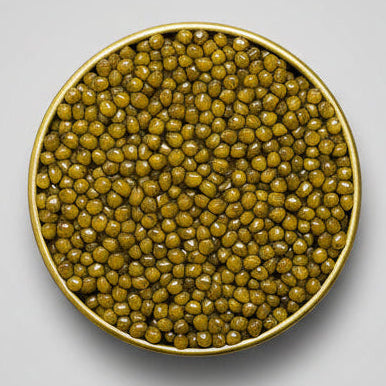
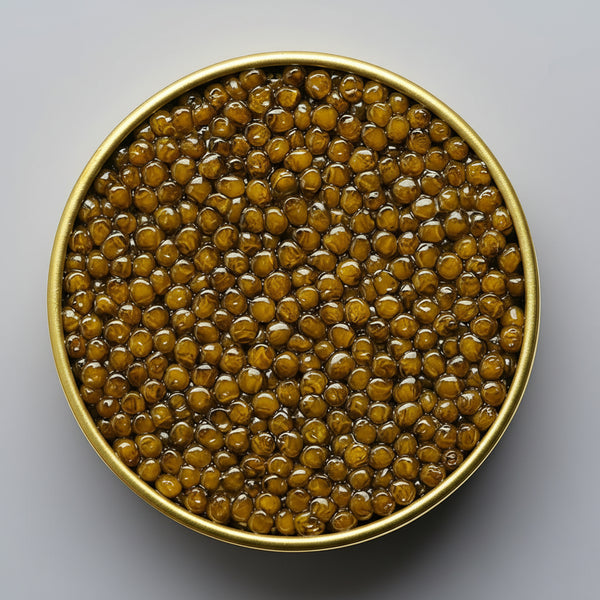
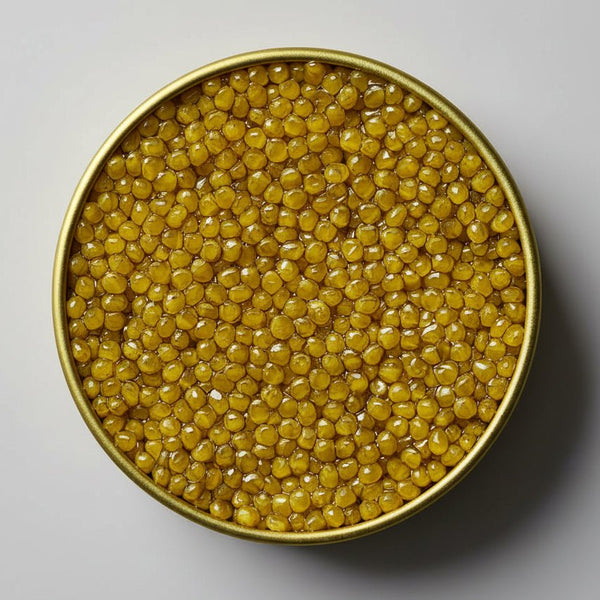
Summary: Eating caviar has basic rules that make the difference between enjoying it and wasting it. The temperature, the correct utensil, the exact quantity, and the ideal accompaniment determine the experience. This guide covers everything you need to know to serve caviar like a professional, from the most affordable types to Beluga.
Serving temperature
Caviar should be served between 0°C and 4°C. At room temperature, it loses texture, the flavor becomes flat, and the fat denatures. The correct method is twofold: the tin on crushed ice and the spoonful directly from the cold to the mouth.
In a conventional refrigerator (4-6°C), it's fine for storing the jar. To serve, place the tin on a bowl of ice 15 minutes before, never in the freezer.
Correct utensils: why metal ruins caviar
Metal (silver, stainless steel) reacts with caviar proteins and produces a metallic taste that ruins the subtle notes. This is not snobbery: it's basic chemistry.
The correct utensils are:
- Mother-of-pearl: the classic. 100% neutral. Mother-of-pearl spoons are the industry standard.
- Bone or ivory: valid, though less and less used for ethical reasons.
- Plastic or wood: acceptable for mid-priced caviar. Neutral and non-reactive.
- Ceramic or porcelain: excellent. Non-reactive, easy to clean, elegant.
- ❌ Silver, steel, alpaca: immediate metallic taste. Do not use.
Quantity per person
| Occasion | Quantity | Approx. cost |
|---|---|---|
| Tasting / initiation | 10-15g | €8-20/person |
| Festive appetizer | 20-30g | €15-40/person |
| Luxury main course | 50g | €40-100/person |
| Grand tasting | 100g+ | €80-300/person |
Accompaniments: classic and modern
Classics:
- Blinis: small, fluffy buckwheat pancakes. The traditional Russian support.
- Thin unsalted toast: melba toast or very thin toasted bread. Crispy, without competing with the caviar.
- Crème fraîche: the slight acidity balances the fat and saltiness of the caviar.
- Grated hard-boiled egg: white and yolk separately. Neutral texture and flavor.
Modern (haute cuisine):
- Cold cooked potato with crème fraîche and caviar: a classic combination revamped.
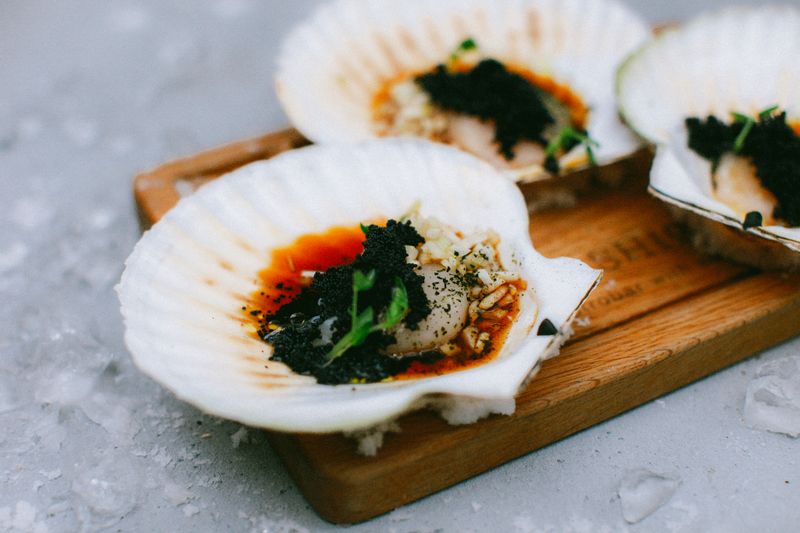
- Oysters with a spoonful of caviar: double iodine, intense marine experience.
- Fettuccine pasta with butter and caviar: simple and extraordinary.
- Low-temperature scrambled eggs with caviar: the perfect luxury brunch pairing.
Caviar types: characteristics table
| Type | Species | Roe size | Flavor | Price (100g) |
|---|---|---|---|---|
| Beluga | Huso huso | Large (3-4mm) | Creamy, mild | €200-500+ |
| Oscietra | Gueldenstaedtii | Medium (2.5-3mm) | Nutty, complex | €80-200 |
| Sevruga | Stellatus | Small (2mm) | Intense, briny | €60-120 |
| Baeri (Siberian) | Baerii | Medium | Balanced | €30-80 |
| Nacarii (Spanish) | Naccarii | Medium-large | Mild, marine | €40-90 |
Pairing: what to drink with caviar
Brut Champagne: the classic pairing par excellence. The acidity and bubbles cleanse the palate between bites. Blanc de blancs (100% Chardonnay) is the most elegant.
Very cold vodka: the Russian tradition. Icy vodka (-18°C) neutralizes the fat of the caviar and enhances its marine notes. No mixers, no ice in the glass.
Cava brut nature: an excellent Spanish alternative with better value for money. See cavas at Bacalalo.
Junmai daiginjo sake: a fascinating Asian pairing. The smoothness of premium sake complements the creaminess of caviar.
❌ Avoid: red wines (tannins clash with iodine), very aromatic wines (mask the caviar), sweet drinks.
Bacalalo — Premium Caspian Caviar
Selection of oscietra, baeri, and nacarii caviar. Delivered chilled in 24h. Perfect for special occasions.
See products →How to taste caviar step-by-step
- Visual: observe the color (from silver-grey to black), shine, and grain size. Uniformity = quality.
- Olfactory: bring the spoon to your nose. It should smell of the sea, fresh, slightly iodized. No ammoniacal or rancid notes.
- Tactile: place the spoonful on the back of your hand (between thumb and forefinger). Body heat releases the aromas. Then to the mouth.
- Gustatory: do not chew immediately. Let the grains dissolve on your tongue. Note the pop, creaminess, saltiness, and aftertaste.
- Finish: good caviar has a long, pleasant aftertaste. Mediocre caviar disappears quickly and leaves a metallic or bitter aftertaste.
The 5 most common mistakes
- Using a silver spoon — immediate metallic taste
- Serving it at room temperature — loses texture and flavor
- Adding too many accompaniments — masks the flavor
- Opening the tin hours before — oxidizes and loses freshness
- Pairing with red wine — tannins destroy marine notes
🛒 Products mentioned in this article
⭐ 4.9/5 · Chilled delivery 24-48h · Since 1990 at Mercat del Ninot
Frequently Asked Questions
Is caviar eaten with a spoon or directly from the tin?
With a mother-of-pearl or ceramic spoon, placed on ice. Never directly from the tin with metal. Presentation in an ice bowl is the professional way.
How long does opened caviar last?
Maximum 2-3 days in the refrigerator, well sealed. Once opened, eat it the same day if possible. Malossol (low salt) caviar lasts less than salted caviar.
Why is it said that caviar is eaten from the back of the hand?
So that body heat releases the aromas before bringing it to the mouth. Also to appreciate the texture without interference from other flavors. It is a professional tasting technique.
Is Spanish caviar as good as Caspian caviar?
Nacarii caviar from Riofrío (Granada) and Girona has international recognition. It is different from Caspian oscietra, milder and with herbaceous notes, but of comparable quality. Read our guide to Spanish caviar.
Can I eat caviar during pregnancy?
Pasteurized caviar is safe during pregnancy. Fresh unpasteurized caviar is not recommended. Consult your doctor.
Related articles
- Caviar: price per gram and buying guide
- Caviar pairing: what to drink with each type
- Caviar canapés: elegant ideas for parties
- Malossol caviar: what it is and why it's the best
Discover our selection of premium caviar: oscietra, baeri, and Spanish nacarii. Guaranteed chilled delivery. See caviar gift packs.
Variants and additional tips
Below, we compile variants and nuances from previous versions of this guide, merged into a single reference.
The 5 basic rules for eating caviar
Before going into detail, these are the five rules that caviar professionals respect without exception. If you only take five things from this guide, let them be these:
- Temperature: between 6°C and 8°C. Never at room temperature, never frozen.
- Spoon: mother-of-pearl, bone, glass or plastic. Never metal.
- Quantity: 10-15g per person for tasting, 20-30g for a generous appetizer.
- Base: the hand (back), blini, brioche bread or alone. Never a strong-flavored base.
- Technique: do not chew — press the grains against the palate with your tongue and let them dissolve.
These five rules are not gastronomic snobbery. Each has a real technical justification that affects the taste you perceive. A €100 caviar eaten at the wrong temperature with a metal spoon tastes worse than a €30 caviar eaten correctly.
The correct temperature: the most important factor
Temperature is the number one factor that determines how you perceive caviar. It is not a matter of preference — it is physics and biochemistry.
Below 4°C, the fats in the caviar are partially solidified. Aromatic compounds are trapped in the fat matrix and are not released on the palate. The result: dull caviar, lacking gustatory brilliance, which tastes "cold" more than anything else. It's like drinking a great red wine straight from the refrigerator.
Above 10°C, the fats become too fluid. The grains lose firmness, the skin softens excessively, and the taste becomes predominantly fatty instead of complex. The grains begin to stick together, and the texture becomes a paste instead of a set of individual spheres.
The optimal range is 6-8°C. In practice:
- Take the tin out of the fridge 5-7 minutes before serving.
- If serving on a tasting plate, place the plate on crushed ice — the ice maintains the temperature while the caviar slightly tempers on top.
- If using a serving bowl, opt for a thick glass one that has been pre-chilled.
- Do not leave the opened tin out of the fridge for more than 15-20 minutes. If there's caviar leftover, cover it with plastic wrap directly touching the caviar and return it to the fridge.

Utensils: why metal spoons ruin caviar
The prohibition of metal spoons for serving caviar is not an arbitrary tradition — it has a measurable chemical basis.
Metals (especially silver, stainless steel, and aluminum) react with the natural sulfur compounds in caviar. These reactions produce metallic sulfides that add an unpleasant metallic, bitter taste to the caviar. The effect is immediate: with just 10-15 seconds of contact between the caviar and a silver spoon, the flavor is contaminated.
Acceptable materials:
- Mother-of-pearl: the classic and preferred material. Chemically inert, it does not impart flavor, has a smooth surface that does not damage the roe, and an aesthetic that complements the ritual. It is the professional standard.
- Bone: equally inert. Harder to find and clean, but functionally equivalent to mother-of-pearl.
- Glass: perfectly valid. Thick glass is inert, easy to clean, and does not impart odors. A good quality glass spoon is an economical alternative to mother-of-pearl.
- Food-grade plastic: works perfectly. It lacks the glamour of mother-of-pearl but is chemically inert and practically free. Many professionals use it in the kitchen.
- Wood: acceptable but not ideal. Wood can absorb odors from other foods and transfer them to caviar. Use new, untreated wood if you have no other option.
If you don't have a mother-of-pearl spoon on hand — and most people don't — use a plastic spoon without any hesitation. It is infinitely better than a silver spoon from grandma's cutlery set.
Caspian Caviar — Premium Selection
Iranian Beluga 000, Oscietra, Sevruga. Refrigerated shipping 24-48h to any point in the Iberian Peninsula. Since 1990 at Mercat del Ninot.
View Caviar →How to taste caviar for the first time: step by step
If it's your first time trying quality caviar, follow this sequence. It's designed for you to progressively appreciate the product, from its purest form to more combined presentations.
Step 1: Visual. Open the tin and observe. The grains should be individualized, shiny, and not crushed. The color should be uniform (within natural variability). A slight oily sheen is normal. If you see excessive liquid at the bottom, too many broken grains, or a rancid smell, the product has a preservation issue.
Step 2: On the back of the hand. Place a small teaspoon (2-3g) in the area between your thumb and index finger on the back of your hand. Bring your hand to your mouth and take the caviar directly with your lips. Body heat will slightly warm the roe and gradually release its aromas. This is the purest way to taste caviar — without any interference from a base, bread, or cream.
Step 3: The technique in the mouth. Do not bite or chew. Place the grains against your palate and press gently with your tongue. Feel how the skins break and release their contents. Let the flavor develop for 10-20 seconds before swallowing. Pay attention to the sequence: the first note is usually saline, then the main flavor emerges (creamy, nutty, marine depending on the variety), and finally the aftertaste (mineral, buttery, iodine).
Step 4: With blini or bread. Now try it with a base. A warm (not hot) blini with a minimal dab of crème fraîche, or a thin slice of lightly toasted unsalted brioche bread. The base should not compete with the caviar — it should provide a neutral support that adds contrasting texture.
Step 5: With a drink. Take a sip of brut nature champagne or a shot of iced vodka between bites. The drink cleanses the palate and allows you to appreciate each spoonful as new.
Accompaniments: what works and what doesn't
There is a Russian tradition of serving caviar with an arsenal of accompaniments: chopped hard-boiled egg, red onion, crème fraîche, chives, lemon, capers. This tradition has a practical origin: to mask the imperfections of medium-quality caviar. With quality caviar, most of these accompaniments hinder more than they help.
What does work
- Blinis: the classic accompaniment and for good reason. A warm buckwheat or wheat flour blini provides a soft, slightly earthy base that complements without competing. Make or buy small blinis (5-6 cm in diameter) — too large a blini makes the caviar/base ratio incorrect.
- Crème fraîche: a minimal dab — the size of a pea — on the blini before the caviar. The fat in the crème fraîche amplifies the fatty flavors of the caviar and softens the salinity. The key is "a dab," not "a spoonful."
- Unsalted brioche bread: an alternative to blini. Lightly toasted, thinly sliced. The butter in the brioche pairs excellently with the fat in the caviar.
- Cooked potato: an underrated accompaniment. A disc of cooked potato (neither hot nor cold, but lukewarm) with caviar on top is an extraordinarily satisfying bite. The neutrality of the potato lets the caviar shine.
What doesn't work (or works worse than you think)
- Raw onion: the flavor of onion crushes caviar. It's like putting ketchup on red tuna sashimi.
- Hard-boiled egg: adds a texture that competes with the grains and a sulfurous taste that interferes.
- Lemon: the acidity of lemon destroys the perception of caviar's subtle nuances. It works with salmon roe; with sturgeon caviar, it is counterproductive.
- Capers: too salty and aromatic. Two intense flavors competing for attention.
- Flavored toasts (garlic, herbs, cheese): any toast with its own flavor overshadows caviar.
What caviar tastes like
It's the question we get asked most often at Mercat del Ninot. And it's the hardest to answer because caviar has a flavor without a direct equivalent in common gastronomy.
What it is NOT: it doesn't taste like fish. It doesn't taste like the sea in the way a mussel or an oyster does. It's not just salty. It doesn't have the intense flavor of anchovies or the fattiness of salmon.
What it IS: caviar has a deep, creamy, umami flavor with integrated salinity (not dominant) and nuances that vary by variety. Beluga is the creamiest and mildest. Oscietra has nutty and hazelnut notes. Sevruga is more intense and marine.
The texture is fundamental: the grains burst in the mouth, releasing a rich, flavorful liquid. That textural experience — the pop followed by the release of flavor — is an essential part of what makes caviar unique. There is no other food that replicates that exact sensation.
If you're looking for an imperfect analogy: imagine the umami of well-aged parmesan, combined with the creaminess of high-quality butter and a clean mineral-marine touch. It's not exactly that, but it's in the right neighborhood.
7 mistakes that ruin caviar
- Serving it too cold: directly from the fridge, the aromas are blocked. Wait 5-7 minutes.
- Using a metal spoon: the metallic taste is immediate and permanent. Any alternative is better.
- Chewing instead of pressing: chewing breaks the grains too quickly and doesn't allow the flavor to develop progressively.
- Adding too many accompaniments: onion + egg + lemon + capers = you're not eating caviar, you're eating everything else with decorative grains.
- Serving too little: 3 grains on a canapé is decoration, not an experience. A minimum of 5-8g per bite is needed for the flavor to develop.
- Leaving it out of the fridge: caviar degrades in minutes outside of refrigeration. An opened tin should not be at room temperature for more than 15-20 minutes.
- Buying it without checking the date: caviar more than 6 months old from production has lost freshness. The production date (not the expiry date) is the relevant information.

How to set up a caviar tasting at home
A caviar tasting at home doesn't require special equipment. With the basics well-executed, the experience is comparable to that of a restaurant.
What you need:
- Caviar: 30g for two people, 50g for four as an appetizer. If you want to compare two varieties, 30g of each.
- Mother-of-pearl or plastic spoons (one per person).
- Crushed ice and a large plate or bowl to place the tins on ice.
- Blinis or unsalted brioche bread.
- Crème fraîche (a small jar is enough).
- Brut champagne or vodka (or both).
Setup: Fill a deep plate or bowl with crushed ice. Place the closed caviar tin on the ice 10 minutes before serving. Prepare the blinis (warm, not hot). Serve the crème fraîche in a small bowl with a serving spoon. Place the mother-of-pearl or plastic spoons nearby. Open the tin just when guests are ready.
Suggested sequence: First, each person tastes the caviar alone (on the back of their hand). Second, on a blini with a dab of crème fraîche. Third, with a sip of champagne. If you have two varieties, serve the milder one first (Baeri or Oscietra) and then the more intense one (Sevruga or Beluga).
Visit our caviar collection to choose the perfect varieties for your tasting. And if you need guidance on which variety to choose, read the caviar types comparison.
Caspian Caviar — Premium Selection
Iranian Beluga 000, Oscietra, Sevruga. Refrigerated shipping 24-48h to any point in the Iberian Peninsula. Since 1990 at Mercat del Ninot.
View Caviar →🛒 Recommended products in this guide
⭐ 4.9/5 · Cold shipping 24-48h · Since 1990 at Mercat del Ninot
The Most Important Rule: the Mother-of-Pearl Spoon
Before discussing temperature, quantity, or pairing, there is a golden rule on how to eat caviar that admits no exceptions: never use metal cutlery to serve or eat caviar.
Metal, especially silver and stainless steel, reacts with the acids in caviar and produces almost instant oxidation that adds an unpleasant metallic taste to the product. This process occurs in a matter of seconds: it only takes a metal spoon to touch the caviar for the time it takes you to bring it to your mouth for the flavor to be compromised. Those notes of butter, toasted nut, and sea that distinguish a good Sevruga from an Oscietra disappear, replaced by a bitter and metallic aftertaste.
The correct alternatives for how to eat caviar without damaging it are:
- Mother-of-pearl (nacre): The traditional and most valued material. It does not react with caviar or impart strange flavors. Additionally, it is a poor conductor of heat, which prevents hand temperature from raising the roe's temperature. A good quality mother-of-pearl spoon costs between 15 and 60 euros and lasts a lifetime.
- Synthetic ivory bone: Inert and elegant, common in high-end presentations. Not to be confused with animal ivory, whose use is restricted for ethical and legal reasons.
- Hard food-grade plastic (ABS or similar): The practical and economical alternative. It works perfectly well for everyday domestic use.
- Non-porous wood: Acceptable for domestic use, although over time porous wood can absorb odors. Avoid treated or varnished woods.
- Glazed ceramic without reactive glazes: Another reasonable option if nothing else is at hand.
- The back of the hand: The most intimate and oldest way of how to eat caviar. Place a small amount between your thumb and forefinger and bring it directly to your mouth. Without mediation, without intermediaries. It is the preferred method of professional tasters to evaluate a product in its purest state.
The Correct Temperature for Serving Caviar
Temperature is the second critical factor in any guide on how to eat caviar. The optimal range is narrow: between 0 °C and 4 °C. Outside this range, the experience degrades noticeably:
- Too cold (below 0 °C): The roe hardens, aromas are blocked, and the flavor becomes flat. Caviar resembling ice loses all its aromatic complexity and tastes like a generic product.
- Too warm (above 8 °C): The roe softens, the marine flavor becomes more aggressive and less refined, and the iodized aftertaste intensifies unpleasantly. The product appears to be of lower quality than it is.
To serve caviar at the correct temperature, the classic technique is to place the tin on a bowl or platter with crushed ice. The tin rests on the ice for the entire serving time, maintaining the temperature without the meltwater coming into direct contact with the product. Serving time should not exceed 20-30 minutes out of the refrigerator.
A practical rule for those who don't have an ice bowl ready: take the tin out of the refrigerator 5-8 minutes before serving. This way, the caviar goes from 2 °C in the fridge to about 4-6 °C, which is the optimal serving range in domestic conditions. This small margin allows the aromas to "awaken" without the roe losing firmness.
Quantity Per Person: How Much Caviar Is Enough
One of the most frequent questions about how to eat caviar is how much to serve. The answer depends on the context and the role it will play at the table:
- First tasting or trial: 10-15 grams per person. Enough to understand the product, perceive the phases of flavor, and develop discernment, without overwhelming the palate.
- Appetizer or light starter: 20-30 grams per person. The standard portion in specialized restaurants and the most common for home celebrations.
- Caviar main course: 50-80 grams per person. A generous amount that allows it to be eaten with accompaniments and for seconds without running out.
- Celebration or very special event: 100 grams or more per person. Reserved for exceptional occasions where caviar is the absolute centerpiece of the evening.
Caviar satiates faster than it seems due to its high salt and protein content. Rarely does anyone want more than 50-60 grams in a single session, even with unlimited access. At Bacalalo, we recommend starting with 15 grams for a first taste: it's the right amount to experience the initial burst of the roe, the saline wave, the umami aftertaste, and the persistent, iodized notes without saturating the palate.
Bacalalo Products

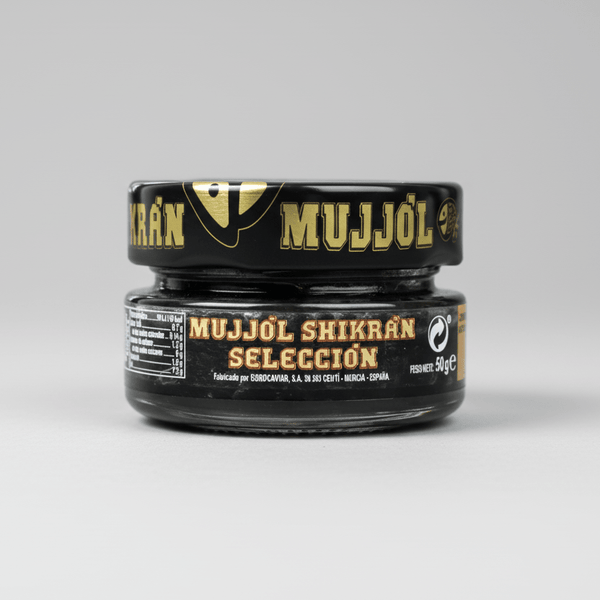
Mújol Shikrán Selection - Premium Roe with Are...
6,95 €

"The Grand Beluga Gift" Assortment
227,91 €

Black Mullet Shikran 550g - Smoked Herring and Mu...
27,95 €

Sevruga Caviar
100,00 €
Refrigerated shipping 24-48h throughout the Peninsula
Caviar Accompaniments: What Works and What Doesn't
The discussion about caviar accompaniments is old and heated. There is a clear division between those who advocate for caviar alone (nothing else) and those who prefer to combine it with neutral bases that serve as a vehicle for the bite. Both approaches make sense. The goal of any accompaniment should be to create a gentle contrast that enhances the caviar, never to compete with it.
Classic accompaniments that work
- Warm blinis: Small Russian buckwheat crepes are the most traditional accompaniment. Warm (never hot), they act as a neutral base with a porous texture that absorbs the fat from the roe and balances the saline intensity. With a small layer of crème fraîche between the blini and the caviar, the combination is classic and very effective.
- Crème fraîche: A small amount under the caviar on the blini adds creaminess without competing with the flavor. The mild acidity of the crème fraîche enhances the marine notes of the caviar. Never whipped cream with sugar or overly acidic sour cream.
- Finely chopped chives: In minimal, almost symbolic quantities. Chives add a fresh vegetal nuance without masking anything. Avoid raw onion or any generous amount of chives that overshadow the caviar.
- Thin white bread toast: Very thin toast, unsalted, at room temperature. Never hot, as the heat from the bread alters the texture of the roe in the mouth.
- Thin rye bread: Crispier and with earthy notes that complement Osetra or Beluga well. Avoid very dark rye breads or those with strong-flavored seeds.
- Grated hard-boiled egg: The white and yolk, grated separately, are a traditional Russian accompaniment that provides texture and a neutral flavor that doesn't interfere with the caviar.
- Boiled potato with skin: Less known outside specialized circles, but very effective. Potato boiled in its skin, served warm and sliced, balances the salinity of the caviar with a completely neutral starch base.
Accompaniments you should avoid
- Lemon directly on caviar: Citric acid coagulates the proteins in the roe and irreversibly alters its texture and flavor. If you want a citrus touch, squeeze the lemon onto the blini or toast, never directly onto the caviar.
- Raw onion in quantity: Its aromatic intensity completely destroys the delicate notes of caviar. There is no combination that justifies this pairing.
- Capers: Too intense and acidic. They overpower the caviar instead of complementing it.
- Strong cheeses: Aged, blue, or soft cheeses with high acidity: cheese has a presence on the palate that makes it impossible to appreciate the caviar afterwards.
- Breads with very pronounced flavor: Garlic bread, breads with aromatic seeds, or toast with oil compete with the caviar instead of serving as a neutral base.
How to Taste Caviar for the First Time: The Sensory Method
If this is your first time learning how to eat caviar, following this small sensory protocol makes a huge difference in the experience:
- Serve a small amount on the back of your hand, between your thumb and forefinger. This area has the lowest body temperature and does not transfer flavors. It is the preferred method for tasters to evaluate the product in its purest state.
- Observe the color and shine before bringing it to your mouth. Good caviar has a uniform shine and separate grains, never clumped or dull.
- Bring it to your mouth and close it without chewing immediately. Let the roe burst on its own with gentle pressure from your tongue against your palate. That burst is the key moment of the experience.
- Breathe through your nose while it's in your mouth. This will activate retro-olfaction and allow you to perceive secondary aromas: butter, hazelnut, seaweed, wet earth. These are the aromas that distinguish great varieties.
- Chew slowly once the roe has started to open. Don't swallow it all at once before the flavor unfolds.
- Wait for the aftertaste. In quality caviar, it can last between 30 seconds and several minutes. This persistence is one of the most reliable indicators of product quality.
After this first bite on the back of your hand, you can then move on to eating it on blinis or rye bread. But that first test gives you the pure reference of the product, without intermediaries.
The Pairing: What to Drink with Caviar
Knowing how to eat caviar includes knowing what to pair it with in your glass. The three options most valued by experts are:
Brut Champagne or Blanc de Blancs
The most classic and effective pairing for most palates. The fine bubbles cleanse the palate between bites, and the acidity of the champagne enhances the creamy notes of the caviar without adding sweetness. A Blanc de Blancs from Champagne (100% Chardonnay) is the ideal reference. Avoid demi-sec or sweet champagnes: residual sugar overpowers the caviar's salinity.
Very Cold Vodka
The traditional Russian option and the one that most enhances the umami of caviar. Good vodka served between -15 °C and -18 °C (directly from the freezer) acts as an absolute neutral: it adds no flavors, cleanses the palate, and allows the caviar to be the star of each bite. High-end Polish or Russian vodkas are the benchmark for this pairing.
Dry and Mineral White Wine
A Chablis Premier Cru, an Albariño from Rías Baixas, a quality Muscadet, or an Austrian Grüner Veltliner are excellent alternatives. Look for white wines with good acidity and mineral notes, without oak: barrel wood competes with the caviar instead of enhancing it.
Still Mineral Water
The option if you don't want alcohol. Cold, still mineral water is the most neutral accompaniment possible: it cleanses the palate without adding anything. It is the best choice for those who want to concentrate exclusively on the taste of caviar during a tasting or for those who simply do not drink alcohol.
Formal Etiquette: Caviar at a Dinner or Event
When the context is a formal dinner, knowing exactly how to eat caviar without making etiquette mistakes adds real social value. These are the most important guidelines:
- Always serve it in its original tin or in a mother-of-pearl, glass, or porcelain dish. Never in a silver bowl in direct contact with the roe.
- The tin is presented sealed to the diner at very strict protocol dinners, so they can verify the original seal and origin. In a more informal setting, it may arrive already open and on ice.
- Each diner should have their own mother-of-pearl spoon. Do not share the serving utensil between several people.
- Do not stir the caviar before serving. If you notice some liquid on the surface (completely normal), carefully tilt the tin to drain it without disturbing the whole.
- Serve small quantities and repeat rounds. It is much more elegant to serve 10-15g two or three times than to pile up a large portion at once. This allows for conversation between bites and extends the pleasure of the experience.
Common Mistakes That Ruin the Caviar Experience
After years of working with caviar at Bacalalo, these are the mistakes that most frequently diminish the experience for those learning how to eat caviar:
- Using metal cutlery: Already extensively explained. The most common and most damaging mistake for the flavor.
- Serving it too cold: Freshly removed from the freezer or a very cold refrigerator, caviar loses its aromas. Always allow those 5-8 minutes margin.
- Opening the tin too far in advance: Once opened, caviar oxidizes quickly. Open just before serving and cover it with cling film if more than a few minutes will pass between rounds.
- Chewing it aggressively: Caviar roe should be gently pressed against the palate to burst in a controlled manner. Chewing it as if it were any other food breaks the texture and accelerates the oxidation of the internal liquid.
- Mixing it with too many ingredients: Caviar is the star. Every additional ingredient you add dilutes its presence on the palate. Less is more.
- Serving it on hot plates: A plate that has just come out of the dishwasher can raise the caviar's temperature in seconds. Always use cold tableware or directly the tin on ice.
- Storing the opened tin without protection: Always place a layer of cling film in direct contact with the surface of the caviar (leaving no air between the film and the roe) before covering and storing in the refrigerator.
- Saving it for "the special occasion" that never arrives: An opened tin of caviar should be consumed within 24-48 hours. A sealed tin has a shelf life of 3-6 months. Don't postpone: the special occasion is now.
Bacalalo Products
Mújol Shikrán Selection - Premium Roe with Are...
6,95 €
"The Grand Beluga Gift" Assortment
227,91 €
Black Mullet Shikran 550g - Smoked Herring and Hu...
€27.95
Sevruga Caviar
€100.00
Refrigerated shipping 24-48h throughout the Peninsula
🛒 Products mentioned in this article
⭐ 4.9/5 · Cold shipping 24-48h · Since 1990 in Mercat del Ninot
Frequently Asked Questions about How to Eat Caviar
Why can't a silver spoon be used for caviar?
Silver (and metal in general) reacts with the acids present in caviar, causing oxidation that adds a metallic taste to the product. This reaction occurs in seconds: even brief contact between the metal and the roe is enough for the flavor to be affected. A mother-of-pearl spoon is the traditional material because it does not react with caviar and does not impart any strange flavors. Hard food-grade plastic is a perfectly valid and much more economical alternative for everyday home use.
Do you chew or swallow caviar?
Neither, strictly speaking. Caviar roe is placed on the tongue and gently pressed against the palate to burst in a controlled manner, releasing the liquid inside. You shouldn't chew it like other food (it's too small and delicate for that) or swallow it whole without bursting it (you'd lose the entire taste experience). The moment the roe bursts is the core of the caviar experience and where most of its aromatic complexity is concentrated.
How much caviar is served per person at a celebration?
For an appetizer or starter, 20-30 grams per person is the standard amount. If caviar is the main star of the evening, 50-80 grams per person can be served. For a first experience, 10-15 grams are enough to understand the product without overwhelming the palate. Above 100 grams per person in a single sitting, the palate begins to fatigue, and the experience loses intensity and appreciation capacity.
Can you cook with caviar?
Technically yes, but it is not recommended with quality caviar. Heat destroys the proteins in the roe and eliminates the volatile aromas that give caviar its complexity. If you cook with caviar, the result is basically salt and a generic marine flavor. For culinary uses with heat, it is much more sensible to use substitute roe (lumpfish, trout, mullet) and reserve sturgeon caviar for cold and raw consumption, where it can show its full potential.
How long does caviar last once the tin is opened?
Once opened, fresh caviar should be consumed within a maximum of 24-48 hours if properly stored in the refrigerator. The key is to cover the surface with cling film in direct contact with the roe (without leaving air between the film and the caviar) and seal the tin tightly. After that time, the flavor becomes more bitter and the texture loses firmness. Unopened pasteurized caviar can last several months, but once opened, the same 24-48 hour shelf life applies.
How to properly store caviar at home?
Caviar should be stored between 0 °C and 4 °C, in the coldest part of the refrigerator (generally the shelf closest to the freezer or the fresh produce drawer). The sealed tin can be kept until its best-before date. Once opened, cover it with cling film in direct contact with the caviar to minimize air exposure. Never freeze caviar: the roe irreversibly loses its texture when thawed because the membrane breaks and the internal liquid is released uncontrollably.
Is imitation or surrogate caviar comparable to the authentic?
It is not comparable, although it should not be dismissed in all contexts. Imitation caviar (dyed lumpfish, salmon, or trout roe) has a completely different texture and flavor profile. If the goal is to learn how to eat real caviar and develop genuine discernment, surrogate caviar does not serve as a reference. However, for decorating dishes or in situations where the budget is limited, it can have its place. Mullet roe, like that sold at Bacalalo, is a much more affordable premium alternative with a genuinely interesting and artisanally produced organoleptic profile.
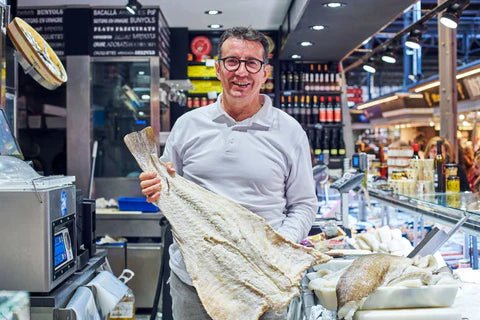
Learning how to eat caviar correctly doesn't take long, but it completely transforms the experience. With the right tools (especially a mother-of-pearl spoon), controlled temperature, suitable accompaniments, and the correct sensory protocol, anyone can enjoy this product like true gourmets. At Bacalalo, we have been helping our customers discover and enjoy the best seafood products for over thirty years at Mercat del Ninot in Barcelona. Caviar, in that catalog, is the product that deserves the most respect and offers the most reward when treated with the care it deserves.
Discover our premium selection
Seafood products selected with expertise since 1990 in Mercat del Ninot, Barcelona. Refrigerated shipping in 24-48h.