Summary — Cogollos with anchovies: Tudela lettuce hearts with Cantabrian anchovies are the perfect appetizer: crunchy, salty, umami, and fresh in every bite. You only need good lettuce hearts, quality anchovies, and an olive oil and Jerez vinegar vinaigrette. Ready in 10 minutes, no cooking required, with a restaurant-quality result.
Cogollos with anchovies: the appetizer that never fails
There are dishes that survive decades on Spanish restaurant menus for a simple reason: they are perfect. Cogollos with anchovies is one of them. A dish that originated in the bars of Navarra and La Rioja, where Tudela lettuce hearts with Denomination of Origin meet Cantabrian anchovies, and which is now a national classic.
The genius of the dish lies in its radical simplicity. There are only three components — crunchy lettuce heart, cured anchovy, and vinaigrette — but each contributes something irreplaceable: the fresh crunch of the lettuce heart, the deep umami of the anchovy, and the acidity of the dressing that binds it all together. There's no cooking, no complex technique, no room to hide behind sauces. Everything depends on the quality of the product.
And that's exactly the kind of cuisine we respect: one that lets the ingredient speak for itself. As with anchovy toasts or any preparation where Cantabrian anchovy is the star, nothing is disguised here — it's presented as is.
The two key ingredients (and how to choose them)
Tudela Lettuce Hearts (Cogollos)
Tudela lettuce hearts have had Protected Designation of Origin since 2013 and are the benchmark for this dish. They are small (10-15 cm), compact, with light green leaves that turn yellow towards the center. Their texture is crunchy even in the inner leaves, and their flavor has a subtle bitter note that contrasts wonderfully with the saltiness of the anchovy.
What makes them special? The combination of the continental climate of the Ebro River basin — cold winters and warm summers — with nutrient-rich alluvial soils. This produces a lettuce heart with more density, more crunch, and more flavor than standard lettuce varieties.
If you can't find Tudela lettuce hearts: look for small, firm lettuce hearts. They shouldn't yield when squeezed. The outer leaves should be taut, not wilted. The heart should be compact and yellowish. Avoid large or loose lettuce hearts — they will be too watery.
Cantabrian Anchovies
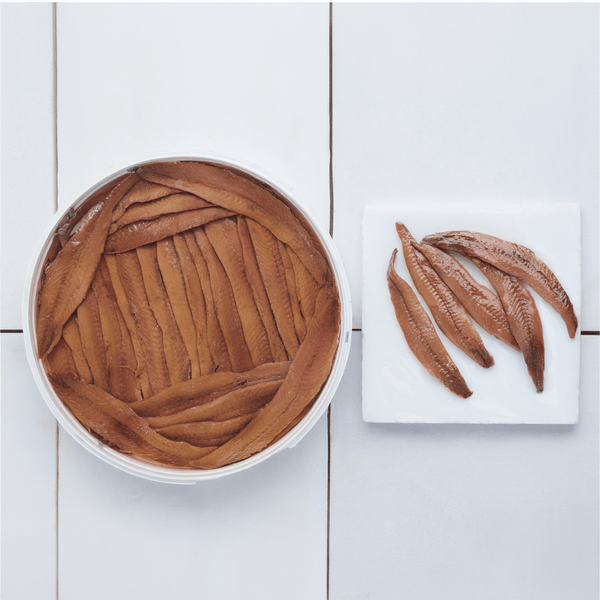
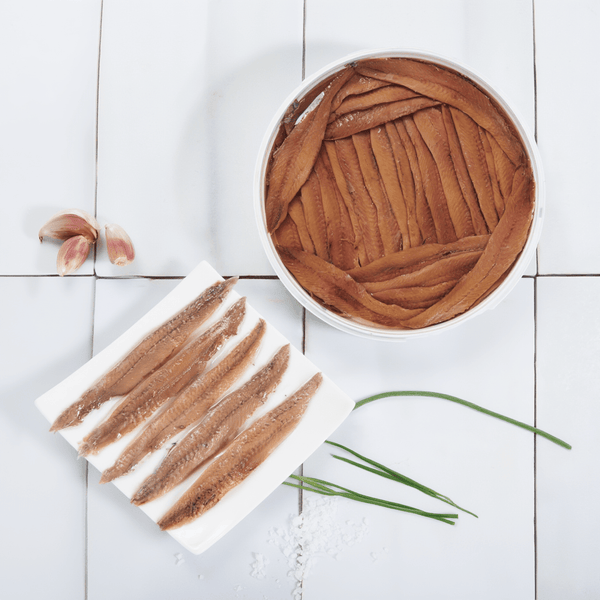
The anchovy defines the dish. You need Cantabrian anchovies in olive oil, cured in salt for at least 12 months. The fillets should be thick, pinkish-brown with a sheen, and the texture should be firm yet melting — it should dissolve in your mouth, not be rubbery.
The best are the 00 (double zero) anchovies, the largest and most premium size. They are perfect for this dish because each fillet has enough presence to cover half a lettuce heart and add flavor to every bite.
A well-cured Cantabrian anchovy fillet concentrates natural glutamate (umami), omega-3 fatty acids, and a balanced saltiness that is not simply "salty" but complex — like a cured cheese, there is a depth of flavor that an industrial product cannot replicate.
Recipe: Cogollos with anchovies step by step
This is the classic version you'll find in the best bars in Pamplona, Logroño, and San Sebastián. No frills, no unnecessary ingredients. The version that lets the product speak for itself.
Ingredients (4 servings)
- 8 small Tudela lettuce hearts (or 4 large ones)
- 12-16 Cantabrian anchovy fillets in olive oil
- 6 tablespoons extra virgin olive oil
- 2 tablespoons Jerez vinegar
- 1 small garlic clove, grated (optional)
- Flaky sea salt (Maldon or similar)
- Freshly ground black pepper
- Cherry tomatoes for garnish (optional)
Preparation (10 minutes, no cooking)
- Prepare the lettuce hearts: Wash the lettuce hearts under cold running water, gently separating the leaves to remove any dirt. Cut them in half lengthwise. Dry them very well with paper towels or a salad spinner — water dilutes the dressing and softens the leaves.
- Prepare the vinaigrette: In a bowl, mix the extra virgin olive oil with the Jerez vinegar (3:1 ratio). Add a pinch of salt, black pepper, and grated garlic if using. Whisk vigorously with a fork until emulsified. Set aside.
- Assemble the dish: Arrange the half lettuce hearts on a wide platter with the cut side facing up, forming "boats." They should be loosely arranged, not piled up.
- Place the anchovies: Place 2-3 Cantabrian anchovy fillets diagonally on each half lettuce heart. If using large 00 anchovies, 1-2 per half lettuce heart is sufficient.
- Dress: Pour the vinaigrette generously over the top, making sure it gets between the leaves of the lettuce heart — that's where the flavor hides.
- Finish: A few Maldon sea salt flakes on top (not too many, the anchovies are already salty), freshly ground black pepper, and optionally, halved cherry tomatoes.
- Serve immediately: This dish doesn't wait. The crunch of the lettuce heart is its raison d'être.
Cantabrian Anchovies for your Cogollos
Selected fillets from Santoña, traditionally cured in salt for a minimum of 12 months. The ingredient that transforms simple lettuce hearts into a Michelin-star-worthy appetizer.
The perfect dressing: Jerez vinaigrette
The vinaigrette is the third pillar of the dish and the difference between correct cogollos with anchovies and memorable ones. The most common mistake is using generic white wine vinegar or, worse, balsamic — which is too sweet and competes with the anchovy.
Jerez vinegar is the right choice, and there's a reason: it has depth. It's aged in oak barrels using the solera system, which gives it woody notes, complexity, and a round acidity that isn't harsh. It's acidic but elegant — exactly what you need to bring together the crunchy lettuce heart and the salty anchovy.
Three vinaigrette variations
- Classic Jerez: 3 parts EVOO + 1 part Jerez vinegar + salt + pepper. The infallible one.
- Old-fashioned mustard: The classic + 1 teaspoon old-fashioned mustard (with seeds). Adds texture and a mild spiciness that works very well.
- Lemon and garlic: 3 parts EVOO + 1 part lemon juice + finely grated garlic + sweet paprika. A fresher version, ideal for summer.
Chef's tip: always prepare more vinaigrette than you think you'll need. The lettuce heart absorbs the dressing between its leaves, and the beauty is that every bite has vinaigrette. If you dress sparingly, the dish will be dry.
6 gourmet variations of cogollos with anchovies
The classic version is perfect, but once you master it, these variations add new dimensions:
1. Cogollos with anchovies and piquillo peppers
Add strips of roasted piquillo pepper between the anchovies. The sweetness of the piquillo balances the saltiness of the anchovy. This is the quintessential Navarrese version — in Tudela, they serve them this way during pepper season.
2. Grilled cogollos with anchovies
Cut the cogollos in half and sear them for 1-2 minutes on the cut side on a very hot griddle or grill. They'll be slightly caramelized on the outside but crunchy on the inside. The anchovies are added afterward. The smoky touch adds another dimension.
3. Cogollos with anchovies and poached egg
Place a poached egg on top of the cogollos with anchovies. When the yolk breaks, it mixes with the vinaigrette, creating a creamy sauce that bathes the anchovy. This is the version served in some Michelin-starred restaurants in the Basque Country.
4. Cogollos with anchovies and ventresca (tuna belly)
Substitute or complement the anchovies with thin slices of tuna belly in olive oil. The contrast between the firm texture of the anchovy and the unctuousness of the ventresca is spectacular. More substantial, ideal as a starter for a meal.
5. Cogollos with anchovies and fried capers
Fry capers in olive oil until they open like flowers (30 seconds). Sprinkle them over the cogollos with anchovies. They add crunch, acidity, and a presentation that looks like it's from a three-star restaurant.
6. Cogollos with anchovies, Caesar style
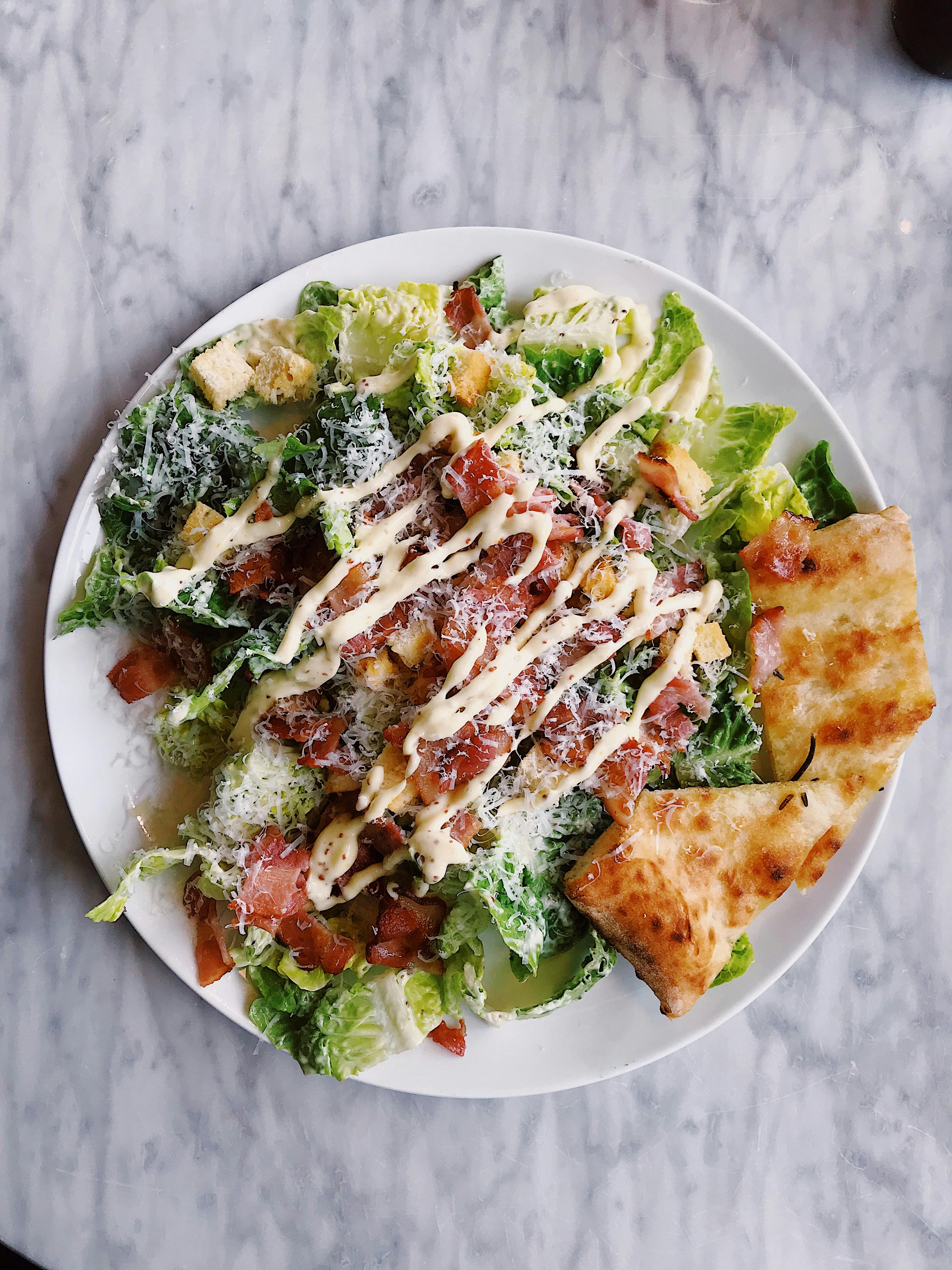
Replace the classic vinaigrette with a Caesar dressing (crushed anchovies, garlic, lemon, grated Parmesan, egg yolk, oil). You double the anchovy — in the dressing and on top. For umami fanatics. Add Parmesan shavings on top.
Restaurant presentation at home
The presentation of cogollos with anchovies makes the difference between a homemade dish and one that looks like it's from a menu. Some tricks:
- The platter matters: Use a long, white ceramic or clay platter. The lettuce hearts should be in a row, not piled up. The space between them is part of the presentation.
- Anchovies with care: Place the fillets with tongs or your fingers, without wrinkling them. They should be stretched over the lettuce heart, not curled up. If the anchovy is straight and shiny, the dish looks professional.
- Visible vinaigrette: Let the dressing be seen — don't hide it. Drops of oil glistening on the anchovy and puddles of vinaigrette on the platter convey generosity.
- Color: The dish is green and brown. It needs a touch of color: halved cherry tomatoes, piquillo pepper, or simply sprinkled paprika add the missing red.
- Flaky salt: Visible Maldon sea salt flakes on the anchovy are a restaurant detail that takes 0 seconds.
Pairing: wines and drinks
Cogollos with anchovies need a pairing that complements the saltiness of the anchovy and the freshness of the lettuce heart. Acidity and bubbles are your allies:
- Txakoli: The perfect pairing. Slightly sparkling, acidic, mineral. It's what they order in San Sebastián to accompany anchovies — and for good reason.
- Manzanilla de Sanlúcar: Dry, salty, with almond notes. The saltiness of the wine harmonizes with that of the anchovy. Serve very cold.
- Albariño: Galician acidity that cleanses the palate. Works especially well in summer.
- Cava Brut Nature: The bubbles cleanse fat and salt between bites. No dosage to avoid adding sweetness.
- Young Verdejo: Fresh, herbaceous, with good acidity. A more economical alternative that works.
- Vermouth: A red vermouth with ice and soda is the classic aperitif with cogollos and anchovies. Impossible to go wrong.
If you want to explore more anchovy combinations, our guide to gourmet canned food appetizers offers a universe of possibilities to create a memorable appetizer.
Nutritional value of cogollos with anchovies
Cogollos with anchovies are a surprisingly balanced appetizer from a nutritional perspective:
| Nutrient | Per serving (1/2 lettuce heart + 2 anchovies) |
|---|---|
| Calories | 120-150 kcal |
| Protein | 8 g |
| Fats | 10 g (mostly monounsaturated) |
| Carbohydrates | 1 g |
| Omega-3 | 0.5-0.8 g (EPA + DHA) |
| Fiber | 1.5 g |
| Sodium | 600-800 mg |
Key nutrients include omega-3 fatty acids from anchovies (EPA and DHA), monounsaturated fats from extra virgin olive oil, and fiber and vitamins from the lettuce heart. It's a low-carb appetizer, rich in healthy fats and quality protein. Suitable for keto, paleo, and Mediterranean diets.
🛒 Products used in this recipe
Cantabrian Anchovies "00" Gourmet Selection
Premium 00 size, artisanally prepared
38,90€
View product →⭐ 4.9/5 · Cold shipping 24-48h · Since 1990 at Mercat del Ninot
Discover our premium selection
Seafood products carefully selected since 1990 at Mercat del Ninot, Barcelona. Refrigerated shipping in 24-48h.
Conclusion
Little gem lettuces with anchovies are proof that Spanish cuisine reaches its peak when it moves away from the usual path and lets the product speak for itself. No technique can compensate for soft lettuces or mediocre anchovies, just as there is nothing to improve when the ingredients are good.
It’s a 10-minute dish that requires zero cooking and achieves something many elaborate dishes don't: everyone at the table wants a second helping. From a bar in Tudela to your home table, the formula is the same — good lettuce, good anchovy, good oil, and Sherry vinegar.
Discover more ways to enjoy Cantabrian anchovies in our 10 anchovy toast combinations and explore the double zero anchovy guide to understand why not all anchovies are created equal.
Cantabrian Anchovies — from Santoña to your table
Direct selection from the producer. Cured in traditional salt. The ingredient that transforms simple little gem lettuces into a restaurant appetizer.
Frequently Asked Questions about Little Gem Lettuces with Anchovies
What type of little gem lettuces are best for anchovies?
Tudela little gem lettuces are the absolute reference. They are small, compact, with crispy leaves and a subtle bitterness that contrasts with the anchovy's saltiness. If you can't find Tudela lettuces, any small, firm lettuce heart works — but avoid iceberg or Batavian lettuces, which are too watery.
Can little gem lettuces with anchovies be prepared in advance?
You can wash and cut the little gem lettuces up to 4 hours beforehand, storing them in cold water in the fridge. The dressing can be prepared the day before. But the final assembly (placing the anchovies and dressing) should be done just before serving — no more than 15 minutes prior. If you dress them too early, the lettuces soften and lose their crucial crispness.
What anchovies should I use for little gem lettuces with anchovies?
Cantabrian anchovies in olive oil, cured for at least 12 months. Santoña anchovies are the Spanish benchmark. Look for thick fillets, pinkish-brown in color, with a sheen. Avoid anchovies that are too dark (over-cured) or smell rancid.
How many anchovies should be put on each little gem lettuce?
For an appetizer, 2-3 anchovy fillets per half little gem lettuce is the ideal proportion. If they are large anchovies (00 or double zero), 1-2 per half lettuce is sufficient. The key is that every bite has anchovy — but not just anchovy.
Are little gem lettuces with anchovies suitable for a keto diet?
Yes, they are ideal for keto: practically zero net carbohydrates (little gem lettuces are 95% water and fiber), rich in healthy fats from olive oil and omega-3 from anchovies, and with protein from cured fish. About 120 kcal per serving.
How do you make the perfect vinaigrette dressing for little gem lettuces?
The classic ratio is 3:1 — three parts extra virgin olive oil to one part Sherry vinegar. Add a pinch of salt, black pepper, and optionally a grated garlic clove. Emulsify well by whisking with a fork. Sherry vinegar is key: it adds depth that white wine vinegar lacks.
Can marinated anchovies (boquerones en vinagre) be used instead of anchovies?
Yes, but it's a completely different dish. Marinated anchovies have a milder flavor and softer texture. They don't combine as well with the bitterness of the little gem lettuce. The version with cured Cantabrian anchovies is more intense, more umami, and has a better contrast of textures.
What is the origin of little gem lettuces with anchovies?
It's a dish with roots in Navarre and La Rioja, where Tudela little gem lettuces (with PDO) are traditionally combined with Cantabrian anchovies. It's a bar appetizer that became popular in the 60s-70s and is now a classic on any Spanish restaurant menu. Some versions add piquillo pepper, mustard vinaigrette, or even caviar.