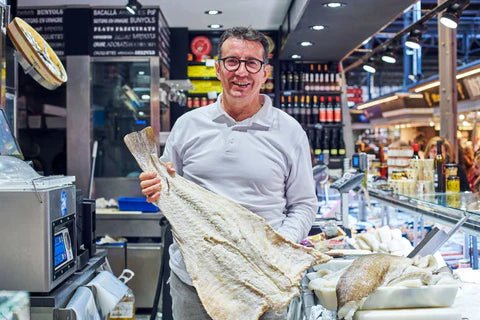
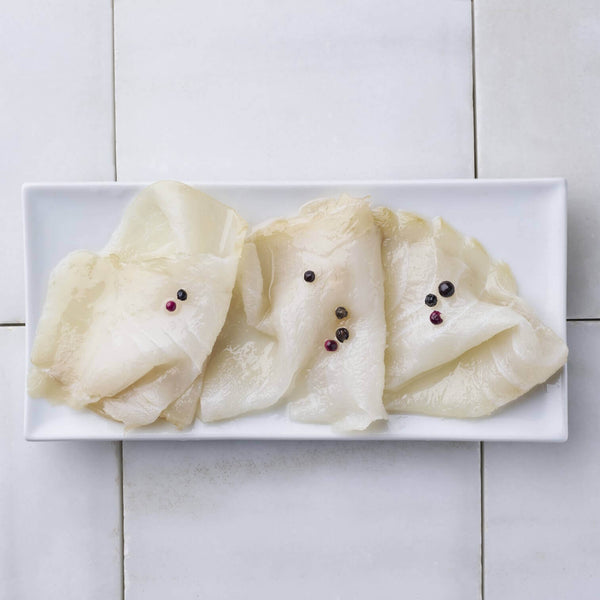
Summary: Cocochas are one of the most mysterious and coveted ingredients in Spanish cuisine. Many people have tried cocochas al pil-pil in a Basque or Catalan restaurant and have wondered where this special cut comes from, when it's in season, and how to get them fresh. At Bacalalo, since 1990 in Mercat del Ninot in Barcelona, we work with them from October to May and know the peculiarities of this exceptional product well.
This guide answers all questions about raw and fresh cocochas: what exactly they are, when their optimal season is, their price, the difference between fresh, frozen, and salted, and how to get the most out of them in the kitchen.
Contents
- What are Cocochas?
- Season: When They Are at Their Best
- Price of Cocochas: Why Are They So Expensive?
- Fresh vs. Frozen vs. Salted Cocochas
- How to Clean Raw Cocochas
- How to Cook Cocochas: The Fundamental Techniques
- Common Mistakes When Cooking Cocochas
- Cod Cocochas vs. Hake Cocochas
- Where to Buy Quality Cod Cocochas
What Are Cocochas?
A cococha (also called "kokotxa" in Basque or "carrillera de bacalao" - cod cheek) is the muscular and gelatinous part of the lower jaw of cod. It is not exactly the cheek (which would be the cheek muscle), but rather the fatty and very gelatinous muscular tissue found under the cod's chin.
Each cod has only two cocochas and they are small: between 30 and 80g each, depending on the size of the fish. To get one kilo of clean cocochas, you need between 12 and 30 cod, which explains their price and scarcity.
The main characteristic of the cococha is its extraordinary richness in collagen and gelatin. This gelatin is what, when cooked correctly in olive oil, creates the unique emulsion of pil-pil without the need for any thickener.
Do not confuse with:- Hake cocochas: Hake cocochas are equally delicious and more accessible (hake is more abundant and has a slightly larger cococha). They are different in taste and texture from cod cocochas.
- Cheeks of other species: The term "carrillera" (cheek) is used for many fish and animals. They are not equivalent.
Season: When They Are at Their Best
Fresh cod cocochas are available in season, not all year round. This is essential to understand when to buy them:
Main season: October to May North Atlantic cod is mainly fished between autumn and spring. The months of maximum availability for fresh cocochas are:
- October-November: Start of season. Moderate availability.
- December-January-February: Full season. Maximum availability and quality.
- March-April: Advanced season. Still good availability.
- May: End of season. Availability decreasing.
- Frozen cocochas (frozen during peak season)
- Salted cocochas (much less common)
- Hake cocochas (which are available all year round)
If you want cod cocochas in summer, the option is to buy them frozen from the season.
Price of Cocochas: Why Are They So Expensive?
Fresh cod cocochas are one of the most expensive fish cuts in Spain. The price range is usually:
Fresh cod cocochas- Approximate price: 25-45 €/kg
- Reason: Only 2 cocochas per cod, very small. High demand in restaurants. Limited season.
- Approximate price: 18-30 €/kg
- Slightly cheaper than fresh ones but with minimal quality difference if properly frozen.
- Approximate price: 12-22 €/kg
- More accessible. Slightly different in taste but excellent for the same preparations.
- Season: during peak season, they may be slightly cheaper due to higher availability
- Origin: first-quality Icelandic or Norwegian cod cocochas are more expensive
- Point of sale: market fishmonger vs. restaurant (where they already include the cooking margin)
The price of cocochas may seem high, but it must be considered that they are a very special, scarce product with practically no waste: everything you buy is eaten.
Related Products from Bacalalo


Recommended Products

Natural Cod Liver Foie Gras - 120g | Smoked I...
€3.90

CHATKA Wild King Crab 60% Legs 40% Shredded | ...
€95.00

Artisan Cut Smoked Cod Carpaccio | 1 Tub Pack
€15.90

Dried Cod Cocochas (1 tub) - 500g
€19.95
Refrigerated shipping 24-48h throughout the Peninsula
Fresh vs. Frozen vs. Salted Cocochas
These three formats have very different characteristics and each has its application:
Fresh raw cocochas The highest quality option when in season. The gelatin is intact, the texture is optimal, and the flavor is the most pronounced and clean. For the perfect pil-pil, fresh cocochas are the benchmark.
How to identify them: translucent and gelatinous appearance, whitish-nacreous color, no spots or dehydration. Clean marine smell.
Storage: 24-48 hours in the refrigerator at most. Use as soon as possible.
Frozen cocochas The alternative for off-season or when fresh ones are not available. If they have been frozen on board or on land immediately after capture, the quality is excellent. The difference from fresh ones is minimal for most uses.
Thawing: always in the refrigerator, never with hot water or microwave. 12-24 hours at 4°C.
The biggest risk with frozen cocochas is gelatin loss if they have experienced temperature variations during storage. Always buy from trusted suppliers.
Salted cocochas The least common format but the one with the longest preservation. Requires desalting before cooking (12-18 hours in the refrigerator with 2-3 changes of water). The flavor is more intense, and the desalting process requires more care than with fillets, as cocochas are delicate.
They are mainly used when no other options are available. The result in pil-pil is good but different from fresh ones.
How to Clean Raw Cocochas
If you buy fresh cocochas at the market, they may come with some membrane or blood residue. Cleaning is simple but important:
Step 1: Briefly wash the cocochas under cold tap water.
Step 2: Gently remove any membrane or dark film covering the surface with your fingers. Do not scrape with a knife: the cococha's natural skin is part of the texture.
Step 3: Dry with paper towels. The surface should be slightly damp but not excessively wet.
Step 4: If the cocochas are already desalted but with a significant amount of salt, you can give them a quick rinse. If they come fresh (unsalted), no additional treatment is needed.
In many market fishmongers (such as at Mercat del Ninot), the fishmonger himself will give them to you already cleaned and ready to cook. Do not hesitate to ask him.
How to Cook Cocochas: The Fundamental Techniques
Cocochas can be prepared in various ways, but two absolutely dominate:
Cocochas al Pil-Pil (The Classic Preparation)
Pil-pil is the preparation that does justice to the cococha's natural gelatin. The technique creates an emulsion between olive oil and the fish's collagen, without any additional thickener.
Ingredients for 4 people:- 600 g fresh or thawed cod cocochas
- 300 ml mild extra virgin olive oil
- 4 cloves of garlic
- 1 chili pepper (optional)
Preparation: Heat the oil over very low heat with the sliced garlic and chili pepper. When the garlic begins to lightly brown, remove it. Add the cocochas skin-side up to the clay pot. Cook over very low heat (the oil should shimmer, not boil) for 8-10 minutes. Remove the cocochas and let the oil cool to about 60-70°C.
The key: gently move the pot in circles while gradually adding the cocochas. The released gelatin emulsifies with the oil. The movement should be constant for 10-15 minutes. The sauce will be ready when it is white, creamy, and homogeneous.
Serve in the same very hot clay pot, with the oil from browning the garlic drizzled over it.
Cocochas in Green Sauce
The other classic Basque preparation. Easier than pil-pil and equally spectacular.
Ingredients for 4 people:- 600 g fresh cocochas
- 4 cloves of garlic
- 1 tablespoon flour
- 200 ml fish stock
- 150 ml extra virgin olive oil
- Plenty of chopped parsley
Preparation: Brown the sliced garlic in oil. Remove from heat and add the flour, stir. Return to very low heat, gradually add the fish stock, stirring to avoid lumps. Add the cocochas skin-side up. Gently move the pot in circles for 8-10 minutes. Add plenty of chopped parsley at the end.
Grilled Cocochas
For those who prefer cleaner, more direct flavors, grilled cocochas are an excellent option:
Heat a griddle or iron pan to maximum. Lightly brush with oil. Place the cocochas skin-side up. Cook for 2-3 minutes per side (depending on size). Serve with a drizzle of olive oil, coarse salt, and parsley.
The result is simpler but allows you to appreciate the pure flavor of the cococha without intermediaries.
Common Mistakes When Cooking Cocochas
Too high a temperature: The most common mistake. Cocochas al pil-pil need oil that "shimmers", not boils. With too much heat, the cocochas harden and the gelatin does not emulsify.
Not moving the pot: The circular motion is essential to create the pil-pil emulsion. Stopping the motion stops the pil-pil.
Using very strong-flavored oil: Extra virgin olive oil with a strong character can overpower the delicate flavor of the cococha. Use a mild oil (arbequina) or even refined olive oil softened with a little extra virgin.
Overcooking: Cocochas are small and cook quickly. 8-10 minutes is enough. More time dries them out and hardens them.
Not letting the oil rest: After cooking the cocochas, the oil should cool slightly before starting the emulsification process. If it's too hot, the sauce won't bind.
Cod Cocochas vs. Hake Cocochas
A frequent question at the fishmonger. They are similar cuts from different species:
Cod cocochas- More intense and pronounced flavor
- Higher gelatin content (thicker and creamier pil-pil)
- Season: October to May
- Price: higher (25-45 €/kg)
- Gastronomic reference of the Basque Country
- Milder and more delicate flavor
- Less gelatin (more liquid pil-pil)
- Available all year round
- Price: more accessible (12-22 €/kg)
- Excellent option when cod cocochas are not available
For pil-pil, cod cocochas give a more spectacular result. For green sauce, hake cocochas are equally excellent. Neither is "better"—they are different and complementary.
Where to Buy Quality Cod Cocochas
Cod cocochas are not found just anywhere. To find good cocochas:
- Municipal market fishmongers: The best option during the season. A specialized fishmonger can get you fresh cod cheeks with 24-48 hours' notice if they don't have them that day.
- Specialty cod stores: Like Bacalalo at Mercat del Ninot. We stock cod cheeks throughout the season.
- Online purchase: Possible for quality frozen cod cheeks, with refrigerated shipping.
- Large supermarkets: Rarely carry fresh cod cheeks. If they do, carefully check their origin and freshness.
Frequently Asked Questions
Do cod cheeks have bones?
No. Cod cheeks are muscle tissue from the jaw, without bones. You only need to remove the outer skin if it's very thick (it's generally edible).
Can you make pil-pil cod cheeks with frozen cod cheeks?
Yes, with excellent results if the cod cheeks have been frozen correctly and thawed slowly in the refrigerator. The gelatin is preserved during the freezing process.
How many cod cheeks per person?
As a main course, 150-180 g of cod cheeks per person. As a tapa or starter, 60-80 g. Considering that individual cod cheeks weigh between 30-80 g, that's about 3-5 cod cheeks per serving.
Why doesn't my pil-pil emulsify?
The most common causes: too high a temperature during cooking (burns the gelatin), not stirring long enough or with the correct motion, or poor quality oil. The quality of the cod cheeks themselves can also influence it: a cod cheek poor in gelatin (poor quality fish or deeply frozen) yields less pil-pil.
Can cod cheeks be eaten raw (like sashimi)?
In theory, yes, if they are fresh from a recent catch and of controlled origin. But it is not a common practice in Spain. Cod cheeks are valued for their cooked texture, not raw.
What wine pairs with pil-pil cod cheeks?
The Basque classics: a cold, mineral txakoli is the traditional pairing. But Atlantic whites (albariño, godello) and whites aged on lees also work very well. Avoid young reds with high tannins.
Can I cook cod cheeks in an air fryer?
It is not the recommended method. An air fryer dries out food, and cod cheeks need to be cooked in oil or liquid for the gelatin to work properly. For pan-fried cod cheeks, a cast iron skillet yields much better results.
What times of the year do you have cod cheeks at Bacalalo?
We stock cod cheeks during the main season, from October to May. In summer, we may have frozen cod cheeks from the previous season. Check availability at bacalalo.com or visit us at Mercat del Ninot.
🛒 Products mentioned in this article
⭐ 4.9/5 · 24-48h refrigerated shipping · Since 1990 at Mercat del Ninot
Conclusion
Fresh, raw cod cheeks are one of the great treasures of North Atlantic fishing. A scarce, seasonal cut, with a unique natural gelatin that makes them irreplaceable for authentic pil-pil.
If you have the opportunity to get them fresh between October and May, don't miss it. And if you're one of those who haven't dared to cook them at home yet, we encourage you to try: pil-pil, with patience and the right technique, is one of those dishes that mark a before and after.
At Bacalalo, since 1990 at Mercat del Ninot in Barcelona, you will find cod cheeks throughout the season and the advice of our team to get the most out of them. Visit us or shop online at bacalalo.com.
Discover more
Discover our premium selection
Carefully selected seafood products since 1990 at Mercat del Ninot, Barcelona. Refrigerated shipping 24-48h.