Summary
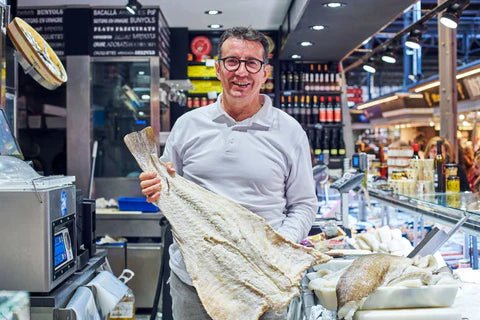
When someone approaches the Bacalalo counter at Mercat del Ninot and asks for caviar but their budget doesn't reach €100 for 30g, the answer almost always includes trout caviar. In this guide: What is trout caviar: definition and types, Flavor and texture of trout caviar: what to expect, Price of trout caviar in Spain.
Trout Caviar: The Accessible Alternative to Sturgeon
When someone approaches the Bacalalo counter at Mercat del Ninot and asks for caviar but their budget doesn't reach €100 for 30g, the answer almost always includes trout caviar. And not as a consolation: it's a genuinely interesting option that many prefer to sturgeon caviar once they try it. Trout roe has its own personality, an instantly eye-catching color, and a texture that makes it versatile in cooking in a way that high-end sturgeon caviar would never allow due to its cost. This guide explains everything you need to know before buying it.
What is trout caviar: definition and types
Trout caviar is the popular name for salt-cured trout roe. Technically, the term "caviar" should be reserved exclusively for sturgeon roe, although in the Spanish market (and much of the European market) it is widely used to refer to any cured fish roe. Rainbow trout (Oncorhynchus mykiss) is the most commonly used species for roe production.
The most common types you'll find on the market:
- Rainbow trout roe: The most widespread. Intense orange color, 4-6mm diameter, mild and slightly sweet flavor with salmon notes. Price from €5-8 per 50g.
- River trout roe (Salmo trutta): Slightly smaller, orange-red color, somewhat earthier and more complex flavor. Less common on the market but highly prized by chefs.
- Steelhead trout roe: A variant of rainbow trout that lives part of its life in saltwater. Its roe is larger and has a slightly more marine flavor than river trout roe.
Trout caviar differs from ikura (salmon roe) in size and flavor. Salmon roe is larger (5-8mm) and more intense in flavor. Trout roe is smaller, more delicate, and less pronounced in flavor.
Flavor and texture of trout caviar: what to expect
Trout caviar has a very different flavor profile from sturgeon caviar. It's not a "lesser" version: it's simply distinct. People who aren't fans of the intensely marine and iodized flavor of Sevruga or Osetra often prefer trout roe for its greater mildness.
Organoleptic characteristics of good trout caviar:
- Color: Bright orange to orange-red, depending on the fish's diet and species. Intense color is a sign of quality: pale or dull trout roe indicates lower quality or poorly preserved product.
- Size: 4-6mm in diameter, noticeably larger than sturgeon caviar (1-4mm depending on species) but smaller than salmon roe.
- Texture: Crunchy and firm. They make a crisp pop on the palate, more pronounced than sturgeon caviar because the membrane is thicker. This texture makes them especially satisfying to chew.
- Flavor: Mild, slightly sweet, with fresh ocean notes but without the iodized potency of sturgeon. There is a clean and pleasant aftertaste without bitterness.
- Salinity: Moderate. Good malossol trout roe has 2-3% salt, making it pleasant without being excessively salty.
Price of trout caviar in Spain
The price, along with its availability, is the great advantage of trout caviar over sturgeon caviar. Approximate ranges in the Spanish market:
- Basic trout roe (50g, supermarket or import): €4-8
- Medium quality trout roe (50g, specialized store): €8-15
- Premium trout roe, artisanal or malossol production (50g): €15-25
- Steelhead trout roe, extra selection (50g): €20-35
To put this in context: 50g of equivalent quality Sevruga costs between €120 and €180. The difference is a factor of 10-15x. This makes trout caviar a very interesting option for use in cooking, for familiarizing oneself with the world of roe, or for events where large quantities are needed without a sturgeon caviar budget.
Bacalalo Products

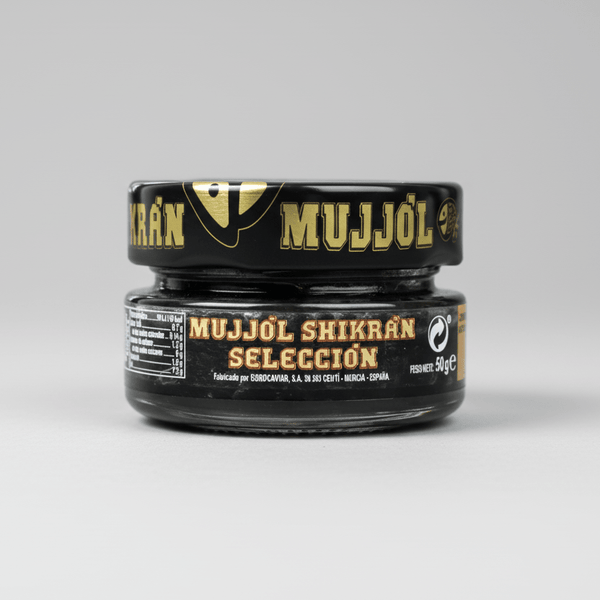
Shikran Mullet Selection - Premium Roe with Smoked He...
€6.95

Assortment "The Great Beluga Gift"
€227.91

Shikran Black Mullet 550g - Smoked Herring and Mu...
€27.95

Sevruga Caviar
€100.00
Refrigerated shipping 24-48h throughout the Peninsula
Culinary uses: where trout caviar shines
Trout caviar is much more versatile in cooking than sturgeon caviar. Its price allows it to be used without the emotional and economic burden of Osetra, and its size and color make it visually very striking in presentations. The most frequent and recommended uses:
On warm blinis: The classic that never fails. The crunchy texture of the roe against the fluffiness of the blini, with a dollop of crème fraîche, is a perfect combination for appetizers. The temperature contrast (warm blinis, cold roe) is part of the appeal.
In pasta: Trout roe holds up well to contact with hot pasta for the 30-60 seconds it takes to plate. A buttered pasta with white truffle or bottarga and 20g of trout roe per dish is a restaurant-quality starter you can make at home. Don't cook it with the pasta: add it when plating.
In salmon or tuna tartare: Trout roe adds texture, color, and a saline note that enhances the tartare without overpowering it. 10-15g per serving is enough. It works better than salmon roe (larger) in this context because it doesn't visually compete with the tartare.
On scrambled or poached eggs: The weekend breakfast worth having. Very creamy scrambled eggs, almost unset, with 15-20g of trout roe on top at the moment of serving. The heat from the egg slightly warms the roe without cooking it.
In sushi and temaki: The bright orange color of trout roe is the same as the salmon ikura used in Japanese cuisine, but with a milder flavor. In temaki (cone sushi) with avocado and cucumber, they work perfectly. Mid-to-high-end Japanese restaurants frequently use trout roe for its better quality-price ratio compared to ikura.
In gazpacho or cold soup: A teaspoon of trout roe on a quality Andalusian gazpacho is a very effective contrast of flavor, texture, and temperature. The acidity of the tomato and the freshness of the gazpacho complement the marine flavor of the roe well.
How to properly store trout caviar
Trout caviar is more delicate than it seems. Its thinner membrane compared to sturgeon makes it susceptible to rapid deterioration if not stored correctly:
- Unopened: Between 0°C and 4°C. Shelf life according to the expiry date on the packaging, generally 2-4 weeks for fresh product or 3-6 months for pasteurized product.
- Once opened: Consume within 2-3 days maximum. Store in the refrigerator covered with plastic wrap pressed directly onto the surface of the roe to minimize air contact.
- Do not freeze: Freezing breaks the roe membrane. When thawed, it becomes a pasty mass without texture. If you buy in quantity, it's better to buy less more frequently than to freeze.
- Serving temperature: Take out of the refrigerator 5 minutes before serving. At full room temperature (20°C), the roe softens and loses texture. Always serve cold.
Trout caviar vs sturgeon caviar: direct comparison
To decide between trout caviar and sturgeon caviar, the most useful mental chart is this:
- If the goal is to impress at a formal event: Sturgeon (Sevruga or Osetra minimum). Trout roe doesn't have the same cultural and gastronomic weight.
- If the goal is to use in cooking regularly: Trout without a doubt. Its versatility and price more than justify it.
- If the goal is to get started in the world of roe: Trout first. More accessible in flavor and price, it allows you to familiarize yourself before making the leap to sturgeon.
- If there is a budget restriction but quality is desired: Premium trout roe or quality black mullet. Both are worthy alternatives with genuine flavor.
- For a gift: Sturgeon caviar has more impact as a premium gift. Trout roe is harder to present as a luxury gift even if the product is excellent.
Bacalalo Products
Shikran Mullet Selection - Premium Roe with Smoked He...
€6.95
Assortment "The Great Beluga Gift"
€227.91
Shikran Black Mullet 550g - Smoked Herring and Mu...
€27.95
Sevruga Caviar
€100.00
Refrigerated shipping 24-48h throughout the Peninsula
🛒 Products mentioned in this article
⭐ 4.9/5 · 24-48h Cold Shipping · Since 1990 at Mercat del Ninot
Frequently Asked Questions about Trout Roe
Is trout roe actually caviar?
Strictly speaking, no. The term "caviar" in the strict sense refers only to sturgeon roe. Trout roe is, technically, "cured trout roe." However, in the Spanish and European markets, the term is widely used to refer to any cured fish roe, and in that colloquial context, it is accepted without problems by consumers and distributors.
Is trout roe healthy?
Yes, it has an excellent nutritional profile. It is rich in high-quality protein (25-28g per 100g), omega-3 fatty acids (EPA and DHA), vitamin D, vitamin B12, and phosphorus. As a salt-processed food, the sodium content is relevant for those controlling salt intake: approximately 1,400-1,800mg of sodium per 100g in the standard version.
How do I know if trout roe is of good quality?
A bright and uniform orange color is the first indicator. Good quality roe is firm to the touch, loose (not clumpy), and has a fresh, clean sea aroma. If it smells strongly of fish or has a pale or dull color, the product is spoiled or of inferior quality. The packaging should indicate the packing date and storage conditions.
Can I use trout roe in hot recipes?
Yes, with caution. Trout roe tolerates moderate heat better than sturgeon caviar because its membrane is thicker. You can add it over hot pasta, egg, or potatoes just before serving. What won't work: cooking it directly in a pan or adding it to a boiling sauce, as it will harden and lose its characteristic texture.
How much trout roe do I need per person?
For an appetizer: 20-30g per person. For a dish garnish (pasta, tartar): 15-20g. For pure tasting on blini: 10-15g. The amount can be greater than with sturgeon caviar without the cost skyrocketing, which is one of the practical advantages of the product.
Can trout roe be purchased online with a freshness guarantee?
Yes, provided the seller guarantees a cold chain in shipping. Fresh trout roe travels well within 24-48 hours with ice packs. Pasteurized trout roe has a longer shelf life and less sensitivity to transport, although its texture may be slightly different from fresh roe.
What is the difference between trout roe and salmon roe (ikura)?
The main differences are size and flavor. Salmon roe (ikura) is larger (5-8mm), has a more intense, marine flavor, and a deeper orange-red color. Trout roe is smaller (4-6mm), has a milder and more delicate flavor, with a somewhat lighter orange. In cooking, both are interchangeable in many recipes, although sushi purists will prefer ikura for Japanese dishes.
Discover our premium selection
Seafood products carefully selected since 1990 at Mercat del Ninot, Barcelona. Refrigerated shipping in 24-48h.