Summary: Cod fritters in an air fryer are crispy on the outside and fluffy on the inside, without the need for frying oil. The key is in the batter: well-bound, with the cod thoroughly integrated and without excess moisture. In this article, you'll find the complete preparation of the batter, the shaping process, exact times and temperatures for the air fryer, tips that make a difference, and an honest comparison between traditional frying and the air fryer. We also answer frequently asked questions.
Contents
- Why cod fritters work in an air fryer
- Batter preparation: ingredients and steps
- Shaping the fritters: size, texture, and resting
- Times and temperatures in the air fryer
- Tips for crispy results
- Comparison: traditional frying vs. air fryer
- The cod you use matters
- Frequently asked questions
Why cod fritters work in an air fryer
Updated March 2026. Every day at Mercat del Ninot, we see what works and what doesn't. This is our real experience.
The first question many people ask is logical: how can a fritter be crispy without hot oil? The answer lies in how an air fryer works. An air fryer doesn't fry in the strict sense; instead, it circulates hot air at high speed around the food, creating a forced convection effect that dehydrates the surface and browns it. The result isn't identical to classic frying, but it's much closer than one might expect.
Cod fritters have a characteristic that makes them especially suitable for the air fryer: the batter. Unlike thin coatings (where crispiness depends almost exclusively on hot oil), fritter batter has its own body. The flour, egg, and cod form a structure that puffs up with heat and develops a crust on its own. The air fryer only needs to apply the correct heat for that crust to form.
The result you'll get: a golden and slightly crispy exterior, a fluffy and moist interior with well-distributed cod. It's not the greasy fritter from deep fryers, but something more akin to a baked fritter but with better browning thanks to air circulation. For many people—especially those looking to reduce fat consumption or avoid the smell of frying at home—it's a preferable option to traditional frying.
An additional practical advantage: the air fryer allows you to prepare small batches of fritters without heating liters of oil. If you're making dinner for two or want to prepare an appetizer without messing up the kitchen, the air fryer is much more convenient. In twelve minutes, you'll have hot fritters on the table.
At Bacalalo, we have been working with cod for over thirty years in Barcelona's Mercat del Ninot. We know this recipe well in all its versions. What follows is the most precise guide you can find for making it in an air fryer: straightforward, with exact temperatures, and common mistakes already addressed.
Batter preparation: ingredients and steps
Cod fritter batter has several variations depending on regional tradition. The version that works best in an air fryer—due to its structure and cohesion—is a light choux-type pastry, which combines cooked flour with egg. It's the same base as the traditional Catalan fritter, adapted to withstand the dry heat of the air fryer well.
Ingredients (for 16-20 fritters):
- 220 g shredded desalted cod (skinless and boneless)
- 130 g all-purpose wheat flour
- 180 ml water
- 40 ml extra virgin olive oil (in the batter, not for frying)
- 2 medium eggs (large)
- 1 teaspoon baking powder
- 1 small garlic clove, very finely minced
- A handful of fresh chopped parsley
- Salt (with caution: cod already provides residual salt)
- Freshly ground black pepper
- Olive oil spray (only to lightly coat the fritters before air frying)
Step 1: Prepare the cod
If you use desalted cod from Bacalalo, you can use it directly without any prior steps. If starting from salted cod, desalt it in cold water in the refrigerator for 24-36 hours, changing the water every 8-10 hours. Thickness determines the time: flakes and scraps need 18-24 hours; thicker loins, up to 36-48 hours.
Once desalted, shred the cod with your fingers. Feel for and remove all bones. The shredded cod should be fine—small pieces that distribute throughout the batter—but without puréeing the fish. Set aside.
Step 2: Cook the flour (the key to the batter)
Place the water and oil in a saucepan over medium-high heat. When they boil, reduce the heat and add the flour all at once. Stir vigorously with a wooden spoon until the dough pulls away from the sides of the saucepan and forms a ball. This process takes about 2 minutes. You are cooking the flour, which gives the batter its structure and prevents a raw flour taste.
Remove from heat and let the dough cool for 5 minutes. This step is important: if you add the eggs to very hot dough, they will scramble, and the texture will be ruined.
Step 3: Incorporate the eggs
Beat the eggs in a separate bowl. Add them to the flour mixture one at a time (or in two batches), stirring vigorously with the wooden spoon or a whisk after each addition. The dough should fully absorb each egg before adding the next. The final result is a dense but manageable dough that falls from the spoon in a thick, continuous stream.
Step 4: Integrate the cod and aromatics
Add the shredded cod, minced garlic, parsley, baking powder, pepper, and a pinch of salt. Mix with folding motions, without beating vigorously: the goal is to distribute the cod throughout the batter without completely breaking it down. Taste the batter and adjust the salt if necessary, keeping in mind that the cod already provides residual salt.
Step 5: Rest
Cover the batter with plastic wrap directly touching the surface and let it rest for 20 minutes at room temperature. This resting period allows the baking powder to start working and the flour to fully hydrate. Fritters are fluffier with this rest than without it.
If you don't have time or if you use Bacalalo's cod fritter batter—which comes pre-made and well-proportioned—you can skip all the previous steps and proceed directly to shaping.
Shaping the fritters: size, texture, and resting
Shaping is the step that most affects the final result in the air fryer. In traditional frying, the batter falls directly into the oil, and the shape is relatively free; in the air fryer, the fritters rest on the rack, and the bottom side will be different from the top if not flipped at the right time. Size also matters: fritters that are too large won't cook thoroughly on the inside before the outside becomes over-browned.
Optimal size: 25-30 g portions, equivalent to a heaping tablespoon. This yields fritters about 4 cm in diameter, a size that the air fryer cooks uniformly in 11-12 minutes. If you make larger fritters (40-50 g), you'll need to increase the cooking time to 14-15 minutes, and there's a greater risk of the exterior drying out before the interior sets.
Two-spoon shaping method: Use one tablespoon to scoop the batter and another to push the portion onto the air fryer rack, which has been previously sprayed with cooking oil. Dip the spoons in cold water between each fritter to prevent the batter from sticking. The portions don't have to be perfectly round; a slightly oval or irregular shape is normal and doesn't affect the result.
Separation between fritters: Leave at least 2 cm between each fritter. The air circulation in the air fryer needs space to work properly. If you stack them or place them too close together, they will stick to each other, and the contact sides will not brown. In a standard 3.5-4 liter air fryer, 8-10 fritters fit comfortably per batch.
Do not place aluminum foil or parchment paper across the entire rack: This blocks air circulation from below. If you want to facilitate cleaning, only place a small piece of perforated parchment paper under the fritters, without covering the entire basket surface.
Times and temperatures in the air fryer
This is the core of the recipe. Times vary slightly depending on the air fryer model (actual power ranges from 1,400 W to 2,200 W even if the thermostat reads the same), but the following ranges work for the vast majority of models on the market.
Base temperature and time:
- Temperature: 200 °C (390 °F)
- Total time: 11-12 minutes
- Flip: at 6 minutes
Step-by-step procedure:
- Preheat the air fryer to 200 °C (390 °F) for 3 minutes. Preheating is important: if you put the fritters in cold, the surface takes longer to seal, and the inside can remain moist.
- Spray the basket or rack with cooking oil. A thin, even layer is sufficient.
- Place the fritters, leaving space between them. Spray the surface of the fritters with a touch of cooking oil: this is what gives them their golden color.
- Cook at 200 °C (390 °F) for 6 minutes.
- Open the drawer, flip each fritter with silicone tongs. Spray the surface that is now facing up with a little more cooking oil.
- Cook for 5-6 more minutes at 200 °C (390 °F).
- Check the result: the exterior should be uniformly golden, not dark brown. The interior should look fluffy when cut, with no raw or sticky parts in the center.
Reference table by fritter size:
| Size | Temperature | Total time | Flip at |
|---|---|---|---|
| Small (20-25 g) | 200 °C (390 °F) | 10 min | 5 min |
| Medium (25-35 g) — recommended | 200 °C (390 °F) | 12 min | 6 min |
| Large (35-50 g) | 190 °C (375 °F) | 15 min | 8 min |
| From frozen (any size) | 180 °C (350 °F) | 16-18 min | 9 min |
Note on dual-basket air fryers: If your model has two baskets and a sync function, you can cook double the quantity in the same amount of time. Make sure both baskets have the same quantity and size of fritters so the timing is identical.
Note on air fryers with steam function: If your model has the option to add steam (some high-end Ninja or Philips models), do not use it for fritters. Steam adds moisture and hinders the formation of a crispy crust.
Tips for crispy results
The biggest challenge with air frying moist batters like fritters is achieving a crispy exterior without drying out the interior. These are the most influential factors, listed by importance:
1. Always preheat the air fryer
It's the simplest tip and the one most people skip. A cold air fryer takes time to reach working temperature, and during that time, the fritters heat up gradually without sealing the surface. The result is a batter that puffs up before the crust forms, leading to a soft exterior. With the appliance preheated to 200 °C (390 °F), the surface of the batter seals within the first 60-90 seconds, ensuring crispiness.
2. Use oil spray, not liquid oil
Oil spray allows you to apply an ultra-thin, even layer over the entire surface of the fritter. Liquid oil applied with a brush tends to accumulate in some areas and not reach others. An even layer of fat ensures uniform browning. Use olive oil or sunflower oil spray; olive oil provides better flavor.
3. Do not stack the fritters
Always arrange them in a single layer. If you place them in two levels or too close together, the steam they generate during cooking gets trapped and softens the crust. The crispiness of air-fried food depends on hot air circulating freely around each piece.
4. Control the moisture of the batter
A batter that is too liquid produces fritters that spread out and flatten in the basket, with a thin crust that won't get crispy. The correct consistency: the batter falls from the spoon but slowly, in a thick stream. If it's too liquid, add an extra tablespoon of flour. If the cod has a lot of water (especially homemade desalted cod that hasn't been drained well), drain it on absorbent paper before incorporating it into the batter.
5. Flip exactly halfway through the cooking time
The side touching the rack receives direct heat by conduction in addition to convection heat from the air. If you don't flip them, that side will brown excessively, and the top side will remain pale. Flipping halfway through ensures even browning on both sides.
6. Do not open the drawer more than once
Every time you open the drawer, the internal temperature drops between 15 and 25 °C (60-77 °F), and the timer may pause depending on the model. Open only once, halfway through, to flip. If you open it more times, the browning process is interrupted, and the result is less uniform.
7. Serve immediately
Air-fried fritters lose their crispiness faster than deep-fried ones because they lack the layer of fat that acts as a barrier. If you let them rest for 10 minutes, the internal steam will soften the crust. Serve them as soon as they come out of the air fryer.
Ready-to-use cod fritter batter for the air fryer
If you want to skip the preparation, our cod fritter batter is made with desalted Icelandic cod, ready to portion and place directly into the air fryer. No additives, no preservatives.
View fritter batterComparison: traditional frying vs. air fryer
The most frequently asked question: is it worth making them in an air fryer or is it better to keep frying them? The honest answer is that it depends on what you prioritize. They are not exactly the same, and there are aspects where each method outperforms the other.
| Aspect | Traditional Frying | Air Fryer |
|---|---|---|
| Exterior Crispiness | Very intense | Moderate, even |
| Fluffy Interior | Very fluffy | Fluffy |
| Added Fat | High (absorbs 8-12% of weight in oil) | Minimal (spray only) |
| Approximate Calories (per fritter) | 85-100 kcal | 55-70 kcal |
| Total Time | 20-25 min (heat oil + fry) | 15 min (preheat + cook) |
| Kitchen Odor | Strong, lingers | Minimal |
| Cleaning | Difficult (oil, splatters) | Easy (dishwasher-safe basket) |
| Quantity per batch | More (depending on pan size) | 8-10 per batch |
| Texture after resting | Stays crispy longer | Softens sooner |
When to choose an air fryer: for everyday use, when preparing small portions, when you want to reduce calories, or when you don't want to deal with frying odors or oil cleanup. Also, if you want to reheat fritters from the day before: the air fryer at 180°C for 4 minutes brings them back to a state very close to freshly made, which the microwave cannot achieve.
When to choose traditional frying: for special occasions, for large quantities, or when you want the fluffiest fritter and the most intense crispiness. Frying in oil at 180°C is still the method that gives the absolute best result in terms of texture. For the complete traditional recipe, consult our guide on traditional cod fritters.
For other cod recipes in an air fryer, including loins, brandade, and croquettes, check out our complete article on cod in an air fryer. If you are specifically looking for how to make croquettes in an air fryer, we also have a detailed guide on cod croquettes in an air fryer with exact cooking times.
The cod you use matters
The quality of the cod is the most determining factor in the final taste, even more so than the technique. Poor quality cod — poorly desalinated, of an inferior species, or with excess residual salt — produces fritters that taste strong and unbalanced, with a bitter aftertaste that no cooking trick can correct.
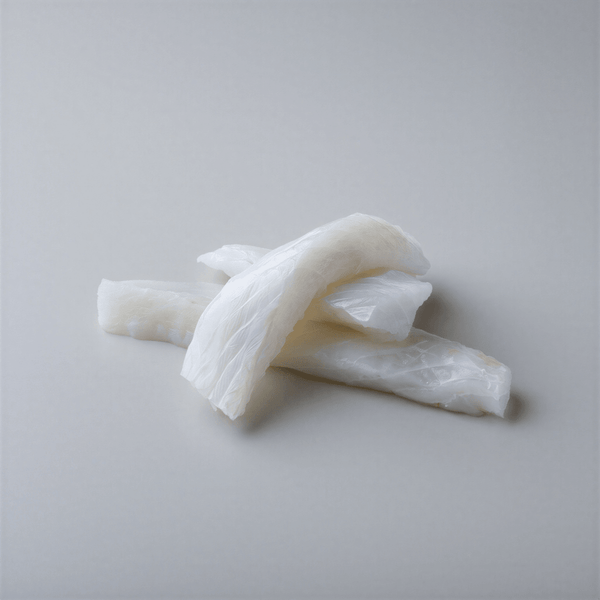
For fritters, the most suitable format is shredded or flaked cod: small, irregular pieces that integrate perfectly into the dough. Whole loins are not the right piece for this recipe; they are expensive, and their texture in the dough does not improve the result.
Our desalinated cod from the desalinated cod collection arrives from Mercat del Ninot with a controlled salt level: enough to flavor the dough, with little need for additional salt. It is Gadus morhua from Iceland, desalinated with the exact process we have used in the market workshop since 1990. We also have prepared dishes and pre-made doughs in our prepared dishes section.
Premium Seafood Products — Cod
Since 1990, selecting the best of the sea at Mercat del Ninot, Barcelona. Refrigerated shipping 24-48h.
View shredded cod →Frequently Asked Questions
What temperature should cod fritters be cooked at in an air fryer?
The optimal temperature is 200°C for medium-sized fritters (25-35g). For larger fritters or if your air fryer tends to brown a lot, lower to 190°C and extend the cooking time by 2-3 minutes. Never go below 180°C: at lower temperatures, the dough does not seal well, and the result is soft and pale.
How long do cod fritters take in the air fryer?
Between 11 and 12 minutes for medium-sized fritters (25-35g) at 200°C, flipping them over after 6 minutes. Smaller fritters need 10 minutes; larger ones, up to 15 minutes. From frozen, allow 16-18 minutes at 180°C.
Do I need to put oil in the air fryer for fritters?
Not for frying, but a minimal amount in spray form. Spray the basket before placing the fritters and also spray the surface of the fritters before putting them in. Without that touch of oil, the dough remains pale, and the crust does not form well. It's a minimal amount — much less than any deep-frying — but necessary for the result.
Can I freeze the fritter dough and use it later in the air fryer?
You can freeze the dough without any problem. Freeze the formed portions (with two spoons) separately on a tray, and once solid, transfer them to a freezer bag. To cook them, go directly from the freezer to the air fryer: 180°C, 17 minutes, flipping them over after 9 minutes. There's no need to defrost them beforehand.
Are air fryer fritters the same as fried ones?
They are not exactly the same. Fried ones have a more intense crispiness and a fluffier interior due to the reaction of hot oil with the dough. Air fryer ones have a softer but even crispiness over the entire surface, and less fat. For everyday use or if you are looking for a lighter option, the air fryer is an excellent alternative. For a special occasion where you want the fritter at its best, traditional frying still wins.
Can I reheat leftover fritters in the air fryer?
Yes, and it's the best method for reheating them. At 180°C for 3-4 minutes, they regain much of their exterior crispiness. The microwave, on the other hand, leaves them soft and soggy. Store leftovers in an airtight container in the refrigerator (maximum 24 hours) and reheat them directly from the refrigerator in the air fryer.
Why are they raw inside if the outside is golden?
The most common cause is that the air fryer is too hot (above 205-210°C in some models that have thermostat variations) or that the fritters are too large. Try lowering the temperature by 10°C and making the portions smaller. This can also happen if the dough has too much moisture: drain the cod well before incorporating it and make sure the dough is not too liquid.
Can I add other ingredients to the dough?
Yes. The base dough allows for variations. The most popular in Catalonia is to add a little garlic and parsley, which is the version we use in this recipe. You can also incorporate chopped chives, very thin strips of roasted red pepper, or a little sweet or smoked paprika. Avoid ingredients that add a lot of moisture (like fresh tomatoes without draining or whole unchopped olives), as they upset the consistency of the dough.