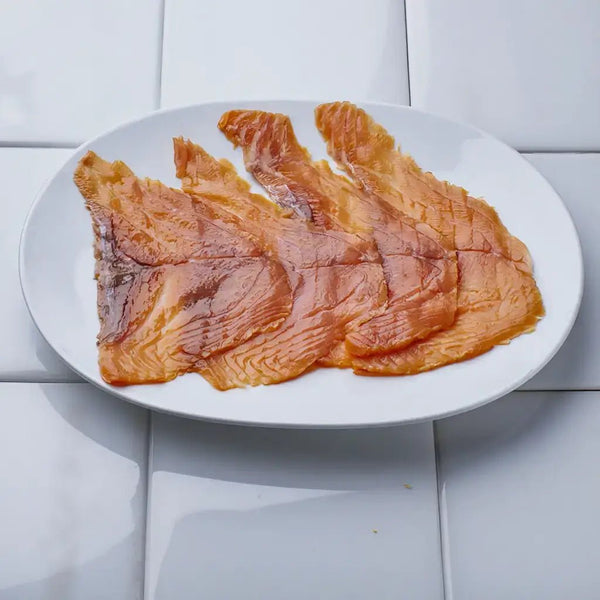
Salted Cod: History, Process, and How to Use it in the Kitchen
Salted cod is one of the most important foods in European history — the protein that fed sailors, soldiers, monks, and entire families for centuries before refrigeration existed. Today, when we can freeze any fish, salted cod continues to exist not out of necessity but for quality: the curing process transforms fresh cod into a product with more flavor, more texture, and more versatility than its frozen counterpart. This guide covers the history, the curing process, the cuts, and everything you need to work with salted cod like a professional.
Contents
What is salted cod
Updated March 2026. Based on our 30+ years of experience at Mercat del Ninot, this is what we recommend.
Salting is an ancient preservation technique that involves covering cod with coarse salt for weeks, followed by a drying process that reduces the moisture content of the meat to 15-20%. The result is a product stable at room temperature, with a shelf life of months or even years, which concentrates the flavor and transforms the texture of the meat in a way no other process can.
Gadus morhua is the ideal fish for salting for a biological reason: its meat is exceptionally lean (less than 1% fat). Fatty fish — salmon, tuna, sardines — do not tolerate prolonged salting well because the fat turns rancid. Cod, with its white, virtually fat-free meat, dehydrates cleanly, developing complex flavor without the risk of rancidity.
The process is not simply "adding salt": it is a complete biochemical transformation. The fish's own enzymes act on the proteins during salting, creating free amino acids and peptides that are responsible for the intense, umami flavor of salted cod. It is the same type of transformation that turns milk into cheese or grapes into wine — salt is the catalyst, but the magic is done by the enzymes.
History of salted cod
The Vikings and stockfish (9th-12th century)
The first to exploit cod on a large scale were the Vikings, but they did not use salt — they dried the fish in the cold Arctic air. The result, called stockfish (tørrfisk in Norwegian), was cod as dry and hard as wood that kept for years. This stockfish was the protein fuel for Viking expeditions to Iceland, Greenland, and North America.
Salt changes the rules (13th-15th century)
The salting of cod began when trade routes from southern Europe brought cheap sea salt to the north. The Basques were probably the first to combine salt with cod, creating the product we know today. Salt not only preserved: it improved flavor and texture, producing a gastronomically superior result to stockfish.
Basque fishermen traveled to the North Atlantic — possibly to Newfoundland before Columbus — to catch cod, salt it on board, and bring it back to the Cantabrian ports. This practice gave rise to an industry that for centuries was one of the economic engines of the Basque Country.
The cod empire (16th-19th century)
The official discovery of the Grand Banks of Newfoundland in 1497 multiplied the supply. Portugal, Spain, France, England, and Holland sent entire fleets to fish for cod. Salted cod became the staple protein of:
- The Catholic Church: essential during days of fasting and Lent, when meat could not be eaten. In an era with more than 150 days of abstinence per year, cod was the main protein alternative.
- Navies: salted cod fed the crews of the Spanish Armada, the French fleet, and the Royal Navy.
- The slave trade: low-quality salted cod was exported to Caribbean plantations as food for slaves — a dark chapter in the product's history.
- Families in Southern Europe: in Portugal, Spain, Italy, and Greece, salted cod was the accessible protein that reached areas without access to the sea.
The 20th century and industrialization
Refrigeration and freezing reduced the need for salting as a preservation method. But instead of disappearing, salted cod was revalued as a gourmet product. Demand remained because the flavor and texture of salted and desalinated cod are different — and superior in many applications — to frozen cod.
Today, Norway and Iceland are the main producers of salted cod, with Portugal, Spain, Italy, and Brazil as the main consumers.
The curing process: from fresh to salted cod
The modern industrial process maintains the principles of traditional curing with scientific control of temperatures and times.
Phase 1: Catch and evisceration
Cod is caught in North Atlantic waters (Norway, Iceland, Faroe Islands). It is eviscerated and bled on board immediately. The speed of evisceration is critical: digestive enzymes can begin to degrade the meat within hours.
Phase 2: Opening and cleaning
The cod is butterfly cut (cut along the belly), removing the spine and leaving the meat exposed in two loins joined at the tail. This format maximizes the surface contact with the salt.
Phase 3: Salting in stacks (2-3 weeks)
The opened cod are stacked, alternating layers of coarse salt and fish. The ratio is approximately 1 part salt to 3 parts fish. The salt acts by osmosis: it extracts water from inside the meat while penetrating the cells. This process lasts between 2 and 3 weeks. The temperature is maintained between 0 °C and 4 °C to prevent bacterial growth.
Phase 4: Washing
After salting, the cod is washed with water to remove excessive surface salt. This step is quick: it only removes the external salt without affecting the salt that has penetrated the meat.
Phase 5: Drying (variable)
Drying can be:
- Natural (air-dried): on outdoor drying racks, as is done in the Lofoten Islands of Norway. Slow process (weeks), produces a result with more flavor complexity. Depends on the climate.
- Industrial (drying tunnel): in chambers with controlled temperature and humidity. Faster (days), more uniform but less complex result.
- Minimum or no drying (wet salted cod): the cod is sold directly after salting, without drying. It has more water, less intense flavor, but is easier to desalt.
| Phase | Duration | What happens |
|---|---|---|
| Evisceration | Hours | Viscera and blood are removed to prevent enzymatic degradation |
| Salting in stacks | 2-3 weeks | Osmosis: salt enters, water leaves. Humidity drops from 80% to 50% |
| Washing | Hours | Excess surface salt is removed |
| Drying | Days to weeks | Final humidity: 15-20%. Maximum flavor concentration |

Shredded Dry Salted Cod Universal - 500g
We offer both dry salted cod (for those who want full control of desalting) and professionally desalinated cod (ready to cook). Both 100% Gadus morhua from the North Atlantic.
Types of salted cod
Dry salted cod (clipfish / bacalhau seco)
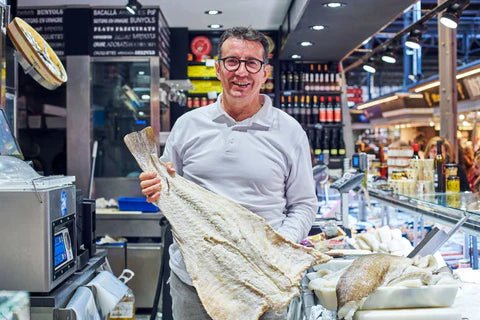
The classic product: salted and dried to 15-20% humidity. Hard, firm, yellowish-golden color. Needs 48 hours of desalting. It is the most intense in flavor and works best for traditional recipes (pil pil, vizcaína, bacalhau dourado).
Wet salted cod (saltfisk / bacalhau verde)
Salted but not dried (or minimally dried). Humidity of 50-55%. Softer and more flexible. Needs only 24 hours of desalting. Less intense flavor but closer to fresh cod. Popular in Scandinavia.
Brine-cured cod
Submerged in a solution of water and salt (brine) instead of stacked in dry salt. Faster but less intense process. The result is milder and less complex than dry salting.
Cuts of salted cod
| Cut | Description | Thickness | Best use | Price |
|---|---|---|---|---|
| Loin | Dorsal part, boneless, skin on one side | 4-6 cm | Grill, oven, pil pil, green sauce | €€€€ |
| Center cut | Transverse slice with central bone | 3-5 cm | Green sauce, oven, stews | €€€ |
| Tail | Caudal end, thinner | 1-3 cm | Fritters, croquettes, salad | €€ |
| Flakes | Irregular trimmings from filleting | Variable | Croquettes, fritters, scrambled eggs, empanada | € |
| Kokotxas | Cod jowls/cheeks | 2-3 cm | Pil pil, battered, in green sauce | €€€€€ |
Each cut has its ideal recipe. If you want to delve into the differences, our complete guide to dry salted cod and cuts details everything you need to know.
How to choose quality salted cod
- Species: must be Gadus morhua (Atlantic cod). Check the scientific name on the label. Any other species is an inferior substitute.
- Color: uniform white-yellowish. Golden tones indicate natural air drying. Never grayish (poor preservation) or translucent (excess moisture).
- Smell: pleasant, of salt and sea. No ammonia, acidic, or rancid smell.
- Texture: firm and dry to the touch. The flakes of the meat should be visible through the salt. If it is soft or sticky, it is not a good product.
- Thickness: quality cod produces thick pieces. A loin 5-6 cm thick indicates a large, well-cured cod. Thin, flat pieces are an indicator of small specimens or minor species.
- Origin: Norway (especially Lofoten Islands), Iceland, and Faroe Islands produce the best salted cod in the world.
Desalting: the step that defines the result
Desalting is the operation that separates an excellent cod dish from a mediocre one. Incorrect desalting produces cod that is too salty, too soft, or with a rubbery texture.
Professional method
Cut the cod into the portions you will use. Place them skin-side up in a large container. Cover with plenty of cold water (3 times the volume of the cod). Refrigerate at 4-5 °C. Change the water every 8 hours.
| Type of cod | Desalting time | Water changes |
|---|---|---|
| Dry salted (thick loin) | 48 hours | 6 changes (every 8h) |
| Dry salted (center/tail) | 36 hours | 4-5 changes |
| Wet salted | 24 hours | 3 changes |
| Flakes | 18-24 hours | 3 changes |
For the complete guide with all the details, consult our article how to properly desalt cod. It is the most consulted content on our blog, and for good reason: good desalting is the basis of everything.

Desalted Cod Brandade - 250g
If you prefer to skip desalting, our desalted cod arrives ready to cook. 48 hours of desalting with controlled water changes by professionals from Mercat del Ninot. The exact salt point for each recipe.
Salted cod in the kitchen
Salted cod, once desalted, is the basic ingredient for hundreds of recipes in the Mediterranean tradition. Salting transforms the fish in three ways that matter in cooking:
- Concentrates flavor: by losing 60-70% of its water, the flavor compounds are concentrated. Desalted cod has more flavor than frozen cod.
- Compacts fibers: dehydration and salt create a structure of firm flakes that remain during cooking. This is why desalted cod holds up on the grill and produces pil pil.
- Increases available gelatin: collagen concentrates during salting. When cooked, this gelatin is released and acts as a natural thickener — it is the basis of pil pil sauce and the reason why cod sauces have that silky texture.
Essential recipes with salted cod
- Cod in green sauce — the quintessential Basque sauce
- Pil pil — the gelatin and oil emulsion
- Baked cod — the most versatile option
- Cod croquettes — the perfect use of leftovers
- Cod brandade — the Franco-Provençal recipe
Home storage
Dry salted cod (undesalted)
In a cool, dry place (10-15 °C), wrapped in breathable paper or cloth: up to 6 months. In the refrigerator, wrapped in cling film: up to 1 year. Do not store in a sealed plastic bag — it needs some air circulation.
Desalted cod
In the refrigerator, covered with water: maximum 3 days. Frozen (well wrapped): up to 3 months. Once desalted, cod is as perishable as any fresh fish.
Frequently Asked Questions
Why is salt cod so expensive?
Several factors contribute: the raw material is Gadus morhua from the North Atlantic (already expensive), the salting and drying process takes weeks, the weight loss during curing is 40-50% (1 kg of fresh cod yields 500-600 g of salt cod), and the labor for filleting and selection is significant. You are paying for a concentrated product.
Can you eat salt cod without desalting?
It is not recommended. Dried salted cod has a salt concentration of 20-25%, making it excessively salty and even harmful to health if consumed without desalting. Desalting is an essential, not optional, step.
How much does cod weigh after desalting?
Dried salted cod absorbs water during desalting and increases its weight by 30% to 50%. 500g of dried cod becomes 650-750g of desalted cod. Keep this in mind when calculating portions for recipes.
Is dried cod the same as salted cod?
Not exactly. Salted cod (saltfisk) is cod cured in salt without drying — it's moister, softer, and desalted in 24h. Dried salted cod (clipfish/bacalao) has undergone both salting and drying — it's firmer, has more flavor, and is desalted in 48h. They are different products with distinct uses, although they are often used interchangeably in Spanish.
What happens if I desalt it for too long?
If you desalt for too long, the cod loses flavor and the texture becomes soft and watery — it loses the firmness that distinguishes it from frozen cod. The solution: taste a small piece during desalting (at 36h for loins). If it's still salty, continue. If it tastes like fish with a pleasant hint of salt, it's ready.
Can I speed up desalting?
There are tricks that partially speed it up: cutting the cod into smaller portions (more surface area in contact with water) and changing the water more frequently. But never use hot water, milk, or other shortcuts — they alter the texture and flavor. Proper desalting requires time and cold water. There are no good shortcuts.
Universal Shredded Dried Cod - 500g
For purists who want to control the entire process: our dried salted cod is Gadus morhua from the North Atlantic cured with the traditional dry-salting method. You decide when to desalt, how much to desalt, and how to cut it.
Conclusion
Salt cod is not an antiquated product — it's a product that has survived refrigeration because it is qualitatively different (and superior in many applications) to frozen cod. Salting concentrates flavor, compacts fibers, and generates gelatin. These three transformations are what allow for a pil pil, a green sauce that emulsifies on its own, or pan-fried cod with defined flakes.
Understanding the salting process gives you perspective as a cook: you're not just "desalting fish" — you're working with a transformed product that carries centuries of accumulated knowledge. With discernment, not slogans.