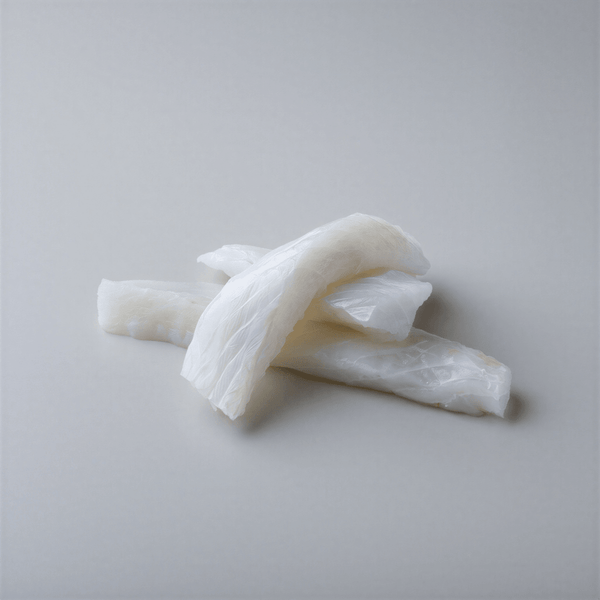
If you've ever bought "cheap" cod at the supermarket, it was probably PCT cod. The abbreviation stands for Pacific, and it refers to Gadus macrocephalus, a different species from Atlantic cod (Gadus morhua). Here we explain the real difference between the two, why PCT is cheaper, and when it's worth paying more for Atlantic cod.
Table of Contents
- What does PCT mean in cod?
- Gadus macrocephalus: Pacific cod
- Gadus morhua: Atlantic cod
- Comparison table: PCT vs Atlantic
- Real differences in taste and texture
- Why PCT is cheaper
- Where to find each type in Spain
- When to use each type of cod
- How to read the label: tricks to avoid confusion
- Frequently Asked Questions
- Conclusions
What does PCT mean in cod?
Updated March 2026. In our over 30 years of experience at Mercat del Ninot, this is what we recommend.
PCT is the commercial abbreviation for Pacific. In the world of salted and desalted cod, this acronym identifies cod caught in the Pacific Ocean, which belongs to the species Gadus macrocephalus (also called Alaska cod or Pacific cod).
The abbreviation appears on invoices, delivery notes, and commercial documents between wholesalers and distributors. On supermarket labels, you will rarely see "PCT" directly; instead, European regulations require indicating the scientific name of the species and the FAO catch area. But if you ask any cod professional, they will use "PCT" to refer to Pacific and distinguish it from "ATL" (Atlantic).
This distinction is not a nomenclature whim: they are two different species with real differences in taste, texture, price, and cooking behavior.
Gadus macrocephalus: Pacific cod
Gadus macrocephalus inhabits the cold waters of the North Pacific, mainly in Alaska, the west coast of Canada, the Bering Sea, and the coasts of Japan and Korea. Its scientific name literally means "large-headed cod," due to its proportionally larger head than that of morhua.
Biological characteristics
- Size: adults of 50-80 cm (smaller than morhua)
- Weight: 2-5 kg typically (vs 3-10 kg for morhua)
- Habitat: waters of 2-10 degrees C, depths of 50-300 meters
- Lifespan: up to 18 years (vs 25+ for morhua)
- Diet: crustaceans, mollusks, small fish
Meat characteristics
The meat of macrocephalus is white, with a slightly softer and less fibrous texture than that of morhua. It has less gelatin (collagen), which translates to:
- Less unctuousness when cooking
- The flakes separate with less definition
- Less emulsifying capacity (less creamy pilpil)
- Dehydrates less well for salting (absorbs more water when desalted, becoming watery)
Gadus morhua: Atlantic cod
Gadus morhua is the original cod, the one that has been in European gastronomy for centuries and that founded the North Atlantic fishing industry. It inhabits from Norway and Iceland to Newfoundland and Greenland.
Biological characteristics
- Size: adults of 60-130 cm (exceptional specimens of 180 cm)
- Weight: 3-10 kg typically (specimens up to 50 kg documented)
- Habitat: waters of 0-10 degrees C, depths of 50-600 meters
- Lifespan: up to 25 years
- Diet: fish, crustaceans, marine worms
Meat characteristics
The meat of morhua is the quality reference in the cod world:
- Firm texture that flakes into thick, well-defined layers
- High gelatin content: key for pilpil, Vizcaina sauce, and confits
- More pronounced flavor: sweet and slightly marine notes
- Better response to salting: denser meat absorbs salt uniformly and rehydrates with better texture

Universal Dried Shredded Cod - 500g
Available at Bacalalo.com with refrigerated shipping in 24-48h
Comparison table: PCT vs Atlantic
| Characteristic | PCT Cod (Pacific) | Atlantic Cod |
|---|---|---|
| Species | Gadus macrocephalus | Gadus morhua |
| FAO Areas | 61, 67 (North Pacific) | 21, 27 (North Atlantic) |
| Average size | 50-80 cm | 60-130 cm |
| Meat texture | Soft, less defined | Firm, large flakes |
| Gelatin content | Low-medium | High |
| Flavor | Mild, neutral | Pronounced, sweet, marine |
| Response to desalting | Absorbs a lot of water, becomes watery | Balanced rehydration |
| Average price (desalted) | 6-12 EUR/kg | 14-28 EUR/kg |
| Availability | High (supermarkets) | Medium (fishmongers, gourmet) |
| Sustainability | MSC certified (Alaska) | Variable according to fishing ground |
Real differences in taste and texture
Anyone who says there's no difference between PCT and Atlantic cod either hasn't tried them together or doesn't have a trained palate. But to be honest: the difference isn't huge in all contexts.
Where it's very noticeable
- Natural or confit: minimalist preparations where cod is the sole protagonist clearly reveal the difference. Morhua has a sweeter flavor, a texture that flakes into defined layers, and a unctuous mouthfeel that macrocephalus cannot achieve.
- Pilpil: morhua's gelatin emulsifies better, creating a denser and more stable sauce. With PCT, pilpil tends to be more liquid and less creamy.
- Dry-salted (table cod): tried side by side in dry-salted form, the difference in texture and flavor is evident.
Where it's less noticeable
- Stew with many ingredients: in a chickpea stew, an ajoarriero, or a zarzuela, cod shares the spotlight with other flavors and the difference is diluted.
- Battered: the batter provides its own texture and the frying oil dominates.
- Shredded for fillings: in croquettes, fritters, or empanadas, the béchamel or dough masks the differences.
Why PCT is cheaper
The price difference between PCT and Atlantic cod is explained by several factors:
- Abundance: Gadus macrocephalus populations in Alaska are well-managed and enormous. Fishing quotas are high. Atlantic morhua has more restrictive quotas after decades of overfishing (the collapse of Newfoundland in 1992 is the best-known example).
- Market size: Alaska is the largest cod fishery in the world. Volumes allow for economies of scale that reduce the price.
- Quality perception: the gourmet market (Portugal, Basque Country, Italy) pays more for morhua, which raises its market price.
- Salting process: morhua salts better, and the dry-salted product has more added value. PCT is sold more as fresh desalted or frozen, with less added value.
It's not that PCT is "bad" and Atlantic is "good." They are two products with two price ranges and two distinct usage profiles. The problem is when PCT is sold at Atlantic prices, or when the species is not clearly indicated.

Smoked Cod in Oil in Thin Slices - 1000g
Available at Bacalalo.com with refrigerated shipping in 24-48h
Where to find each type in Spain
PCT Cod (Gadus macrocephalus)
- Mercadona: most of its desalted cod is PCT
- Lidl, Aldi, Dia: common in their refrigerated and frozen aisles
- Frozen foods (Pescanova, Fribesa): many frozen brands use PCT
- Neighborhood fishmongers: may have PCT as an economical option
Atlantic Cod (Gadus morhua)
- Specialized fishmongers: where you find quality dry-salted cod
- Mercat del Ninot, la Boqueria and municipal markets: specialized offer
- Gourmet stores: El Corte Ingles Club del Gourmet, Portuguese stores
- Specialized online sales: cod from Iceland, Norway, Faroe Islands
- Supermarkets: some have morhua, but you have to read the label carefully
When to use each type of cod
| Preparation | Recommendation | Justification |
|---|---|---|
| Pilpil | Atlantic (morhua) | Gelatin is essential for emulsion |
| Confit / low temperature | Atlantic | Firm texture holds up better to slow cooking |
| Grilled | Atlantic | Thick flakes give better results |
| Vizcaina sauce | Atlantic | Gelatin adds body to the sauce |
| Stew / casserole | PCT or Atlantic | Both work; PCT is a valid economical option |
| Fritters / bunyols | PCT valid | The fritter dough dominates; significant savings |
| Croquettes | PCT valid | Béchamel masks the differences |
| Salad | Atlantic preferred | Natural, morhua's flavor stands out |
| Battered | PCT valid | The batter provides its own texture |
| Brandada / atascaburras | PCT or Atlantic | When mashed, both give good results |

Desalted Cod Brandade - 250g
View desalted Gadus morhua cod | Guide to choosing quality cod
How to read the label: tricks to avoid confusion
European regulations require indicating:
- Commercial name: "cod" (applies to both species)
- Scientific name: Gadus morhua or Gadus macrocephalus
- FAO catch area: zone 27 or 21 (Atlantic) or zone 61 or 67 (Pacific)
- Production method: wild-caught or aquaculture
- Fishing gear: trawling, longline, etc.
Practical tricks
- If the label only says "cod" without the species, look for the small print of the scientific name.
- If the FAO zone is 61 or 67, it's Pacific (PCT).
- If the price is less than 10 EUR/kg for desalted cod, it is almost certainly PCT.
- If it says "origin: Alaska" or "North Pacific," it's macrocephalus.
- If it says "origin: Iceland," "Norway," or "Faroe," it's morhua.
Beware of labels that say "Atlantic type" or "Atlantic quality": these expressions have no legal meaning. What counts is the scientific name.
Frequently Asked Questions
What does PCT cod mean?
PCT is the commercial abbreviation for "Pacific." It refers to cod of the species Gadus macrocephalus, caught in the Pacific Ocean (mainly Alaska). It is distinct from Atlantic cod (Gadus morhua). PCT is more economical and has a softer texture and less gelatin.
Is Mercadona cod PCT?
Mostly, yes. Most of the desalted cod sold by Mercadona is Gadus macrocephalus (Pacific). You can confirm this by reading the scientific name on the label and the FAO catch area (61 or 67 for Pacific).
Is PCT cod worse than Atlantic cod?
It is not "worse" in absolute terms, it is different. It has less flavor, less gelatin, and a softer texture. For stews, croquettes, and battered dishes, it is a valid and much more economical option. For dishes where cod is the protagonist (pilpil, confit, grilled), Atlantic cod gives better results.
How do I distinguish PCT cod from Atlantic cod in the store?
Read the scientific name on the label: Gadus macrocephalus is Pacific (PCT), Gadus morhua is Atlantic. The FAO zone also tells you: 61 or 67 is Pacific, 21 or 27 is Atlantic. If the price is less than 10 EUR/kg, it is very likely to be PCT.
Can you make pilpil with PCT cod?
You can, but the result is not the same. PCT cod has less gelatin, so the pilpil emulsion is less creamy and stable. If you make pilpil with PCT, use cuts with skin (it provides extra collagen) and stir the pot with more patience.
Does Alaska pollock have the same nutritional properties?
The nutritional differences between both species are minimal. Both are rich in protein (17-19%), low in fat (less than 1%) and a good source of B vitamins, phosphorus and selenium. The difference is in the cuisine, not in the nutrition.
Is Alaska pollock sustainable?
Yes. The Alaska pollock fishery is certified by the MSC (Marine Stewardship Council) and is considered one of the best-managed in the world. Gadus macrocephalus populations in Alaska are at healthy levels. In this, pollock has an advantage over some Atlantic cod fishing grounds that are still recovering.
🛒 Related Cod Products
"Discover Bacalalo" Assortment
The best-selling pack — ideal for first-time buyers
€19.90
View product →⭐ 4.9/5 · 24-48h chilled delivery · Since 1990 at Mercat del Ninot
Conclusions
Alaska pollock is not a scam or a poor-quality product. It is a different species with a different flavor, texture, and price profile. The problem is not that it exists, but that many consumers buy it believing it is the same as Atlantic cod because the label does not make it clear at first glance.
Our recommendation: use pollock without hesitation for stews, croquettes, and preparations where it is mixed with other ingredients. And reserve Atlantic Gadus morhua for dishes where cod is the star. It's a matter of judgment, not budget.
At Bacalalo, we only work with Gadus morhua because our customers are looking for the best cod. But we respect pollock for what it is: an honest product when sold as such.
Related articles: