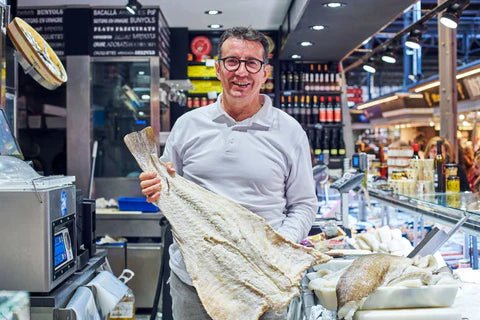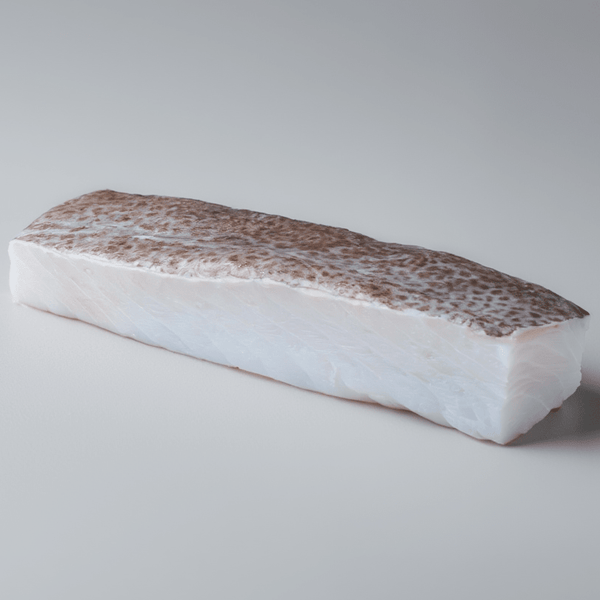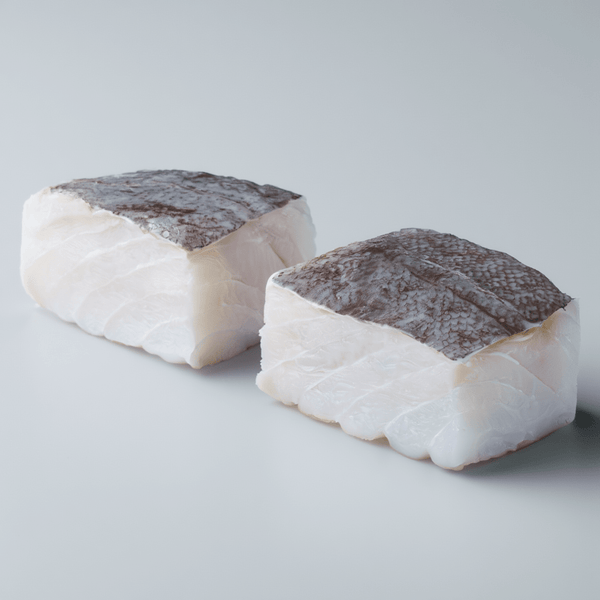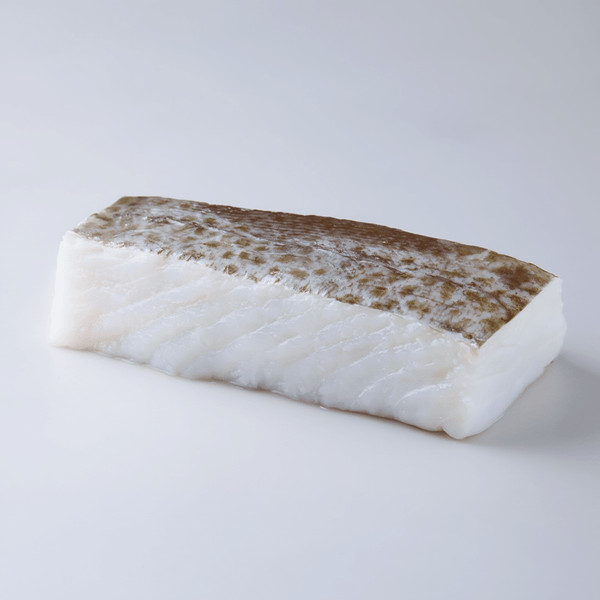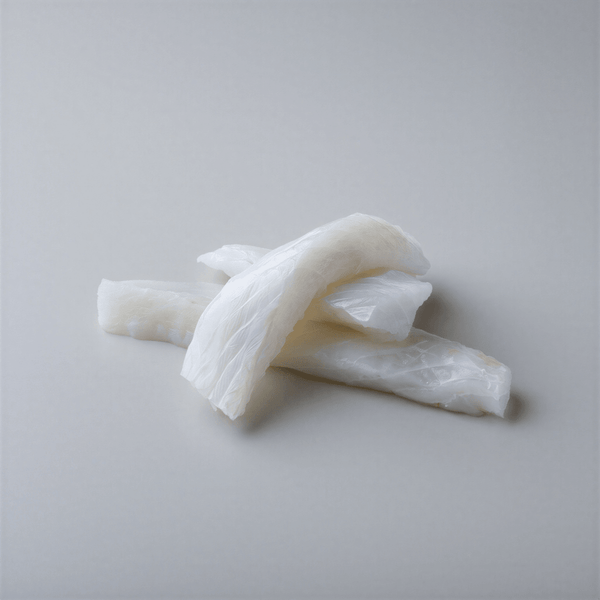
Faroese cod (Gadus morhua, FAO stock 27.Vb) is the fourth largest Atlantic cod fishery after Norway-Barents, Iceland, and the North Sea. Annual catch ~30,000 tonnes, predominantly artisanal fishing, intermediate quality. It has been categorized at safe biological levels since 2018 after a notable recovery. In Spain, it is minor but present in some professional markets — milder flavor than Norwegian, slightly less firm than Icelandic.
Faroese Cod: where and how much
The Faroe Islands are an autonomous archipelago within the Kingdom of Denmark in the North Atlantic, located between Scotland and Iceland (62°N, 7°W). They comprise 18 islands with a population of 54,000, and their capital is Tórshavn. They are not part of the EU, although Denmark is.
Cod fishing data (Gadus morhua, FAO area 27.Vb):
| Indicator | 2025 Value | Notes |
|---|---|---|
| Annual catch | ~30,000 t | Stable for the last 5 years |
| National quota 2026 | 32,000 t | Decided by Faroese government |
| Spawning stock biomass | ~92,000 t | Within safe biological limits |
| Active fleet | ~280 vessels | Mostly artisanal |
| Main export markets | United Kingdom, Denmark, Germany | Little to Spain |
Actual quality compared to Iceland and Norway
The organoleptic quality of Faroese cod is comparable to that of average quality Icelandic and Norwegian cod. The waters are similar (5–8 °C, continental shelf), fishing is mostly artisanal (longline, handline), and management is institutionally advanced.
Characteristics of Faroese fish meat:
- Color: white, similar to Icelandic.
- Texture: intermediate between Icelandic (flakier) and Norwegian (firmer).
- Fat: 0.9–1.3 g/100 g.
- Flavor: mild, clean marine profile.
📌 Honest note: The fact that Faroese cod is rarely seen in Spain is due to volume (30,000 t is small for large international markets) and trade routes, not quality. Most of it is exported to the UK, Denmark, Germany, and Japan before reaching southern European markets.
The 4 main origins: table
| Origin | FAO Area | Catch/year (t) | Certification | Distribution in Spain |
|---|---|---|---|---|
| Norway | 27.I + 27.IIa | ~340,000 | MSC + Skrei quality mark | Dominates northern Spain and Europe |
| Iceland | 27.Va | ~210,000 | MSC + ITQ + IRF | Dominates southern Europe, Catalonia |
| Faroe | 27.Vb | ~30,000 | Partial MSC | Minority in Spain |
| Greenland | 27.XIV | <20,000 | In recovery | Almost non-existent in Spain |
Greenlandic Cod: in recovery
The Greenlandic cod stock collapsed in the 1990s due to historical overfishing combined with climate changes in Arctic currents. Current catch: less than 20,000 t/year. It has been in gradual recovery since 2015 but is still well below historical levels.
The organoleptic quality is comparable to Icelandic cod, but the available volume is very limited, and almost all of it is consumed in Greenland and Denmark. In Spain, it is residual.
North Sea: European stock
An independent stock (FAO area 27.IV) shared between the United Kingdom, Norway, Denmark, the Netherlands, and Belgium. It collapsed in the 1990s and is undergoing gradual recovery managed by the International Council for the Exploration of the Sea (ICES).
- 2026 catch: ~35,000 t.
- Flesh softer than Arctic or Icelandic cod.
- Organoleptic quality considered inferior due to less time in cold waters.
- Almost never reaches Spain as salted cod.

Pacific Cod: another species (Gadus macrocephalus)
“Pacific cod” is a distinct species: Gadus macrocephalus. It is caught in Alaska, the American northwest coast, Russia, and Japan. Annual global catch: ~280,000 t.
Characteristics different from Atlantic Gadus morhua:
- More fibrous flesh, milder flavor.
- Softer texture when cooked.
- Lower fat concentration.
- Mostly sold as processed products (IQF fillets, surimi).
- Shorter life cycle: sexual maturity at 3–4 years (vs 5–7 in Atlantic).
- Slightly less white flesh color after desalting.
There is also polar cod (Boreogadus saida), a different species from the above, caught in the Arctic and mainly commercialized in Russia, Norway, and Japan as an industrial processed food. It does not reach the Spanish market as fresh product.
Honest ranking: our order of preference 2026
After 35 years working with all origins in the Mercat del Ninot, this is our honest ranking considering quality, sustainability, and real availability for the Spanish consumer:
| Pos. | Origin and cut | Reason |
|---|---|---|
| 1 | Iceland (extra cheek or throat) | Premium quality + Catalan tradition + ITQ |
| 2 | Coastal Norway (loin or cheek) | Basque tradition + firm texture + MSC |
| 3 | Skrei in season (Jan–Apr) | Only if you find it fresh and for short cooking |
| 4 | Faroe (when available) | Excellent alternative, difficult access |
| 5 | North Sea / Greenland | Acceptable but variable quality |

📌 Honest note: In Spain, legally, only Gadus morhua from the Atlantic can be called "cod" (EU Regulation 1379/2013). Gadus macrocephalus must be called "Pacific cod" or by its specific trade name. Beware of very low-priced products labeled only as "cod" without specifying origin.
How to choose based on use
| Use | Recommended origin | Why |
|---|---|---|
| Traditional Catalan cuisine | Iceland (1st option), Norway (2nd) | Tradition + texture |
| Traditional Basque cuisine | Norway (1st option), Iceland (2nd) | Tradition + firmness |
| HoReCa volume | Norway or Iceland | Availability and price |
| Maximum sustainability | Iceland (ITQ) or Faroe | Best per capita management |
| Reasonable minimum price | Faroe or coastal Norway | Same quality, lower cost |
| Skrei in season (Jan–Apr) | Skrei PDO | Unique time of year |

Related articles
- Norway vs. Iceland Cod — an honest comparison
- Types of cod: Gadus morhua, Skrei, Iceland, and Faroe
- View the entire Bacalalo cod collection
- Desalted cod ready to cook
- Traditional dry salted cod
Frequently asked questions
Where are the Faroe Islands?
An autonomous archipelago within the Kingdom of Denmark in the North Atlantic, between Scotland and Iceland (62°N, 7°W). It consists of 18 islands, with a population of 54,000, and its capital is Tórshavn. It is not part of the EU, although Denmark is.
Is Faroese cod good quality?
Yes, very acceptable quality. The fishery is small but technically comparable to Iceland's: cold waters (5–8 °C), predominantly artisanal fishing, strict regulation. The difference with Iceland/Norway is in volume and institutional traceability, not organoleptic quality.
Why is Faroese cod rarely seen in Spain?
Due to its small volume (30,000 t/year compared to 210,000 t from Iceland) and exports primarily directed to the United Kingdom, Denmark, and Germany. What reaches Spain is residual and usually via professional B2B routes, not final consumption.
Is Faroese cod MSC certified?
Partially. The longline and line fishery has been MSC certified since 2018. The trawl fishery is not MSC certified but does comply with the Faroese Fisheries Inspection Authority. Most exportable cod is certified longline.
What is the difference with Greenlandic cod?
Greenlandic cod (FAO 27.XIV): a distinct stock, recovering after collapse in the 90s. Current catch <20,000 t/year. Meat similar to Faroese but more variable. Today it is a minority, rarely reaching the European consumer market.
What is the origin of cod in the North Sea?
Independent stock (FAO 27.IV) shared between the United Kingdom, Norway, Denmark, the Netherlands. Collapsed in the 90s, gradually recovering. Catch 2026: ~35,000 t. Softer meat, inferior quality to Arctic cod. Rarely reaches Spain as salted cod.
Is there Pacific cod?
Yes, another species: Gadus macrocephalus (Pacific cod), caught in Alaska and Japan. Meat is more fibrous and softer than Atlantic cod. It is NOT the same cod traditionally sold in Spain. In Spain, legally, only Atlantic Gadus morhua can be called "cod" (bacalao).
What is the best origin for buying cod?
Honestly, there is no universal "best." For quality-price in salted cod: Norway and Iceland are on the same level. For freshness (Skrei in season): Norway-Lofoten. For Catalan tradition: Iceland. For professional volume: Norway. For artisan niche: Faroe.