


![Anchoas en Mercadona: Precio, Marcas y Alternativas Artesanales [2026] - Bacalalo](http://bacalalo.com/cdn/shop/articles/anchoas-en-mercadona-precio-marcas-y-alternativas-artesanales-2026-3018911.jpg?v=1772955415&width=480)
Summary: Mercadona offers canned anchovies at competitive prices under its Hacendado brand and other private labels. Specialty stores work with artisanal Cantabrian anchovies, featuring larger fillets and longer curing times. We objectively analyze both options to help you choose the one that best suits your needs.
What anchovies Mercadona offers
Mercadona includes several canned anchovy products in its catalog, both under its Hacendado brand and from selected suppliers. The anchovy offering is one of the supermarket's most popular canned goods sections:
Hacendado Anchovies
Mercadona's own brand offers anchovies in olive oil in different formats:
- Anchovies in olive oil (standard can): anchovy fillets in olive oil. Net weight format of 50-80 g. Approximate price between 2 and 4 euros depending on the format.
- Hacendado Cantabrian Anchovies: a product line with Cantabrian origin indicated, generally at a higher price than standard anchovies, between 4 and 7 euros.
- "Banderillas" and prepared dishes: anchovies in "banderilla" format or combined with other ingredients (olives, pickles).
Supplier brands at Mercadona
Historically, Mercadona has worked with suppliers such as Conservas Codesa or Conservas Gomes da Costa for its anchovies. Suppliers may change depending on commercial agreements. Some stores also offer specific products from recognized Cantabrian brands.
Available formats
- 50 g cans (drained net weight: ~30 g)
- 80-100 g cans or tubs
- Larger "economy" can format
- Anchovies rolled with capers (in some products)
Exact availability varies by store and season. Mercadona updates its catalog regularly, removing and adding products according to its inter-supplier strategy.
What artisanal Cantabrian anchovies are
Artisanal Cantabrian anchovies represent a centuries-old canning tradition, concentrated mainly in the towns of Santoña, Laredo, and Castro Urdiales in Cantabria, as well as in Basque Country towns like Bermeo and Getaria.
Raw material: Cantabrian anchovy (boquerón)
Artisanal anchovies are made from anchovies (Engraulis encrasicolus) caught in the Cantabrian Sea during the spring fishing season (April-June). The fishing season determines the quality:
- Spring anchovies have a higher fat content
- Fish size influences the final fillet size
- Only the largest anchovies are selected for premium anchovies
Artisanal process
The production process for artisanal anchovies is significantly longer and more labor-intensive:
- Selection: the largest and freshest anchovies are chosen
- Salting: they are placed in barrels with layers of salt for a minimum of 6-12 months
- Curing: during this period, natural enzymes transform the fish protein, developing the characteristic flavor
- "Sobado" (cleaning): bones and skin are removed manually, fillet by fillet
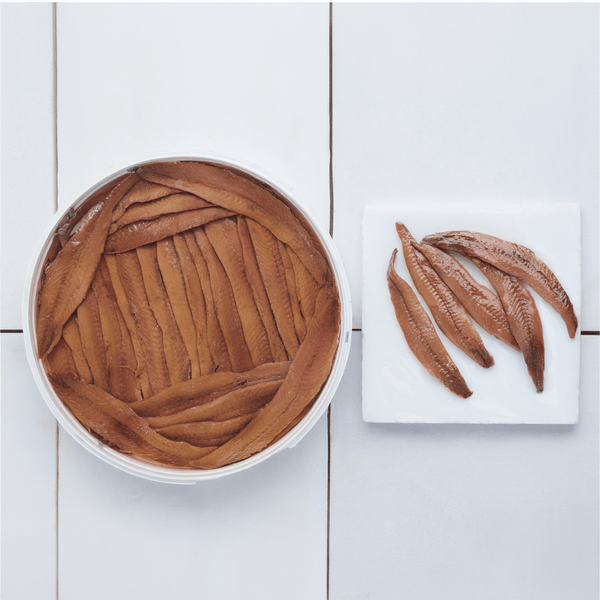
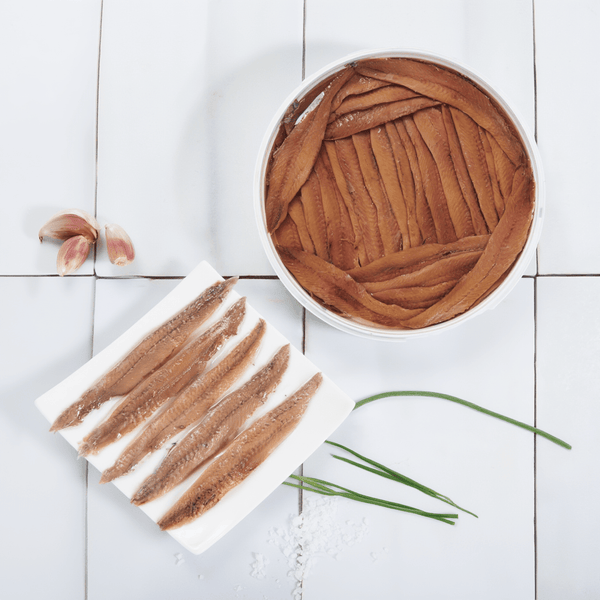
- Packaging: the fillets are placed in olive oil, aligned by hand
Classification by size
Artisanal anchovies are classified by the number of fillets per can:
- 00 (doble cero): extra large fillets, the most prized. Less than 10 fillets per 50 g can.
- 0 (cero): large fillets, highly valued.
- 1 and 2: standard and small size fillets.
The larger the fillet, the rarer and more expensive it is, as it comes from larger anchovies.
Objective comparative table
| Criterion | Mercadona (Hacendado) | Specialty Artisanal |
|---|---|---|
| Usual Origin | Variable (Cantabrian, Argentina, Morocco) | Cantabrian Sea (spring fishing season) |
| Curing Time | 3-6 months (generally) | 6-18 months |
| Fillet Size | Small to medium | Medium to extra large (00) |
| "Sobado" (Cleaning) | Semi-automatic | Manual, fillet by fillet |
| Price per can (50g net) | 2-7 € | 8-20 € |
| Oil | Olive oil | Extra virgin olive oil (generally) |
| Variety of Formats | 2-4 products | Multiple (00, 0, 1, pandereta, menu format) |
| Availability | +1,700 stores | Gourmet stores + online shipping |
| Texture | Firm, saltier | Buttery, melts in the mouth |
Note: prices are indicative based on public information and may vary by season and establishment.
The production process: industrial vs. artisanal
The fundamental difference between industrial and artisanal anchovies lies in time and human intervention:
Industrial production
Large canneries that supply supermarkets optimize the process to reduce costs and increase production:
- Anchovies can come from different fishing areas (not just the Cantabrian Sea)
- The curing time is shorter (3-6 months) to speed up production
- Part of the cleaning and filleting process is semi-automatic
- Fillets are sorted by size, but volume is prioritized
- The oil is usually olive oil (not necessarily extra virgin)
This does not mean the product is bad. It is an efficient process that allows anchovies to be offered at an accessible price for the average consumer.
Artisanal production
Artisanal canneries in the Cantabrian Sea follow a process that has barely changed in a century:
- Anchovies are bought at the fish market during the spring fishing season
- Salt curing lasts between 6 and 18 months (some premium canneries reach 24 months)
- Each fillet is peeled, deboned, and cleaned by hand by "sobadoras" (specialized female workers)
- Fillets are placed in the can one by one, aligned
- They are covered with first-press extra virgin olive oil
This artisanal process explains the price difference: specialized labor, curing time, and raw material selection represent costs that do not exist in industrial production.
How to understand anchovy prices
Anchovy prices can seem confusing if you don't consider what you're comparing:
Net weight vs. drained weight
An "80 g" can of anchovies does not contain 80 g of anchovy. The net weight includes the oil. The drained weight (the actual amount of anchovy) is usually 50-60% of the net weight. So:
- An 80 g net can contains approximately 40-48 g of anchovy
- A 50 g net can contains approximately 25-30 g of anchovy
Price per kilo of real anchovy
If we calculate the price per kilo of anchovy (drained weight):
- Mercadona (basic range): approximately 60-100 €/kg of anchovy
- Mercadona (Cantabrian range): approximately 100-160 €/kg of anchovy
- Specialty artisanal: approximately 180-400 €/kg of anchovy
Anchovies are, by themselves, an expensive product per kilo, even the cheapest ones. The difference between a supermarket anchovy and an artisanal one can be 2x to 4x, which is significant.
Number of fillets per can
Another useful way to compare is the price per fillet:
- Mercadona: 0.15-0.30 € per fillet approximately
- Artisanal 00: 0.60-1.50 € per fillet approximately
Artisanal 00 fillets are considerably larger, so a single fillet can cover an entire slice of bread, while with standard fillets you would need 2-3.
When to buy anchovies at Mercadona
Mercadona anchovies are a perfectly valid choice in many contexts:
- Cooking with anchovies: for pizzas, salads, sauces, or dishes where the anchovy is integrated with other ingredients, supermarket anchovies work well.
- Frequent consumption: if you like anchovies and eat them regularly, the supermarket price allows for more regular consumption.
- Limited budget: artisanal anchovies are a gourmet luxury product. Supermarket ones allow you to enjoy anchovies without a high expenditure.
- Informal appetizers: for a casual snack, Mercadona anchovies with bread and oil are a great option.
- To try if you like them: if you've never eaten anchovies, starting with supermarket ones makes sense before investing in artisanal ones.
When to choose artisanal anchovies
Artisanal Cantabrian anchovies stand out especially in:
- Gourmet tapas: served alone on a slice of bread with good olive oil, where flavor and texture are the protagonists.
- Gourmet gifts: a can of 00 Cantabrian anchovies is a highly appreciated gift by food lovers.
- Special occasions: an important dinner, a celebration, or a gastronomic experience deserve ingredients of the highest quality.
- Wine pairings: artisanal anchovies pair exceptionally well with white wines (Albariño, Txakolí) or champagne.
- Gin and tonics and vermouths: as an accompanying tapa for a post-meal drink or premium appetizer.
How to identify anchovy quality
Regardless of where you buy, these indicators will help you assess quality:
Quality indicators
- Color: uniform pinkish-brown, with no dark or reddish areas
- Texture: firm fillets that melt smoothly when chewed ("buttery" texture)
- Integrity: whole fillets, without breaks or fraying
- Aroma: clean sea and cured scent, without ammoniacal or rancid notes
- Oil: clear, without excessive turbidity or bone fragments
Lower quality indicators
- Broken or frayed fillets
- Very dark or grayish color
- Excess salt (flavor that masks the fish)
- Pasty or excessively soft texture
- Cloudy oil or with a bad smell
Related Bacalalo Products

The premium alternative to Mercadona anchovies
Frequently asked questions
Are Mercadona anchovies good?
Mercadona anchovies offer a good quality-price ratio for their segment. They are suitable for cooking and informal appetizers. If you are looking for the complete experience of an artisanal Cantabrian anchovy (buttery texture, long curing, large fillet), specialty stores offer a different product.
How much do anchovies cost at Mercadona?
Anchovies at Mercadona range between 2 and 7 euros depending on the product and format. Basic Hacendado anchovies are around 2-4 euros, while products with a Cantabrian origin indication can reach 5-7 euros. Prices are subject to seasonal variations.
Why are artisan anchovies so expensive?
The price of artisan anchovies reflects several factors: selected raw material (only large anchovies from the spring fishing season), curing for 6-18 months (vs 3-6 months for industrial), manual cleaning and filleting fillet by fillet, and limited production. Each tin of 00 anchovies requires anchovies that represent less than 5% of the total catch.
What does 00 or double zero anchovy mean?
The 00 (double zero) classification indicates the largest fillet size. It is the most premium and scarce grade, as it comes from the largest anchovies of the fishing season. A 00 fillet can measure 8-10 cm and cover an entire slice of bread. The numbering goes from 00 (highest quality/size) to 2 (smaller size).
What is the best brand of anchovies at Mercadona?
Mercadona works with a system of inter-suppliers, so brands may vary. Generally, anchovies with the "Cantabrian" origin indication tend to be of higher quality than generic anchovies. Always check the labeling to verify the origin and species (Engraulis encrasicolus is the species of the true anchovy).
How to store anchovies once opened?
Once opened, anchovies should be consumed within 2-3 days. Transfer them to an airtight container (do not leave in the opened tin), cover them completely with olive oil, and store them in the refrigerator. If the fillets are exposed to air, they oxidize and quickly lose quality.
Conclusion: different anchovies for different occasions
Anchovies are one of those products where the difference between the supermarket version and the artisanal one is most noticeable, even for non-expert palates. However, this does not invalidate either option:
Mercadona democratizes access to anchovies. Their prices allow anyone to enjoy this product regularly, whether in a Caesar salad, a pizza, or a simple appetizer. Their network of stores guarantees immediate availability, and the quality is good for its price range.
Artisan Cantabrian anchovies are a different product in terms of gastronomic experience. The long curing process, manual filleting, and raw material selection create fillets with a buttery texture and a complex flavor that make them a true delicacy. They are ideal for enjoying on their own, with good bread and oil, in moments where you want to elevate the experience.
Many food enthusiasts keep both options in their pantry: supermarket anchovies for cooking and daily use, and a tin of artisan anchovies for special occasions. This combination allows enjoying the product in all its dimensions without budget being an obstacle.
Informative comparison based on public data. Prices and availability may vary.



![Bacalao en BonPreu: Precios, Calidad y Alternativas Especializadas [2026] - Bacalalo](http://bacalalo.com/cdn/shop/articles/bacalao-en-bonpreu-precios-calidad-y-alternativas-especializadas-2026-2437338.jpg?v=1772955422&width=480)
