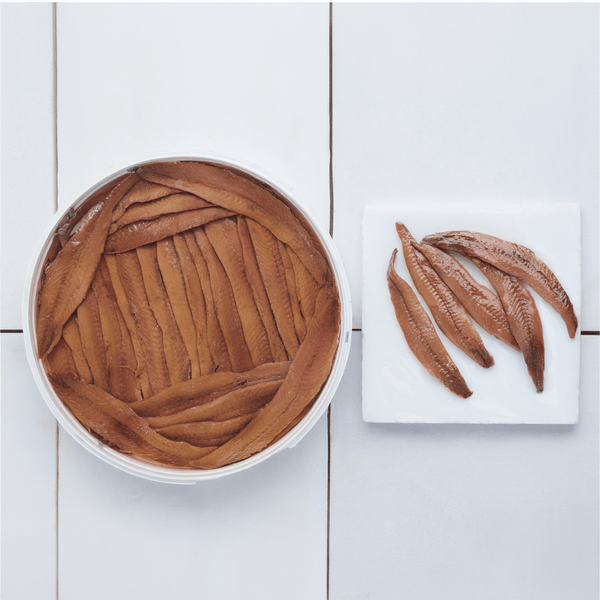
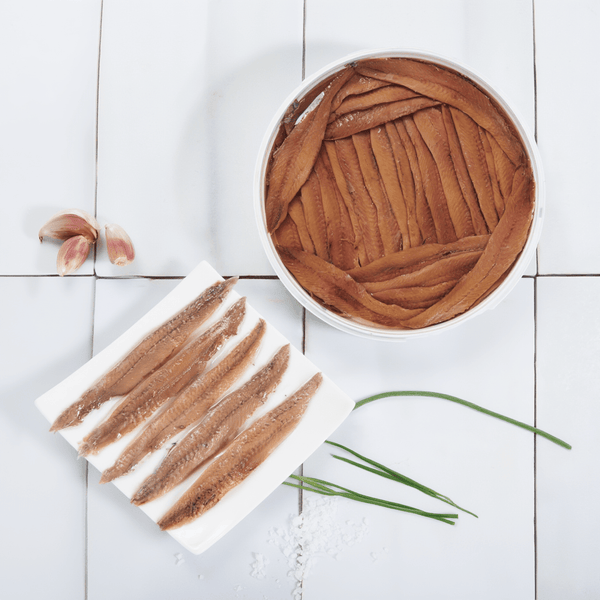
Cantabrian anchovies are one of the most revered ingredients among Michelin-starred chefs in Spain. Far from being a mere canned appetizer, anchovies have become a high-end culinary resource: as an umami enhancer, as the star of deconstructed pintxos, as the base for butters and sauces found in the country's most exclusive tasting menus. In this article, we explore how great chefs use anchovies and present 4 anchovy recipes inspired by Michelin-starred restaurants, with techniques and plating you can replicate at home. Marc González Sáez, from Mercat del Ninot in Barcelona, analyzes this ingredient with the perspective of over 30 years working with the best seafood products.
Contents
- Anchovies in haute cuisine: from appetizer to star ingredient
- Anchovy as an umami booster
- Recipe 1: Anchovy butter with toasted brioche
- Recipe 2: Tomato and strawberry tartare with Cantabrian anchovy
- Recipe 3: Umami anchovy sauce for meats and fish
- Recipe 4: Deconstructed anchovy, gilda, and pickled vegetable pintxo
- How to choose anchovies for haute cuisine
- Frequently asked questions
Anchovies in haute cuisine: from appetizer to star ingredient
For decades, anchovies were relegated to a supporting role: on toast, in a Caesar salad, as a bar tapa. Michelin-starred restaurants have completely changed that perception. Chefs like Andoni Luis Aduriz (Mugaritz, 2 stars), Eneko Atxa (Azurmendi, 3 stars), and Ángel León (Aponiente, 3 stars) have integrated anchovies into their tasting menus as an ingredient in their own right.
Why? Because Cantabrian anchovies — the authentic kind, cured in salt for 10-12 months, hand-filleted, preserved in extra virgin olive oil — are a product with a complexity of flavor that few ingredients can match. Each fillet contains: salt, umami, fat, gentle acidity, metallic notes (in a good way), and a buttery texture that melts in the mouth. It is, in essence, a perfect condiment that also works as a main character.
In haute cuisine, anchovies fulfill three fundamental functions:
- Protagonist: as the crown jewel of signature pintxos and toasts, where the anchovy is the centerpiece of the dish.
- Enhancer: incorporated into butters, sauces, and vinaigrettes that intensify the flavor of other dishes without the anchovy being identified as such.
- Contrast: its saltiness and umami used as a counterpoint to sweet, sour, or bitter flavors in complex compositions.

Anchovy as an umami booster
Umami — the fifth taste, discovered by Japanese chemist Kikunae Ikeda in 1908 — is present in foods rich in glutamic acid: Parmesan cheese, ripe tomatoes, shiitake mushrooms, kombu seaweed... and anchovies. Cantabrian anchovy is one of the most concentrated sources of umami in Western cuisine. Its curing process (12 months in salt) breaks down fish proteins into free amino acids, including glutamate, creating a natural umami bomb.
Michelin-starred chefs exploit this quality invisibly: one or two anchovies dissolved in a meat sauce, in a cooking stock, in a vinaigrette, or in a compound butter, amplify the flavor of the entire dish without the diner identifying an "anchovy flavor." It's the same principle as fish sauce (nam pla) in Thai cuisine or garum in ancient Roman cuisine.
Ángel León explained it this way: "Anchovy is our garum. It's the flavor enhancer that the Romans invented 2,000 years ago and that we have perfected in Cantabria."
Anchovies worthy of a Michelin star. Not all Cantabrian anchovies are created equal. Those that reach starred restaurants are extra-large: large fillets (8-10 cm), long curing (12+ months), buttery texture without stringiness, first-press extra virgin olive oil. At Bacalalo, we select anchovies from artisan canneries in Cantabria that meet these standards. It's the same quality that chefs use, available for your kitchen. See our Cantabrian anchovies →
Recipe 1: Anchovy butter with toasted brioche
Compound anchovy butter is an omnipresent resource in Michelin-starred restaurant kitchens. It is, arguably, the most elegant and versatile way to use anchovies. Spread on hot toasted brioche, the butter melts and creates an addictive bite that has served as a welcome appetizer in restaurants like Mugaritz and Celler de Can Roca.
Ingredients
- 250 g high-quality unsalted butter, at room temperature
- 10 Cantabrian anchovy fillets, well-drained of oil
- Finely grated zest of 1 lemon
- 1 tablespoon finely chopped fresh parsley
- ½ teaspoon freshly ground black pepper
- 1 pinch of pimentón de la Vera (optional, for color and aroma)
- Quality brioche bread, cut into 1.5 cm slices
Preparation
- Anchovy paste: chop the anchovies as finely as possible with a sharp knife until almost a purée. Some chefs pound them in a mortar to get a completely smooth paste. The texture is up to you: more rustic (chopped with a knife) or more refined (in a mortar).
- Mix: in a large bowl, work the soft butter with a fork. Incorporate the anchovy paste, lemon zest, parsley, pepper, and pimentón. Mix until the color is uniform: a pale yellow with pinkish streaks from the anchovy.
- Shape: place the butter on a large piece of plastic wrap. Roll into a cylinder 3-4 cm in diameter, pressing firmly to remove air pockets. Twist the ends like a candy wrapper. Refrigerate for at least 3 hours until firm.
- Serve: toast the brioche slices in a pan with a little regular butter until golden. Cut 1 cm slices of the anchovy butter and place on the hot brioche. The butter should start to melt on contact.
Advanced uses: this butter is extraordinary on a freshly grilled entrecôte (the classic French steak-beurre d'anchois version), on grilled asparagus, on roasted potatoes, or even on corn on the cob. It keeps for 2 weeks in the refrigerator and 3 months in the freezer.

Recipe 2: Tomato and strawberry tartare with Cantabrian anchovy
This recipe is inspired by the compositions of Andoni Luis Aduriz, who has explored the combination of fruit, vegetables, and anchovy at Mugaritz. The idea is radical but works: the sweetness of the strawberry and the acidity of the tomato create a canvas where the saltiness of the anchovy explodes as a perfect contrast.
Ingredients (4 servings)
- 4 ripe seasonal tomatoes (such as Raf or ox heart), peeled and diced into 5mm pieces
- 8 ripe strawberries, diced into 5mm pieces
- 8 Cantabrian anchovy fillets
- 1 shallot, very finely chopped
- 2 tablespoons extra virgin olive oil
- 1 tablespoon aged Modena vinegar (not glaze, actual vinegar)
- Fresh basil leaves
- Freshly ground black pepper
- Flaky sea salt (Maldon)
Preparation
- Tartare: mix the diced tomato and strawberry with the shallot, olive oil, and Modena vinegar. Season with black pepper and, very carefully, with salt (the anchovies will add saltiness). Marinate for 10 minutes in the refrigerator.
- Plating: place a plating ring in the center of each plate. Fill with the tartare, pressing lightly. Remove the ring. Place 2 crossed anchovy fillets on top of each tartare. Decorate with basil leaves, a flake of Maldon salt on the anchovy, and a drizzle of olive oil.
The sweet-savory-sour contrast in a single bite is the signature of this dish. The strawberry provides sweetness and freshness, the tomato provides acidity and umami, and the anchovy provides salt and depth. It's an appetizer that radically awakens the appetite.
Recipe 3: Umami anchovy sauce for meats and fish
This sauce is the "secret weapon" of many Michelin-starred kitchens. It's invisible in the dish — no one identifies anchovy — but it intensifies the flavor of any protein spectacularly. It works on a sirloin steak, a hake loin, roasted vegetables, or even a homemade pizza.
Ingredients
- 12 Cantabrian anchovy fillets
- 100 ml extra virgin olive oil (the oil from the anchovy jar is perfect)
- 4 confit garlic cloves (cooked in oil over low heat for 15-20 minutes until soft)
- 2 tablespoons tomato paste
- 1 tablespoon soy sauce (tamari)
- 1 tablespoon honey
- 1 tablespoon Jerez vinegar
- ½ teaspoon black pepper
- 100 ml meat or fish stock (depending on use)
Preparation
- In a saucepan over low heat, warm the oil and add the crushed confit garlic. Cook for 2 minutes.
- Add the anchovies and stir with a wooden spoon. In 2-3 minutes the anchovies will completely dissolve in the oil, forming a paste.
- Incorporate the tomato paste, soy sauce, honey, vinegar, and pepper. Mix well and cook for 3 minutes.
- Add the stock and reduce over low heat for 8-10 minutes until the sauce has a light cream consistency — it should coat the back of a spoon.
- Blend with a hand blender until completely smooth. Strain through a fine-mesh sieve if you want a restaurant-style finish.
How to use: this sauce is used as a finishing sauce, not a cooking sauce. Drizzle 1-2 tablespoons over the plated dish, or paint the bottom of the plate with a pastry brush. It keeps for 2 weeks in the refrigerator in a glass jar covered with a layer of oil.
Recipe 4: Deconstructed anchovy, gilda, and pickled vegetable pintxo
Our selection of gildas — the Basque pintxo of olive, guindilla pepper, and anchovy — has been revisited by chefs like Eneko Atxa and Dani García in deconstructed versions that maintain the essence but change the form. This pintxo separates the elements of the classic gilda into individual components treated with haute cuisine techniques, and reassembles them on a plate where each bite is a surprise.
Ingredients (4 pintxos)
- 4 extra-large Cantabrian anchovy fillets
- 4 Ibarra guindilla peppers in vinegar
- 8 Manzanilla olives stuffed with anchovy
- 4 tablespoons green olive cream (see preparation)
- 4 very thin (crispy) crystal bread sheets
Green olive cream
- 100 g pitted Manzanilla green olives
- 1 tablespoon capers
- 50 ml olive oil
- 1 teaspoon lemon juice
Guindilla gel
- 100 ml vinegar from the Ibarra guindilla peppers
- 50 ml water
- 1.5 g agar-agar
- 1 teaspoon sugar
Preparation
- Olive cream: blend the olives, capers, oil, and lemon until you get a fine paste, but with some texture. Don't make it too smooth: the rustic texture adds interest. Set aside.
- Guindilla gel: mix the vinegar, water, and sugar in a saucepan. Heat until it boils. Add the agar-agar and cook for 2 minutes, stirring. Pour onto a flat tray (2-3 mm layer) and refrigerate for 45 minutes. Cut into 1 cm cubes or decorative shapes.
- Plating: place a spoonful of olive cream on one side of the plate (spread with the back of the spoon to form a streak). Place the crystal bread sheet on the cream. On the bread, place the rolled or flattened anchovy fillet. Distribute the guindilla gel cubes around it. Place the whole guindilla pepper as a decorative element. Finish with a drizzle of the anchovy oil and, if desired, a speck of Espelette pepper.
Each bite combines the three flavors of the gilda — olive, guindilla, anchovy — but in different textures: cream, gel, crunchy, buttery. It's a gilda that's eaten with a fork and knife instead of a toothpick.
How to choose anchovies for haute cuisine
Not all anchovies are suitable for restaurant cooking. Michelin-starred chefs look for anchovies that meet specific criteria:
- Size: large fillets (at least 8-10 cm). Small fillets fall apart and lose their presence on the plate.
- Curing: minimum 10-12 months in salt. Short curing produces flat-tasting anchovies; long curing develops complexity and deep umami.
- Texture: buttery, melting in the mouth without stringiness. A good anchovy crumbles gently when bitten, it's not chewy.
- Oil: extra virgin olive oil, not sunflower oil. The oil from the preserve is part of the flavor and is used as an ingredient (in sauces, vinaigrettes, butters).
- Color: dark pink to uniform light brown. Dark or gray spots indicate oxidation. A color that is too light may indicate insufficient curing.
Artisan cannery anchovies, not factory-made. The difference between an artisan anchovy and an industrial one is like the difference between acorn-fed Iberian ham and supermarket ham. Our Cantabrian anchovies come from artisan canneries that cure in wooden barrels for 12+ months, hand-fillet piece by piece, and preserve in extra virgin olive oil. This is the anchovy that Michelin-starred chefs use — and the one you deserve to have in your kitchen. See our premium anchovies →

Premium Seafood Products — Bacalalo
Since 1990, selecting the best from the sea at Mercat del Ninot, Barcelona. Refrigerated shipping 24-48h.
See Cantabrian Anchovies →🛒 Related products from Bacalalo
Cantabrian Anchovies "00" Gourmet Selection
Premium 00 size, artisan preparation
38,90€
View product →⭐ 4.9/5 · Cold shipping 24-48h · Since 1990 at Mercat del Ninot
Frequently asked questions
Why are anchovies so expensive?
Authentic Cantabrian anchovies require an artisanal process of 12-18 months: spring fishing, cleaning piece by piece, salting in barrels, maturation for months, hand filleting, and preservation in extra virgin olive oil. Each step is manual. From each kilo of fresh anchovy, barely 200-250g of finished fillets are obtained. This yield, combined with the manual labor, explains a price that reflects quality, not speculation.
Can anchovies be cooked or are they only eaten raw?
Anchovies can be integrated into cooking — in fact, the umami sauce in recipe 3 dissolves them in hot oil — but with nuances. When cooked, anchovies melt and their flavor transforms: they lose their buttery texture and become an invisible flavor enhancer. To enjoy their full texture and flavor, anchovies are served at room temperature, without cooking. Both uses are legitimate and complementary.
How many anchovies are in a serving as an appetizer?
As an appetizer or individual pintxo, 2-3 fillets per person. As an ingredient in a more complex recipe (those in this article), 2-3 fillets per dish are sufficient because they are accompanied by other components. For an anchovy board as a shared starter, estimate 4-6 fillets per person. A can of 10-12 fillets is enough for 4 people as an appetizer.
Do anchovies have a lot of salt?
Yes, anchovies are a naturally salty product (they are cured in salt for months). An anchovy fillet contains between 1.5 and 2g of salt. Therefore, when you use them in recipes, you should reduce or eliminate additional salt. The umami sauce in recipe 3, for example, has no added salt: the 12 anchovies provide all the necessary salinity. If you control your sodium intake, moderate the quantities but don't give up the product.
What is the difference between an anchoa and a boquerón?
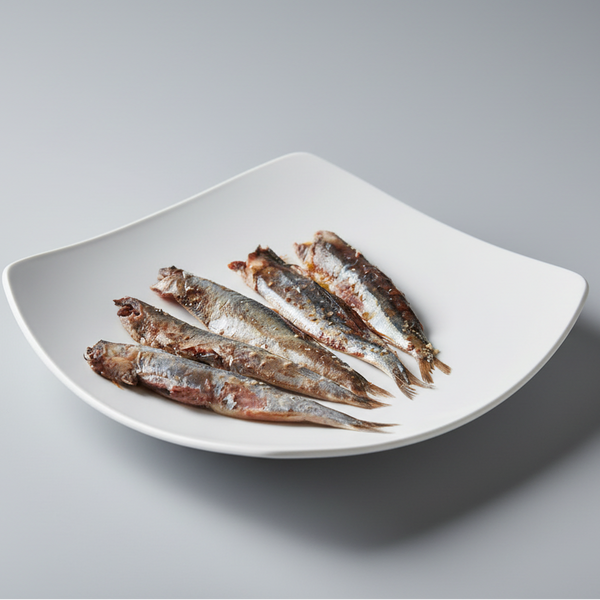
They are the same fish (Engraulis encrasicolus) but with different treatments. "Boquerón" refers to fresh fish or fish marinated in vinegar (boquerón en vinagre). "Anchoa" refers to the product cured in salt for months and preserved in oil. The difference in flavor is radical: boquerón is fresh, acidic, light; anchoa is deep, salty, umami, buttery. They are two completely different products that share the same origin.
How do I store anchovies once the can is opened?
Transfer any unused anchovies to a clean glass container and cover them completely with extra virgin olive oil (the oil from the can plus new oil if needed). Cover tightly and refrigerate. They will keep for 2-3 weeks in perfect condition. The key is that the fillets are always submerged in oil; those left exposed to air oxidize and darken quickly.
Can I substitute Cantabrian anchovies for others?
You can use anchovies from other regions (Sicily, Croatia, Portugal), but the result will not be identical. Cantabrian anchovies are distinguished by their particularly buttery texture (due to the climate and cold waters) and a more subtle and less aggressive flavor than Mediterranean ones. For the recipes in this article, where anchovies play a starring role, the Cantabrian quality makes a real difference.
Anchovies in haute cuisine are not a fad: they are a belated recognition of a product that has always been extraordinary. Michelin-starred chefs have simply highlighted what Cantabrian fishermen and salters have known for centuries: that an anchovy fillet cured with time and skill is one of the most perfect ingredients that exist. These four recipes — butter, tartare, umami sauce, and deconstructed pintxo — are four ways to explore anchovies beyond just an open jar on the table. Because anchovies deserve much more than being an appetizer: they deserve to be treated as what they are, a luxury artisanal product.