Summary
This is the question we are most often asked at Bacalalo when customers approach the counter at Mercat del Ninot with curiosity, but also with a certain apprehension. In this guide: The taste of caviar: an honest, no-nonsense description, How the taste varies depending on the type of caviar, The texture: what nobody tells you.
What Does Caviar Taste Like? Flavor and First Experience
This is the question we are most often asked at Bacalalo when customers approach the counter at Mercat del Ninot with curiosity, but also with a certain apprehension. Caviar has a reputation for being complicated, an acquired taste, difficult to understand. The reality is simpler and more fascinating: caviar tastes like something you haven't eaten before, and that first experience, well-managed, often turns skeptics into connoisseurs. This guide accurately describes what caviar tastes like depending on the variety, what texture to expect, and how to organize your first tasting to get the most out of it.
The taste of caviar: an honest, no-nonsense description
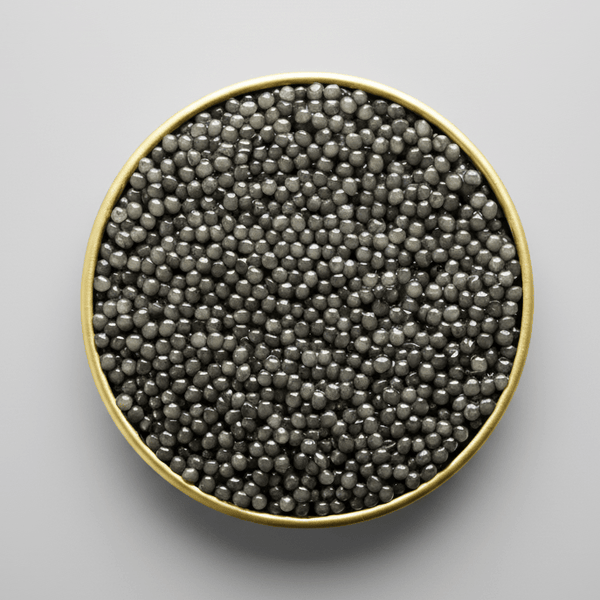
Trying to describe what caviar tastes like in a single sentence is almost impossible, but if I had to choose one, it would be: sea, toasted butter and nuts, with a long, subtly salty finish.
The flavor profile of authentic sturgeon caviar consists of several layers:
- First impact (0-5 seconds): A soft salty and marine burst. It's not the aggressive sea flavor you find in an anchovy or seawater, but something more elegant and controlled. Many liken it to the ocean breeze on a cool morning.
- Central development (5-15 seconds): Notes of butter, toasted nuts (hazelnut, walnut) emerge, and a creaminess that coats the palate. Beluga and Osetra caviars are particularly pronounced at this point.
- Finish (15-30 seconds): A long aftertaste, slightly salty and with notes reminiscent of seaweed. In the best caviars, this finish can last up to a minute.
What caviar does not have is a strong fishy taste. That's the most common misunderstanding. People who expect something intensely fishy are surprised by the product's delicacy and complexity. If the caviar you tasted was too fishy, it was probably of poor quality or not at its best.
How the taste varies depending on the type of caviar
Not all caviar tastes the same. There are substantial differences depending on the sturgeon species, the origin of the water, and the production process. The three main types of caviar and their flavor profiles:
Beluga Caviar (Huso huso)
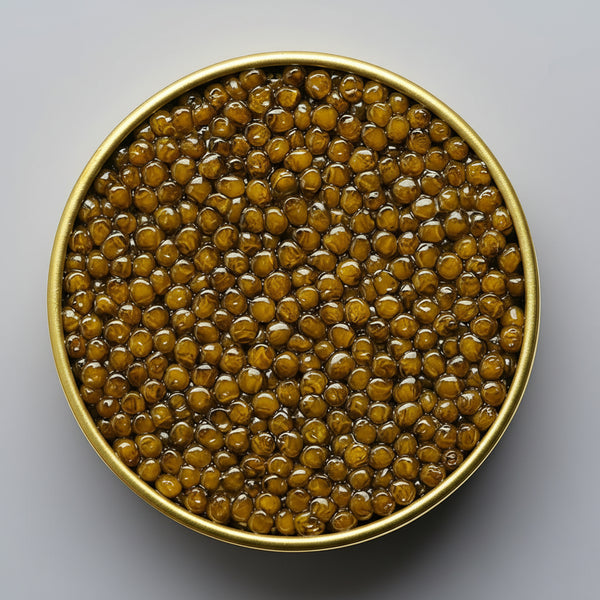
The most prized and rarest. The roe are large, between 3 and 4 mm, pearly gray to dark black in color. The taste is extraordinarily smooth, with a creaminess comparable to fresh cream and very defined hazelnut notes. There is almost no trace of salt. It is the caviar with the least flavorful intensity, which paradoxically makes it the most sophisticated. Price: €2,000-€5,000/kg depending on origin and quality. Import to Europe is highly regulated.
Osetra Caviar (Acipenser gueldenstaedtii)
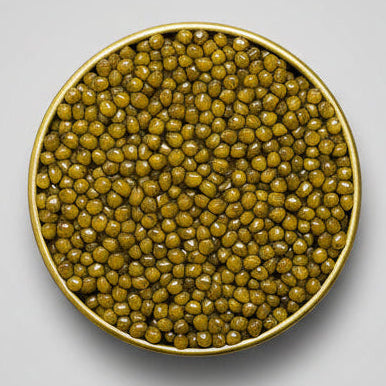
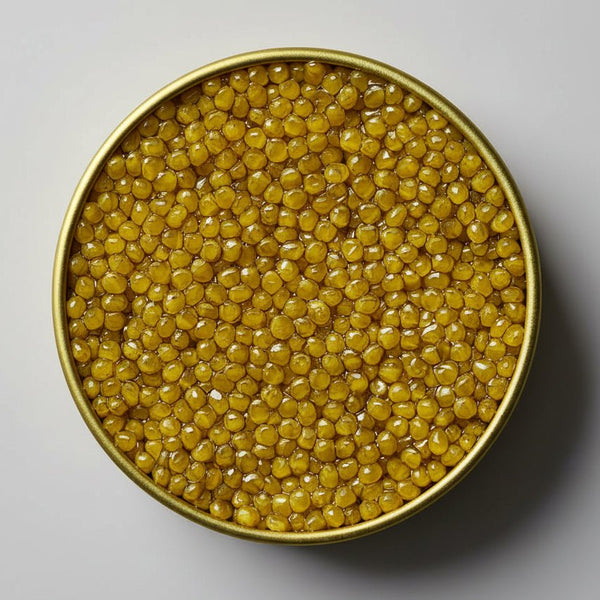
A favorite of many experts. Medium roe, 2.5-3 mm, color ranging from golden to dark brown. The taste is more complex than Beluga: notes of walnut, toasted butter, and a more present but well-integrated saltiness. Golden Osetra, from Iranian or Riofrío (Spain) farms, has a sweeter and creamier taste. Price: €500-€1,500/kg.
Sevruga Caviar (Acipenser stellatus)
The most intense of the three. Small roe, 1.5-2 mm, dark gray to almost black in color. The taste is more marine and pronounced, with a more evident saltiness and smoky notes. It is the closest to the popular idea of "caviar taste." Many connoisseurs consider it the best for pairing with champagne because it holds up better to acidity. Price: €300-€800/kg.
The texture: what nobody tells you
Taste is only half the experience. The texture of quality caviar is equally important and is what makes it unique. The roe should:
- Pop gently on the tongue. You don't chew them; they are pressed against the palate and explode, releasing all the internal liquid at once. That moment is the core of the experience.
- Be firm but not hard. Soft roe that breaks apart before reaching the mouth indicates poor storage. Excessively hard roe indicates that the caviar is past its prime or was of low quality.
- Not stick together. Good caviar roe should separate easily, without forming clumps. If the caviar is clumped together, it is a sign that it has been poorly handled or has undergone temperature changes.
The sensation that remains after tasting good caviar is that of a smooth, salty film coating the inside of the mouth for several minutes. This is the sensation that connoisseurs become addicted to.
Bacalalo Products

Mújol Shikrán Selección - Premium Roe with Smoked Herring...
6.95 €

Assortment "The Great Beluga Gift"
227.91 €

Black Mújol Shikrán 550g - Smoked Herring and Roe...
27.95 €

Sevruga Caviar
100.00 €
Refrigerated shipping 24-48h to all of the Iberian Peninsula
How to taste caviar for the first time: the correct protocol
If you are trying caviar for the first time, how you do it matters as much as the quality of the product. Follow these steps to ensure the best possible experience.
Temperature matters
Caviar should be served between 0°C and 4°C. Cold, but not frozen. If you serve it too cold (straight from the freezer), the roe harden and lose their aroma. If you serve it at room temperature, the roe soften and the taste becomes more abrupt. Ideally: take it out of the refrigerator 5 minutes before serving.
Mother-of-pearl spoon, not metal
Metal instantly oxidizes caviar and adds a metallic taste that ruins the product. Always use mother-of-pearl, bone, or hard plastic spoons. If you don't have any, the back of your hand is the classic alternative: place a small amount between your thumb and forefinger and lick it slowly.
The amount for the first time
For a first tasting, 5-10 grams is enough to understand the product. You don't need more. The minimum amount for an "enjoyment" portion is 20-30 grams per person. More than 50 grams is already a generous serving that only makes sense in very special contexts.
No accompaniments on the first try
Taste the caviar alone, without anything else. This is the only way to understand its true flavor. Afterwards, you can explore accompaniments: warm blinis with crème fraîche, unleavened bread toast, or grated hard-boiled egg. What never to do: raw onion, capers, lemon directly on the caviar, or very strong flavors that completely mask the delicate notes of the product.
What if you don't like caviar the first time?
It's perfectly normal. What caviar tastes like is something the brain takes time to process if it's not used to it. The flavor profile is unusual: it's not sweet, not sour, not bitter in the conventional sense. It's pure umami with marine notes, and these types of flavors require several exposures to be fully appreciated.
If your first experience with caviar was disappointing, consider these possibilities before definitively ruling it out:
- The caviar you tasted was of low quality or improperly stored.
- The serving temperature was incorrect (too cold or too warm).
- You tried it with accompaniments that masked its flavor.
- You simply need more exposure to get used to the profile.
Many of the best caviar connoisseurs tried it and didn't like it the first time. The second or third try, with better product and without prejudice, completely changed their perception.
Alternatives to start without spending a fortune
If you want to explore the world of caviar without the expense of an Osetra or Beluga, there are intermediate options that teach the concept at a much more accessible price:
- Trout caviar: Orange roe, fresh and marine flavor, milder. Price: €20-€40/100g. A good gateway.
- Grey mullet roe (bottarga): Mediterranean caviar. More intense and salty flavor, with smoky notes. Widely used in Italian cuisine.
- Lumpfish caviar: The classic substitute. Cheap (€2-€5/can) but without the texture or complexity of real caviar. It serves to understand the concept, not the product.
- Spanish caviar from Riofrío or Nacarii: Sturgeon caviar farmed in Spain at more competitive prices than Iranian brands. Excellent value for money to get started with real caviar.
Bacalalo Products
Mújol Shikrán Selección - Premium Roe with Smoked Herring...
6.95 €
Assortment "The Great Beluga Gift"
227.91 €
Black Mújol Shikrán 550g - Smoked Herring and Roe...
27.95 €
Sevruga Caviar
100.00 €
Refrigerated shipping 24-48h to all of the Iberian Peninsula
🛒 Products mentioned in this article
⭐ 4.9/5 · Cold shipping 24-48h · Since 1990 in Mercat del Ninot
Frequently asked questions
What does caviar actually taste like?
Caviar tastes like the sea in its first note, followed by toasted butter, nuts (mainly hazelnut and walnut), and an elegant, lingering saltiness. The finish is long, with notes of seaweed. What it doesn't have is a strong or aggressive fishy taste: if caviar tastes like that, it's probably of poor quality or spoiled.
Why is caviar so expensive?
The price of caviar comes from the biology of sturgeon: these fish take between 8 and 25 years to reach reproductive maturity and produce roe. Extraction is manual and delicate. In addition, wild sturgeon is protected by CITES conventions, so most commercial caviar comes from aquaculture farms with very high production costs. Wild Beluga can cost over €10,000/kg at origin.
Can caviar be swallowed without chewing?
Caviar is not chewed: it is gently pressed against the palate with the tongue and the roe is allowed to burst on its own. Swallowing them whole without bursting them is to waste the experience, because the flavor is in the liquid inside each egg. Nor are they chewed in the conventional sense: the flesh of the roe is fine and does not need that treatment.
How much caviar should be eaten to appreciate the flavor?
For a first experience, 5-10 grams are enough. To enjoy it as an appetizer, 20-30 grams per person is the standard amount. Consuming more than 50 grams at once is something even big fans reserve for very special occasions, both because of the price and because the palate gets saturated.
Does caviar taste different depending on its origin?
Yes, notably. Iranian Caspian caviar is famous for being the most complex and nuanced. Russian is also excellent. French (Kaviari, Prunier) has a cleaner, less intense profile. Spanish Riofrío is softer and more vegetal. Chinese, which dominates the market by volume, can be good but very variable in quality. The water, the sturgeon's diet, and the processing method decisively influence the final taste.
Does black caviar taste different from red caviar?
They are completely different products. Black caviar is from sturgeon; red caviar is salmon roe (ikura). Salmon caviar has a more intensely marine, saltier flavor and a larger, more "explosive" texture. It is delicious in its own context, especially in Japanese cuisine, but it is incorrect to compare it directly with black sturgeon caviar.
What should you drink with caviar for the first time?
The classic answer is brut champagne or very cold vodka. Champagne works because its acidity and bubbles cleanse the palate between bites, enhancing the creamy notes of the caviar. Vodka, served at -18°C, neutralizes the palate without adding flavors. If you prefer something non-alcoholic, cold still mineral water is the best option.
Discover our premium selection
Seafood products carefully selected since 1990 at Mercat del Ninot, Barcelona. Refrigerated shipping in 24-48h.