

Summary: There are more than 10 types of commercial clams in Spain, but the most important ones are four: the fine clam (the queen), the babosa clam, the Japanese clam, and the blonde clam. Each has very distinct texture, flavor, and price. In this guide, we teach you how to differentiate them, when to choose each type, the real difference between Galician and imported clams, and how to get the most out of them — both fresh and canned.
The 4 main types of clams in Spain
When you go to the market or buy seafood online, you encounter names like "fine clam," "Japanese clam," "babosa clam," or "blonde clam" — and prices can range from 8 to 60 euros per kilo. How do you know which one to buy? The key is to understand that each species has a distinct flavor profile, texture, and culinary use.
The four main clams in the Spanish market are:
- Fine clam (Ruditapes decussatus): the most prized. Intense sea flavor, firm and meaty texture. The quintessential "Galician clam."
- Babosa clam (Venerupis corrugata): similar in appearance to the fine clam but with a smoother shell. Excellent flavor, slightly less meaty.
- Japanese clam (Ruditapes philippinarum): the most abundant in the market. Introduced in the 1980s from Asia. Good value for money.
- Blonde clam (Polititapes rhomboides): the most economical. Golden shell, smaller. Ideal for rice dishes and stews.
Additionally, there is the chirla clam (Chamelea gallina), very small and economical, and the coquina (Donax trunculus), typical of Huelva and Cadiz, which is technically not a clam but is marketed as such.
Fine clam: the queen of clams
The Galician fine clam is to seafood what Iberian acorn-fed ham is to cured meats: the premium product that defines the category. It is distinguished by:
Visual identification: oval shell with well-marked radial and concentric ridges, forming a "grid" pattern. Variable color: beige, brown, with irregular markings. The siphons are separate (this is the ultimate trick to distinguish it from the Japanese clam, whose siphons are joined).
Flavor and texture: intense and persistent marine flavor, with a subtle sweet note. Firm and meaty texture that withstands cooking well without becoming rubbery. This is the clam eaten "a la marinera" or simply steamed to appreciate its full flavor.
Origin: Rías Baixas (Galicia) mainly. Those from Carril (Vilagarcía de Arousa) are the most renowned. They are also caught in Portugal, France, and the Cantabrian Sea.
Price: 30-60 euros/kg depending on size and season. Those from Carril during peak season can exceed 80 euros/kg. It is not a cheap product — it is a gastronomic luxury.
Best use: a la marinera, steamed, grilled with a touch of garlic and parsley. The simpler the preparation, the better. This clam does not need sauce because it is the sauce itself.
Babosa clam: the underestimated sibling
The babosa clam is frequently confused with the fine clam, and many fishmongers take advantage of this confusion. Learning to distinguish them will save you money or, at least, allow you to know what you are buying.
Visual identification: smoother shell than the fine clam, without the strongly marked grid. Softer concentric ridges. Generally lighter in color, often grayish or yellowish. The siphons are separate (like the fine clam).
Flavor and texture: very good flavor, slightly less intense than the fine clam. The texture is more tender, slightly less meaty. Some people prefer it precisely for its softness.
Price: 15-30 euros/kg. Significantly cheaper than the fine clam with a quality that many consider comparable.
Best use: same as the fine clam. A la marinera, steamed, in fish sauces. It is the smart choice for those seeking high quality without the premium price of the fine clam.
Japanese clam: the best-selling clam in Spain
The Japanese (or Manila) clam was introduced in Galicia in the 1980s to support production after the overexploitation of the fine clam. Today it accounts for more than 80% of the clams sold in Spain. It is not a bad clam — it is simply different.
Visual identification: very similar to the fine clam but with joined (fused) siphons. Oval shell with marked radial ridges. The inside of the shell often has a purplish or bluish spot.
Flavor and texture: milder flavor than the fine clam, less iodized. Slightly softer texture. It absorbs the flavors of the preparation well, which makes it versatile in cooking.
Price: 8-20 euros/kg. The accessible clam that allows you to eat clams without breaking the bank.
Best use: rice dishes, pasta, stews with sauce. By absorbing flavors well, it performs better in preparations where there are other potent ingredients (tomato, white wine, bell pepper). For a pure "marinera," the difference with the fine clam is noticeable.
An important fact: many clams sold as "Galician" are Japanese clams cultivated in the Galician estuaries. Technically they are not lying (they are from Galicia), but they are not the native fine clam.
Blonde clam: the economical option you shouldn't dismiss
The blonde clam is the Cinderella of the clam world. Cheap, small, and little known outside of Galicia and the Cantabrian Sea. But it has a surprising flavor for its price.
Visual identification: rounder and flatter shell than the previous ones. Golden or yellowish color (hence "blonde"). Smaller than the fine and Japanese clams.
Flavor: delicate, sweet, with less marine intensity. Very pleasant in preparations where the clam is just one ingredient.
Price: 6-12 euros/kg. Very accessible.
Best use: rice dishes, fideuás, seafood stews, fish soups. Its small size allows it to integrate well into dishes where you don't need large clams as the main feature.
Comparative table of clam types
| Type | Scientific name | Flavor | Texture | Price/kg | Best use |
|---|---|---|---|---|---|
| Fine | R. decussatus | Intense, iodized | Firm, meaty | 30-60 EUR | Marinera, steamed |
| Babosa | V. corrugata | Good, mild | Tender | 15-30 EUR | Marinera, sauces |
| Japanese | R. philippinarum | Mild, sweet | Soft | 8-20 EUR | Rice dishes, pasta |
| Blonde | P. rhomboides | Delicate | Tender, small | 6-12 EUR | Stews, soups |
| Chirla | C. gallina | Light | Small, fragile | 4-8 EUR | Broths, fideuá |
Galician vs. imported clams: the uncomfortable truth
The clam market has a transparency problem that directly affects the consumer:
The real scenario: the production of native fine clams in Galicia cannot meet Spanish demand. Genuine Galician fine clams represent less than 10% of the market. The rest are mostly Japanese clams cultivated in the estuaries or imported from Italy, Portugal, France, and even South Korea.
The purification trick: imported clams go through Galician purification plants for 24-48 hours and come out with the label "purified in Galicia." This is legal but misleading: the clam did not grow in the Galician estuaries; it was only cleaned there.
How to protect yourself:
- Demand to be told the species (fine, Japanese, babosa), not just "Galician clam."
- If the price is less than 25 EUR/kg at the fish market, it is almost certainly not an authentic fine clam.
- Carril fine clams with a designation of origin have full traceability.
- For canned clams, the species must be stated on the label by law.
There is nothing wrong with Japanese clams — they are good and more affordable. The problem is paying fine clam prices for them.
Fresh vs. canned clams: when to choose each?
Both have their time and purpose. Canned clams are not an inferior substitute for fresh clams — they are a distinct product with their own virtues.
Fresh clams: for preparations where the clam is the star (marinera, steamed, grilled). The fresh texture and flavor cannot be replicated. They require prior cleaning (sand purging) and must be cooked the same day or the next.
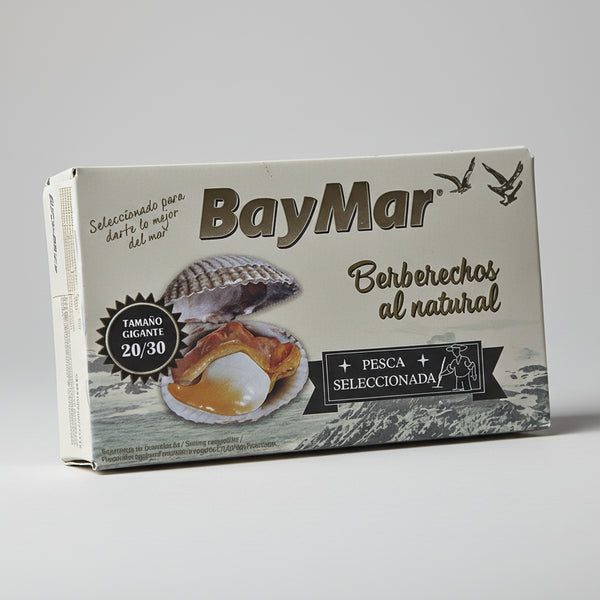
Canned clams: for appetizers, rice dishes, salads, and pasta. The texture is more tender, and the flavor has concentrated during maturation in the can. Huge logistical advantage: always available, no purging needed, just open and eat. Quality natural canned clams are a gourmet product in their own right.
In our collection of gourmet preserves, you will find clams, cockles, and other premium canned seafood. And to understand more about cockles, read our complete guide to cockles.
How to buy fresh clams: 5 signs of quality
If you decide to buy fresh clams, look for these indicators:
- Closed shells: a fresh clam has its shell closed or closes when touched. If it remains open and motionless, it's dead — discard it.
- Smell of the sea: fresh clams smell of sea breeze, never ammonia or "fishy." If they smell bad, don't hesitate.
- Weight: hold several in your hand. They should feel heavy for their size (full of water and meat). Those that feel light may be empty or dry.
- Response to tapping: gently tap two clams together. The sound should be solid, not hollow. Hollow ones are dead or empty.
- Check the label: by law, the packaging must indicate the species, catch area, and packing date. The fresher, the better.
How to clean and purge clams correctly
The step that most people skip — and then complain about sand in their dish:
- Discard dead ones: throw away any that are open and don't close when touched.
- Saltwater: prepare saltwater (35 g/liter, approximately the salinity of the sea). Do not use tap water without salt — clams do not purge well in fresh water.
- Soak for 2-4 hours: place the clams in the saltwater and leave them in a cool place (refrigerator or cold spot). They will expel the sand as they "breathe."
- Change the water: if possible, change the water halfway through the process. You will see the sand settled at the bottom.
- Rinse and rub: before cooking, rinse the clams under the tap and rub them together to remove any shell fragments or external impurities.
For a complete guide to canned seafood and how to choose them, visit our article on canned seafood: smart buying guide.
Conclusion
Knowing the types of clams allows you to buy wisely and cook with purpose. The fine clam is the undisputed queen for simple preparations where the natural flavor shines. The Japanese clam is the smart choice for rice dishes, pasta, and stews. The babosa clam is the best-kept secret for those seeking quality without paying a fine clam price. And the blonde clam is the silent hero of seafood broths.
The important thing: know what species you are buying, don't be fooled by generic labels, and adapt the clam to the dish. And if you want seafood always available regardless of the season, quality canned clams are a legitimate alternative that you should not underestimate.
You might also be interested in our article on pickled mussels, another gem of Spanish canned seafood.
Frequently asked questions
Which is the best clam?
The "almeja fina" (grooved carpet shell - Ruditapes decussatus) is the most valued gastronomically due to its intense flavor and firm texture. Those from Carril (Galicia) are considered the best. Price: 30-60 EUR/kg.
How to distinguish the grooved carpet shell from the Japanese carpet shell?
The definitive trick: look at the siphons (the two "tubes" that protrude when the clam is alive). In the grooved carpet shell, they are separate; in the Japanese carpet shell, they are joined or fused. Also, the inside of the Japanese carpet shell usually has a purplish stain.
Is the Japanese carpet shell good?
Yes. It is not as flavorful as the grooved carpet shell, but it has a good taste and is much more accessible (8-20 EUR/kg vs 30-60 EUR). It is the ideal clam for paellas, pasta, and stews where it is mixed with other ingredients.
How long should clams be purged?
Between 2 and 4 hours in saltwater (35 g/liter). Change the water halfway through the process for best results. Place them in the refrigerator during purging and discard any that are open.
Are clams from Mercadona good?
Supermarket clams are usually Japanese carpet shells (domestic or imported) at a reasonable price. They are suitable for paellas and stews. For a gourmet experience, look for grooved carpet shells at a fishmonger or quality canned clams.
Can canned clams be eaten directly from the can?
Yes. Canned clams are cooked and sterilized. They can be consumed directly as an appetizer, in a salad, or on toast. For paellas or pasta, they are added at the end so they don't overcook.
How many clams per person for pasta or rice?
Between 200-300 g of fresh clams per person (in shell). For canned, a 120 g can serves 2 people as an ingredient for pasta or rice. As a main dish (marinière style), count 400-500 g/person.
What is the difference between clams and cockles?
Cockles (Cerastoderma edule) have a rounder shell with distinct radial ribs, and a sweeter flavor. Clams have an oval and smoother shell, and a more iodine flavor. Both are bivalves but from different families. More in our cockle guide.
Lalo González Rodríguez
Since 1990 in Mercat del Ninot, Barcelona. We select cod and seafood directly from the producer. It's not marketing — there are verifiable factors.