Table of contents
Complete Nutritional Table: Atlantic Salmon (100 g)
| Nutrient | Farmed Salmon (raw) | Wild Salmon (raw) | Smoked Salmon |
|---|---|---|---|
| Calories | 208 kcal | 142 kcal | 117 kcal |
| Proteins | 20.4 g | 19.8 g | 18.3 g |
| Total Fat | 13.4 g | 6.3 g | 4.3 g |
| — Omega-3 (EPA+DHA) | 2.1 g | 1.8 g | 1.0 g |
| — Saturated | 3.1 g | 1.0 g | 0.9 g |
| Cholesterol | 55 mg | 55 mg | 23 mg |
| Vitamin D | 11 µg | 11-17 µg | 8 µg |
| Vitamin B12 | 3.2 µg | 3.2 µg | 3.3 µg |
| Selenium | 36.5 µg | 36.5 µg | 32.4 µg |
| Potassium | 363 mg | 490 mg | 175 mg |
| Sodium | 59 mg | 44 mg | 672 mg |
Sources: USDA FoodData Central, updated data 2024-2025.
Wild vs. farmed: the difference no one tells you about properly
99% of the salmon you buy in Spain is farmed, mostly from Norway (Salmo salar). Wild Pacific salmon (Oncorhynchus spp.) is scarce, expensive, and difficult to find outside of specialty stores.
Farmed Salmon (Norway, Scotland, Chile):
- Fatter (13% vs 6%) — because it swims less and eats feed designed for fattening
- More omega-3 in absolute terms (2.1 g vs 1.8 g) but a worse omega-3/omega-6 ratio
- Pink color from astaxanthin added to feed (SalmoFan — yes, producers choose the shade of pink with a color chart)
- Possible use of antibiotics (varies by country; Norway has reduced by 99% since the 90s)
- Price: 10-18 €/kg
Wild Salmon (Alaska, Pacific):
- Leaner, more protein per calorie
- Natural color from astaxanthin in the krill and shrimp it eats
- Better omega-3/omega-6 ratio (8:1 vs 3:1 in farmed)
- No antibiotics or artificial feed
- More vitamin D (up to 17 µg/100 g)
- Price: 25-50 €/kg (fresh), 40-70 €/kg (smoked)
Honest verdict: Both are good fish. Wild salmon has a slightly better nutritional profile and zero aquaculture contaminants. Farmed salmon has more absolute omega-3 but also more saturated fat. If you can afford wild, go for it. If not, farmed Norwegian salmon is nutritionally excellent — don't let snobbery deprive you of a good source of omega-3.
Omega-3: why salmon is the benchmark
Salmon is the fish with the highest omega-3 (EPA+DHA) content commonly consumed in Spain. And it's not a minor nutrient — marine omega-3s are backed by solid evidence:
- Cardiovascular health: Reduces triglycerides by 15-30%. Meta-analysis of 79 trials (JAMA Cardiology, 2021) confirmed reduction in cardiovascular events with >1 g/day of EPA+DHA.
- Brain function: DHA accounts for 40% of brain fatty acids. Regular consumption is associated with a lower risk of cognitive decline (meta-analysis of 21 studies, Nutrients, 2020).
- Inflammation: Omega-3s are precursors to resolvins and protectins — anti-inflammatory molecules. Relevant for arthritis, psoriasis, and inflammatory bowel diseases.
With 2.1 g of EPA+DHA per 100 g, a 150 g serving of salmon gives you 3.1 g of omega-3 — more than you need in an entire week. No supplement can compete with this in terms of bioavailability.
Smoked vs. fresh: what you gain and what you lose
Smoked salmon is a processed product with a different nutritional profile than fresh:
What you gain:
- Much longer shelf life (weeks vs. days)
- Complex flavor: smoky + salty + umami
- Versatility — eaten directly, without cooking
- Concentration of protein per calorie (due to partial dehydration)
What you lose:
- Sodium: increases from 59 mg to 672 mg per 100 g — 11 times more. If you have high blood pressure, limit quantities.
- Some omega-3: the smoking process (both cold and hot) partially degrades polyunsaturated fatty acids.
- Some vitamin D and B12 (minor loss, 10-20%).
Cold smoking (temperature < 30 °C, Scandinavian technique) better preserves nutrients than hot smoking (60-80 °C). Most smoked salmon bought in Spain is cold-smoked.
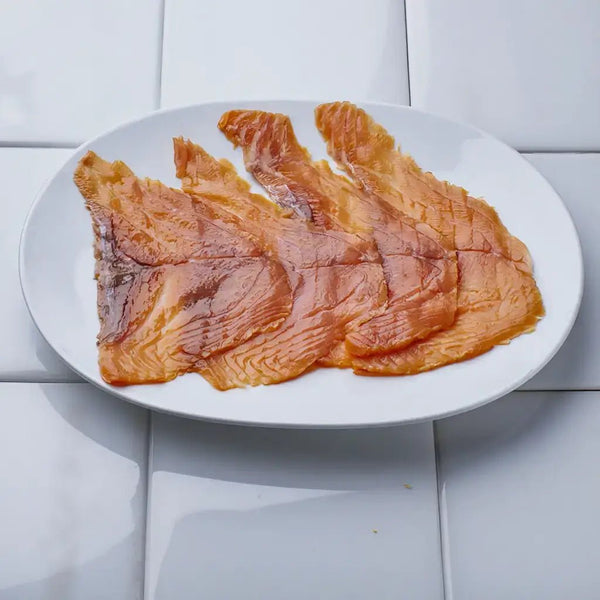
Our artisanal smoked salmon is cured with sea salt and slowly smoked with oak wood. No liquid smoke, no rushing — the entire process takes 24-48 hours. The difference from industrial smoking is noticeable from the first slice.
Calories by type of preparation
| Preparation | Calories / 100 g | Total Fat | Omega-3 | Notes |
|---|---|---|---|---|
| Raw (sashimi) | 208 | 13.4 g | 2.1 g | Maximum omega-3, no loss |
| Steamed | 183 | 10.9 g | 1.9 g | Best method to preserve nutrients |
| Grilled | 200 | 12.0 g | 1.7 g | Loses some fat due to direct heat |
| Baked (180°C, 20 min) | 195 | 11.5 g | 1.6 g | Even cooking, good retention |
| Fried | 245 | 15.6 g | 1.5 g | Absorbs oil, loses omega-3 |
| Cold smoked | 117 | 4.3 g | 1.0 g | Concentrated by dehydration |
| Canned | 142 | 6.3 g | 1.2 g | Soft bones = more calcium |
Best preparation for omega-3: Raw > steamed > baked > grilled > fried. Temperature destroys polyunsaturated fatty acids. If you want to maximize omega-3, raw salmon (sashimi) or steamed are the best options.
Mercury in salmon: the reassuring truth
Salmon is one of the fish with the LOWEST mercury levels. The FDA classifies salmon as a "best choice" for consumption, along with sardines, anchovies, and mussels.
Average methylmercury levels in salmon: 0.022 ppm (parts per million). For context: bluefin tuna has 0.35 ppm, swordfish 0.99 ppm, and shark 0.98 ppm. Salmon has 15 times less mercury than bluefin tuna.
Why so little? Because salmon is a mid-level predator (eating krill, shrimp, and small fish), not a top predator like tuna or swordfish. Mercury bioaccumulation increases with each step up the food chain.
Even pregnant women and children can eat salmon 2-3 times a week without concern, according to AESAN and FDA recommendations.
How much salmon to eat per week
International guidelines agree: 2-3 servings of 150 g per week is the optimal range for healthy adults. This provides 3-6 g of omega-3 weekly, well above the minimum recommended (1.75 g/week).
For pregnant women: 2 servings of salmon per week are safe and recommended (low mercury, high DHA for fetal brain development).
For children (2-11 years): 1-2 servings of 50-100 g depending on age.
Can you eat salmon every day? Technically yes — there's no risk of mercury. But variety is key: alternating with other fish (sardines, mussels, cod) provides a more complete nutritional spectrum.
Artisanal smoked salmon is an elegant and practical way to incorporate salmon into your diet — no cooking required, ready for toasts, salads, or platters. Discover our selection of premium smoked salmon.
Keep exploring
Properties of mussels · Canned sardines · Mercury in tuna · Smoked and salted products
Frequently Asked Questions
Is farmed salmon worse than wild salmon?
Not necessarily. Farmed salmon has more total fat and more absolute omega-3, but a worse omega-3/omega-6 ratio and possible antibiotic exposure (minimized in Norway). For most consumers, Norwegian farmed salmon is an excellent nutritional option.
How much omega-3 does smoked salmon have?
Approximately 1.0 g of EPA+DHA per 100 g — half that of fresh raw salmon (2.1 g). The curing and smoking process degrades some of the polyunsaturated fatty acids. Even so, it remains a good source of omega-3.
Does salmon have a lot of mercury?
No. Salmon has one of the lowest mercury levels of all fish: 0.022 ppm. That's 15 times less than bluefin tuna. The FDA classifies it as a "best choice" even for pregnant women and children.
Can I eat smoked salmon during pregnancy?
Cold-smoked salmon is not cooked, which implies a theoretical risk of listeria. The AESAN recommends avoiding cold-smoked fish during pregnancy or heating them to >70 °C before consumption. Hot-smoked salmon (>60 °C) is safe.
Does salmon make you gain weight?
At 208 kcal/100 g (farmed), it's a caloric fish compared to hake (76 kcal), but those calories come from healthy fats (omega-3) and protein. In the context of a balanced diet, salmon is a satiating and nutritionally dense food; it doesn't cause weight gain.
Why is farmed salmon orange?
Due to synthetic astaxanthin added to the feed. Without it, the flesh would be grayish. Wild salmon is naturally pink because it eats krill and shrimp rich in astaxanthin. Producers use a color chart (SalmoFan) to choose the shade — it's legal food cosmetics.