Summary: Black caviar and red caviar are fundamentally distinct products that share the term "caviar" by popular convention — not by legal or gastronomic logic. Black caviar is sturgeon caviar in the strict sense; red caviar is salmon roe. This guide honestly compares both: origin, taste, real price, verifiable quality, and when it makes sense to choose each one.
Table of Contents
- Black caviar and red caviar: what each one really is
- Origin and production: sturgeon vs. salmon
- Taste and texture: direct comparison
- Price comparison: why the difference is so great
- Nutritional value: omega-3, vitamins, and minerals
- Culinary uses: where each one works best
- Quality within each category
- When to choose black caviar and when to choose red caviar
- Where to buy each with guarantees
- Frequently Asked Questions
Black caviar and red caviar: what each one really is
The first point in this guide is also the most important: in the legal and technical sense within the European Union, the term "caviar" refers exclusively to mature sturgeon roe cured with salt. Salmon roe — popularly called "red caviar" — is not caviar under that definition. It is salmon roe, a distinct product with its own technical name: ikura in Japanese, salmon roe in English, huevas de salmon in correct Spanish.
This distinction is not gastronomic snobbery: it is relevant for understanding why prices are so different and why a direct comparison between the two products has a logical limit. They are not versions of the same product — one black and one red — but two completely different products that share the "cured fish roe" format and that the popular market groups under the same denomination for communicative convenience.
That said, the comparison is valid and useful for the consumer facing a purchase decision: both are high-quality fish roe available on the market, with very different prices and different usage profiles. The question "which to choose" has an answer that depends on the use, budget, and context.
Origin and production: sturgeon vs. salmon
Black caviar: Caspian sturgeon
Classic black caviar comes from three main species of sturgeon — Huso huso (Beluga), Acipenser gueldenstaedtii (Osetra) and Acipenser stellatus (Sevruga) — today raised almost exclusively in controlled aquaculture, given that the trade of wild Caspian sturgeon caviar has been practically banned since 2006 due to 20th-century overexploitation.
The production process defines the price: Beluga sturgeon needs between 18 and 25 years to reach sexual maturity. Osetra between 8 and 15 years. Sevruga between 7 and 10 years. During that period, the fish farm invests in infrastructure, feeding, veterinary care, and quality control without generating product. The yield in caviar per adult female is between 10% and 18% of her body weight, and the extraction and curing process is artisanal. This entire chain explains the price — it's not brand perception but production arithmetic.
Red caviar: salmon and trout
Salmon roe — the so-called "red caviar" — comes mainly from three species: Atlantic salmon (Salmo salar), Pacific salmon (various varieties of Oncorhynchus, of which keta is the most used for roe) and rainbow trout (Oncorhynchus mykiss) as an accessible variant.
The salmon production cycle is radically different: farmed Atlantic salmon reaches slaughter weight in 2-3 years. Females producing quality ikura in Japanese or Norwegian aquaculture produce in annual cycles. The possible production volume is orders of magnitude higher than that of sturgeon. Hence the price difference.
The highest quality salmon roe in the Spanish market is from Pacific keta salmon (Oncorhynchus keta), whose roe is larger and has a purer flavor profile than that of intensively farmed Atlantic salmon.
Taste and texture: direct comparison
The taste comparison between black caviar and red caviar starts from completely different profiles. They are not versions of the same flavor at different intensities: they are structurally different flavors.
Black sturgeon caviar
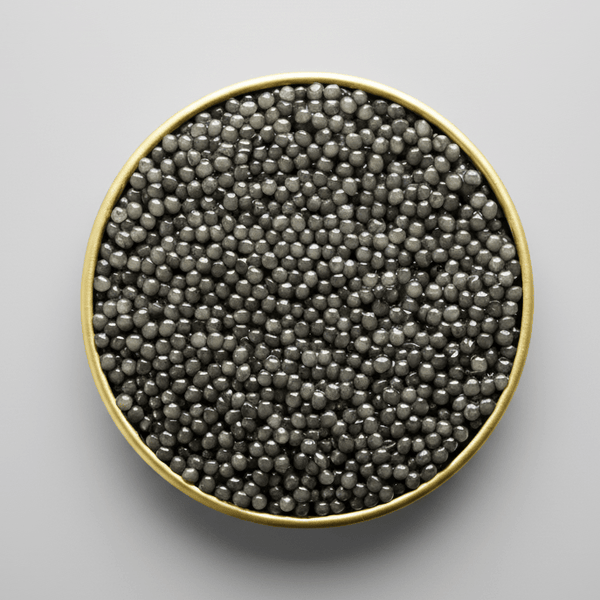
The taste of black caviar has three characteristic layers depending on the species: measured salinity in the first impact, development of secondary notes (walnut in Osetra, creaminess in Beluga, iodized intensity in Sevruga) and a prolonged aftertaste of 20 to 60 seconds. The texture consists of small or medium-sized roe (1.5-4 mm depending on the species) with a fine but firm membrane that yields with gentle pressure, giving the characteristic sensation of a controlled "explosion" in the mouth.
The salinity of sturgeon caviar is measured — between 3% and 5% salt — and is integrated into the total aromatic profile, not dominant. A quality sturgeon caviar where salt is the predominant flavor is an oversalted product, indicating inferior quality or excessive preservation process.
Salmon roe (red caviar)
Salmon roe has a more direct, intense, and marine flavor than sturgeon caviar. The iodized and oceanic note is dominant, with visible fat content — each roe has an intense orange oil that is released when chewed — contributing a creaminess different from that of sturgeon. The "salmon" flavor is perceptible and quite direct: there are far fewer of the complex secondary notes (walnut, mineral, prolonged aftertaste) that define sturgeon caviar.
Salmon roe is larger than sturgeon roe — between 4 and 6 mm in diameter — and has a thicker membrane that gives a more pronounced "explosion" when bitten. The orange-gold fat content is visually striking and its flavor is more accessible and immediately recognizable than that of sturgeon caviar.
Comparative taste summary
Black caviar has more complexity, a longer aftertaste, and a more sophisticated profile that demands more from the palate to be fully appreciated. Salmon roe has a more direct, more intensely marine, and more immediately recognizable flavor — but with fewer layers of complexity.
It is not that one is "better" than the other in objective terms. They are distinct taste experiences that adapt to different contexts.
Price comparison: why the difference is so great
The price difference between black sturgeon caviar and quality salmon roe is an order of magnitude: Iranian Imperial Osetra caviar costs approximately 2.50 EUR per gram; premium keta salmon roe costs approximately 0.90 EUR per gram. Beluga can reach 4-5 EUR per gram. The differential is not arbitrary: it reflects the real difference in production cost described in the previous section.
| Product | Approx. price/gram | Price 30g | Production cycle |
|---|---|---|---|
| Iranian Beluga | 4.00-4.50 EUR/g | 120-135 EUR | 18-25 years |
| Iranian Imperial Osetra | 2.50 EUR/g | 75 EUR | 8-15 years |
| Caspian Sevruga | 3.30 EUR/g | 100 EUR | 7-10 years |
| Premium keta salmon roe | 0.90 EUR/g | 26.90 EUR | 2-3 years |
Nutritional value: omega-3, vitamins, and minerals
Both products have an excellent nutritional profile, with quantitative but not qualitatively relevant differences for most consumers:
Sturgeon caviar has a higher concentration of omega-3 (DHA and EPA) per gram than salmon roe, although the difference is not dramatic. Both are excellent sources of omega-3 fatty acids.
Salmon roe has a higher content of vitamin E and carotenoid pigments (astaxanthin) that give it its intense orange color — pigments with relevant antioxidant properties.
Sturgeon caviar has a higher concentration of vitamin D and slightly higher levels of vitamin B12.
Both contain high biological value proteins, zinc, iron, and iodine. For a consumer evaluating these products for their nutritional value, both are excellent sources of key nutrients — the nutritional difference alone does not justify the price difference.
Culinary uses: where each one works best
The difference in taste and texture between black caviar and red caviar determines their optimal culinary uses:
Black sturgeon caviar works best in neutral and sophisticated culinary settings where its complexity can be expressed: on egg, with butter, in unseasoned pasta, on cream. Also as a signature element in presentations where the product is the absolute star — toast, blini, pure tasting spoon.
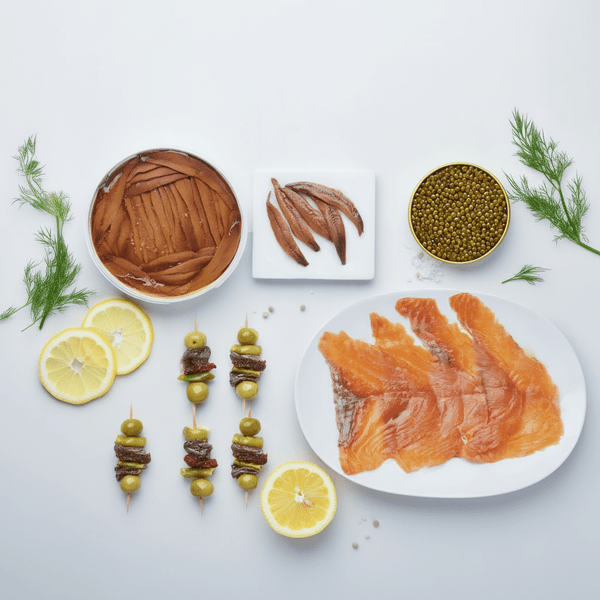
Salmon roe works best in contexts of more intense flavor where its iodized character and size contribute visually and in taste: on sushi and temaki, in bowls with rice and Asian vegetables, on toast with avocado and cream cheese, as a color and flavor element in beet salads, on blinis in combination with smoked salmon. Its larger size and intense orange color make it especially effective in presentations where visual appeal matters.
The general rule: black caviar for elegance and complexity; salmon roe for intensity, color, and flavor accessibility.
Quality within each category
The difference between the best and worst product within each category is greater than the difference between categories. An Iranian Imperial Osetra and a low-end continental fish farm sturgeon caviar are products of the same biological group but with a completely different consumption experience. The same applies to salmon roe: premium Pacific keta roe and supermarket pasteurized salmon roe in a plastic jar are the same biological group with radically different qualities.
When choosing black caviar, the quality criteria are: declared species with scientific name, CITES label present, Iranian Caspian origin for the highest reference, malossol process (minimum salt), uniform size, bright color.
When choosing salmon roe, the quality criteria are: declared species (Pacific keta for maximum quality), processed at source with an uninterrupted cold chain, just the right amount of salt (not oversalted), whole roe without crushing, vibrant orange color without brown tones.
When to choose black caviar and when to choose red caviar
Choose black sturgeon caviar when:
- The occasion justifies the investment — celebration, luxury gift, high-level dinner
- You want the maximum organoleptic experience in complexity and aftertaste
- The caviar will be the absolute star of the dish or tasting
- You are looking for the product with the greatest symbolic value and cultural recognition in gastronomy
Choose salmon roe when:
- Budget is a relevant factor and you want verifiable quality within that budget
- The culinary application requires volume — sushi, bowls, visually product-heavy presentations
- The flavor you are looking for is more direct, intense, and marine rather than sophisticated and complex
- You are looking for a product that is accessible to diners without previous roe experience
Tanit Keta Premium Salmon Roe — 26.90 EUR — Verified quality of Pacific keta salmon. The best entry point into the world of premium roe without the investment of sturgeon caviar.
View Premium Salmon Roe (26.90 EUR)Where to buy each with guarantees
For black sturgeon caviar, the purchase criteria are: verifiable origin traceability, CITES label present, declared scientific species, channel with direct responsibility for conservation and cold shipping. At Bacalalo, we work with sturgeon caviar with IIFRO certification for Iranian origin and full CITES labeling on all items in the Caspian caviar collection.
For premium salmon roe, the criteria are: declared species (keta vs. Atlantic), verified origin, uninterrupted cold chain, recent production date. Tanit Keta Premium Salmon Roe meets all these criteria at 26.90 EUR.
Iranian Imperial Osetra Caviar — 75 EUR — The benchmark black caviar for those seeking the ultimate experience. Certified Iranian Caspian origin, characteristic nutty note, CITES compliant.
View Imperial Osetra Caviar (75 EUR)Frequently Asked Questions
Is red caviar inferior to black caviar?
They are not the same product in different qualities — they are different products. High-quality salmon roe is excellent in its category and has culinary uses where sturgeon caviar would not work as well. Saying one is "inferior" to the other is like saying extra virgin olive oil is inferior to foie gras — the comparison is meaningless because they don't compete in the same space.
Why is lumpfish roe called "caviar" if it's not?
Lumpfish roe (Cyclopterus lumpus) is marketed as "caviar" in many markets due to a popular convention that predates current regulations. Strictly speaking, it is not sturgeon caviar, and European legislation does not permit this denomination for salmon or lumpfish. However, the term is so ingrained in the popular market that consumers recognize it. Lumpfish roe is a completely different product from sturgeon caviar and salmon roe: smaller, saltier, and with a less noble flavor profile than either.
Can black caviar and red caviar be mixed in a dish?
Yes, and the combination can be visually spectacular — the contrast of black and orange is striking. From a flavor perspective, the profiles are so distinct that the mixture can be confusing on the palate. A more logical presentation is to serve both separately on the same plate, allowing the diner to taste them individually and then combine.
Which of the two has more calories?
Both have similar caloric content — approximately 250-270 kcal per 100g — although in typical consumption quantities (20-30g) the difference is irrelevant. The calories in both products come mainly from omega-3 fats, which are exactly the type of fat recommended for inclusion in the diet.
Is salmon roe good for health?
Yes. Salmon roe has an excellent nutritional profile: high concentration of omega-3 DHA and EPA, B vitamins, vitamin D, vitamin E, complete proteins, zinc, and iron. In usual consumption quantities (20-50g), it is one of the marine foods with the best ratio between nutritional content and total calories.