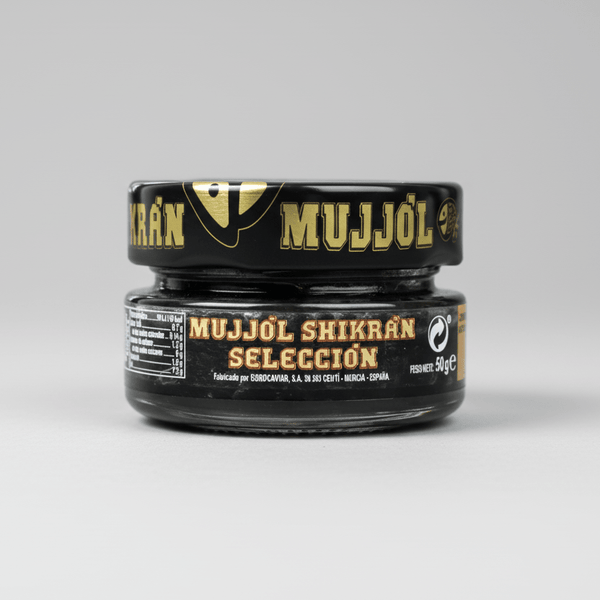
If you've seen "salmon caviar" on a menu or in a store and wondered if it's real caviar, the short answer is no. "Salmon caviar" is a trade name: what you're buying is salmon roe, known in Japan as ikura. It doesn't come from sturgeon, which is the only fish whose roe can be strictly called caviar. Here we clarify what you're buying, what it tastes like, and how it fits into your table, without any pretense.
Is "salmon caviar" actually caviar? No, it's ikura
The term "caviar" designates, by definition and by regulation in much of the world, sturgeon roe. Any other roe—from salmon, trout, capelin, flying fish, or mullet—is legally "caviar substitute" or, simply, roe with its proper name. That's why "salmon caviar" is a marketing label: it sounds luxurious, but it describes salmon roe.
It's not a deception if understood correctly. Salmon roe is an excellent product in itself, with its own character. The problem arises when someone pays sturgeon prices expecting something it's not. Calling things by their name avoids confusion: if the label says salmon, it's ikura. Authentic sturgeon caviar is another category, another price, and another experience.
What is ikura (salmon roe)?
Ikura is the mature roe of salmon, separated from the membrane that holds it together (the entire roe sac, without separation, is called sujiko). After extraction, it is cured in brine—or in soy sauce and mirin in the Japanese version—to preserve it and give it flavor.
Visually, it's unmistakable: large spheres, 5 to 7 mm, an intense, almost translucent orange, and shiny. They are much larger than tobiko or masago. Each roe has a thin, firm membrane that pops in the mouth, releasing a salty liquid: that "pop" is the signature of good ikura.
- Origin: different species of salmon (chum, coho, king...).
- Size: large, 5-7 mm, the largest among commonly used roe.
- Preservation: in brine or in sauce (Japanese style).
- Category: fish roe, not sturgeon caviar.
Flavor, color, and culinary use
Ikura has a clean, briny, marine flavor, with a slightly fatty undertone and a hint of sweetness. The texture is key: the juicy pop of each sphere is precisely what makes it special. Its vibrant orange color provides an immediate contrast in any dish.
It's a versatile and easy-to-use ingredient because it doesn't require cooking or preparation. Some ideas that work well:
- On sushi gunkan (the classic seaweed wrap filled with ikura) and in chirashi.
- Topping blinis with sour cream or toasts with cream cheese.
- In creamy scrambled eggs or on a baked potato with cream.
- As a garnish for salmon or avocado tartare, adding salt and texture.
- Over pasta with butter or a mild risotto, off the heat.
Practical rule: always add it at the end and cold. Heat bursts the roe and hardens it, losing the pop. One teaspoon per serving is usually enough, as it seasons generously.
Salmon caviar vs. sturgeon caviar vs. masago/tobiko
Confusing all these roes is normal, but each has its own category. This table clarifies it:
| Roe | Fish origin | Size | Is it caviar? | Key feature |
|---|---|---|---|---|
| Ikura ("salmon caviar") | Salmon | 5-7 mm | No | Juicy pop, intense orange |
| Sturgeon caviar | Sturgeon | 2-3.5 mm | Yes | Only true caviar; complex and expensive |
| Tobiko | Flying fish | ~1 mm | No | Crunchy, varied colors |
| Masago | Capelin | <1 mm | No | Smallest and most economical |
In summary: only sturgeon roe is caviar. Ikura is large salmon roe; tobiko and masago are tiny, crunchy roes used to decorate economical sushi. Different products, different prices and uses: none substitutes the other; they simply fulfill different functions.
Where it fits on your table
Ikura is the perfect option when you want visual impact and that marine pop without incurring the price of sturgeon. It's ideal for homemade sushi, party appetizers, and for finishing simple dishes, elevating them in a second. If you're looking for the gastronomic experience of authentic caviar—fine nuances, creaminess, and complexity—then sturgeon is your product, not salmon.
The important thing is to buy discerningly: knowing that "salmon caviar" is ikura helps you pay a fair price and choose according to what you truly want on your plate. In our selection of gourmet caviar and roe, you'll find each category clearly named, so you can choose with knowledge and not by the label.
Frequently Asked Questions
Is salmon caviar real caviar?
No. "Salmon caviar" is a trade name for salmon roe (ikura). Authentic caviar, by definition, is sturgeon roe. Ikura is an excellent product, but it belongs to a different category and has a different price.
What does ikura taste like?
It tastes of clean, salty sea, with a slightly fatty undertone and a hint of sweetness. The most characteristic feature is the texture: each large roe bursts in the mouth, releasing a briny liquid. That juicy "pop" is the mark of quality ikura.
What is the difference between ikura and tobiko or masago?
The size and the fish. Ikura are large salmon roe (5-7 mm) that pop; tobiko (flying fish) and masago (capelin) are tiny and crunchy, designed to decorate economical sushi. None of the three is sturgeon caviar.